VLESS Protocol: V2Ray VPN, Xray Server, and Censorship Bypass Guide

Roughly half a decade after it appeared in an obscure GitHub incubation repo, VLESS has quietly become the default protocol behind the proxies people in Russia, Iran, and China actually use. The reasons are unromantic. It is small. It does not encrypt anything itself. It is also the only widely deployed protocol that the largest state-run deep-packet-inspection (DPI) systems have not yet decisively beaten as of mid-2026.
This guide explains what VLESS is as a lightweight protocol, how it works internally, what runs on top of it (Xray, XTLS, REALITY), how it compares to VMess, Trojan, Shadowsocks, WireGuard, and traditional VPN protocols like OpenVPN, and what a real VLESS VPN setup looks like in practice. It is a technical explainer, not a configuration walkthrough. If you finish it and still want copy-paste server commands, the project docs at xtls.github.io are the right next step.
What VLESS Is and Why the V2Ray Community Built It
VLESS, short for "VMess Less," is a stateless lightweight proxy protocol introduced in 2020 by the developer known as RPRX, who maintained an incubation repo at RPRX/v2ray-vless from 2019. It was designed as a deliberate stripping-back of VMess, the original V2Ray protocol, which had grown unwieldy by the late 2010s under its own encryption, replay-protection, and clock-synchronization machinery.
Today VLESS lives primarily in two codebases. The original v2fly/v2ray-core repository carries it for compatibility. The XTLS/Xray-core fork, also maintained by RPRX, is the more actively developed implementation: 38,600 GitHub stars and roughly 5,400 forks as of May 2026, against 33,900 stars on v2fly/v2ray-core. Xray ships the features that matter, namely XTLS Vision flow control and the REALITY transport, which v2fly upstream does not.
How the VLESS Protocol Works: UUID, No Encryption, TLS Outside
The VLESS wire protocol is short enough to describe in a paragraph. A client opens a connection. It sends a header. The header has a version byte, a 16-byte UUID for the user, a length indicator for the optional addons field, the addons themselves, a one-byte command (TCP or UDP), the destination port, an address-type byte, and the address. That works out to 25 to 50 bytes per connection. OpenVPN runs over 100 bytes per packet.
The header is not encrypted in any way by VLESS itself. The protocol explicitly requires `encryption: "none"` in its JSON configuration, and the v2fly documentation states that this field cannot be left blank — it must say "none" out loud, so that operators are reminded that the protocol delegates all confidentiality to whatever transport sits underneath. In practice, that transport is almost always TLS 1.3.
This design choice is the source of every interesting property VLESS has. By not running its own encryption layer, VLESS avoids the failure mode that doomed VMess in censored networks. A second layer of encryption inside an outer TLS tunnel produces what traffic-analysis researchers call "TLS-in-TLS" patterns. State DPI systems trained to spot exactly that double-wrap shape were the main reason VMess detection rates climbed past 80 percent on the Chinese Great Firewall by September 2025. VLESS, carrying only an authentication blob and routing metadata, looks far closer to a single, ordinary TLS conversation, which defeats the kind of protocol fingerprinting that deep packet inspection systems rely on.
The other deliberate omission is statefulness. VMess relies on synchronized clocks between client and server, with packet timestamps used to prevent replay attacks. The result was years of confusing connection failures whenever a phone's clock drifted, a laptop dual-booted, or a server lived in the wrong timezone. VLESS is stateless. The UUID is the entire authentication story. If the UUID matches, the connection is authorized; if not, it is rejected at the first byte. Nothing depends on time.
UUIDs in VLESS are standard RFC-4122 identifiers. The `xray uuid` command generates them; any standard UUID generator also works. Custom strings of up to 30 bytes are accepted and mapped to UUIDs through what the docs call the "VLESS UUID Mapping Standard." Most setups stick to canonical UUIDs because the mapping changes nothing in practice.
Transport options sit underneath the protocol: TCP (with or without TLS), mKCP, WebSocket, gRPC, and QUIC are all supported. Each shapes the traffic differently. WebSocket lets VLESS hide behind a normal HTTP/1.1 upgrade handshake and route through CDNs like Cloudflare. gRPC piggybacks on HTTP/2 multiplexing. QUIC carries everything inside an outer UDP-based TLS 1.3 session. The protocol does not care which transport it runs on. That separation is what makes it portable.
Xray, REALITY, and XTLS: The Stack VLESS Actually Runs On
In practice, no one runs VLESS naked. The interesting parts are what runs around it.
Xray-core is the dominant runtime. It is a fork of V2Ray-core started by RPRX and the XTLS contributors after a community split, and it ships two technologies that VLESS depends on for serious censorship-circumvention work: XTLS Vision and REALITY.
XTLS Vision (specified as `flow: "xtls-rprx-vision"` in configuration) is a padding scheme applied to TLS 1.3 traffic. The problem it solves is subtle. TLS 1.3 records have predictable length signatures when they carry inner application data of fixed shapes — the lengths leak information about what is being tunneled. Vision adds padding bytes during the early handshake phase. Once the connection is established, it switches to raw socket copying. On Linux it uses the `splice()` system call to forward TCP packets in the kernel without copying through userspace. The result is throughput close to what a non-proxied TCP connection would deliver, with the length-signature leakage flattened out.
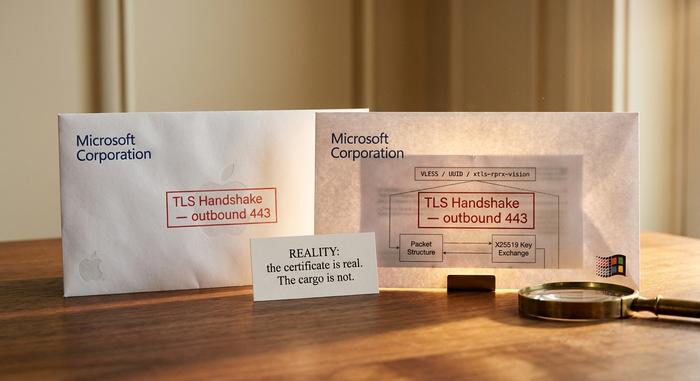
REALITY, released in 2023 and maintained at github.com/XTLS/REALITY, is more radical. A standard VLESS+TLS server presents its own TLS certificate, which means it owns a domain, runs a Certbot somewhere, and exposes a certificate fingerprint that a DPI system can correlate with proxy use. REALITY discards the entire idea. Instead of running its own TLS, the server impersonates the handshake of a real third-party website. The operator picks the target: `microsoft.com`, `apple.com`, any domain. The server uses SNI faking and an X25519 key exchange. Clients that know the correct REALITY public key complete a real TLS 1.3 handshake against the impersonated certificate chain, exactly as a browser would handshake with a real web server, and then get routed into the VLESS tunnel. Clients that do not, including probing DPI systems, see what looks like a normal connection to the impersonated site, including the real certificate.
The combination of VLESS as the inner protocol, XTLS Vision for length-signature flattening, and REALITY for handshake camouflage is what people mean when they say "VLESS+REALITY" or "VLESS+Vision+REALITY." It is the configuration that, as of mid-2026, still works in environments where almost nothing else does.
VLESS vs VMess vs Trojan vs Shadowsocks vs WireGuard
The protocol space around VLESS is small and the differences matter. The short version is below; the long version is the table.
VMess is VLESS's predecessor. It carries its own AEAD encryption, replay protection, and alterId-based variants. In an uncensored network these features cost a few percent of throughput and add no benefit. In a censored network, the encryption-inside-TLS pattern is detectable, and GFW telemetry has it at ~80 percent detection since September 2025.
Trojan is a sibling design from a different team. It is even simpler than VLESS: a password instead of a UUID, no addons field, TLS on the outside. For years this minimalism made it strong; the GFW upgrade in August 2025 changed that, and Trojan now sits around 90 percent detection.
Shadowsocks comes from a different family altogether. It is a symmetric AEAD cipher with no TLS facade, designed to look like random bytes rather than HTTPS. That approach worked until the GFW began flagging fully encrypted traffic as suspicious by default; modern Shadowsocks deployments rely on transport plugins (v2ray-plugin, cloak) that wrap the cipher in TLS or HTTP, effectively rebuilding the VLESS architecture from the other direction.
WireGuard belongs in a different conversation entirely. It is a kernel-level VPN, not a proxy protocol. On a clean network it is ~2–3 percent faster than VLESS+XTLS at raw throughput, with much less CPU overhead, and it remains the right answer for ordinary privacy-from-ISP use cases. In censored networks its fixed 0x01 handshake byte is trivially fingerprinted, and effective throughput collapses to near zero.
| Protocol | Family | Outer layer | DPI resistance | Best for |
|---|---|---|---|---|
| VLESS+REALITY | V2Ray/Xray proxy | Impersonated TLS 1.3 | High (≤5% detection in field reports) | Hostile networks |
| VMess | V2Ray proxy | Self-encryption inside TLS | Low (~80% GFW) | Legacy compatibility only |
| Trojan | TLS-fronting proxy | Self-owned TLS | Low (~90% GFW post-Aug 2025) | Simpler self-hosting |
| Shadowsocks (AEAD) | Symmetric obfuscation | Random bytes / plugin TLS | Mixed (depends on plugin) | Mobile users on flaky links |
| WireGuard | Kernel VPN | UDP + Noise handshake | Very low (DPI-detectable) | Clean-network privacy and speed |
VLESS, Censorship, and the Russian DPI Blockade
VLESS would be a footnote in the history of proxy software if not for the fact that it bypasses censorship in Russia and similar regimes more reliably than any other widely deployed protocol. Since 2024, the largest state DPI systems in the world have been actively trying to kill it. The story since then has been a slow public game of escalation.
In Russia, Roskomnadzor reported 439 VPN services blocked by January 2026. The federal VPN-blocking budget runs to roughly 60 billion rubles (about $780 million) for 2025–2027, with another 2.27 billion rubles (~$29 million) earmarked specifically for AI-based traffic filtering, according to reporting by zona.media in April 2026. On February 17, 2026, Roskomnadzor escalated again, with a sharp wave of blocking targeting VLESS-over-TCP-with-TLS specifically, as documented by Mezha and digirpt. Users moved to REALITY, gRPC, and CDN-fronted transports within hours. The reported community bypass rate for VLESS+REALITY against Russian DPI sat near 99.5 percent through that wave, a number that should be treated as directional rather than measured.
In China, the Great Firewall went through a similar sequence in 2025. Trojan dropped to ~90 percent detected in August, VMess to ~80 percent in September. A separate cybersecurity event in September 2025, a 600 GB leak from a Chinese GFW contractor reported by Cybernews, exposed parts of the internal classification infrastructure but did not by itself change deployment economics. Community testing at greatfirewallguide.com reported 98 percent bypass rates for VLESS+REALITY+Vision in early 2026.
In Iran, MCI's IRGFW has been graylisting REALITY IP addresses since at least April 2024, documented in XTLS/Xray-core Discussion #3269. Operators report that an IP carrying around 100 GB of REALITY traffic tends to be blocked by Irancell within 48 hours, which is why server rotation and CDN fronting have become standard practice there.
How a VLESS VPN Setup Looks: Server, Clients, Configs
A working VLESS deployment has three parts: a server somewhere, a client on each device, and a connection string that links them.
The server side is undemanding. Any cheap VPS will do: Hetzner, Vultr, OVH, anything with public IPv4. Install Xray-core from the project's release binaries or a package manager, generate a UUID (`xray uuid`), generate an X25519 keypair for REALITY (`xray x25519`), pick an impersonation target (a real HTTPS site that supports TLS 1.3 and HTTP/2), and write a JSON server configuration that binds to port 443. Total setup time, once you have done it once: maybe ten minutes. Web panels like 3X-UI and Hiddify-Manager wrap the same configuration in a browser interface for operators who prefer not to edit JSON. Managed appliances exist as well. AWS Marketplace lists an Xray VLESS VPN Server image at $0.063 per hour on a t3.micro, with a 5-day free trial.
On the client side, the ecosystem is fragmented but reliable. v2rayN and Nekoray are the dominant Windows clients. v2rayNG, NekoBox, and Hiddify cover Android. Hiddify runs cross-platform on macOS and Linux as well. On iOS, where Apple's App Store policy makes life harder, Streisand is the free option and Shadowrocket or V2Box the paid ones. All of them speak VLESS; most support REALITY. Configuration is usually imported through a `vless://` URI scheme, a single URL containing UUID, address, port, transport, and REALITY parameters, or scanned as a QR code from the server-side panel.

Performance, Risks, and When VLESS Is Not the Right Tool
Performance first. Community benchmarks put VLESS at roughly 15 to 25 percent better throughput than VMess on the same transport, mostly because the VLESS header is so much shorter and there is no inner encryption pass. With XTLS Vision and the Linux splice optimization, a well-tuned VLESS deployment gets close to native TCP throughput, capped only by VPS bandwidth and the round-trip time to the server. WireGuard remains 2–3 percent faster on uncensored networks, where its handshake is not a liability.
Risks are real. VLESS the protocol is neutral and open-source, but the legal status of using it to bypass state censorship varies sharply by jurisdiction. Russia's federal law on circumvention tools criminalizes the promotion of working configurations rather than personal use; China's regulatory posture is harsher and more arbitrary; Iran prosecutes operators of large proxy pools. Corporate networks frequently forbid all proxy and VPN traffic outright. Readers in those environments should know the rules they are operating under before they set anything up. Free VPN apps that ship pre-loaded VLESS subscriptions belong to a separate regulatory category in some jurisdictions and may attract different scrutiny.
A final, less dramatic point. If you are not in a censored network, VLESS is overkill. For ordinary privacy from your ISP on a clean link, WireGuard or a modern OpenVPN configuration is faster, simpler, and supported by every commercial VPN provider already. VLESS+REALITY is a tool for a specific problem, and reaching for it when the problem is something else mostly buys complexity.