
XRP Stock: Why It Doesn’t Exist and How to Invest
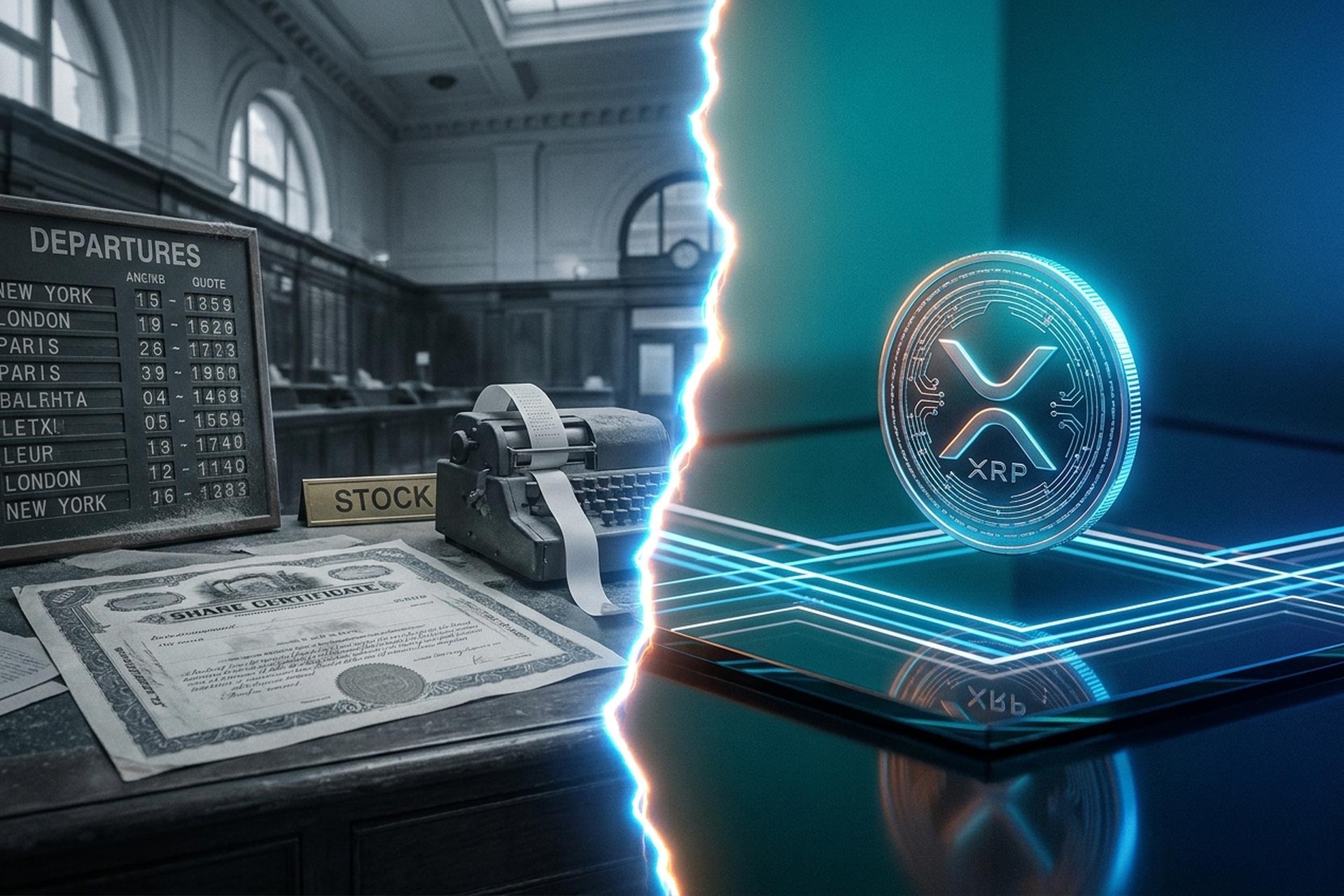
Thousands of people search for "XRP stock" every month. They will not find one, because it does not exist. There is no XRP share you can add to a brokerage portfolio, and you cannot buy stock in Ripple at your broker the way you would buy Apple or Tesla. The phrase mixes up two different things.
That confusion is worth clearing up, because the people typing "XRP stock" usually want something real and reachable. This guide explains why there is no XRP stock, how to actually invest in XRP if you want to, whether you can own a piece of Ripple, and what a sober look at XRP as an investment turns up. Some of it is encouraging. Some of it should give you pause.
XRP Is a Crypto Token, Not a Stock
Start with the distinction the whole confusion rests on. A stock is a piece of a company. Own one share and you own a sliver of the business, maybe collect a dividend, and get a vote at the annual meeting. XRP is none of that. It is a cryptocurrency, a digital token that lives on a blockchain called the XRP Ledger, and it represents ownership of nothing.
That ledger, often shortened to XRPL, went live back in 2012, built by David Schwartz, Jed McCaleb, Arthur Britto, and Chris Larsen to move money fast and cheaply. XRP is the asset that greases the wheels. No mining is involved; a network of independent validators agrees on transactions through a consensus mechanism, and the ledger can carry other tokenized assets too, not just XRP. But hold XRP and that is all you hold. No equity, no dividend, no seat at any table. Its price swings on supply, demand, and mood, never on a quarterly earnings report, because there is no company filing one.
The practical differences run deep. Stocks trade during market hours through regulated exchanges and clearing houses; XRP trades 24 hours a day, seven days a week, on crypto exchanges worldwide. There is no earnings call to read, no balance sheet to analyze, no analyst rating. In the United States the IRS treats XRP as property, not a security, so the tax rules differ from stock too. Calling it a "stock" is not just sloppy wording; it points you at the wrong tools and the wrong expectations.
Then there is Ripple, the other half of the muddle. Ripple is a private company building payment software around the XRP Ledger. Useful to the ecosystem, certainly, but not the same thing as the token. You can hold a stack of XRP and own exactly zero of Ripple. And owning Ripple, as the next section shows, is the genuinely hard part.
What Ripple Stock Would Mean for XRP Holders
If XRP is not a stock, the obvious next question is whether you can just buy Ripple the company instead. For almost everyone, the answer is a flat no.
Is there a Ripple stock?
Short version: Ripple is private. No IPO, no ticker, nothing on the Nasdaq or NYSE you can grab with a brokerage button. And it is not as if the company is too small to bother listing. A $750 million share buyback in March 2026 valued Ripple at roughly $50 billion, which would put it among the most valuable private firms in all of crypto. People keep waiting for the IPO that would turn that valuation into shares they can actually buy. They have been waiting a while. In early 2026, Ripple's president Monica Long flatly ruled out going public any time soon. So the "Ripple stock" you pictured? It is not on the menu.
Here is what muddies things further. Ripple is itself the single largest holder of XRP, sitting on tens of billions of tokens locked in escrow. When XRP pumps, Ripple looks richer, so the two stories bleed together in the headlines. They are still separate, legally and financially. Buy XRP and you are placing a bet near Ripple, not buying a slice of it.
Pre-IPO shares and the accredited-investor wall
There is a narrow side door, and most people cannot fit through it. Ripple shares do trade on private secondary markets, where employees and early backers occasionally sell, and venues like Nasdaq Private Market have listed the stock. The catch is who gets in. You generally have to be an accredited investor, the regulator's label for high income or net worth, before you can buy a single share. For the rest of us the truth is blunt: if you want a wager on Ripple's success, XRP is the only liquid way to make it, even though token and company can drift apart.
How to Buy XRP and Where to Start
Buying the token is the easy bit, almost boringly so. Where people slip up is everything that comes after the purchase.
Every major exchange lists it, Coinbase and Kraken included. You can start with ten dollars, fund the account in USD in a few minutes, and switch on recurring buys if dollar-cost averaging suits you better than guessing the bottom. On the XRP Ledger itself, a transfer clears in a few seconds for a fraction of a cent.
Expect a few standard steps. You will verify your identity (KYC) before trading, pick between a simple "buy" button and a slightly cheaper limit order on the exchange's trading view, and pay a small spread or fee either way. One quirk worth knowing: the XRP Ledger requires a small reserve, currently a handful of XRP, to activate a new self-custody wallet, so a brand-new address needs a minimum balance to function.
Custody is where beginners get careless. Leaving XRP on an exchange is convenient but means the exchange holds your keys — if it fails or freezes withdrawals, your access goes with it. Moving the token to a wallet you control, software or a hardware device, hands you full ownership and full responsibility, which means guarding the seed phrase like cash, because anyone who has it has your XRP. Decide which trade-off you want before you buy, not after. Honestly, I have watched more people lose crypto to a misplaced seed phrase than to a bad trade.
Spot XRP ETFs and the XRP Market
If you specifically want XRP exposure inside a brokerage, sitting next to your stocks and retirement funds, the closest thing to "XRP stock" is a spot XRP ETF.
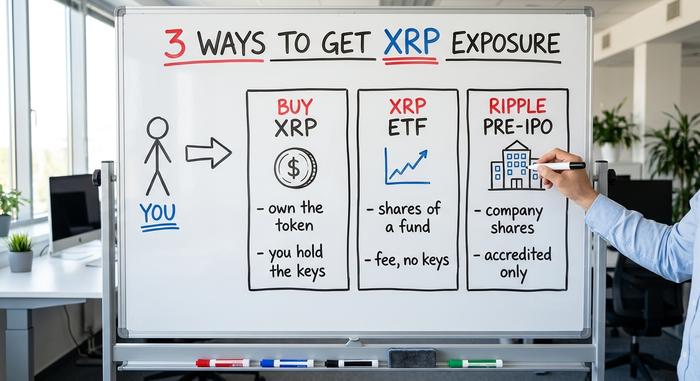
| Route | What you own | Who can buy | Key caveat |
|---|---|---|---|
| Buy XRP directly | The token itself | Anyone | You manage custody and keys |
| Spot XRP ETF | Shares of a fund holding XRP | Anyone with a brokerage | Annual fee, no keys, market hours |
| Ripple pre-IPO equity | Shares of Ripple the company | Accredited investors only | Illiquid, no IPO planned |
These funds showed up fast. Between November and December 2025, seven US spot XRP ETFs went live, from names like Bitwise, Grayscale, Franklin Templeton, and 21Shares, charging as little as 0.19% a year. Day one alone drew about $164 million, and cumulative inflows hit roughly $1.44 billion by March 2026. The appeal is obvious if you already live inside a brokerage. You buy the ETF like any share, it sits in a normal account or even a retirement one, the custody nightmare vanishes, and come tax time it behaves like every other fund you own. The catch is what you give up. You pay a yearly fee, and you never actually hold the XRP, so you can't move it on-chain, spend it, or hold your own keys. Control for convenience. It is the same trade index-fund buyers have happily made for decades.
XRP Price, Market Cap, and Supply
These are the numbers a stock investor reaches for first. One of them has no equivalent in the stock world at all.
| XRP snapshot | Figure (June 2026) |
|---|---|
| Price | ~$1.23 |
| Market cap | ~$76.5B (rank #5) |
| 24h trading volume | ~$3.2B |
| Circulating supply | 61.98B XRP |
| Max supply | 100B XRP |
| All-time high | $3.84 (Jan 2018) |
By market cap, XRP usually sits near the top five cryptocurrencies. The number that actually matters, though, is one a stock investor never has to think about. Supply. A hundred billion XRP will ever exist, and only about 62 billion are loose in the market today. The rest? Ripple keeps a huge pile locked in escrow and releases as much as a billion XRP a month, month after month after month. Picture a company that prints new shares on a fixed timetable and you have the idea, except here everyone can read the timetable in advance. That overhang is why XRP's fully diluted valuation, what it would be worth with all 100 billion tokens live, towers over its current market cap. If one number trips up people arriving from stocks, it is this one.
XRP Price History and the SEC Case
You cannot make sense of XRP's chart without the lawsuit that hung over it for years. Late in 2020, the SEC sued Ripple and called XRP an unregistered security. Sentiment froze. US exchanges delisted the token to stay safe, and the price spent years stuck in limbo.
Then July 2023 changed everything. Judge Analisa Torres ruled that XRP sold to ordinary buyers on exchanges was not a security, even though Ripple's direct sales to institutions were. Crypto lawyers called it a landmark, and they were right. The whole fight finally wrapped in May 2025 with a $50 million settlement, trimmed from an earlier $125 million order once both sides dropped their appeals. Washington had warmed up, too. With XRP even floated for a proposed US digital-asset reserve, the Gensler-era hostility that triggered those delistings was finished, and the ETFs landed within months.
The price still carries the bruise. XRP's record usually gets quoted as $3.84, set way back in January 2018, and it has never returned there, though some trackers point to a $3.65 high in the 2025 run. Either way, near $1.23 the token sits about 67% under its peak. Call it a brutal multi-year drawdown, or call it a discount. Which word you pick depends entirely on what you think happens next.

Is XRP a Good Crypto Investment Now?
No price prediction here, and definitely no financial advice. What I can do is lay out both sides honestly, because for once the bull case and the bear case are each genuinely strong.
Start with the bulls, who have more to point at than they have in years. The SEC fight is settled. Seven ETFs are live and taking in money. And Ripple keeps spending: it bought prime broker Hidden Road for $1.25 billion, renamed it Ripple Prime, and now clears trillions of dollars a year through it, while its RLUSD stablecoin has pushed past $1.7 billion in supply. That is plumbing and institutions, not just a hopeful story.
The bear case is just as concrete. XRP still sits about 67% below its 2018 high, the monthly escrow releases add steady supply, and the token competes in a crowded field where Bitcoin, Ethereum, stablecoins, DeFi platforms, and rival networks all chase a share of global payments. There is also the old debate about how much of XRP's price reflects genuine usage versus speculation. Beneath that sits a question of identity that no chart settles — is XRP mainly a payments tool that banks and fintechs will use, or mainly a speculative asset that trades on hope? The honest answer in 2026 is that it is both, and the mix keeps shifting. A few real-world payment corridors and a growing stablecoin push one way; the price chart, driven by traders, pushes the other.
The reasonable move, if you choose to invest, is the boring one — size the position to what you can afford to lose, and consider dollar-cost averaging rather than a single bet on the perfect entry. Treat any round-number price target you see online as entertainment, not a plan.
XRP Stock: What You Actually Need to Know
So there is no XRP stock, and there probably never will be. What exists instead is a liquid token you can buy on any exchange, a fresh basket of spot ETFs that behave like shares, and a private company most people simply cannot invest in directly.
The useful question is not "what is XRP stock worth," but which kind of exposure you actually want: the token, the ETF wrapper, or a slice of Ripple you most likely cannot reach. Get that straight and the rest is just execution. Which one matches how you actually invest?



