Best Crypto to Invest In 2026 : Top Cryptocurrencies Compared
Bitcoin closed 2025 about 6% below where it opened, the first negative post-halving year in its history. That single fact tells you the framework most "best crypto to invest" guides still use is broken. Halvings no longer drive the cycle. ETF flows, Fed policy, and stablecoin liquidity do, and they reward a different kind of analysis: cold, risk-adjusted, less interested in narratives.
This article walks through the cryptocurrencies that matter in May 2026 and treats them the way a fixed-income desk would treat any other asset class. Spot prices and market data come from CoinGecko, CoinMarketCap, and Fortune's daily tracker as of mid-May 2026. Risk metrics (Sharpe ratio, drawdown, annualised volatility) come from XBTO, Fidelity Digital Assets, and Amberdata. I lean on a portfolio lens rather than a "top 10 with descriptions" lens because that is what 2026 actually demands. If you want a shopping list, this is not the right page. If you want to understand which crypto deserves capital, and how much, keep reading.
How 2026 reshaped the crypto landscape for investors
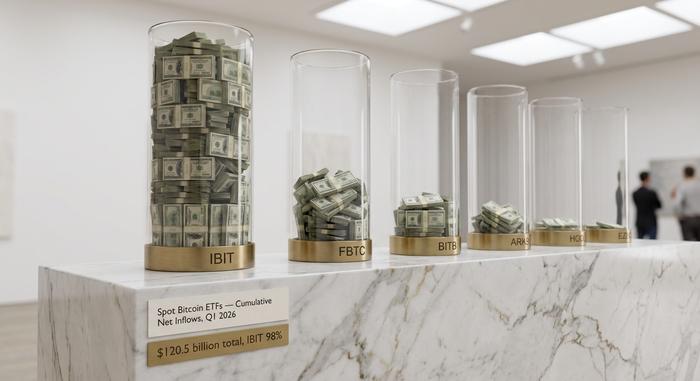
Any honest answer to "what is the best crypto to invest in" starts here. The marginal buyer of crypto has changed. For most of this market's history, retail set price and miners supplied flow. That is no longer true. Portfolio allocators using spot ETFs now do most of the buying that matters. By Q1 2026, cumulative net inflows into spot Bitcoin ETFs crossed about $65 billion, with BlackRock's IBIT alone close to $64 billion (The Block). Spot Ethereum ETFs cleared $11.6 billion. Spot Solana and XRP ETFs, both launched in late 2025, already hold more than $2 billion combined.
Then macro. Wells Fargo currently expects zero Federal Reserve rate cuts in 2026. The IMF projects a single 25-basis-point cut, dragging the funds rate from 3.6% to 3.4%. That keeps liquidity half-closed for the year. CoinShares' May 2026 outlook for Bitcoin: a base case of $110,000 to $140,000, a stagflation bear of $70,000, and a $170,000 ceiling only if the Fed is forced into emergency easing. Total crypto market cap currently sits at $2.81 trillion. BTC dominance is 58.6%. The altcoin season index reads 45 out of 100, well under the 75 threshold that signals genuine altcoin outperformance. Capital is concentrating, not rotating. That detail matters more than any individual token's chart this year.
Bitcoin (BTC): the risk-adjusted anchor
Bitcoin trades at $80,304 with a $1.33 trillion market cap as of May 13, 2026, per Fortune's daily price tracker. The drawdown from the October 2025 peak above $126,000 is roughly 40%. That sounds painful, and for some investors it has been. Compared with what altcoins did during the same window, it is the calmest seat in the room.
Here is the analytical case for keeping Bitcoin as the anchor of any 2026 crypto portfolio. The 12-month Sharpe ratio for BTC, as measured by XBTO and PortfoliosLab, is 2.42 — high enough to rank it in the top 100 risk-adjusted assets globally, ahead of most equities and most commodities. The Sortino ratio, which only penalises downside variance, is 3.2. Annualised volatility has compressed from over 200% in 2012 to roughly 50% in 2025, according to Fidelity Digital Assets. Bitcoin is no longer the wild outlier it was a decade ago; it behaves more like a high-beta tech stock with a fixed supply schedule.
What changed about the bull case? Not much in the asset itself. The narrative shifted. Halving-cycle theory — the idea that supply shocks every four years drive predictable rallies — was contradicted by 2025's negative return. Bitcoin's correlation with the S&P 500 rose materially in 2025, and prices now key off Fed expectations and ETF flow data. A reasonable mental model: BTC is a macro-correlated risk asset with an asymmetric tail, not a hedge against fiat collapse and not a yield-bearing instrument.
The risks worth taking seriously. A 40% drawdown is not unusual for Bitcoin, but if the Fed truly delivers zero cuts and global liquidity tightens further, $70,000 (the CoinShares bear case) is not a tail event. The asset still requires the same position-sizing discipline it has always demanded. Most institutional models put BTC between 2% and 5% of total portfolio AUM; the same range applies for retail investors who treat crypto as a satellite allocation rather than a core one.
Ethereum (ETH): yield, ETFs and the upgrade pipeline
Ether is the most interesting case in this market because its institutional thesis genuinely changed in the past 12 months. ETH trades near $2,350 with a $233 billion market cap, well off the August 2025 all-time high of $4,946. Price tells one story. On-chain numbers tell a different one. Around 35.8 million ETH (close to 30% of supply) is staked, paying 2.8% to 3.5% APR. BlackRock's ETHB, the first staking-enabled spot Ether ETF in the US, launched in March and is now distributing 1.9% to 2.2% monthly to holders. The product matters because, for the first time, Ether is being pitched to allocators as a yield-bearing alternative asset, not a smart-contract bet.
The roadmap backs the thesis up. Pectra went live in May 2025 (EIP-7702 account abstraction, blob expansion). Fusaka shipped December 3, 2025 (PeerDAS, more data scaling). Glamsterdam, due mid-2026, brings enshrined proposer-builder separation. The L2 stack, which is the scaling solutions layer that handles most user traffic, now holds $48 billion in TVL across 73 rollups. Arbitrum (~$16 billion) and Base (~$11 billion) together control roughly 77% of L2 liquidity (DefiLlama). Tokenization of real-world assets has settled on Ethereum too: BlackRock's BUIDL fund and Franklin Templeton's on-chain money-market product both chose it as primary settlement.
The bear case is fair. ETH/BTC is at multi-year lows. The L2 explosion sucked activity off mainnet, fees fell, and the deflationary burn slowed. If the burn stays muted, the "ultrasound money" thesis weakens. I am not convinced ETH beats BTC on a 12-month risk-adjusted basis under these conditions, even after factoring in staking yield. For anyone who wants real exposure to programmable money and the decentralized finance stack, though, ETH is the only asset where institutional money, regulatory clarity, and a working yield mechanism converge.
Solana (SOL): the performance bet for 2026
Solana trades at $95.30 in May 2026, down from highs above $250 in late 2024. The pullback is a clean illustration of how altcoins behave when ETF capital concentrates in the majors: SOL fell harder than BTC on every macro down day, with rolling drawdowns of about 8% on days BTC fell only 4%, according to Amberdata.
The bull case is technical execution. Firedancer, the second independent Solana validator client built by Jump Crypto, cleared a 1 million transactions-per-second public stress test in early 2026, with mainnet deployment scheduled for H2 2026. Alpenglow targets 150-millisecond block finality in Q3 2026. Spot Solana ETFs launched on October 28, 2025; combined AUM across Bitwise and Fidelity products surpassed $1 billion by May 2026. Standard Chartered's year-end SOL target is $250, conditional on Firedancer shipping and macro conditions improving.
This is a high-conviction, high-variance position. SOL is genuinely a different bet than BTC or ETH: more upside if the roadmap lands, more downside if liquidity stays tight. Treat it accordingly.
XRP and BNB (Binance Coin): institutional plays
XRP and BNB sit in a different conceptual bucket from the speculative L1 tokens. Both are infrastructure plays attached to working revenue businesses: Ripple's cross-border payments network and Binance's exchange flywheel.
XRP trades at $1.45 in May 2026. The Ripple-SEC case was formally closed in August 2025 when appeals were dropped, removing the largest regulatory overhang in crypto. Spot XRP ETFs launched in late 2025 and have pulled in roughly $1.29 billion in cumulative inflows across seven US funds. Goldman Sachs disclosed a $153.8 million spot XRP ETF position in its Q4 2025 13F filing. RippleNet now has over 300 member banks; On-Demand Liquidity volume hit $1.3 billion in Q2 2025 alone. Standard Chartered's end-2026 target is $8, implying roughly 4x upside conditional on continued ETF flows and institutional adoption.
BNB sits at $659.50 with an $88.9 billion market cap, making it the fifth-largest crypto by capitalisation. The investment thesis is unglamorous but durable. BNB benefits from Binance's quarterly burns, which take supply out of circulation; from a deep ecosystem of decentralized applications on BNB Chain; and from Binance's track record as the largest exchange by trading volume. Its main use case is paying fees and unlocking discounts on Binance itself, but the broader scalability of BNB Chain has also made it a base layer for retail-focused DeFi. It is the closest thing to a "crypto exchange equity proxy," with all the regulatory risk that implies.
Cardano (ADA), Chainlink, Avalanche: the mid-cap losers
The mid-cap tier tells a hard truth. Cardano (ADA), a proof-of-stake layer-1 blockchain, trades at $0.28. Avalanche (AVAX) is at $9.76. Chainlink (LINK), the dominant oracle network for cross-chain interoperability and real-world asset price feeds, sits between $8.50 and $9.50. Polygon's POL token, the successor to MATIC, trades at $0.097. None of these has a 2026 catalyst comparable to a spot ETF launch or a major protocol upgrade. The 45-out-of-100 altcoin season index reflects exactly this: capital is concentrating in the top four names plus stablecoins, and the mid-caps are bleeding from it. Trading volume on decentralized exchanges across these networks has fallen alongside price. Even pure meme coins like Dogecoin and Shiba Inu, which sometimes outperform mid-caps in retail-driven rallies, look like risky positions in a year defined by institutional flows. Treating any of them as a core 2026 position is hard to justify against the risk-adjusted alternatives.
Stablecoins (USDC and USDT) as a portfolio anchor
Stablecoins went from "crypto cash" to "regulated yield product" once President Trump signed the GENIUS Act on July 18, 2025 (House 307-122, Senate 68-30). Implementation rules land by July 18, 2026. Under the new framework, US issuers of any fiat-currency stablecoin must keep 1:1 reserves in cash or short-dated Treasuries and accept federal supervision. Total stablecoin market capitalization reached $319 billion by April. Tether (USDT) sits at $189.6 billion, USD Coin (USDC) at $77.6 billion. USDC supply alone has grown 220% since late 2023, according to Bitrue research. The driver is regulated capital and institutional investors choosing the most compliant issuer. Bernstein now projects total stablecoin supply hits $420 billion by year-end.
Two real uses for the average investor. First, dry powder for buying drawdowns. Second, a short-duration Treasury proxy via the yield-bearing variants on regulated platforms. Stablecoins are not an investment in the upside sense. They are the cleanest way to keep crypto-denominated capital out of beta during a tight-liquidity year.
Risk-adjusted comparison: gainers, losers, the numbers
| Asset | May 2026 price | 12-mo Sharpe | Max drawdown (12 mo) | Annualised vol | YTD return |
|---|---|---|---|---|---|
| Bitcoin (BTC) | $80,304 | 2.42 | ~40% | ~50% | -6% (2025 close) |
| Ethereum (ETH) | $2,350 | not published | ~52% from Aug 2025 ATH | ~70% | negative |
| Solana (SOL) | $95.30 | not published | ~65% from late-2024 ATH | ~90% | negative |
| XRP | $1.45 | not published | ~55% | ~80% | mixed |
| USDC/USDT | $1.00 | n/a | ~0.1% | <1% | flat by design |
| Mid-cap basket (ADA/AVAX/LINK/POL) | various | not published | 70%+ | 100%+ | negative |
Source: XBTO, PortfoliosLab, Fidelity Digital Assets, Amberdata, CoinGecko. Sharpe and Sortino figures are reliably published only for Bitcoin; for the others, the field uses estimated rolling figures from on-chain proxy data.
Two takeaways from this table. First, BTC remains the only crypto asset with institution-grade risk metrics, and on those metrics it ranks well against any global asset class. Second, altcoin drawdowns systematically amplify Bitcoin drawdowns by 1.5x to 2x, confirmed by Amberdata across the 2024-2025 sample. If you cannot stomach a 70% drawdown on a position, you should not size altcoins as if you can.

How investors should build a 2026 cryptocurrencies portfolio
A useful frame: pick an allocation based on volatility tolerance, not on conviction in any single story. Two reference portfolios for a 2-5% total-wealth crypto allocation:
| Allocation | BTC | ETH | SOL | XRP/BNB | Stablecoins (yield) | Mid-caps |
|---|---|---|---|---|---|---|
| Conservative | 60% | 20% | 5% | 10% | 5% | 0% |
| Growth | 40% | 25% | 15% | 10% | 0% | 10% |
The conservative version targets the lowest possible drawdown without giving up exposure to the dominant assets. The growth version takes meaningful altcoin risk but caps any single mid-cap line at modest size. Neither is a recommendation; both are useful starting templates. Whichever you choose, rebalance quarterly rather than chasing narratives weekly.
Conclusion
The best crypto to invest in for 2026 is the one that survives a tight-liquidity year with your portfolio still functioning. That means assets that can be analysed like any other holding: by Sharpe, drawdown, liquidity, and regulatory standing. Bitcoin anchors the portfolio on risk-adjusted grounds. Ethereum offers the only credible institutional yield story in crypto. Solana is the highest-conviction execution bet. XRP and BNB are infrastructure plays with revenue businesses behind them. Stablecoins are the patient capital. The open question is whether the Fed is forced to ease before year-end. If it does, the altcoin rotation begins. If it doesn't, BTC dominance climbs above 60% and the boring portfolio outperforms the exciting one again.