CryptoPunks: How 10,000 Pixel NFTs Made History
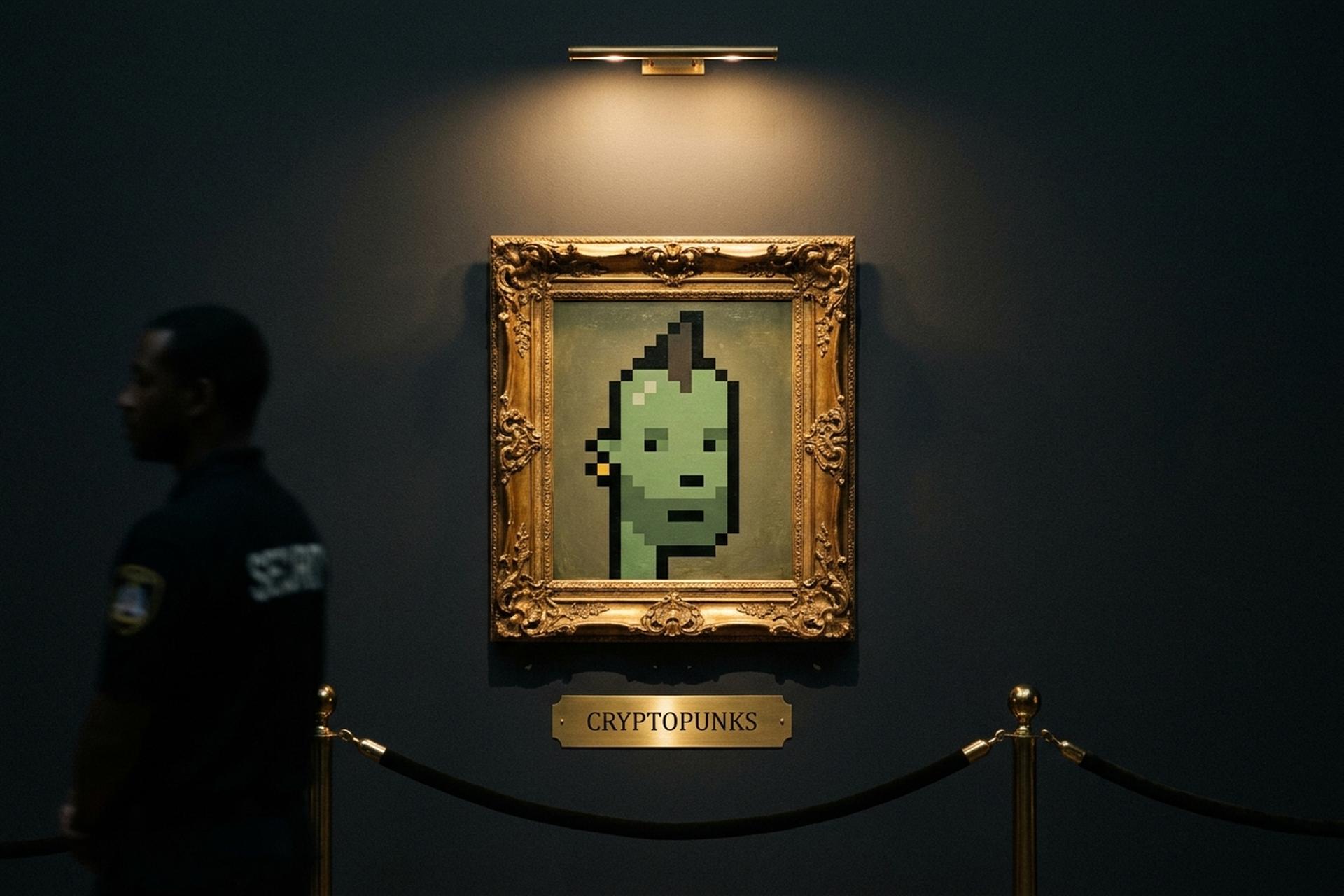
One tiny pixel face. Twenty-four by twenty-four. It sold for $23.7 million. Eight others like it now hang in the Museum of Modern Art, donated and taken seriously as art. Same project both times: CryptoPunks, a batch of 10,000 cartoon portraits that two coders gave away for free back in 2017.
Free to a museum wall in eight years. That is the story worth telling, and it is not really about the prices, which spike and fade. It is about where these things came from, the bug that nearly killed them on day one, how a cartoon avatar became a flex that celebrities chased, and what they quietly changed about owning anything online.
What CryptoPunks Are: 10,000 Pixel Portraits
A CryptoPunk is a tiny face. Twenty-four pixels by twenty-four, a piece of pixel art drawn in the blocky 8-bit style of a 1980s arcade game. Ten thousand of them exist. No more will ever be made. Each one is different, each one lives on the Ethereum blockchain, and the cap is enforced by the code rather than promised in a pitch deck. That last detail matters more than it sounds. It is most of the reason anyone bothered to care.
The five types and 87 attributes
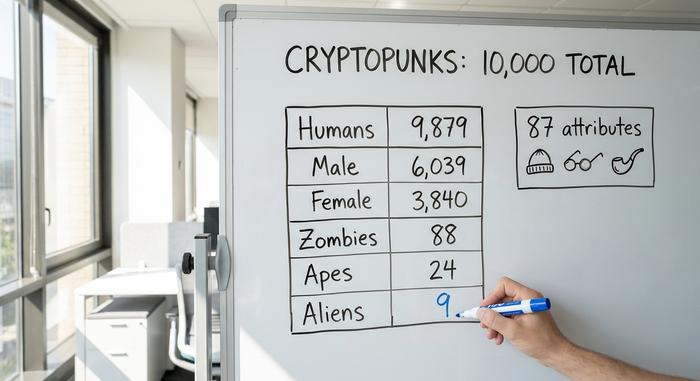
Each Punk is algorithmically generated from a pool of 87 traits: hairstyles, hats, glasses, pipes, earrings, the works. A small piece of generative collectible art, assembled by code. A face might carry seven of those traits, or just one, or none at all. The rarer the mix, the more people pay. And some traits are genuinely scarce. Only 44 Punks wear a beanie. Only 78 have buck teeth. One unusual accessory can move a Punk's price by six figures. Then there are the five character types, and their counts are lopsided on purpose. That lopsidedness handed the collection a prestige ladder before a single Punk ever changed hands. A face with seven traits, or with none, beats the ordinary two or three.
| Type | Count | Rarity |
|---|---|---|
| Male | 6,039 | Common |
| Female | 3,840 | Common |
| Zombie | 88 | Rare |
| Ape | 24 | Very rare |
| Alien | 9 | Legendary |
Why they live on the Ethereum blockchain
Here is the technical bit, kept short. Most NFTs are just a receipt that points at an image sitting on someone's server. CryptoPunks are different. The artwork itself lives on Ethereum, fully onchain, an Ethereum-based generative artwork that cannot quietly vanish if a company folds or forgets to pay its hosting bill. That permanence was the whole pitch. It also helped popularize the idea of a non-fungible token, the digital-ownership format the ERC-721 standard later wrote down for the entire NFT industry.
The London punk and cyberpunk roots
The look was a choice. Hall and Watkinson leaned on the 1980s London punk scene and 90s cyberpunk culture: the mohawks, the wild hair, the cigarettes hanging off pixel mouths. The name nodded to a subculture built on rejecting the mainstream, which is funny, given where the Punks landed. There is a real tension in that. Punk was anti-establishment, anti-commercial, proudly cheap. CryptoPunks took the look and turned it into one of the most expensive, most exclusive assets online. Betrayal of the reference, or a sly joke about value? Depends how cynical you are feeling. Either way, the contradiction sits right in the project's DNA.
How Larva Labs Launched CryptoPunks in 2017
CryptoPunks began as an art project and an experiment, not a business plan. Hall and Watkinson, two Canadian software developers running a studio called Larva Labs, wanted to see whether a few lines of code could make a digital item feel as real to own as a physical collectible. The collection launched in June 2017, on the 23rd to be exact, long before the word NFT meant anything to anyone.
The free claim almost nobody took
Of the 10,000 Punks, 9,000 were free to claim. Anyone with an Ethereum wallet could take one for the cost of a small network fee. The creators kept the remaining 1,000. And for a while, the giveaway barely moved. The idea of paying gas for a cartoon face was a hard sell in 2017, and most of the early claims came from a small circle of crypto insiders who simply found it interesting. Picture that for a second: assets that would later sell for millions were sitting there, free, and most people scrolled past. The few who claimed a handful on a whim ended up holding some of the most valuable digital objects ever made, which is either the best argument for early adoption or the most painful one, depending on whether you were there.
The bug that nearly killed them
There was also a problem in the original contract. The first version was built on the ERC-20 standard, and it had a flaw: when a Punk sold, the buyer's payment went to the buyer, not the seller. The Punks were effectively unsellable. Rather than abandon the project, Larva Labs redeployed a fixed second version and airdropped new Punks to the original holders. That redeploy is the reason the collection survived at all.
Inventing the NFT template before ERC-721
What Hall and Watkinson built did not fit any existing mold. The CryptoPunks NFT project was among the first NFTs ever made, and the ERC-721 standard that defines NFTs today did not exist yet; CryptoPunks predated it and helped inspire it. They also predated CryptoKitties, the game usually credited with the first NFT craze. In hindsight, the Punks were the template that almost everything after them copied.
From Free to Millions: The Record Sales
The CryptoPunks collection shipped with its own marketplace, written straight into the contract. Every bid, every offer, every sale, public and instant, with no middleman skimming a cut. Then 2021 happened. Crypto money poured in, the rarest Punks turned into trophies, and the nine aliens became the most fought-over JPEGs on the planet.
| Punk | Type | Price | Note |
|---|---|---|---|
| #5822 | Alien | $23.7M | All-time record, Feb 2022 |
| #7523 | Alien | $11.75M | "Covid Alien", Sotheby's |
| #4156 | Ape | $10.26M | |
| #7804 | Alien | $7.56M | |
| #3100 | Alien | $7.51M |
Take Punk #5822, an alien in a bandana. It sold for 8,000 ETH. About $23.7 million, the most anyone has ever paid for a single Punk. The masked Covid Alien, #7523, fetched $11.75 million at Sotheby's in 2021, the first time a serious auction house ran a pixel JPEG as a headline lot. Even Visa bought in, dropping around $150,000 just to plant a flag. Add it all up and the collection has moved something like $3.8 billion over its life, with nearly all of that value parked in the rare types. The nine aliens are the whole game. Everything else trades at a discount to them.
Three Owners in Eight Years: Larva, Yuga, Node
Here is the part most price guides skip: the rights to CryptoPunks have changed hands three times, and each move reshaped what owning a Punk actually means. The collection went from its creators, to the biggest brand in NFTs, to a nonprofit built to preserve it.
| Era | Owner | What changed |
|---|---|---|
| 2017-2022 | Larva Labs | Created and ran the collection |
| 2022-2025 | Yuga Labs | Gave holders full commercial rights |
| 2025- | Infinite Node Foundation | Nonprofit preservation |
First, Larva Labs sold the rights to Yuga Labs, the studio behind Bored Ape Yacht Club, in March 2022. Yuga did something the creators never had: it handed every Punk holder full commercial rights to their own image. Then came the twist. In May 2025, Yuga sold the IP yet again, this time to the Infinite Node Foundation for roughly $20 million plus a $25 million endowment, reportedly the first time a nonprofit took full ownership of a major internet-native artwork. Hall and Watkinson joined the advisory board. Sit with that for a second. A company has to make a collection pay; a foundation with an endowment can just keep it safe, the way a trust keeps an old building standing. For a project that sold permanence as its entire reason to exist, handing the keys to a nonprofit — that might be the most fitting ending it could get.
Why CryptoPunks Became a Status Symbol
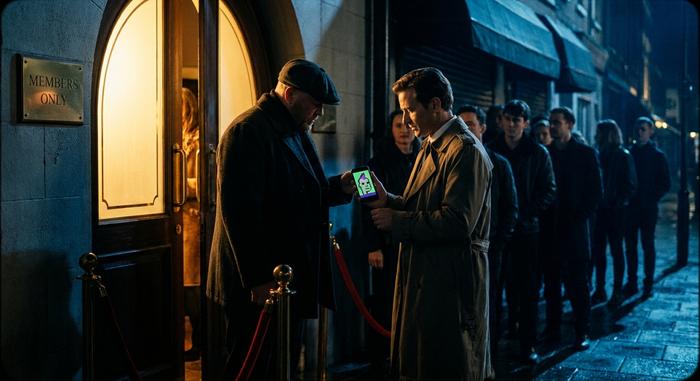
Strip away the money and the most interesting thing about CryptoPunks is social. Somewhere around 2021, owning one stopped being about the art and started being about belonging. The Punk became a profile picture, and the profile picture became a membership card.
The profile picture as a flex
Using a Punk as your avatar on social media signaled that you were early, that you were in, and frankly that you could afford it. One holder described the feeling from the outside bluntly: without a Punk, the scene felt like "this gentlemen's club of the 10,000 people that can afford these kinds of avatars." Verified owners gathered on Discord, traded gossip, and quietly set the tone for what the rest of the NFT world would do next. Digital ownership had become a public identity, not a private asset. When Bored Ape Yacht Club arrived in 2021 and built a whole club around the same idea, it was following a path the Punks had already cut.
The owners who would not sell
The attachment got genuinely emotional, which is the part outsiders never expect. Dylan Field, the CEO of Figma, bought an alien Punk and predicted it would become "the Mona Lisa of digital art." Daniel Maegaard, an early collector, turned down a $4.2 million offer for his rarest Punk and explained it about as honestly as anyone could: "a million dollars is nice, but I really liked her." Jay-Z, Serena Williams, and a long list of others bought in too.
A blue-chip in a crashed market
The broader NFT market later collapsed, falling roughly 95% from its 2021-2022 peak in trading volume. Most collections from that era are now worth close to nothing. CryptoPunks held on. With a market value still around $580 million and the deepest history in the category, the Punks kept their blue-chip status while almost everything around them faded.
CryptoPunks as Digital Art in the Museum
The final stamp of approval did not come from crypto at all. It came from the art establishment. In December 2025, the Museum of Modern Art took in eight CryptoPunks for its permanent collection, every one of them donated. Pixel JPEGs — filed alongside the artists MoMA has canonized for nearly a century.
And MoMA was not alone. The Centre Pompidou in Paris, LACMA, the ICA Miami, the Toledo Museum of Art, and ZKM in Germany all hold Punks now. Curators describe them as among the earliest artworks ever to exist as non-fungible tokens, which makes them historically important no matter what the floor price does. That is a different kind of stamp than an auction record. A museum does not collect a thing hoping it appreciates. It collects a thing because the thing matters to the story of its medium. A free pixel experiment had become art the institutions felt they had to keep.
Are CryptoPunks Still Worth Anything?
Yes, but quieter than the headlines suggest. As of May 2026, the floor price, the cheapest Punk you can buy, sits around 31 ETH, somewhere in the range of $58,000 to $73,000 depending on the day. The whole collection is worth roughly $580 million. Trading is thin compared to the frenzy years, with monthly volume measured in single-digit millions rather than hundreds. They remain valuable. They are no longer a lottery ticket. Worth saying plainly: a Punk is an illiquid, speculative asset whose price rests on cultural status, not cash flow, and that status could fade. Buy one because you want to own a piece of internet history, not because you expect the next $23.7 million sale.
What CryptoPunks Really Changed
The real legacy is not that $23.7 million sale. It is the format itself. CryptoPunks showed that a fixed set of generated avatars, owned onchain, could carry real ownership and a real identity at the same time. Nearly every profile-picture project since has copied that blueprint, knowingly or not. Two coders asked a simple question: could a few lines of code feel like owning something? Eight years and a museum wing later, the answer is plainly yes. The harder question is the one they left behind. What is a thing worth once anyone can see the exact same picture?