Courtyard.io: Pokemon Trading Cards as Vaulted NFTs
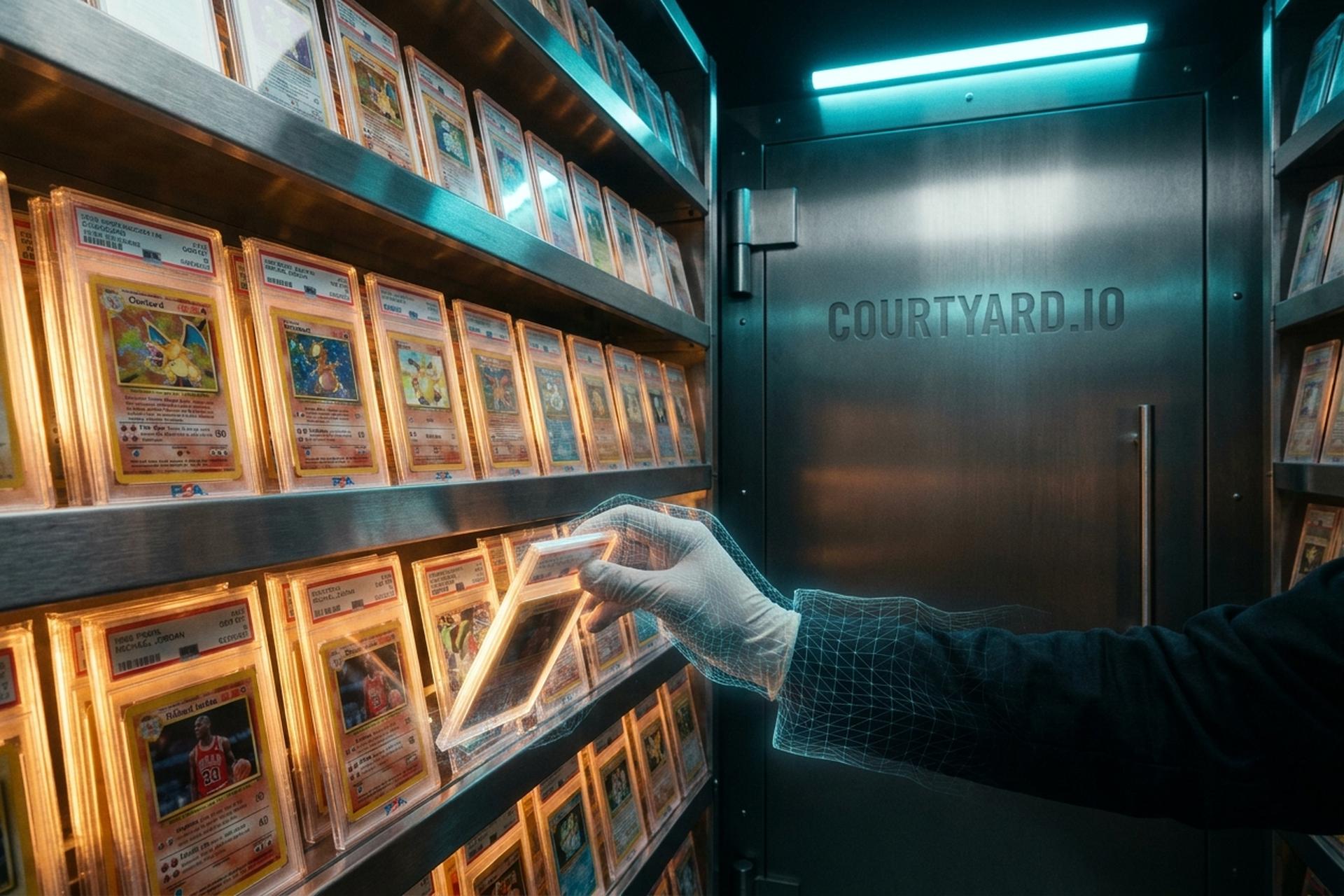
You can buy a Charizard you will never touch. It sits in a Brink's vault, it trades on-chain as an NFT, and the day you actually want the cardboard in your hands, Courtyard ships it to your door. That is the whole strange, clever idea behind Courtyard.io: take a physical graded trading card, lock it in a vault, and let people own and trade it as a digital token until someone decides to redeem the real thing.
It sounds like a gimmick. The volume numbers say otherwise. This guide walks through what Courtyard is, how the digital packs and the vault actually work, what it costs, whether there is a token (spoiler: there isn't), how big it has really gotten, and the honest question at the end of all of it — should you use it?
What is Courtyard.io? Cards as NFTs explained
Courtyard.io is a marketplace where each NFT is backed one-to-one by a specific physical trading card sitting in a professional vault. Buy the token and you own the card. Most of the inventory is graded Pokemon, with sports cards (basketball, baseball, football) filling out the shelves. The company came out of Y Combinator's Winter 2022 batch and has spent its life solving an unglamorous problem: how do you trade collectibles without the friction, fraud, and shipping risk of mailing cardboard back and forth?
The answer is to separate ownership from possession. Your card lives in the vault. Your claim on it lives on a blockchain. You can sell that claim to someone on the other side of the world in seconds, and neither of you ever has to package a card, trust a stranger's photos, or wait a week for delivery to find out the corner was dinged. You do all of it from the Courtyard app or website, in a few taps, and you can redeem the physical card worldwide anytime you want.
This puts Courtyard in the middle of one of crypto's busiest narratives: real-world assets, or RWAs, the push to represent physical things as on-chain tokens. Most RWA projects chase treasury bonds or real estate. Courtyard picked collectibles, which turns out to be a shrewd fit. Cards are already graded, authenticated, and priced by an active market, so the hard part, agreeing on what a thing is worth, is largely solved before the token is ever minted. The result is a platform that has pulled in a genuine crowd of collectors and flippers, not just crypto tourists looking for the next mint.
Physical cards, vaulted and insured
Every card on Courtyard is a real, graded, physical object. The platform stores them in a Brink's facility, the same kind of operation that guards gold and fine art, and they are insured for free at their market value. That is the trust anchor for the entire model. When you hold a Courtyard NFT, you are not holding a picture of a card. You are holding a redeemable receipt for a specific PSA-graded card that a security company is physically protecting.
From Ethereum to Polygon
Courtyard started on Ethereum, then migrated to Polygon on August 3, 2023. The reason is simple economics. When you are trading cards that might be worth four dollars, you cannot afford a fifteen-dollar gas fee to move one. Polygon's low transaction costs are what make a sub-ten-dollar collectible viable as an on-chain asset at all. It is a small technical decision that quietly makes the whole business possible.

How buying a digital pack works
Here is where Courtyard gets fun, and where it gets risky. Most people come to rip packs, not to shop for a specific card. You buy a digital pack and rip it open, exactly like tearing into a physical booster, except the rip reveals a card NFT that lands in your wallet. If you do not like what you pulled, you can sell it on the secondary marketplace or redeem it. Simple loop. Dangerous loop.
Packs come in tiers, from cheap ones stuffed with commons to premium legend packs priced in the hundreds with a real shot at a grail. You are not forced to gamble, though. If a specific card is what you want, you can usually skip the packs entirely and buy that exact card NFT on the secondary marketplace at its going rate. Packs are the entertainment. The marketplace is the store. Knowing the difference is the single most useful habit a new user can build here.
Ripping a pack and the odds
The pack-opening is randomized, and Courtyard uses Chainlink VRF, a verifiable randomness service, so the pull cannot be quietly rigged in the house's favor. The odds for each pack are published before you buy. That transparency matters, because it is the difference between a fair game and a black box. You still will not beat the math, though. Most packs return less than they cost, the same way most booster boxes do. The vault and the blockchain are new; the gacha incentive underneath is very old.
Pikachu, Charizard, and the chase cards
Every pack tier has its grails. A pristine PSA 10 Charizard, a rare Pikachu promo, a graded vStar or a vintage Fleer sports card, these are the chase cards people are really ripping packs to hit. The thrill is identical to the physical hobby: most pulls are filler, and then once in a while you hit something worth hundreds. The on-chain twist is that the moment you pull a chase card, you can list it for sale instantly, no envelope required.
Selling, value, and redeeming your card
A Courtyard card has two exits, and this is the part that separates it from a plain NFT. You can sell the token on the marketplace for liquidity, or you can redeem it and have the actual card shipped to you. That second option is the whole point. It is what makes the NFT a claim on something real rather than a speculative JPEG.
Pricing follows the underlying card market. A token's value is whatever that exact graded card trades for among collectors, minus the friction you are avoiding. Selling is fast and carries no seller fee, which is unusually generous. Redeeming costs a small handling fee per card plus shipping, and once you redeem, the NFT is burned and the card leaves the vault for good. Choose liquidity or choose the cardboard. You cannot have both at once.
One honest caveat on liquidity. The top Pokemon and marquee sports cards sell quickly and close to their real-world price. Step down into mid-tier or obscure cards and the order book thins out, spreads widen, and you may wait, or take a haircut, to get out. The vault solves storage and authentication. It does not guarantee a buyer is standing by whenever you decide to sell.
PSA grading and how to verify a card
Grading is the foundation of everything here. A card's value is set largely by its condition score, and Courtyard deals in cards graded by established authorities like PSA and BGS. A raw card and a PSA 10 of the same Pokemon can differ in price by a factor of ten or more, so the grade is not a detail. It is the asset.
Grades run on a ten-point scale, where a PSA 10 is gem mint and anything below an 8 starts shedding value fast for the cards people actually chase. The same Charizard might be a hundred-dollar card in a 7 and a five-figure card in a 10. That gap is the entire reason a graded card sealed in its plastic slab is the unit Courtyard trades, rather than a loose card a careless owner could swap, bend, or quietly downgrade.
Verification is how you trust the vault holds what the NFT claims. Each token is tied to a specific graded card with its own certification number, and you can check that link rather than taking it on faith. This is the quiet advantage of putting collectibles on-chain: provenance and ownership history are transparent and permanent, instead of living in a shoebox of receipts. If you cannot verify a card's grade and cert, you should not be buying it, on Courtyard or anywhere else.
Courtyard fees, custody, and Brink's vault
On paper, Courtyard is cheaper than most collectors expect. Here is the structure.
| Fee | Cost |
|---|---|
| Selling a card (seller fee) | 0% |
| Vault storage | $0 (free) |
| Redemption handling | ~$2 per card + shipping |
| Creator royalty | 6% |
The custody side is where you have to think carefully. Brink's storing your card is genuinely reassuring, and free insurance at market value is a real benefit. But it also means Courtyard's model rests on a single custodian. Your card is only as safe as that arrangement, and that is a concentration of trust the marketing does not dwell on. For most users this is a fine trade. For anyone vaulting serious money, it is worth understanding exactly where the risk sits.
There is also a quiet convenience most people overlook. Because storage is free and open-ended, you can leave a card vaulted indefinitely and trade the token for years without ever paying to hold it. That is genuinely useful for active traders. It is also what keeps cards on the platform and liquidity flowing, which is precisely why Courtyard hands it out for free.
Is there a Courtyard or COURT token?
Short answer: no. As of June 2026, Courtyard has no native cryptocurrency, no COURT token, and has run no airdrop. The only on-chain assets it has issued are the card NFTs themselves. If you see a "Courtyard token" or a "COURT airdrop" advertised anywhere, treat it as a scam until proven otherwise, because the company has not launched one. The platform runs on Polygon and settles in standard crypto; there is simply no separate coin to farm or speculate on.
Courtyard.io traction: volume and growth
The growth here is hard to overstate, and just as hard to take entirely at face value. Backers have poured real money in, and the trading volume has gone vertical.
| Milestone | Figure |
|---|---|
| Seed round (Nov 2022) | $7M, led by NEA |
| Series A (Jul 2025) | $30M, led by Forerunner Ventures |
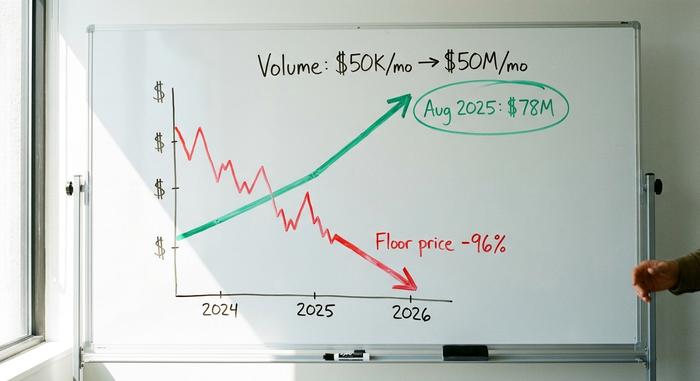
| GMV growth | ~$50K/mo to ~$50M/mo in 18 months |
| Record month (Aug 2025) | ~$78M Pokemon secondary volume |
| Weekly NFT ranking (Apr 2026) | #1 globally, ~$8.6M |
That is roughly a thousandfold jump in monthly volume in a year and a half. In August 2025 Courtyard set a record month of about $78 million in Pokemon secondary volume, at points out-trading long-established NFT collections. Now the other side. The floor price of its cards crashed about 96% from a February 2026 peak, and liquidity thins out fast once you step away from the most sought-after Pokemon. The volume is real. So is the volatility.
Two clouds hang over those numbers. Regulators have not settled how tokenized collectibles should be treated; asked about tokenized Pokemon cards in 2024, then-SEC chair Gary Gensler essentially said he would need to know more, which is a long way from a clean bill of health. And a growing chorus frames the pack-ripping model as gambling dressed up as collecting. Neither issue is fatal today. Both are unresolved, and both could rewrite the rules tomorrow.
Is Courtyard.io legit and worth using?
Here is my honest read. Courtyard is a real company with real backing, real cards, and a genuinely novel product. Brink's custody, Y Combinator pedigree, and roughly $37.5 million in funding are not the markers of a scam. If you want exposure to graded cards without the storage, insurance, and shipping headaches, it solves a real problem well.
The cautions are just as real. The pack mechanic is gambling with extra steps, and dressing it in blockchain does not change the odds. The regulatory status of tokenized collectibles is unsettled, and a future ruling could reshape the model. Custody leans on a single provider. And that 96% floor crash is a reminder that hype cycles here are brutal. So: Courtyard is a useful platform for collectors who value liquidity and safe storage, and a bad idea for anyone treating mystery packs as an investment strategy. Use it for what it is. Do not pretend the slot machine pays.