What Is x402? The Payment Protocol for AI Agents

An AI agent can book a flight, write a working app, and pull data from ten databases in the time it takes you to read this sentence. The one thing it cannot do is pay for any of it. Card networks were built for humans with bank accounts, not software making a hundred tiny purchases a minute.
x402 is the piece that closes that gap. The x402 protocol is an open standard that lets any client, human or machine, pay for something over the web in stablecoins, instantly, with no account and no API key. This guide walks through what x402 is, how its payment flow actually works, why AI agents are the reason it exists, and where the whole thing honestly stands today.
What Is x402 and What Problem It Solves
Start with what x402 is not. It is not a coin you can buy, and it is not a Coinbase product you sign up for. It is an open payment standard, a shared set of rules, released by Coinbase on May 6, 2025 and now maintained as a public protocol.
The rules are simple. When a client asks a server for something that costs money, the server can demand payment as part of the normal web request, and the client can pay on the spot using a stablecoin like USDC. No checkout page, no subscription, no API keys handed out in advance.
That last part is the real problem it solves. Today, paying for a digital service means creating an account, storing a card, and clearing a payment that settles days later. For a one-cent API call, that overhead is absurd. For a piece of software with no bank account at all, it is impossible. x402 strips payment down to a single step that fits inside a request a machine already knows how to make.
How HTTP 402 Went From Dead Code to x402
Here is the fun part. The "402" is not new. When the web's plumbing was written in the 1990s, the engineers reserved an HTTP status code called 402 Payment Required, a placeholder for a payments layer they assumed someone would build later.
Nobody did. For roughly thirty years, 402 sat there unused while the internet paid its bills with ads, logins, and subscriptions instead. You have met its cousins many times: 404 Not Found, 200 OK. 402 was the one that never got a job. x402 finally gives it one, pairing that dormant status code with stablecoin settlement so the slot the web's designers left blank gets filled.
How Does x402 Work? The Payment Flow
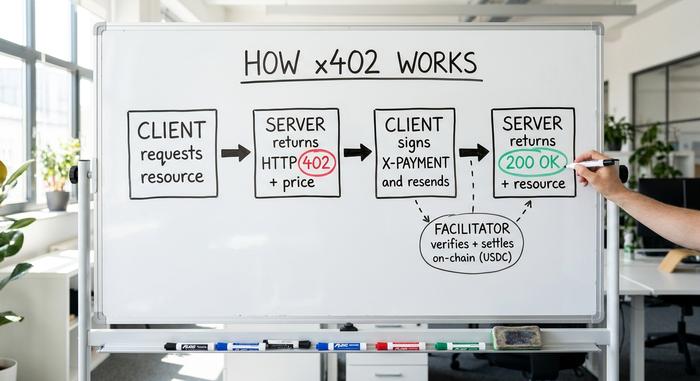
Under the hood, x402 is a short request-and-pay loop bolted onto an ordinary web request. The clever trick is a middleman, called a facilitator, that hides all the blockchain infrastructure from both sides.
The four-step request-and-pay loop
It runs like this:
1. The client requests a protected resource, exactly as it would request any web page.
2. The server replies with HTTP 402 and a PAYMENT-REQUIRED message: the price, the accepted token, the network, and where to pay.
3. The client signs a payment payload authorizing the transfer and resends the request, this time with the signature attached.
4. The server checks the payment, settles it, and returns a normal 200 response with the resource.
The whole exchange feels like one request to the user. The payment happens in the gap between asking and receiving.
Picture an agent that needs one weather lookup. It calls the API, gets a 402 quoting $0.001 in USDC, signs the payment, and resends — and a heartbeat later it has its forecast and the provider has its tenth of a cent. No invoice, no monthly bill, no human approving anything. Multiply that by a million calls and you have the shape of machine commerce.
What a facilitator does
Most servers do not want to run a blockchain node just to take payments. The facilitator handles that. It runs the verification of the signed payload, pushes the transaction on-chain, and confirms settlement, so the seller only deals with plain HTTP. That convenience comes with a tradeoff worth naming early: the facilitator is a central point in an otherwise decentralized flow, and whoever runs it sees the traffic.
Why stablecoins and gasless transfers
Stablecoins fit this job because they hold a steady value and settle in seconds. x402 leans on USDC and a standard called EIP-3009, which lets a user authorize a transfer without first holding gas to pay for it. The result is settlement in roughly 200 milliseconds to two seconds, at a cost well under a cent, with zero protocol fees on top. That sub-cent economics is the whole reason the model can work at all.
Why x402 Matters for AI Agents
This is the real reason x402 exists. An autonomous agent is software that acts on its own, and the moment it needs to buy something, the human payment system falls apart.
Why agents can't use cards
A credit card assumes a person with a verified bank account tapping "confirm." An agent has neither. And card networks are uneconomic below about 30 cents a transaction, which quietly kills the one-cent-to-ten-cent API call that defines machine-to-machine commerce. You cannot run a thousand micro-purchases an hour on rails that charge a fixed fee bigger than each purchase.
Agent wallets and autonomous payments
x402 flips that. An agent gets its own wallet, through tooling like Coinbase's AgentKit, and can sign and settle agentic payments without a human in the loop. It can discover a service, see the price in the 402 response, pay, and move on. The numbers are starting to back the idea. According to a 2026 report from Keyrock, AI agents settled about $73 million across roughly 176 million on-chain transactions between May 2025 and April 2026, and 98.6% of it moved in USDC.
| Metric | Figure |
|---|---|
| First released | May 6, 2025 (Coinbase) |
| Governance | x402 Foundation (Linux Foundation), Apr 2026 |
| Founding members | 22 (Coinbase, Cloudflare, Stripe, Google, Visa, Circle) |
| Agent settlement, May 2025-Apr 2026 | ~$73M across ~176M tx, 98.6% USDC |
| Settlement time | ~200ms to 2s |
| Protocol fees | $0 |
It is still small money. But the shape of it, millions of tiny stablecoin payments moving between machines, is exactly what the protocol was designed to carry. The bet underneath is large: research groups now talk about "machine customers" directing trillions in spending later this decade, and if even a fraction of that materializes, it needs a rail like this. Whether that future arrives on schedule is a separate question, one I will come back to.

x402 vs Traditional Payment Rails
x402 does not beat traditional payment methods at what they are good at. Buying a fridge online is still a job for a credit card and Visa. What x402 serves is the set of payments cards physically cannot: tiny, instant, account-less, and started by a machine.
| Feature | x402 | Cards and bank rails |
|---|---|---|
| Settlement | ~200ms to 2s | 1-3 days |
| Fees | near-zero, $0 protocol fee | ~2-3% plus ~$0.30 |
| Smallest viable payment | a fraction of a cent | around $0.30 |
| Accounts / KYC | none by default | required |
| Chargebacks | none, payments are final | yes |
| Agent payments | native | not supported |
Read that bottom row twice. "Not supported" is not a fee problem you can negotiate down; it is a wall. That is the gap x402 walks through.
What You Can Build With x402: Use Cases
The unlock is per-request pricing — micropayments at machine scale. Instead of selling a monthly plan, you can monetize a service programmatically and charge for exactly one thing, once.
A few patterns are already taking shape:
- Pay-per-call APIs, where a weather feed or a language model charges a fraction of a cent per request instead of issuing API keys.
- Content paywalls with no signup, letting a reader buy a single article rather than subscribe.
- Metered compute, billed by the second of actual use.
- Agent-to-agent payments, where one piece of software hires another and settles the bill itself, with no human intervention.
Each of these dies under card fees and comes alive under sub-cent settlement. That is the practical case for the protocol, stripped of the hype.
There is also a defensive use that gets less attention. Cloudflare reported sending more than a billion HTTP 402 responses a day to bots and crawlers as of September 2025 — a way for sites to say "pay if you want this data" to the scrapers feeding AI models, instead of either blocking them or giving the content away for free. Pricing access, rather than fighting it, may end up being x402's quietest big use.
The x402 Foundation and Who Backs It
The biggest credibility jump for x402 as payment infrastructure did not come from a metric. It came from governance. In April 2026, x402 moved out of a single company's code repository and into a neutral home: the x402 Foundation, launched under the Linux Foundation with 22 founding members.
That roster is the tell. Alongside Coinbase and Cloudflare sit Stripe, Google, Visa, Mastercard, American Express, AWS, Shopify, and Circle. When card networks and cloud giants help steward an open standard, they are hedging that machine payments matter, even if they cannot say yet exactly how much.
The Limits and Risks of x402 Today
Now the honest part most explainers skip. The rails work, but the design has sharp edges and the demand is thinner than the headlines suggest.
Start with demand. In March 2026, analytics firm Artemis estimated that roughly half of all raw x402 transaction volume looked artificial — self-dealing and test traffic rather than real commerce. CoinDesk summed up the moment bluntly: the technology is ready, but the demand is just not there yet. Even the genuine activity is modest in absolute terms. One 30-day snapshot of x402 on Base in May 2026 counted about 3.1 million transactions moving just $1.2 million in value, with buyers up 37% over the month. Real growth, but off a tiny base.
The design has open questions too. Facilitators reintroduce a central party. Native support leans heavily on USDC and one token standard, so other assets need extra work. There are no built-in refunds, disputes, or tax receipts, which real businesses still need. Compliance at machine scale, KYC and sanctions screening for software that pays software, is unsolved. And because payments ride live blockchains, a fee spike or a stalled chain can break a flow mid-request.
None of this makes x402 vaporware. It makes it early. The plumbing is real; the building on top of it has barely started.
What x402 Means for the Internet's Future
x402 is one of the more interesting bets in crypto right now precisely because it is so unflashy. It takes a forgotten status code and a boring stablecoin and tries to give the web the internet-native payments layer it was supposed to have all along.
The infrastructure is built and now governed by serious names. What is missing is proof that armies of agents will actually show up to use it. So the real question is not whether x402 works. It clearly does. It is whether the machine economy it was built for arrives before the hype around it runs out. What would make you trust an agent to spend your money?