Gamification in Crypto: Rewards, Risks, and Real Adoption
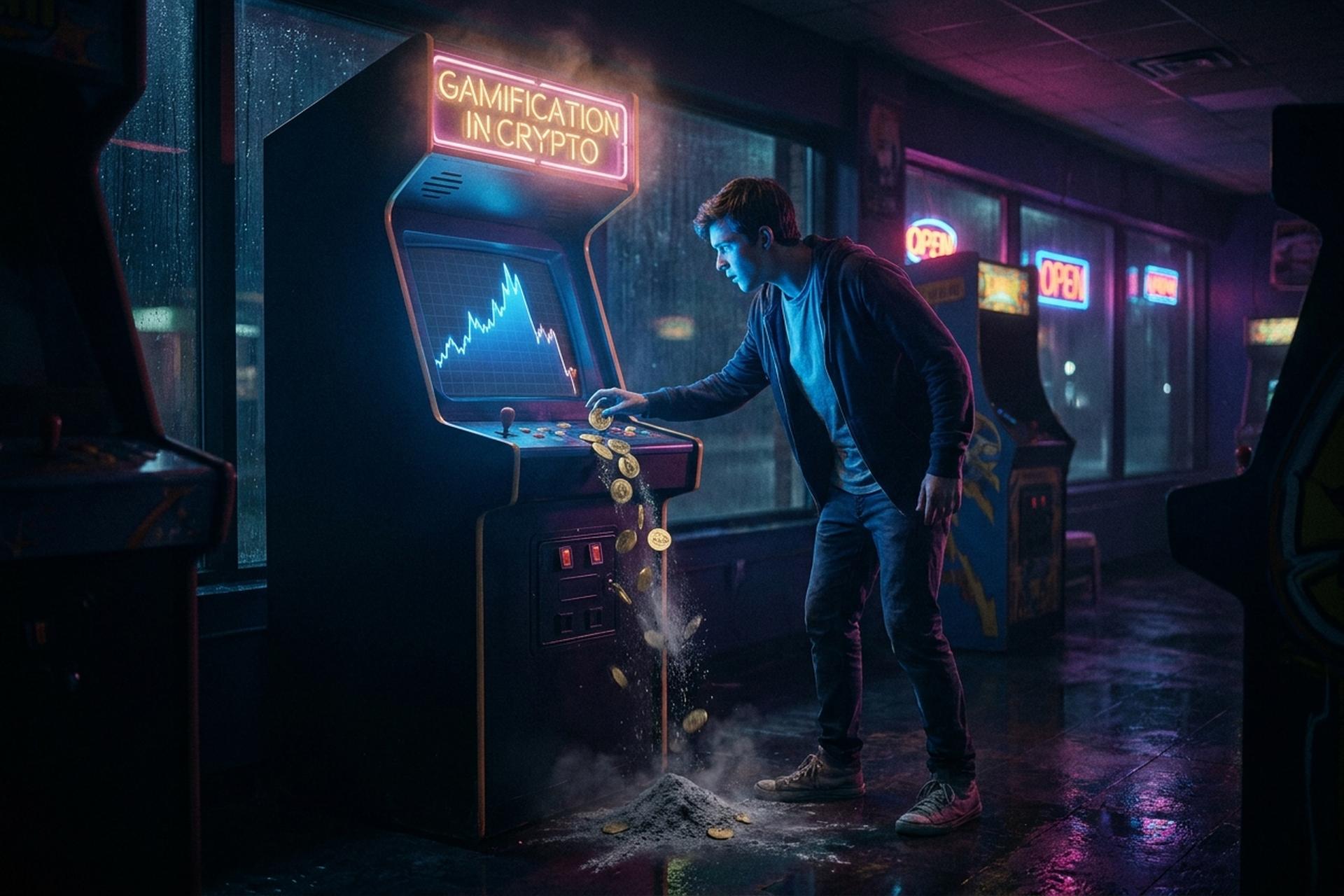
At its peak, a game about cartoon monsters paid players in the Philippines more than the local minimum wage. People quit day jobs to breed and battle digital pets. Two years later, the token behind that game had lost about 99% of its value, and most of those players were gone. That whiplash, from gold rush to ghost town, is gamification in crypto in a single picture.
The mechanics are everywhere now. Open almost any cryptocurrency wallet, exchange, or trading app and something is nudging you to come back tomorrow, finish a quest, climb a leaderboard, or claim a reward. This piece explores what those mechanics actually are, what the 2026 data says about whether they work, and the harder question nobody selling them wants to answer: is any of it good for the people playing along?
What Gamification in Crypto Actually Means
Gamification is the use of game elements, like points, badges, levels, streaks, and leaderboards, in things that are not games. The idea is old. Airlines did it with frequent-flyer miles long before anyone used the word, which only caught on around 2010. Yu-kai Chou, who built one of the best-known frameworks for it, argues the point is motivation, not decoration: good design taps into why people act, not just what buttons they press.
Crypto adds one twist that changes everything. In a normal loyalty app, the reward is a point with no resale market. In crypto, the reward is often a token you can sell. That turns a harmless engagement nudge into something wired directly to money. Two things get mixed up here. Gamification means game mechanics layered onto a financial product, such as an exchange running a trading tournament. Crypto gaming, or GameFi, is when the game itself is the product. This article is mostly about the first, because that is where most users actually meet these mechanics.
How Gamified Rewards Hook New Users
Strip away the jargon and the toolkit is small. The same handful of levers shows up everywhere, borrowed from decades of game design built to motivate.
The engagement loop
Do a task, watch a bar fill, collect a small reward, come back tomorrow to do it again. That is the whole loop. Progress bars and levels make you feel like you are getting somewhere. Streaks punish you for skipping a day. Leaderboards and badges drag your private activity into public view, where status does the rest, and a referral link quietly turns you into the marketing department. None of it is new. None of it is crypto-specific. It's the exact machinery that keeps you tapping a language app at 11pm.
Points versus token rewards
Crypto changes one thing, and that one thing changes everything. A points balance is a number on a screen. A token has a price, and you can sell it. The moment a reward can be cashed out, the game stops being a game. People chase tokens the way they never chase loyalty points, because now there is rent money in it. That pull is the model's great strength. It is also exactly where it goes wrong.
What the engagement numbers show
Platforms love a big number. One exchange-software vendor says gamified features lifted daily active users by 73% and retention by 43%. Maybe. But those figures come from a company selling the software, not from anyone independent, so I would not lean on them. Fintech has its own favourite stat, a 48% engagement boost, repeated across a hundred blog posts that all forget to name a source. Strip the marketing away and you are left with something duller but true: gamification moves engagement. By how much, nobody can really say.
Blockchain Gaming and GameFi by the Numbers
If you want one honest data point in this whole topic, it is the gap between usage and price. Crypto gamification keeps pulling people in, but the speculative value built on top of them is not following.
Engagement is real
Games built on blockchain technology remain the busiest corner of the on-chain world. According to DappRadar, daily active gaming wallets averaged about 4.66 million in Q3 2025, down from a 5.8 million peak earlier in the year but still roughly a quarter to 28% of all decentralized-app activity. That is not a dead category. Plenty of people use these apps every day.
Speculation unwound
The money tells the opposite story. The GameFi market cap fell about 67%, from $23.87 billion at the end of 2024 to $7.8 billion a year later, according to ChainPlay.gg. Venture funding dried up too, with one quarter in 2025 drawing just $73 million, down 93% year over year. More than 300 games were officially cancelled during the year. Real engagement, collapsed valuations.
| GameFi metric | 2024 | 2025 |
|---|---|---|
| Market cap | $23.87B | $7.8B (down 67%) |
| Daily active wallets (peak) | — | 5.8M (Q1) to 4.66M (Q3) |
| Gaming share of dapp activity | ~20% | 25-28% |
| Funded projects | 241 | 114 |
| Games cancelled | — | 313 |
Play-to-Earn and the Boom-Bust Pattern
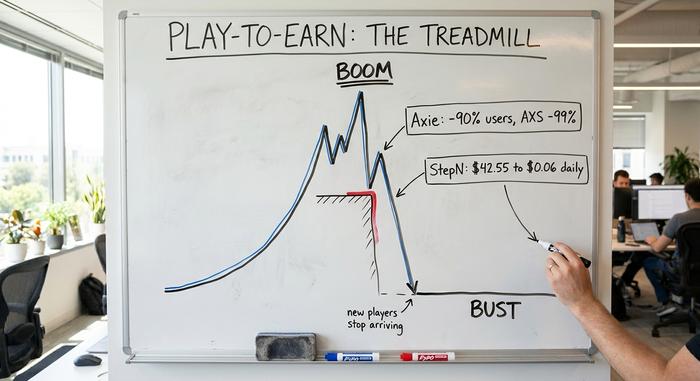
Play-to-earn is gamification stripped to its core, and its failures aren't bad luck. They're designed in. When the reward is a token whose price needs fresh buyers to hold up, you have built a treadmill. Fast user growth keeps it spinning. The day that growth slows, it stops, and everyone still standing on it gets thrown off.
Axie Infinity, the cautionary classic
Everyone cites Axie because it ran the whole arc in public. Its whitepaper records a peak of 2.78 million daily active users in January 2022, per the project's own history. People borrowed money just to afford the creatures you needed to start playing. Sit with that for a second. Then the new players stopped arriving, the reward token had nowhere to go but down, and Axie shed roughly 90% of its users while AXS fell about 99%. A $600 million hack of its Ronin bridge that same year turned a bad story into a brutal one.
StepN and move-to-earn
StepN ran the identical script, only faster. Walk, run, earn tokens. It hit 700,000 monthly users and booked $122 million in a single quarter of 2022. Then the math arrived. CoinGecko's earnings data shows daily income sliding from $42.55 at the top to $0.06 by 2023. That is a 99.9% drop, and it came from the same place it always does: the tokens were printed far faster than anyone actually wanted them.
| Project | Peak | After the bust |
|---|---|---|
| Axie Infinity | 2.78M daily users (Jan 2022) | ~90% drop; AXS down 99% |
| StepN | $42.55 daily earnings (May 2022) | $0.06 by 2023 (down 99.9%) |
The lesson writes itself. When the only reason to show up is the payout, and the payout depends on the next person buying in, there is a date stamped on the whole thing. You just cannot read it yet.
Tap-to-Earn and Airdrop Farming in Crypto
The 2024 wave tried to lower the stakes. Tap-to-earn games on Telegram asked for almost nothing: tap a screen, earn points, wait for an airdrop. Notcoin was the breakout. The Block reported its May 2024 launch handed more than 80 billion tokens to 35 million players and generated over $1 billion in trading volume within hours. Hamster Kombat claimed around 300 million users, though that figure is self-reported and never independently confirmed.
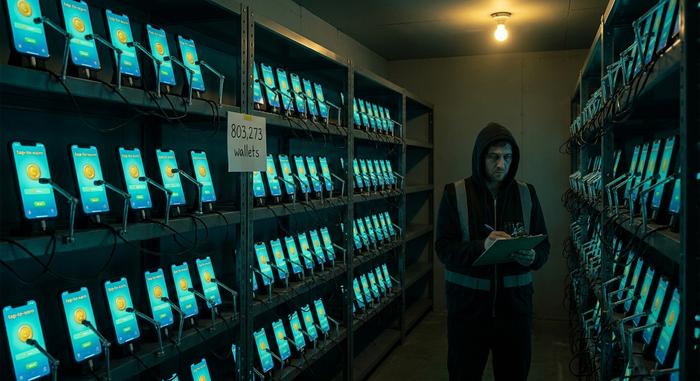
The catch is the same distortion in a new costume. When you reward raw activity with a future token, you attract bots, not fans. Airdrop farming has industrialized to the point where filtering it out is a major project on its own. LayerZero publicly removed 803,273 wallets from its airdrop, 59% of all applicants, after identifying them as sybil farmers gaming the system. Points programs have replaced one-time snapshots, but they have not solved the underlying problem of gamification in crypto: pay people in tokens for clicks and many of the clicks will be fake.
Gamified Crypto Exchanges and Trading Apps
None of this is limited to games. The biggest exchanges run the same playbook to pump trading volume and stop users wandering off to a rival. Bybit's World Series of Trading pulled in around 77,000 participants and something like $100 billion in volume in its 2024 run. Binance has its seasonal campaigns, its quizzes, its loyalty points you can swap for vouchers. KuCoin went and built a Telegram mini-game where you feed a cartoon character to earn rewards. Yes, really.
The upside is genuine: more engagement, an easier first step for the nervous newcomer. The catch is right underneath it. An app that feels like a game will quietly push you to trade more than you meant to, hunting streaks and a leaderboard spot instead of asking whether the trade is smart. That extra churn suits the exchange. The trader often just pays more fees for worse results.
Learn-and-earn is the rare version I actually like. Coinbase used to hand you a few dollars of a token for watching a short lesson and passing a quiz, which is gamification doing something useful for once: teaching you what a coin is before you buy it. And yet Coinbase quietly closed that program in May 2025. Even the good versions only live as long as they serve the house.
NFTs, Ownership, and Digital Collectibles
NFTs add the one genuinely new lever crypto brings to gamification: verifiable ownership. A badge you actually own, and can sell, lands differently than a points balance the platform can wipe out. Upland turned real-world addresses into tradable property NFTs and reached a $300 million valuation in 2021, and it's still running in 2026. The Sandbox built a whole virtual world around owned land and its SAND token. The appeal here is obvious. The caveat is blunt: ownership only means something if the digital asset holds value, and most of these digital assets do not.
The mechanic that does survive is collecting itself. Players will chase a rare creature, a numbered land plot, or a limited badge for the same reason people always have, the pull of owning something scarce. Add a marketplace where they can trade it and the loop sustains itself. Strip out the speculation, and that collecting instinct is one of the few gamified hooks with real staying power.
Security, Gambling, and Regulatory Risks
This is the part the marketing pages skip, and it matters most. Three risks stand out.
The first is gambling by design. Variable rewards, loss-chasing, and the thrill of a surprise drop are the same psychological hooks slot machines use. Regulators and researchers in Australia and Europe have started comparing gamified crypto trading to gambling, and the comparison is not a stretch when the app is engineered to keep you pulling the lever.
The second is security. Every gamified flow adds buttons, integrations, and incentives, which means more attack surface. Big reward pools become honeypots, and the $600 million Ronin bridge hack showed how much can be drained when a popular game holds real value.
The third is regulation, and it's barely keeping up. ChainPlay's review found that under 1% of GameFi projects meet any recognized regulatory framework. Token rewards can quietly cross the line into securities or gambling law depending on how they are structured, and the bot-farming problem raises basic questions about integrity. The rules are coming. Most projects are not ready.
Is Gamification Good for Crypto Adoption?
It depends on what the mechanic is rewarding. A quest that walks a beginner through their first swap, or a quiz that explains what a token even is, lowers the barrier and brings real people into the crypto ecosystem. That is gamification earning its keep. A mechanic that just dangles a token to harvest your attention is a sugar high, and sugar highs end the way they always do.
Same tool, opposite results. I am convinced the engagement is real, because the DappRadar numbers are hard to wave away. I am far less convinced most of it does the user any long-term good. There is a simple test, and I keep coming back to it: does the mechanic still make sense the day the reward stops paying out? If the answer is no, you were never the player. You were the product.
The Bottom Line on Gamification in Crypto
Treat any "earn while you play, tap, or trade" pitch as a marketing mechanic first and an income source last. Before you join, ask two plain questions: who is paying the reward, and what happens when new users stop arriving? If the answer to the second is "the rewards collapse," you already know how the story ends. Gamification can make crypto easier to learn and more pleasant to use. It can also dress up a treadmill as a game. The difference is worth your attention, because nobody running the leaderboard will point it out for you.