GameFi in 2026: what survived, what died, and where blockchain gaming is actually going
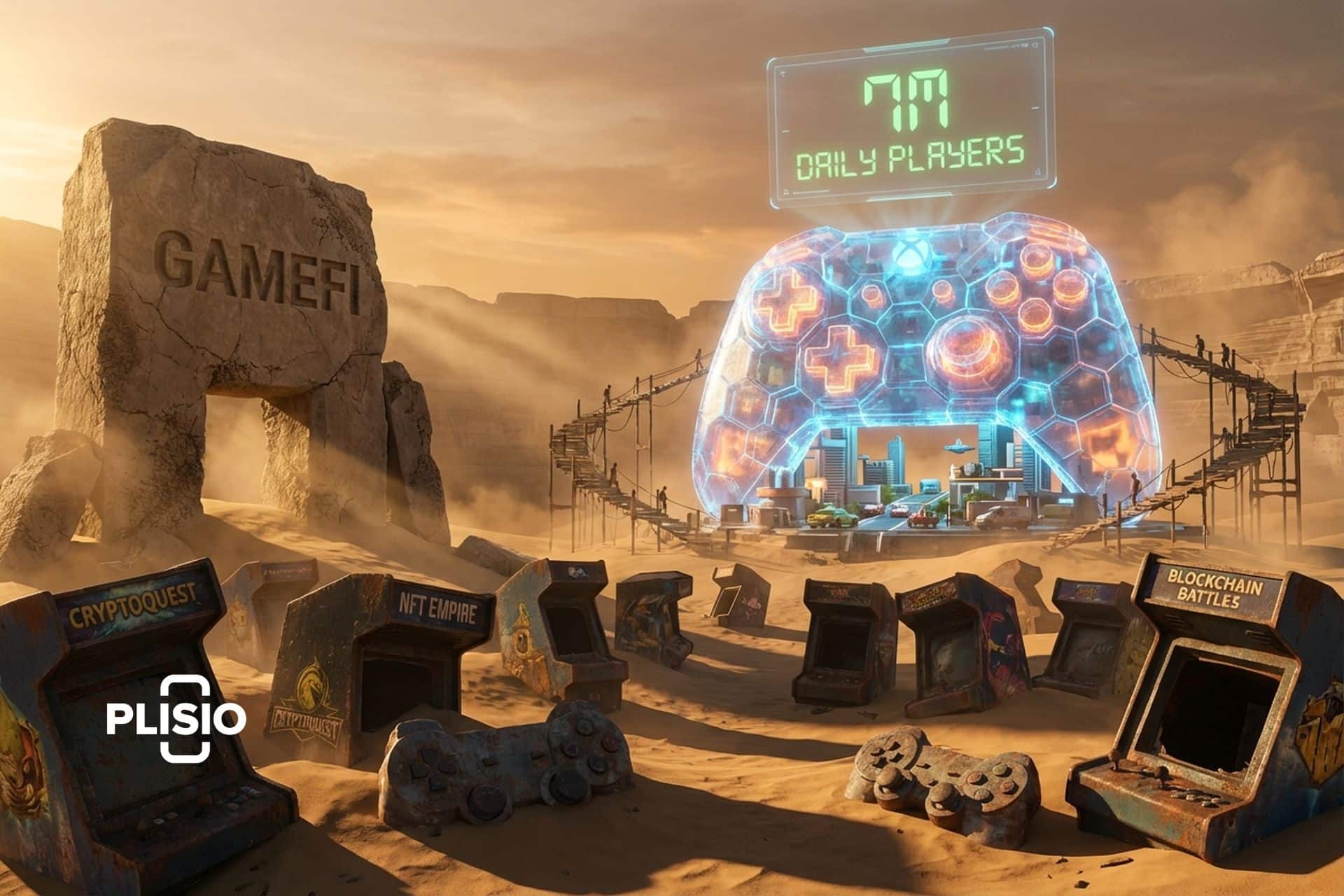
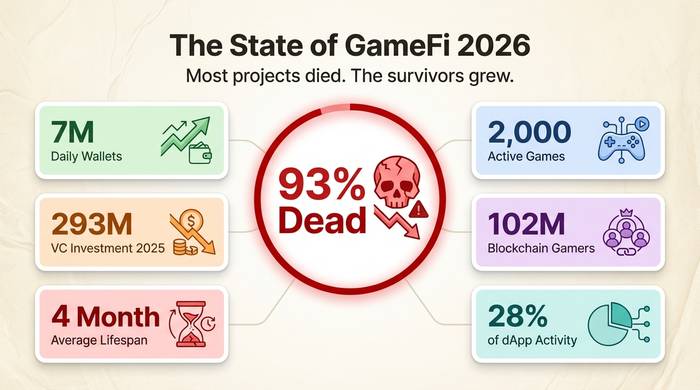
93% of all Web3 gaming projects are dead. That number comes from ChainPlay's December 2024 report and nobody seriously disputes it. The average blockchain game lasted four months. Over 300 gaming dApps shut down in Q2 2025 alone. The graveyard includes projects that raised millions: Ember Sword, Nyan Heroes, Blast Royale, Rumble Kong League.
And yet. Seven million people opened blockchain gaming wallets every day in early 2026. Gaming accounted for 27.9% of all dApp activity in October 2025, the highest share of any category. The market is projected at $29.9 billion in 2026. Axie Infinity, left for dead after its $620 million hack and 90% price crash, saw its token rally 200% in January 2026.
GameFi is not dead. But the version of it that most people remember, the play-to-earn gold rush of 2021, is. What replaced it is smaller, quieter, and possibly more durable. This article breaks down the current state of blockchain gaming: what works, what failed, which games and chains matter, and whether any of this will eventually reach the 3.48 billion people who play traditional games.
What is GameFi and why did it blow up?
Take a game. Put the items on a blockchain. Now your sword is an NFT. Your character skin has a market price. Your virtual land parcel can be sold on OpenSea. That is GameFi. Instead of a company owning everything in the game (and deleting it whenever they want), the player owns the assets.
In 2021, a game called Axie Infinity proved you could earn real money doing this. People in the Philippines quit their day jobs to breed digital creatures and battle them. $9.5 billion market cap. 2.7 million daily players. StepN came along and said you could earn crypto by walking. Sneaker NFTs hit $1,400.
Then reality arrived. These games paid players in tokens they printed from nothing. New players' money funded old players' earnings. When new signups slowed down, the tokens crashed. $50 a day became $0.50. Axie's earning token SLP fell below a penny. StepN sneakers dropped to $90. The late arrivals, usually the poorest players in the poorest countries, lost the most. By 2023, telling someone your project was "play to earn" was like admitting you were running a Ponzi scheme with extra steps.
What survived had to be different.
The state of GameFi in 2026: the numbers
| Metric | Value |
|---|---|
| GameFi market size (2026) | ~$29.9 billion |
| Projected market (2035) | $259 billion (CAGR 27%) |
| Daily active wallets (early 2026) | 7 million+ |
| Daily active wallets (Q3 2025) | 4.66 million |
| Total blockchain gamers (2025) | ~102 million |
| Total gamers worldwide | 3.48 billion (2.9% blockchain penetration) |
| Active blockchain games | ~2,000 |
| Defunct blockchain games | 93% of all ever launched |
| Gaming share of dApp activity | 27.9% (Oct 2025 peak) |
| Daily gaming transactions (Q1 2026) | 18 million+ |
| VC investment in web3 gaming (2025) | $293 million (down from $1.8B in 2024) |
| Average blockchain game lifespan | 4 months |
| 30-day player retention | ~12% (vs 25% traditional mobile) |
The numbers tell two stories at once. Seven million daily wallets is real adoption by crypto standards. 102 million blockchain gamers is a big number. But set against 3.48 billion total gamers, blockchain has reached 2.9% of the market. Retention at 12% is half what traditional mobile games achieve. And VC money collapsed from $1.8 billion in 2024 to $293 million in 2025. Investors stopped writing checks because most of their previous bets died.
Games that actually survived
Most blockchain games failed. These are the ones that did not.
World of Dypians on opBNB quietly became the most-played blockchain game with 3.7 million monthly on-chain players. An MMO metaverse that built steadily without the hype cycle most GameFi projects relied on.
Pixels on Ronin hit 1 million DAU at peak and settled around 180,000 steady daily players. The team shifted focus in 2025 from raw daily active addresses (easily farmed) to daily active usage quality, a sign that the industry learned from airdrop gaming.
Axie Infinity refused to die. After the $620 million Ronin bridge hack in March 2022 and the SLP token collapsing below a penny, the team rebuilt. Q3 2025 saw a 55% jump in daily active wallets. In January 2026, AXS rallied 200% after the Bonded AXS Token launch and a decision to halt SLP emissions in Origins, cutting daily token inflation by 30%. Ronin is planning a "Homecoming" migration to become an Ethereum L2 by mid-2026.
Off The Grid is the first AAA blockchain game that a regular gamer might actually play. A battle royale directed by Neill Blomkamp (District 9), available on Steam, Epic Games Store, PS5, Xbox, and GeForce Now. It runs on Avalanche but never forces blockchain terminology on the player. You can play it like a normal shooter and never know there is a blockchain underneath.
Gods Unchained and Splinterlands survived by being good card games first and crypto projects second. Gods Unchained on Immutable X has been running since 2019. Splinterlands on Hive since 2018. Both proved that a game with actual gameplay loop can outlast multiple market cycles.
Which chains run gaming?
| Chain | Games | Strength | Key game |
|---|---|---|---|
| Polygon | 480+ | Largest game count and TVL ($972M) | Multiple mid-tier titles |
| Immutable X / zkEVM | 680+ titles | Fastest-growing, 180 added in 2025 | Gods Unchained, Illuvium |
| Ronin | 20+ | Purpose-built for gaming | Axie Infinity, Pixels |
| opBNB | Growing | 1.05M daily wallets | World of Dypians |
| Sui | ~70 in development | 81.7x DAU growth in 2024 | SuiPlay0X1 hardware console |
| Solana | Growing | 340% YoY gaming DAU increase | Star Atlas |
| Avalanche | Growing | AAA credibility | Off The Grid |
| WAX | Established | 687M transactions in Q3 2025 | Alien Worlds |
Immutable is making the biggest bet. Over 680 titles in its ecosystem. The merger of Immutable X and Immutable zkEVM creates a gaming-focused L2 with zero gas fees for players. GameStop partnered with Immutable. Razer integrated. Major studios are building there because Immutable handles the blockchain complexity and lets developers focus on the game.
Ronin stays relevant because of Axie and Pixels. It is a sidechain purpose-built for gaming transactions: fast, cheap, and tailored. The Ethereum L2 migration planned for mid-2026 could give Ronin access to Ethereum's security and liquidity while keeping its gaming performance.
Sui is the dark horse. 81.7x growth in gaming DAU during 2024. 52 million NFTs minted. They even announced SuiPlay0X1, a gaming hardware console running on the Sui blockchain. Whether a blockchain gaming console has a market is debatable, but nobody else in the industry is trying it.
From play-to-earn to play-and-earn: what changed
Three phases. Each one killed the previous.
Phase one: play-to-earn. 2021-2022. The game pays you to play. Sounds amazing until the token crashes and the only reason anyone played disappears overnight. P2E games were jobs dressed as entertainment. Most players were not having fun. They were grinding.
Phase two: play-and-earn. 2025-2026. The game has to be fun first. If it is not fun without the tokens, it will not work. Off The Grid is the poster child. You play it because it is a good battle royale. The blockchain is there if you want to trade items. If you do not care, you never see it. That is the model that works.
Phase three: play-to-own. Still emerging. Instead of earning tokens, you own persistent assets that (someday) move between games. Your weapon in one game shows up in another. Cross-game interoperability barely exists in practice. But Immutable's zkEVM, Ronin's standards, and Sui's object model are building the pipes for it.
Lily Liu, President of the Solana Foundation, said something in March 2026 that made people angry: "Gaming on a blockchain is not coming back." She meant P2E. And she was right about that. What is coming is gaming with blockchain under the hood, invisible to the player but real in the property rights it provides.
Is GameFi worth paying attention to?
Depends on what you are looking for.
If you want to earn money playing games, the opportunities are fraction of what they were in 2021. Axie no longer pays people a living wage. StepN walkers earn pocket change. The P2E dream is over for most players.
If you are a gamer who wants to actually own in-game items and potentially sell them, the infrastructure is better than ever. Immutable X has zero gas fees. Ronin settles in seconds. A handful of games have real economies where items trade for real money.
If you are an investor, the sector is in a trough. VC money dried up. Token prices crashed 68% in 2025. But 7 million daily wallets suggest the users have not left, even if the speculators did. The next cycle will bring new games, new funding, and new hype. Whether those games are actually worth playing is the question that determines whether GameFi grows beyond 2.9% of the global gaming market.
The honest answer? GameFi proved that blockchain can work in gaming. It also proved that games have to be good first and crypto second. The projects that understood that survived. The ones that did not are part of the 93%.