ACH Number Meaning: Routing Numbers Explained

You're setting up direct deposit for a new job or paying a bill online, and the form asks for an ACH routing number. If you've never had to fill one in before, the request can stop you cold. The ACH number meaning is straightforward: it's a 9-digit code that identifies your bank on the Automated Clearing House network, the system that moves money between US bank accounts electronically. It is not your account number. It doesn't change from person to person at the same bank. Knowing exactly what it is, where to find it, and when to use it prevents the kind of payment errors that delay deposits by days.
This guide covers what ACH routing numbers are, how they're structured, how they differ from account numbers and wire transfer codes, and what to do when ACH doesn't work at all.
What Is an ACH Number?
ACH stands for Automated Clearing House, the US electronic payment network that processes direct deposits, bill payments, and bank-to-bank transfers. The ACH number is a 9-digit bank routing number assigned to each financial institution by the American Bankers Association, a system dating back to 1910. Understanding the ach number meaning matters most when setting up payroll, making ACH payments, or authorizing recurring debits.
Every digit in that 9-digit string has a specific function:
- Digits 1–2: Identify the Federal Reserve district where the bank's main office is located
- Digits 3–4: Indicate the specific Federal Reserve processing center
- Digits 5–8: The bank's unique identifier within its Federal Reserve district
- Digit 9: A check digit, calculated mathematically from the first eight digits to catch transcription errors
ACH routing numbers for electronic transfers typically begin with digits in the 61–72 range. Traditional ABA paper check routing numbers start with 01–12. Most banks use the same number for both, though some large institutions keep them separate.
The number identifies your bank, not you. Every customer at Chase's New York branch shares the same routing number. It tells the ACH network where to send money; the account number tells it who gets it.
ACH Number vs. Account Number
These two numbers appear together on every check and every direct deposit form, which is why they get confused. They serve completely different purposes.
The routing number is your bank's address on the network. The account number is your specific mailbox at that address. You need both to send or receive an ACH payment, and one without the other won't work.
| Feature | ACH Routing Number | Account Number |
|---|---|---|
| Length | Always 9 digits | 8–17 digits (varies by bank) |
| Unique to | The bank or branch | Your individual account |
| Shared by | All customers at that bank | Only you |
| Purpose | Identifies the financial institution | Identifies your specific account |
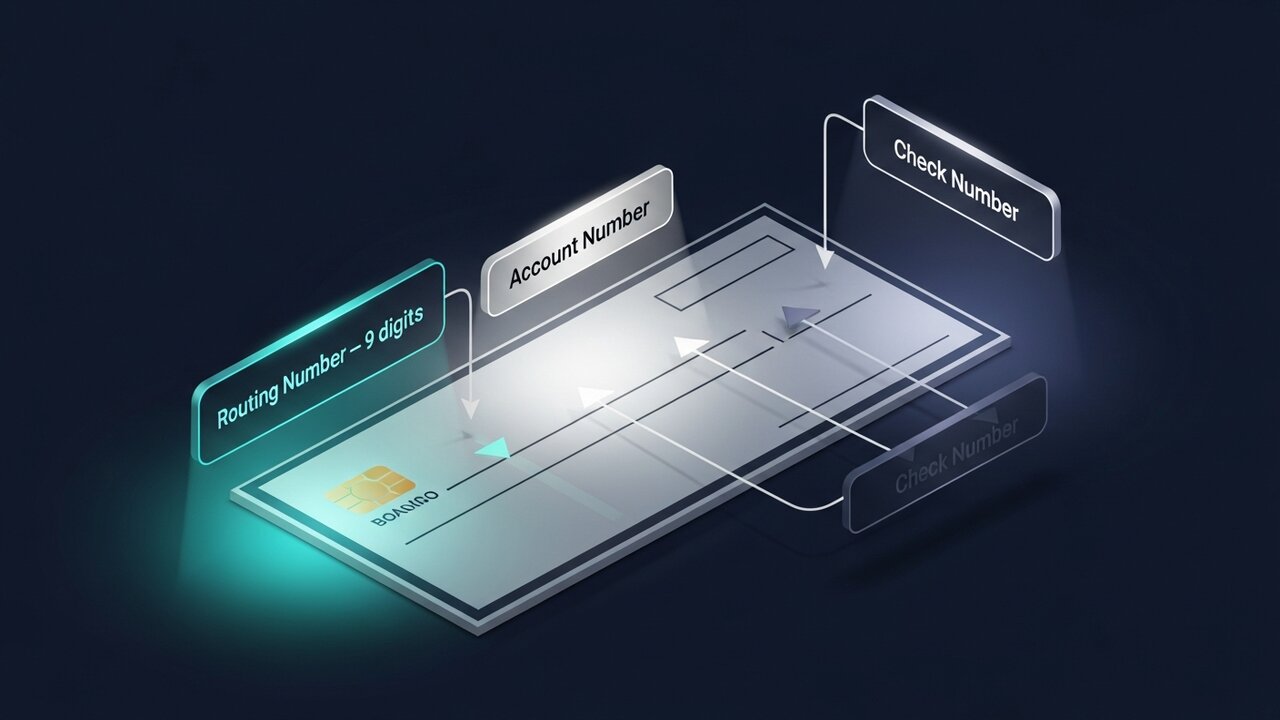
| Location on check | Bottom-left | Center-bottom |
| Changes when? | Bank merges or restructures | You open a new account |
On a paper check, the routing number is always the first number in the bottom-left corner, before the account number. They're separated by a special symbol (⑆). Count from left to right: the first nine digits are the routing number.
ABA Routing Number vs. ACH Routing Number
The terms get used interchangeably, and most of the time that works fine. There's a technical distinction worth knowing, though, and when you're comparing ach vs aba, the difference comes down to what type of transaction each number was designed for.
The ABA routing number was created in 1910 for processing paper checks. The ACH routing number is the electronic variant used for transactions on the ACH network. For most US banks, including community banks and credit unions, these are the same 9-digit number. If your bank only lists one routing number, that single ABA routing number doubles as the ACH routing number.
Large banks are where it gets complicated. Bank of America uses 021000322 for ACH electronic payments but 026009593 for domestic wire transfers. Wells Fargo maintains different ABA routing numbers depending on the transaction type and sometimes the state where the account was opened. For an ach vs aba comparison at a major institution, always ask which number applies specifically to electronic ACH transfers.
Practical rule: when a form asks for a routing number for direct deposit, payroll, or online bill pay, use the ACH routing number. For a wire transfer, confirm the wire-specific ABA routing number with your bank separately. This ach vs aba distinction is one of the most common sources of misdirected transfers at large institutions.
What Are ACH Routing Numbers Used For?
The ACH network is the backbone of everyday US payment processing. The network handled 8.5 billion ACH payments in Q1 2025 alone. Your ACH routing number is needed for:
- Direct deposit — employers deposit payroll directly into employee accounts; government agencies use the same path for benefits and tax refunds
- Online bill payment — utilities, mortgage lenders, and subscription services pull payments from your account on a set schedule
- Person-to-person bank transfers — moving money between accounts at different banks
- Business ACH payments — companies paying vendors, contractors, or suppliers via ACH batch processing
- Recurring ACH debits — any automatic payment you've authorized, from gym memberships to insurance premiums
- IRS refunds — the fastest way to receive a tax refund is via ACH direct deposit
Each of these is an ACH transaction that requires both a bank routing number and an account number to complete. One hard limit applies to all of them: ACH is a US-only network. Routing numbers mean nothing outside the United States. Sending money internationally requires a different system entirely — SWIFT codes for wire transfers, IBANs in Europe, or alternative payment rails.
How to Find Your ACH Routing Number
To find ach routing number details specific to your account, five methods work reliably:
- Check the bottom of a paper check — the 9-digit number in the bottom-left corner, before your account number, is the bank routing number. It's the most accurate source because it's printed for your specific account type.
- Log into online banking — most banks display the routing number under account details or settings. Look for "routing" or "ABA" in the label.
- Check your bank's official website — routing numbers are usually in the FAQ or help center. Large banks list multiple numbers by state, so confirm you're looking at the right region.
- Call customer service — if you're unsure which routing number applies to your transaction type, calling is the safest option. Representatives confirm the correct number for ACH vs. wire.
- Use the ABA's official lookup tool — the American Bankers Association operates a public bank routing number directory at routingnumbers.aba.com. This is also the most reliable way to find ach routing number data after a bank merger or acquisition.
If your bank went through a merger recently, the routing number may have changed. When in doubt about how to find ach routing number details post-merger, call the bank before submitting any direct deposit form.
ACH Number vs. Wire Transfer Routing Number
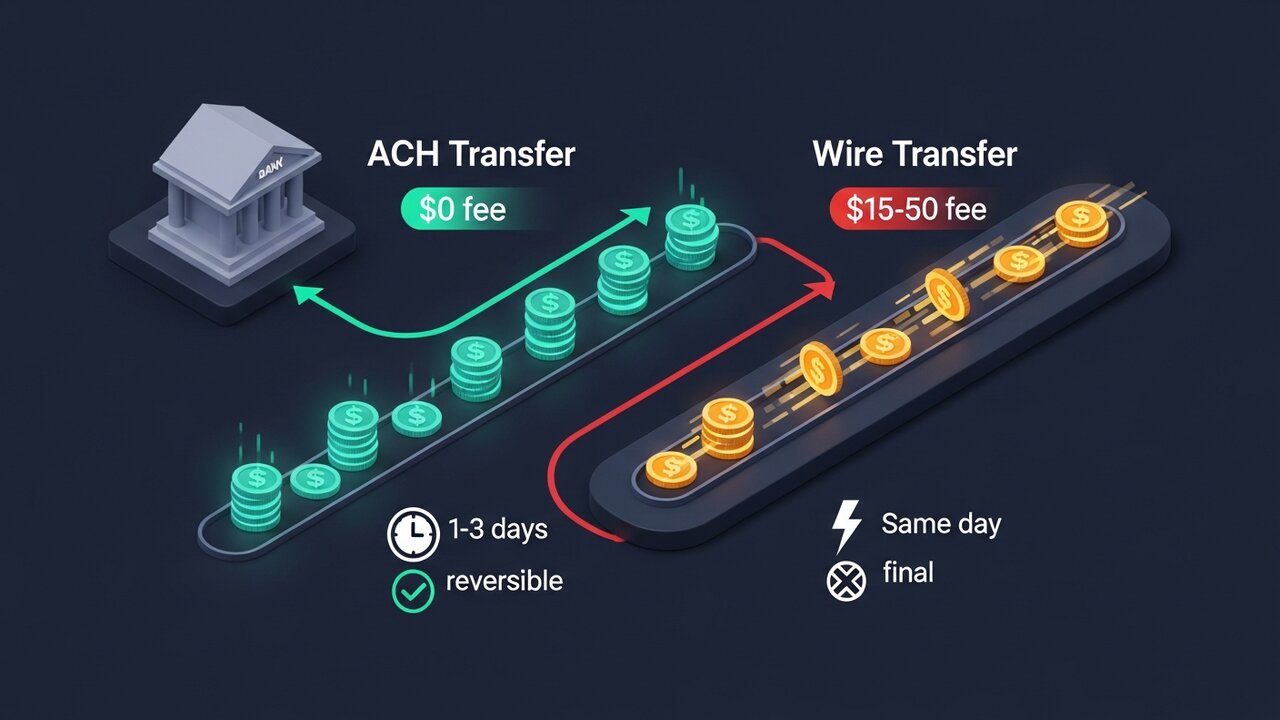
ACH transfers and wire transfers both move money between bank accounts, but they run on different networks with different speeds, costs, and rules. At some banks they use different routing numbers entirely.
Speed versus cost is the central trade-off. ACH is slower and cheaper. Wires get there the same day but at a price.
| Factor | ACH Transfer | Wire Transfer |
|---|---|---|
| Speed | 1–3 business days (same-day ACH available) | Same day (domestic) |
| Cost | Free or $1–$5 | $15–$50 per transfer |
| Reversible | Yes, within a window | No — final once sent |
| International | US only | Yes |
| Routing number | ACH routing number | Wire routing number (may differ) |
| Best for | Payroll, bills, recurring payments | Large one-time transfers, time-sensitive funds |
For payroll or automatic bill pay, ACH is the default. For closing on a house or funding something that has to land today, wire transfer is the right tool — but confirm the wire routing number with your bank separately, since it may differ from the ACH routing number.
Common Mistakes When Using ACH Numbers
Most ACH payment failures trace back to a handful of predictable errors. Getting familiar with them saves the 1–3 day wait while a rejected ACH transaction makes its way back.
- Using the wire routing number for an ACH transaction — at banks with separate numbers, this causes a routing failure or sends money to the wrong processing queue
- Transposing routing and account numbers — putting the account number where the routing number goes; the length difference (9 vs. 8–17 digits) sometimes catches this, but not always
- Using an outdated routing number after a merger — banks that have merged often maintain old numbers temporarily before retiring them; check what's current if your bank has changed hands
- Assuming one routing number covers the whole bank — Wells Fargo alone has more than a dozen, organized by state; using the California number for a Texas account fails
- Getting the check digit wrong — digit 9 is a mathematical check on the first eight; a single transcription error should trigger a validation flag, but only if the receiving system checks it
When an ACH transaction fails because of a wrong routing number, funds typically return within 1–2 business days. The rejection generates a return code that tells you what went wrong. Most failed ACH payments are correctable — catching the error before you resubmit is the key step.
ACH Payments and International Transfers
ACH payments only work within the United States. Sending money to someone in another country, or receiving payment from a customer abroad, puts you outside what ACH can handle. Your bank routing number is irrelevant to those transactions.
Traditional international options are SWIFT wire transfers (using SWIFT codes and IBANs) or consumer services like Wise and PayPal that route through local payment networks. Neither is free. SWIFT wires typically run $20–$50 per transfer plus a currency conversion spread, and even "fee-free" services build their margin into the exchange rate.
Crypto payments sidestep the routing number and payment processing infrastructure entirely. No ACH number, no SWIFT code, no IBAN — just a wallet address. Settlement takes minutes rather than days, and fees are a fraction of wire costs.
For businesses receiving cross-border payments regularly, Plisio offers a practical path in: accept Bitcoin, Ethereum, USDT, USDC, and 20+ other digital assets at checkout with transaction fees starting at 0.5% and no chargeback exposure.
Conclusion
The ACH number meaning comes down to one function: identifying your bank on the US electronic payment network. Nine digits, same for every customer at your institution, telling the system where to route direct deposits, bill payments, and transfers while your account number handles the rest.
For everyday US banking, the bank routing number is something you set up once and rarely revisit. It matters most in high-stakes moments: first payroll direct deposit, a new recurring payment, a tax refund that needs somewhere to land. Get the digits right, confirm you're using the ACH routing number rather than a wire code, and verify after any bank merger.
When ACH transactions aren't an option — international payments, cross-border business, anything that can't wait the standard 1–3 days — wire transfers or crypto payment networks fill the gap. For any business processing payments across borders, that ach number meaning hits a hard limit, and the alternatives start looking a lot more practical.