Best Cryptocurrency Portfolio Trackers: Top Crypto Tracker Apps 2026

The first wave of IRS Form 1099-DA notices landed in mailboxes in January 2026, and most crypto investors received something they had never seen before: a third-party report of every digital asset sale they made in 2025. That changes how you should think about the best cryptocurrency portfolio trackers and which one belongs on your phone this year. It used to be a watchlist with a profit-and-loss screen. It is now closer to your accounting software, your tax engine, and your audit trail rolled into one application. Pick the wrong one this year and you either overpay tax, underreport income, or hand a SaaS company API keys to wallets that hold real money.
This guide to the best crypto portfolio trackers is built around the 2026 reality: per-wallet cost basis is mandatory in the US, MiCA grandfathering ends July 1 for European service providers, and Lazarus Group has now hit tracker infrastructure twice in 24 months. I will walk through how to manage your crypto with CoinTracker, Koinly, CoinStats, CoinLedger, Kubera, Delta, the free aggregators, the privacy-first stack, and a single comparison table that pulls all the meaningful differences into one screen. Whether you need a free crypto portfolio tracker for a small holding or a portfolio management tool that handles thousands of crypto transactions a year, the recommendation depends on three axes: tax reporting, DeFi coverage, and privacy. Sources for pricing, user counts, and integrations come from each tracker's published documentation and from Coinbase, Chainalysis, the IRS, and ESMA where relevant.
What a crypto portfolio tracker does in 2026
A crypto portfolio tracker is a portfolio app or web platform that pulls your transaction history and balances from every wallet tracker, crypto exchange, and chain you use, normalises the data in real-time, and shows it in a single dashboard with prices in your local currency. That was roughly the description in 2020. In 2026 the bar has moved, and a serious crypto investor needs a tool that crosses into portfolio management territory.
A modern tracker for crypto now does five things that matter. It connects via read-only API keys to centralized exchanges. It reads your self-custody wallets through public addresses, so it can show NFTs, digital assets, and DeFi positions without holding any custody. It tags every crypto transaction automatically as a buy, sell, swap, transfer, staking reward, airdrop, or fork event. It runs portfolio analytics, calculates realised and unrealised crypto gains using the cost-basis method your jurisdiction requires, and reports your entire crypto portfolio value with price alerts on key moves. And it exports the result as a crypto tax report something a tax authority will accept, usually a Form 8949 in the United States or a country-specific schedule for tax reporting in Europe.
The integration count has become the headline marketing number. CoinTracker now lists more than 500 supported exchanges and wallets across 70+ blockchains. Koinly claims 800-plus crypto exchanges covering more than 100 self-custody wallets. CoinStats covers 10,000-plus DeFi protocols and 300 wallets, and tracks yield positions inside the same dashboard. Those numbers are still useful, but they have started to feel like processor specs from the 1990s. Two trackers can both claim "500+ integrations" and still produce wildly different tax outputs because the parsing rules for, say, a Solana DEX trade are a difficult engineering problem and not every tracker has solved it.
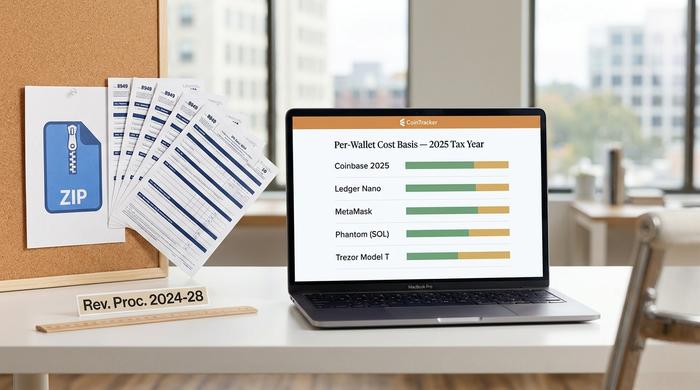
Demystify crypto taxes in 2026: 1099-DA, MiCA, per-wallet basis
Three regulatory changes restructured the tracker market in the past 18 months.
The IRS Form 1099-DA is the headline one. Under final regulations published in 2024, brokers must report gross proceeds for every digital-asset sale from January 1, 2025, with cost-basis reporting added from January 1, 2026. Coinbase, Kraken, Gemini, Binance.US, PayPal, Venmo, Cash App, Robinhood, and OpenSea are among the brokers covered. The first 1099-DA forms went out in January 2026 for the 2025 tax year. For the first time, the IRS has a machine-readable record of your sales, and any mismatch between your filing and the broker form is a flag.
Rev. Proc. 2024-28 took effect on the same date. It requires US taxpayers to track cost basis per wallet, not pooled across an account. That ended the old "universal basis" workflow that many trackers used. CoinTracker rebuilt its core data model around it; CoinLedger now issues a separate Form 8949 per wallet or exchange, packaged as a ZIP of PDFs, from tax year 2025 onward. If your tracker still uses a single pooled-basis report, it is wrong by default.
In Europe, MiCA became fully applicable to crypto-asset service providers on December 30, 2024. National grandfathering for existing providers runs out on July 1, 2026, after which every CASP serving EU users must hold authorisation under the new regime. France, Malta, Luxembourg, and Estonia opted for the full transition window. Trackers themselves are not always CASPs, but the wallets and exchanges they connect to are, and any data they pass to third parties now sits inside the GDPR-and-MiCA perimeter.
CoinTracker: crypto tax software for US filers
CoinTracker is the most institutionally embedded tracker in the US market. It serves about 3 million users, has been Coinbase's official tax partner for five consecutive years, and is the only major tracker that publicly carries both SOC 1 and SOC 2 Type II certifications according to its security page. For the 2025 tax year, Coinbase routed more than a million of its users through CoinTracker for filing support.
The product covers 500-plus exchanges and wallets across more than 70 blockchains. Pricing has four tiers in 2026: a free portfolio view, Base at $29 per year, Prime at $99 per year, and Ultra at $599 per year for high-volume traders. Tax reports unlock at the paid tiers. The Ultra plan adds dedicated support and bulk reconciliation tools, which matters if you have thousands of DeFi transactions and need a human to sign off before filing.
What makes CoinTracker the default pick for US filers is not any single feature. It is the depth of compliance work. The product re-architected for per-wallet cost basis ahead of Rev. Proc. 2024-28, integrated directly with the 1099-DA workflow, and made loss-harvesting projections part of the standard report. If you live in the US, file your own taxes, and want the fewest surprises in April, this is the cleanest option.
The trade-offs. Outside the US the product is competent but less optimised. Some DeFi protocols still require manual tagging of crypto transactions. The Ultra tier price is a real number that smaller traders will not justify. iOS and Android apps mirror the web product, and tax-season turnaround on the paid plans is fast even with high transaction counts.
Koinly: the best portfolio tracker for global tax reporting
Koinly is the international counterpart. It supports tax reports for more than 100 countries, with native templates for the IRS Form 8949 and Schedule D, the Australian myTax format, and most major European jurisdictions. The user base passed 1.5 million in late 2025 according to publicly disclosed figures.
Coverage is the strongest in the market for breadth. Koinly lists 800-plus exchange integrations and more than 100 self-custody wallets, including L1 chains, L2 rollups, and the major Solana DEX aggregators. The free tier lets you import up to 10,000 transactions and view your portfolio; you can preview a tax report but cannot download it without a paid plan. Paid plans run from $49 for a Newbie up to $199 for a 10,000-transaction Trader.
Two things make Koinly the strongest non-US choice. First, the jurisdiction templates are reviewed annually by local tax professionals, not auto-generated. Second, the free version is genuinely usable as a long-term holdings dashboard if you never need a downloadable report — a rare free option in this category. Koinly's tracking app for iOS and Android also covers harvest losses for tax purposes by default, which helps active crypto investors smooth the year-end bill. The trade-off is that the SOC 2 attestation status is not publicly published on Koinly's site as of May 2026; the company claims bank-level security but does not list a third-party audit report.
CoinStats: the best crypto portfolio tracker for DeFi users
CoinStats is the strongest DeFi-first tracker, supporting more than 10,000 DeFi protocols, 300 wallets and exchanges, and 70 blockchains. The user base sits around 1.2 million. Pricing is free for a basic view, $13.99 per month for Premium, and $63 per month for the Degen tier aimed at active on-chain traders.
The reason to consider it is depth on the on-chain side. If your cryptocurrency holdings include Aave positions, Uniswap LP tokens, GMX trades, Solana memecoin trades, and a few NFT mints, CoinStats will surface most of your crypto holdings without manual tagging. The interface is the most visually polished of any tracker in this category, the real-time portfolio data updates per block, and the AI-driven exit-strategy and yield-tracking modules are popular crypto management tools for active traders who want analytics and the latest crypto news in one place.
The caveat is real and worth taking seriously. In July 2024 CoinStats disclosed that approximately 1,590 of its hosted wallets had been drained by attackers investigators attributed to North Korea's Lazarus Group, with losses exceeding $2 million. The breach involved a socially-engineered employee and a compromise of the company's HashiCorp Vault deployment. CoinStats rebuilt its AWS environment in response and the read-only tracker side was never directly affected, but if you use CoinStats's hosted wallet product alongside the tracker, treat that as a custodial decision and size accordingly.
CoinLedger, Kubera, Delta: cryptocurrency portfolio tracker apps
CoinLedger is the second-strongest tax-focused option after CoinTracker, with 500,000-plus users and a 4.6 Trustpilot rating on more than 1,200 reviews. Pricing runs $49 for 100 transactions, $99 for the 1,500-transaction DeFi tier, and $199 for the unlimited Investor plan. From the 2025 tax year, CoinLedger now issues a separate Form 8949 per wallet or exchange, packaged as a ZIP of PDFs, to comply with Rev. Proc. 2024-28.
Kubera takes a different angle. At $249 per year, it is a multi-asset net-worth tracker rather than a tax tool. It aggregates more than 20,000 banks and brokerages via Plaid, Yodlee, and Salt Edge, plus crypto on Ethereum, Bitcoin, Solana, Polygon, Avalanche, and Cosmos, and NFTs via OpenSea. The beneficiary feature, which lets you designate access to your accounts if you become incapacitated, is unique among trackers and aimed squarely at high-net-worth users.
Delta sits in the multi-asset middle. eToro acquired it in 2019 and continues to develop it. It tracks 300-plus exchanges and brokers and 7,000-plus altcoins along with stocks and ETFs. The free plan is the most polished consumer mobile interface in the category — a leading crypto tracker for casual users — and the iOS app and Android app share parity. The Pro tier at $99 per year unlocks unlimited connections. Delta is not a tax engine; if that is your primary need, look elsewhere.

Free options: CoinMarketCap, CoinGecko, Crypto Pro
The free aggregators occupy a smaller-but-useful niche. CoinMarketCap Portfolio supports more than 11,000 cryptocurrencies and is free with no paywall, but every transaction is entered manually. CoinGecko Portfolio covers more than 18,000 coins plus NFTs with the same manual-entry model and supports multiple portfolios, alerts, and watchlists. Both work well for holdings overviews and for traders who do not need exchange auto-sync. Neither produces a tax report.
Crypto Pro is the iOS and macOS option, with Apple Watch support and a Premium tier at $7.99 per month. It supports 90+ exchanges and 180+ wallets, but its real differentiator is that all data is encrypted locally on the device with nothing stored on third-party servers. For Apple-ecosystem users who care about not handing API keys to a SaaS, it is the cleanest commercial option.
Privacy-first and self-hosted: Rotki and the local-only stack
Every SaaS tracker discussed above ingests your API keys, KYC data where required, and complete transaction history into a multi-tenant cloud environment. That is normal in 2026 but it is not the only model. Rotki is an AGPLv3-licensed open-source tracker that runs entirely on your own hardware, with all portfolio data encrypted locally. The company changed its pricing model in October 2025: the free tier stayed, while the paid plan became Basic at €25 per month (VAT included). You can deploy Rotki via Docker, Umbrel, or pre-packaged binaries.
The privacy case is not abstract. The June 2023 Atomic Wallet breach saw more than $100 million stolen from approximately 5,500 wallets, attributed by Elliptic to Lazarus Group. The June 2024 CoinStats incident, also attributed to Lazarus, drained $2 million from 1,590 hosted wallets. North Korean state actors are actively targeting tracker and wallet infrastructure. If your portfolio is large enough that you would not casually deposit it at a custodial exchange, you should probably not be giving the same exposure surface to a SaaS tracker either.
Tracking crypto: portfolio trackers on the market in 2026
| Tracker | Free tier | Paid from | Exchanges/wallets | Tax reports | DeFi | Privacy posture |
|---|---|---|---|---|---|---|
| CoinTracker | Yes (portfolio only) | $29/yr | 500+ | Form 8949 + ZIP per wallet | Strong | SaaS, SOC 1+2 Type II |
| Koinly | Yes (no download) | $49/yr | 800+ | 100+ country templates | Strong | SaaS, no published SOC 2 |
| CoinStats | Yes | $13.99/mo | 300+ wallets, 10,000+ DeFi | Via CoinLedger partnership | Strongest | SaaS, 2024 Lazarus breach |
| CoinLedger | Free tracking | $49/yr | 500+ | Form 8949 per wallet, ZIP | Yes | SaaS |
| Kubera | $1 trial | $249/yr | 20,000+ accounts (Plaid) | No native tax | Limited | SaaS |
| Delta (eToro) | Yes | $99/yr | 300+ | None | Limited | SaaS |
| CoinGecko Portfolio | Yes | n/a | Manual only | None | Limited | SaaS, lowest data take |
| CoinMarketCap | Yes | n/a | Manual only | None | None | SaaS |
| Crypto Pro | Yes | $7.99/mo | 90+ exchanges, 180+ wallets | None | Limited | Local-only (Apple) |
| Rotki | Yes | €25/mo | Connectors for most majors | Country reports | Yes | Self-hosted, AGPLv3 |
Note: Accointing was retired on January 31, 2024, after Blockpit acquired it from Glassnode. Existing users were migrated to Blockpit or Koinly.
How to choose the best crypto tracker to manage your portfolio
| Profile | Recommended tracker |
|---|---|
| US filer, Coinbase user, wants minimum tax friction | CoinTracker |
| Non-US filer, multi-jurisdiction reporting | Koinly |
| DeFi-heavy active trader, many chains | CoinStats (with caveats) |
| Pure tax prep, smaller transaction count | CoinLedger |
| High net worth, multi-asset, estate planning | Kubera |
| Watchlist + holdings overview, free | CoinGecko Portfolio |
| iOS/Apple ecosystem, privacy-leaning | Crypto Pro |
| Maximum privacy, technically comfortable | Rotki self-hosted |
Conclusion
A portfolio tracker in the 2026 crypto market is a compliance tool first and a dashboard second. The best crypto portfolio tracker for you depends mostly on where you file taxes, how much DeFi exposure you carry, and how you feel about handing API keys to a cloud service. None of these products is perfect, but each one is better than a spreadsheet for anyone trying to track their crypto investments seriously and manage their portfolio across more than a few coins on one exchange.