What Is MOMO Crypto Coin? Price, Risks & How to Buy
Type "momo crypto coin" into a price tracker and you might land on any of at least six different tokens, most of them trading near zero. That is the first problem with MOMO, and it is bigger than the price chart. The token most people are actually looking for is a Solana meme coin that briefly touched a market cap around $25 million in 2025, then handed almost all of it back.
This guide does the boring but useful work first: it sorts out which MOMO is which, because buying the wrong contract is the real way to lose money here. After that we cover the live price and market data, the rise-and-collapse story behind the chart, how to buy the Solana token without getting trapped, and a frank answer to whether any of this is worth your time.
Which MOMO Crypto Coin Do You Actually Mean?
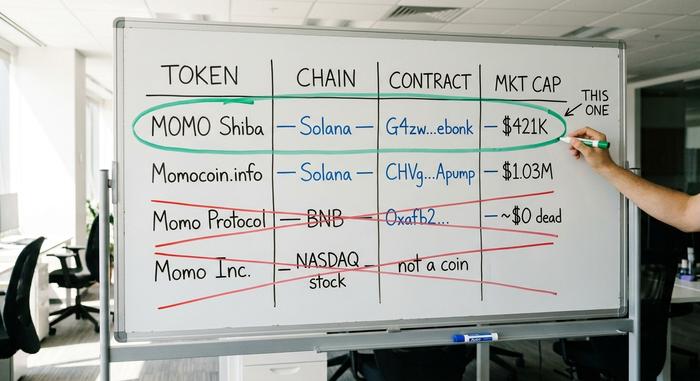
With MOMO, the wild volatility is not even the main hazard. The bigger one is grabbing the wrong token by accident. Several coins use the MOMO ticker across different blockchains, and price trackers routinely mix up their data, so a number you read on one site may describe a completely different asset. Sorting this out takes thirty seconds and it is the most important thirty seconds in this article.
Why do so many MOMO tokens exist in the first place? Because launching one costs almost nothing. On Solana, anyone can mint a token through a launchpad in minutes, pick a catchy name, and hope a community forms around it. Popular names get copied constantly, both by genuine fans and by people hoping a buyer fat-fingers the wrong contract. "MOMO" is short, memorable, and dog-themed, which in meme-coin culture is three reasons to reuse it.
Here is the short version of who is who, with data as of June 2, 2026.
| Token | Chain | Contract (short) | Market cap | Status |
|---|---|---|---|---|
| MOMO "first female Shiba Inu" | Solana | G4zwEA9…ebonk | ~$421K | Live, most searched, MEXC-listed |
| Momocoin.info | Solana | CHVggq5B…Apump | ~$1.03M | Live, higher cap, thinner content |
| Momo Protocol | BNB Chain | 0xafb2…4b02 | ~$0 | Effectively dead, ~$2 daily volume |
| Minor MOMO forks | ETH / Solana | various | < $150K each | Negligible, ignore |
One more source of confusion: Momo Inc. trades on the Nasdaq under the ticker MOMO, but that is a Chinese social and dating app, not a cryptocurrency. If a "MOMO" result shows quarterly earnings and a CEO, you are on the stock, not the coin. Close the tab and start over.
The Solana "first female Shiba Inu" token
When people say "momo crypto coin," they usually mean the Solana token that markets itself as the first female Shiba Inu and a sibling project to BONK. There is no company behind it in any traditional sense. Its main asset is its story and a community that rebuilt the project after early holders moved on. That community matters, because for a meme coin the crowd is the product. Take away the holders posting, trading, and making memes, and there is nothing underneath. No revenue, no users, no protocol generating fees. The BONK association is the closest thing it has to a fundamental, and even that is a marketing link rather than a technical one.
Momocoin.info, Momo Protocol and the long tail
Momocoin.info is a separate Solana token with a higher reported market cap but much less coverage. Momo Protocol on BNB Chain still exists on-chain but barely trades, with daily volume measured in single dollars rather than thousands. A handful of smaller MOMO forks float around on Ethereum and Solana with market caps under $150,000, none of them worth your attention.
The practical lesson is simple: never trust the name alone. Copy the full contract address from a source you trust, then paste that exact string into your wallet or DEX, and confirm it character by character. The name "MOMO" is shared; the contract is unique. This one habit protects you from the most common and most avoidable way to lose money on a meme coin, which is buying a worthless clone that happens to share a ticker with the one you researched.

MOMO Price Today and Live Market Data
The MOMO price today is tiny, and it moves fast, so every figure needs a date stamped on it. The MOMO to USD snapshot below covers the main Solana token, as of June 2, 2026, pulled straight from public market data.
| Metric | Value (June 2, 2026) |
|---|---|
| Price | ~$0.000423 |
| Market cap | ~$421,000 |
| Circulating supply | 994,622,583 MOMO |
| Max supply | 1,000,000,000 MOMO |
| 24-hour trading volume | ~$199K–$685K (sources disagree) |
| All-time high | $0.04081 (Jul 26, 2025) |
| Holders | 10,406 wallets |
| DEX liquidity | ~$86,650 |
A few of these numbers carry the whole story. Start with liquidity: about $86,000. That is the one that matters most, because when a pool is that thin, even a modest sell order drags the chart down with it. The holder count, 10,406 wallets you can see on-chain through Solscan, is real but small. Market cap sits near $421,000, per CoinGecko. Tiny, in other words, which is exactly why the price can swing double digits in a day. The supply line is the one mildly reassuring entry: almost all of it already circulates, so there is no big locked tranche waiting to dump on holders later. And the volume? Over the last 24 hours the trackers could not even agree. CoinGecko and CoinMarketCap posted very different figures for the same day, which is normal once a market gets this small.
From $0.04 to Almost Zero: MOMO Price History
The MOMO chart is a compressed lesson in how meme coins live and die, which is why it is worth reading even if you never buy a single token. The whole cycle played out in under a year.
The 2025 run-up and the BONK halo
MOMO climbed through the first half of 2025 on the back of Solana's meme-coin season and its self-styled link to BONK, one of the chain's better-known community tokens. When BONK and its orbit of related tokens caught a bid, attention spilled over to anything that could plausibly claim a connection, and MOMO positioned itself right in that slipstream. On July 26, 2025 it printed an all-time high of $0.04081, which worked out to a market cap in the tens of millions. For a token with no product, no roadmap worth the name, and no team you could call, that is a remarkable amount of value created out of attention alone. According to CoinGecko's price history, that peak was the high-water mark, and the coin has not come close since. That is the pattern with meme coins tied to a bigger name: they rise faster than the leader on the way up because they are smaller and easier to move, and they fall harder on the way down for exactly the same reason.
The collapse and what "near all-time low" means
From that high, MOMO fell roughly 97.5%. By the time of writing it trades close to its all-time low, which means anyone who bought near the top is sitting on a near-total loss, and anyone buying now is buying a coin that has already round-tripped its entire run. I will be honest: there is something sobering about researching a token on the exact day it is grinding out a new floor. "Near all-time low" is not automatically a bargain. Sometimes it is just the market agreeing on a lower number. The coin can still bounce, but a bounce on a $400,000-cap meme is a trade, not an investment thesis.
How to Buy MOMO Coin on Solana Safely
Buying MOMO is easy. Buying the correct MOMO without getting caught in a low-liquidity trap is the part that takes care. The token lives on Solana, so the flow looks like this:
1. Set up a Solana wallet such as Phantom or Solflare and fund it with SOL.
2. Find the exact contract address from a trusted source and copy it in full.
3. Swap SOL for MOMO on a Solana DEX like Raydium or Meteora, or buy it on a centralized exchange such as MEXC or KCEX.
4. Before you confirm, check the live liquidity. If it is thin, your slippage will be brutal.
There is a real tradeoff between the two routes. A centralized exchange like MEXC supports MOMO trading and handles custody and the swap for you, which is simpler, but you are trusting that platform and you may pay withdrawal fees to move the token out. A DEX like Raydium keeps you in control of your own keys the entire time, but you have to manage slippage yourself and you carry the full risk of pasting a bad contract. For a coin this small, slippage is not a footnote. On a pool holding around $86,000, a trade of even a few thousand dollars can move the price against you by several percent before it fills.
One concrete warning. On at least one MOMO listing, the trading aggregator CoinSwitch flagged that buying was restricted because of low liquidity while selling stayed open, a classic sign of a market you can get into but not easily out of. Always verify that the pool can actually absorb your trade in both directions before you commit funds to any micro-cap asset. And ignore any direct message offering to sell you MOMO "early" or at a discount. Legitimate tokens trade on open markets; private deals in your inbox are how people get drained.
Is MOMO a Good Investment? An Honest Take
Separate two questions that people constantly blur. "Can MOMO bounce?" and "Should you put real money into it?" are not the same question, and the honest answers point in different directions.
On the risk side, the picture is rough. The token carries a CertiK security score of about 3.2 out of 10, as reported by CoinMarketCap citing CertiK. There is no whitepaper, no named team, and no audited roadmap. Liquidity sits near $86,000, the chart shows a 97% drawdown, and the entire narrative rests on a meme — an unusual footing for any digital asset claiming a second life. That is not a portfolio holding. That is a lottery ticket with a logo.
What would a bull case even need? Realistically, three things would have to line up: a fresh exchange listing to bring new buyers, a genuine revival in the BONK-adjacent corner of Solana, and a community willing to rebuild attention from scratch. None of that is impossible in meme-coin land, where dead tokens occasionally come back to life on pure social energy. But hope is not a strategy, and you should size any position here as money you are fully prepared to lose.
It helps to think in base rates. Among speculative cryptocurrencies, the vast majority of meme coins that round-trip a major run never reclaim their highs; they fade into permanent low-volume obscurity, and only a tiny fraction stage a second act. Betting on MOMO is a bet that it lands in that small minority, against long odds, with no fundamental edge to tip them in your favor. That can still be a fun, tiny speculative position. It is not a place to park savings. My read: treat MOMO as entertainment with a small, defined budget, never as a core position.
MOMO Price Prediction: Why Forecasts Mislead
You will find automated price predictions for MOMO promising specific targets years into the future. Treat them as theatre. These pages run the same template across thousands of coins, projecting tidy percentage gains out to 2030, 2040, even 2050. For a token with a $400,000 market cap and $86,000 of liquidity, those models are meaningless, because liquidity and attention, not moving averages, decide what happens next.
The useful news for MOMO will never be a forecast. It will be a concrete event: a new listing, a contract migration, a community update, or a sudden spike in trading volume. Watch for those. Ignore the calculators that tell you a near-dead meme will be up four figures by mid-century. Nobody knows, and the ones pretending to know are filling a page, not doing analysis. The honest forecast for any micro-cap meme coin fits in one line: it will do whatever attention tells it to do, and attention is the one variable no model can predict. If you need a number to justify a position, that is usually a sign you have already talked yourself into the trade. There is also a quieter risk in these forecasts. A confident-looking target gives a dying coin a veneer of analysis it has not earned, and that false comfort is exactly what pulls in the last round of buyers right before liquidity dries up for good.
Storing MOMO and Tracking Its Live Price
If you do hold MOMO, self-custody it. Keep it in a Solana wallet like Phantom or Solflare rather than leaving it on an exchange you do not control. Self-custody matters more than usual here. For a token this illiquid, holding your own keys means you can react the moment liquidity appears, without waiting on an exchange withdrawal queue. For tracking the live price and live charts, stick to sources that actually update in real time: CoinGecko, DexScreener, and GeckoTerminal all pull current on-chain data, and DexScreener in particular shows the live pool so you can watch liquidity yourself. Be skeptical of the wave of near-identical "live MOMO price" clone sites that exist mainly to rank in search; they rarely add anything beyond what the primary trackers already show, and their data can lag.
Final Word on the MOMO Crypto Coin
The most valuable move in this entire article is not a trade. It is the disambiguation step: confirming which MOMO you are looking at before you spend a cent. The token itself is a high-risk Solana meme coin trading near its floor after a 97% fall, with a weak security score and a story for a foundation. It might bounce. It might not. Either way, the open question is the one that decides every meme coin's fate: can a community breathe life back into a coin that has already lived and died once, or is the second act just a slower goodbye?