TikTok Stock: How to Invest in ByteDance in 2026
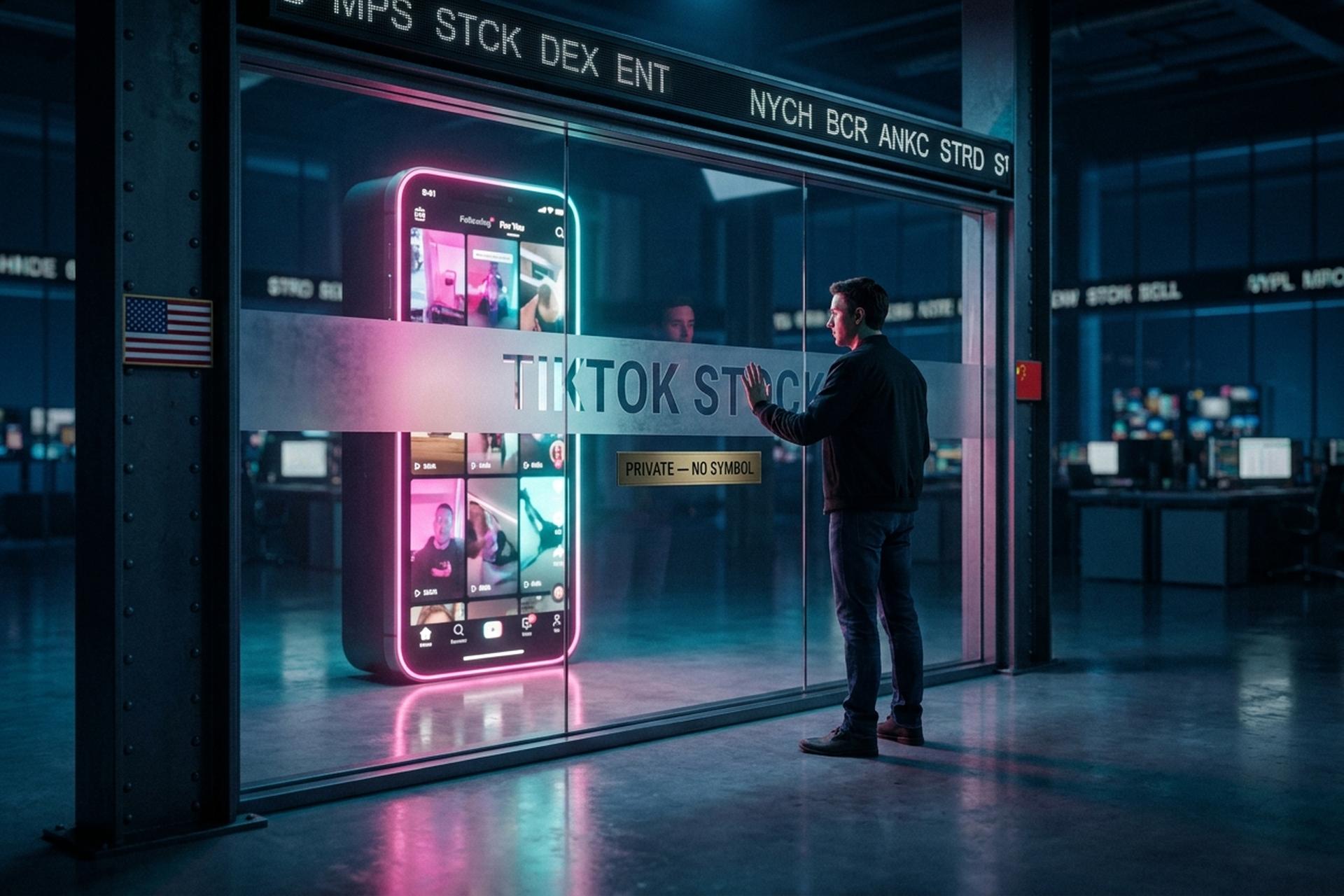
A company most people have never heard of now runs the app that around 136 million Americans open every month. It is called TikTok USDS Joint Venture LLC, it was stitched together in late January 2026, and one widely repeated estimate, attributed to Vice President JD Vance, put its value near $14 billion. And you still cannot buy a single share of it.
That gap, between how big TikTok feels and how little of it anyone can actually own, is the whole story here. The 2026 deal changed who controls the app. It did not change whether ordinary people can buy TikTok stock or invest in it. This guide walks through what really happened, who owns what now, and the narrow, often disappointing ways to get any exposure to TikTok at all.
Can You Buy TikTok Stock Right Now?
No. There is no TikTok stock symbol, no share price, and no exchange where TikTok trades. The app is not publicly traded, and neither is its parent. If you type "TikTok stock" into a brokerage app, you will find nothing to buy, because nothing exists to buy.
What you actually want, then, is a workaround, a way to gain exposure to TikTok through something that is tradable. Those workarounds exist. They are just narrower and weaker than most articles admit, and the rest of this piece is honest about that.
Who Owns TikTok and ByteDance in 2026
TikTok is owned by ByteDance, the Chinese technology group that also runs Douyin (TikTok's domestic twin in China), the editing app CapCut, and Lemon8. So buying "TikTok stock" was never really an option. The closest thing would be buying ByteDance, the parent company, and ByteDance is privately held.
Ownership there looks like a set of Russian dolls. Roughly 60% of ByteDance sits with global institutional investors, about 20% with its founders, and the last 20% or so with current and former employees. Co-founder Zhang Yiming holds an economic stake estimated at 20% to 25%, paired with supervoting rights that keep him in control. The institutional names are the ones you would expect from the private-equity world: KKR, SoftBank, General Atlantic, Sequoia, and the trading firm Susquehanna, whose roughly 15% holding makes it the largest outside institutional shareholder and one of the earliest, most profitable bets on the company.
Susquehanna's founder, Jeff Yass, is sometimes described as one of the largest individual beneficiaries of TikTok's rise, which tells you something useful: the people with real ByteDance exposure are private-equity firms and early backers, not the public market. That is the structural reason every route to TikTok stock ends up indirect, and why there is no public company through which you can buy shares in the platform outright.
Here is the catch that trips up most first-time buyers. None of those owners can simply sell you a piece of their stake from a phone. ByteDance shares do not float freely. They move through tightly controlled private transactions, and the company has spent years keeping it that way. That single fact shapes every option below.
The 2026 TikTok US Deal With Oracle Explained
This is the part that nearly every other guide gets wrong or glosses over. The headlines in early 2026 made it sound as if TikTok had been "sold," which led a lot of readers to assume shares were suddenly up for grabs. They were not. The deal was a restructuring built to satisfy a US law, not an offer to investors.
What the USDS joint venture actually is
For years, US lawmakers argued that a Chinese-controlled TikTok was a national-security problem. That argument became law in 2024 as the Protecting Americans from Foreign Adversary Controlled Applications Act, usually shortened to PAFACA, which forced ByteDance to either divest TikTok's US operations or face a ban. The Supreme Court removed the last escape hatch in January 2025, upholding the law 9 to 0. The answer, finalized on January 22 and 23 of 2026, was a brand-new American entity: TikTok USDS Joint Venture LLC. Reports valued the US business at roughly $14 billion, a figure TechCrunch and other outlets tied to comments from the vice president in January 2026. That number describes the carved-out US operation, not TikTok worldwide and certainly not ByteDance.
Who owns the new TikTok US entity
The point of the deal was to push control out of Chinese hands, and the ownership table shows it. ByteDance kept a stake of 19.9%, deliberately under the 20% line that US negotiators cared about. Oracle, the investment firm Silver Lake, and the Abu Dhabi fund MGX each took roughly 15%, a combined 45%. The remaining 35% or so stayed with existing American investors, a list that reads like a Rolodex of US capital: a Susquehanna affiliate, a General Atlantic affiliate, the Dell Family Office, Alpha Wave Partners, Revolution, and Dragoneer among them, according to TikTok's own announcement of the deal in January 2026. A US-majority board sits on top. None of those slices, again, is something a retail investor can purchase.
Why the algorithm now lives in Oracle's cloud
The recommendation algorithm was always the real prize, and the deal treats it that way. Under the new arrangement, the algorithm was retrained on US data and runs inside Oracle's cloud infrastructure, with Oracle (NYSE: ORCL) responsible for hosting and security. ByteDance, according to TikTok's own newsroom, no longer has access to American users or influence over what they see. For an investor, this is the one thread worth pulling: Oracle is publicly traded, which makes it the most direct, if heavily diluted, listed link to TikTok's US machinery.
ByteDance Valuation: From $268B to $550B
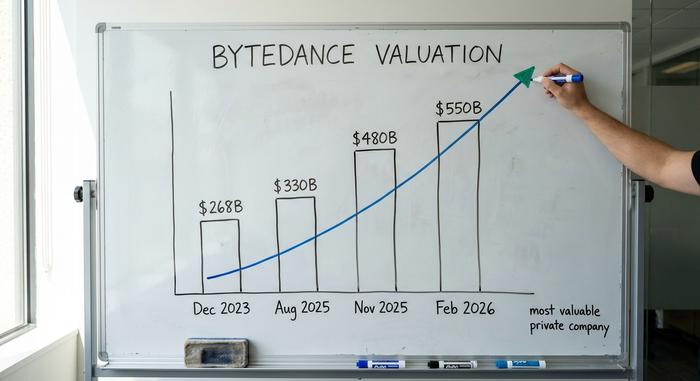
If you read an older guide, you probably saw ByteDance valued at $268 billion. That figure is badly out of date, and the gap matters because valuation is the only real yardstick for a private company. ByteDance has quietly become the most valuable private company on the planet.
The climb is easier to see in a table than in a paragraph.
| Date | ByteDance valuation | What set the mark |
|---|---|---|
| Dec 2023 | $268 billion | $5 billion employee buyback |
| Aug 2025 | $330 billion | Employee share buyback |
| Nov 2025 | $480 billion | Secondary share sale |
| Feb 2026 | $550 billion | General Atlantic-led secondary sale |
Notice the pace. ByteDance jumped from $330 billion in August 2025 to $550 billion by February 2026, a two-thirds gain in roughly half a year, and much of that came from the US regulatory cloud lifting once the joint-venture deal closed. The $550 billion mark came in a secondary share sale, according to the South China Morning Post. At $550 billion it has passed the likes of SpaceX to sit at the top of the private-company league table, worth more than many of the public social media companies it competes with. Those numbers rest on a real business, not hype. ByteDance reported around $155 billion in revenue for 2024, up roughly 29% year on year, as Bloomberg reported in April 2025, with international sales growing 63% to $39 billion and US TikTok Shop alone moving about $9 billion in goods. It was reportedly on track for close to $50 billion in profit in 2025, putting it in the same conversation as Meta. The irony is hard to miss: one of the most financially impressive technology companies in the world is also one of the very few that ordinary buyers cannot own a piece of, no matter how badly they want TikTok stock. For a private-equity holder, a higher valuation is good news on paper. For an ordinary investor, it is just a bigger party you are not invited to.
Ways to Invest in TikTok Indirectly Today
So you have accepted there is no TikTok stock ticker. The next real question is how much indirect exposure to TikTok you can realistically get through something tradable. The answer, for every route below, is "less than you think." Each one is a compromise, and pretending otherwise is how people end up disappointed.
Public proxy stocks: KKR, SoftBank, Oracle
The simplest path needs nothing more than an ordinary brokerage account. KKR (NYSE: KKR) and SoftBank (OTC: SFTBY) both hold stakes in ByteDance, and Oracle now owns about 15% of the US joint venture. You can buy all three today.
The problem is dilution, and it is severe. Oracle's 15% of a $14 billion entity is worth on the order of $2 billion, a rounding error next to Oracle's own market value, which runs well past $600 billion. SoftBank's remaining ByteDance position has been estimated at around $2 billion after it sold part of its holding in 2023, barely 1% of SoftBank's size, and KKR's stake is a similarly thin slice of a sprawling firm with hundreds of investments. Buying any of them for TikTok exposure is a bit like buying a shopping mall because you liked one store inside it.
Pre-IPO platforms and the accredited-investor wall
A more direct route runs through secondary market platforms such as Forge Global, EquityZen, Hiive, and Nasdaq Private Market, where pre-IPO shares in private companies, ByteDance among them, occasionally change hands. ByteDance stock turns up there from time to time; one Hiive listing priced it at $279.03 a share as of May 2026, per StockAnalysis.
There is a wall in front of this door, though. These platforms are generally limited to accredited investors, meaning US rules expect an income above $200,000 a year or a net worth over $1 million, and minimum tickets often start around $25,000. For most people that rules it out before the conversation starts. And even here you are buying ByteDance, not a pure slice of TikTok.

Why no ETF or index fund holds ByteDance
People often ask which fund to buy for TikTok exposure, expecting a clean answer. There isn't one. ETFs and index funds are built mostly from publicly listed securities, and an unlisted company simply is not eligible for inclusion. Until ByteDance lists somewhere, no mainstream fund can hold it directly. Any fund marketed as a "TikTok play" is really holding the same diluted proxies you could buy yourself.
| Route | How you access it | Requirement | Real TikTok exposure | Liquidity |
|---|---|---|---|---|
| Public proxy stocks | Buy KKR, SoftBank, Oracle on an exchange | Any brokerage account | A small fraction of each firm | High |
| Pre-IPO platforms | Forge, EquityZen, Hiive | Accredited investor, ~$25k minimum | ByteDance shares, not TikTok-only | Low, with lock-ups |
| ETFs and index funds | None hold ByteDance | Not available | Zero | Not applicable |
Will ByteDance Go Public? The IPO Outlook
The one clean way to buy TikTok stock would be a ByteDance IPO, so it is fair to ask whether one is coming. The honest read: do not hold your breath.
ByteDance reportedly explored going public around 2021 and was pushed back by Chinese regulators wary of sending a data-rich national champion onto foreign markets. Nothing has been filed since. Add the US political complexity on top, and the obstacles to a listing are structural, not a matter of waiting for the right quarter. There are two governments with a say in any listing, and their interests rarely line up.
In the meantime, those periodic stock buybacks serve as a pressure valve, giving insiders a way to cash out without the scrutiny and disclosure an IPO would force on the company. A company throwing off close to $50 billion a year in profit does not need public money to grow, which removes the usual reason a firm lists in the first place. For ByteDance, staying private has been a feature, not a delay, and nothing about the 2026 deal changed that calculus.
Risks of Chasing TikTok Stock Exposure
Suppose you decide to chase exposure anyway. Before you do, it is worth naming the traps, because the riskiest mistake is buying a proxy while believing it is a clean bet on TikTok.
Regulatory and ban risk
TikTok's American future was settled by politics, and politics can unsettle it again. The TikTok ban threat technically exists under PAFACA, future administrations can reinterpret enforcement, and Beijing keeps export controls over the recommendation algorithm that make any arrangement fragile. A holding whose value depends on a single law surviving is a different kind of investment than a normal stock, and it deserves that label up front. This is not investment advice; it is a flag.
Dilution: TikTok is a rounding error in each proxy
Even when a proxy genuinely owns part of ByteDance, the price you pay tracks that company's whole business, not TikTok. When SoftBank's shares move, they move on its other bets. When Oracle's stock jumps, it is usually about cloud contracts, not short-form video. You can be completely right about TikTok and see almost none of it in your returns, because the exposure is swallowed by everything else on the balance sheet.
Liquidity, lock-ups, and pricing in private shares
The private-market routes carry their own quieter risks. Secondary shares often come with lock-up periods that stop you selling when you want. Pricing is opaque, set by occasional transactions rather than a live market, so you may overpay and not know it. And there is no guaranteed exit: if you need your money back before a sale or listing, you may simply be stuck holding shares nobody is buying that week.
The Bottom Line on TikTok Stock in 2026
The 2026 deal made TikTok more American, more scrutinized, and more carefully governed. It did not make it more buyable. Strip away the headlines and the picture is the same as before, only with a fresh coat of paint: TikTok sits inside ByteDance, ByteDance stays private, and the routes to exposure are either heavily diluted or walled off behind accredited-investor rules. Treat any "TikTok stock" pitch as a proxy at best. The only door that would let you truly own the company is an IPO, and that is the one almost nobody expects to open any time soon.