
Monad Crypto: The High-Performance EVM Blockchain

The pitch behind Monad is almost too clean. Take Ethereum's exact software, the same code, the same tools, the same wallets, and run it thousands of times faster. No rewrites, no new programming language, just speed. That promise turned Monad into one of the most hyped launches in crypto, and now that it is live, the interesting question is whether the speed is real.
This guide covers what Monad crypto actually is, how its parallel execution works, what the MON token is worth and why, how it compares to Solana and Ethereum, and the risks the hype tends to skip. Some of the numbers are impressive. Others deserve a harder look.
What Is Monad Crypto and Who Built It
Monad is an independent Layer-1 blockchain, not an Ethereum rollup or a Layer-2. That distinction matters: it has its own validators and its own security, yet it stays fully compatible with the Ethereum Virtual Machine, so developers can deploy any Ethereum app on it without changing a line of code.
The team behind it is unusual for crypto. Founder Keone Hon and his co-founders came out of Jump Trading, where they built ultra-low-latency systems for high-frequency trading. That background matters more than it sounds. The people who shaved microseconds off Wall Street order routing treated the blockchain as a performance engineering problem, not an ideology, and it shows in the design choices. Before mainnet, Monad ran one of the largest public testnets in the space, drawing millions of wallets that stress-tested the network and fueled months of airdrop speculation.
The money followed the pedigree. Monad Labs raised a $19 million seed round led by Dragonfly Capital in 2023, then a much larger $225 million Series A led by Paradigm in April 2024, reportedly at a $3 billion valuation. That round was one of the biggest in crypto that year. After a long testnet, the mainnet went live on November 24, 2025, with the MON token arriving the same week.
How Monad Works: Parallel Execution
To see why Monad can be fast, you have to see why Ethereum is slow. The reason is almost embarrassingly simple, and fixing it is the whole point.
Parallel and optimistic execution
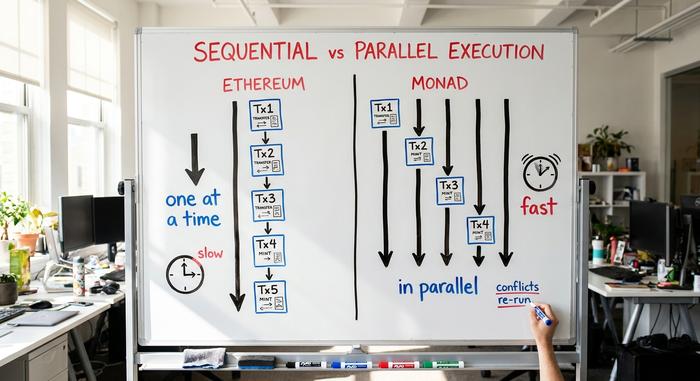
Ethereum processes transactions one at a time, in a single line, even when two transactions have nothing to do with each other. A payment between two strangers waits behind an unrelated trade. Monad processes many transactions in parallel instead, running unrelated ones at the same time.
Think of a supermarket with one checkout line versus one with twenty cashiers. Ethereum is the single line. Monad opens every register and only pauses when two shoppers reach for the last item on the same shelf.
It does this with optimistic parallel execution. The network assumes transactions will not conflict, runs many of them simultaneously across CPU cores, and checks afterward. If two did touch the same data, only those get re-run. Monad also separates the job of agreeing on transaction order from the job of executing them, a trick called asynchronous execution that keeps the pipeline full. The clever part is that none of this is visible to a developer. They write the same Solidity, deploy the same bytecode, and the EVM behaves exactly as it always did. The speed comes from the plumbing underneath, not from a new rulebook on top.
The supporting stack
Parallel execution alone is not enough, so Monad rebuilt the rest of the chain to match. MonadBFT is a custom consensus mechanism tuned for fast finality, the moment a transaction becomes irreversible. MonadDB is a purpose-built database that stores the chain's state efficiently enough to run on consumer hardware rather than data-center machines, which matters because hardware that is too demanding quietly centralizes a network around whoever can afford it; cheap nodes help decentralize it instead. RaptorCast handles block propagation so the chain is not bottlenecked simply moving data between nodes. Each piece exists to remove one more ceiling on throughput, and skipping any of them would leave the parallel engine starved.
The numbers, honestly
Here is where you should slow down. Monad's headline specification is roughly 10,000 transactions per second, with 0.4 to 1 second block times and sub-second finality. Those are design targets. In its early months of real production, the chain peaked closer to 350 TPS, and no independent, audited mainnet benchmark under heavy load exists yet. The architecture may well deliver more as usage grows. But "10,000 TPS," repeated as fact across most write-ups, is a spec sheet, not a measurement. Hold both ideas at once: the design is genuinely novel, and the proof is still pending.
The MON Token: Price and Tokenomics
The token tells a soberer story than the technology. Understanding Monad's tokenomics starts with one number: a fixed total supply of 100 billion MON, with only about 11.8 billion — roughly 11.8% — actually circulating as of June 2026. That single fact shapes almost everything about the price.
Supply and utility
MON pays for gas, secures the network through staking, and carries governance rights, with a dual model that issues new tokens to validators while burning a portion of fees. In theory, heavy usage burns more than the network issues, creating gentle deflation; in practice, with activity still low, emissions to validators dominate, so MON is mildly inflationary for now. That balance is worth watching, because it decides whether holding the token is rewarded or quietly diluted over time. The launch itself was large. An airdrop sent 3.3 billion MON to about 289,000 eligible wallets, and a token sale on Coinbase raised $269 million from 85,820 participants in November 2025. Plenty of supply went out the door, and far more is still waiting.
Price and the unlock overhang
| MON snapshot | Figure (June 2026) |
|---|---|
| Price | ~$0.021 |
| Market cap | ~$247M |
| Fully diluted valuation | ~$2.1B |
| Circulating supply | ~11.8B MON (~11.8%) |
| Total supply | 100B MON |
| All-time high | $0.04883 (Nov 26, 2025) |
Read the gap between market cap and fully diluted valuation. At today's price the circulating tokens are worth about $247 million, but if every token were unlocked the network would be valued near $2.1 billion. The other ~88% of supply unlocks over the coming years, and each tranche is fresh sell pressure. MON hit an all-time high of $0.04883 days after launch and has since fallen roughly 57%. That is not a verdict on the technology — it is what happens when a thin float meets a long vesting schedule. Allocations to the team, investors, and the ecosystem fund vest over several years, so the supply that lands on the market in 2027 and beyond dwarfs what trades today.
How to Buy and Store MON Crypto
Buying MON is the easy part. It trades on major exchanges including Coinbase, Kraken, and MEXC, where you can fund an account and place an order in minutes. Because Monad runs near-zero gas fees and uses the familiar 0x address format, EVM wallets like MetaMask or Phantom hold it natively with no special setup.
Storing it is where beginners get careless. If you plan to hold rather than trade, move MON off the exchange into a wallet you control, and protect the seed phrase like cash, because anyone who has it owns your tokens. Self-custody is the whole reason crypto exists; it only works if you treat the backup seriously.
Monad vs Solana and Ethereum Compared
Monad is built for high throughput and low latency, and it sits between the two chains it is most often measured against. Its advantage over Solana is not raw speed today; it is EVM compatibility, which lets Ethereum's enormous developer base move over without learning a new language. Its advantage over Ethereum is throughput.
| Feature | Monad | Solana | Ethereum |
|---|---|---|---|
| Throughput | ~10,000 TPS (target) | ~1,000 sustained* | 15-30 TPS |
| Block time | ~0.4-1s | ~0.4s | ~12s |
| Finality | ~0.8-2s | ~12.8s | ~13 min |
| Fees | near-zero | very low | variable, often high |
| EVM-compatible | Yes, full | No | Yes, native |
| Consensus | MonadBFT (PoS) | PoH + PoS | PoS |
One honest footnote: Solana's throughput is contested. Sustained real-world figures sit closer to 1,000 TPS, while lab benchmarks of its Firedancer client reach far higher. Comparing peak-benchmark numbers to sustained ones is how most "fastest chain" claims get inflated, Monad's included.
The table also flatters the newcomer in one way it should not. Ethereum and Solana have years of uptime, battle scars, and deep validator sets behind their numbers — Monad has months. Speed on a spec sheet is cheap; surviving a market crash, a contentious upgrade, and a real exploit attempt without going down is the test that actually ranks chains, and Monad has not faced it yet.
The Monad Ecosystem and Its Use Cases
A fast EVM chain only matters if applications actually arrive, and scalability alone does not guarantee adoption. The early signs are real but small: DeFi total value locked on Monad reached around $355 million by April 2026, up from roughly $220 million two months earlier, and the network has processed well over 140 million transactions since launch. EVM-native projects have begun porting over to test the speed. Full EVM compatibility helps here in a way that is easy to underrate: the existing Ethereum toolkit, MetaMask, block explorers, Solidity frameworks, and audited contract libraries, works on Monad on day one, so a team can redeploy in an afternoon rather than rebuild for months. That low switching cost is arguably Monad's real growth engine, more than any single throughput number.
The natural use cases play to the founders' trading roots: high-frequency DeFi, fully on-chain order books that need to update many times a second, and prediction or gaming apps where a half-second of latency ruins the experience. These are exactly the workloads that choke on Ethereum and benefit most from parallel execution. A central limit order book on-chain, for example, is close to impossible on a 12-second chain and becomes plausible on a sub-second one.
The catch is motivation. A lot of early on-chain activity anywhere is mercenary, chasing airdrops and yield rather than using the apps for their own sake. Whether enough builders and users commit to Monad once the incentives cool, rather than rotating to the next shiny chain, is the question the TVL chart cannot answer yet.

The Risks of Monad Crypto Today
Between the spec sheet and the price chart, there is plenty to be skeptical about, and a clear-eyed investor names the risks out loud.
The performance is unproven at scale. The chain is built for 10,000 TPS but has not had to sustain anything close to that under real demand, so the headline number remains a promise. The token structure is a heavier weight. With around 88% of supply still locked, MON faces years of scheduled unlocks, and history is unkind to tokens fighting that much dilution. Early activity is also incentive-driven, which means today's usage may not survive once rewards taper off.
There is competition, too. Fast Layer-1s are a crowded field, and EVM compatibility, Monad's strongest card, is something other chains can copy. The blockchain trilemma — the old tension between throughput, decentralization, and security — also remains an open question for any chain this young. Supply concentration adds another layer of caution, since a large share sits with the foundation and early backers. None of this makes Monad a bad project. It makes it an early one, where the technology is further along than the proof that people will use it.
Is Monad Crypto Worth Watching?
Monad is one of the more credible high-performance blockchains to launch in years, precisely because the engineering is serious and it is already running, not a whitepaper promise. The questions worth tracking are not whether the code works, but whether real demand shows up and whether the token can absorb years of unlocks without bleeding.
So watch the chain, not just the chart. If transactions, developers, and locked value keep climbing as incentives fade, Monad crypto will have earned its hype. If they do not, it joins the long list of fast chains nobody used. Which signal would actually change your mind?



