What is the Blockchain Trilemma?
On January 3, 2026, Vitalik Buterin posted that Ethereum had "solved" the blockchain trilemma. Ten years of work, he said. Data availability sampling, zero-knowledge proofs, and rollups. Done.
Crypto Twitter went nuts. Half the replies were congratulatory. The other half were variations of "dude, Ethereum still does 25 TPS on L1, fees still go crazy when things get busy, and Lido controls 24% of all staked ETH. In what world is that solved?"
Fair question. Let us look at it.
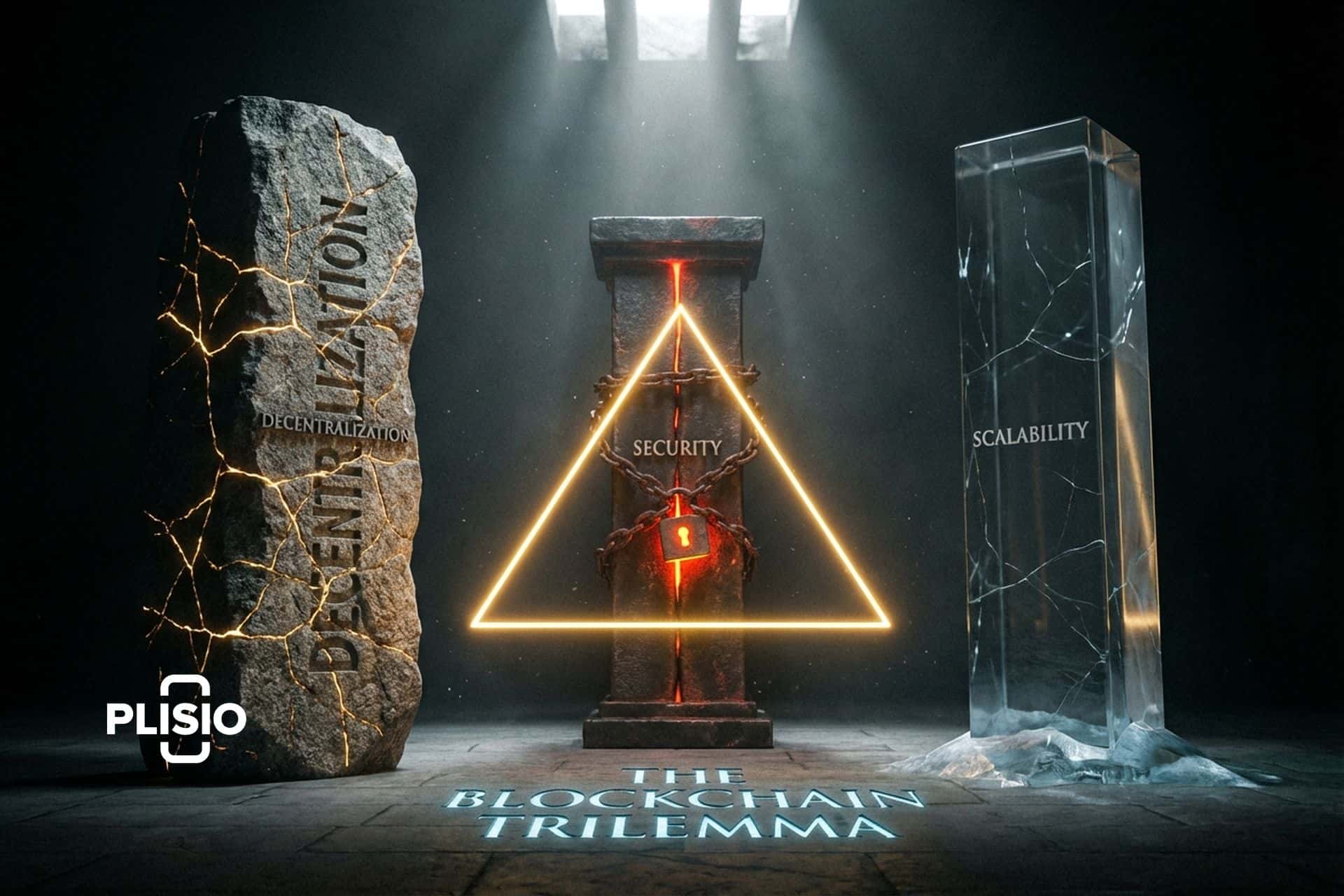
The blockchain trilemma refers to the idea that a blockchain network can only optimize two out of three critical aspects of blockchain technology: decentralization, security, and scalability. Want all three? Something breaks. Ethereum co-founder Vitalik Buterin put the concept into words years ago, and it has shaped every blockchain design tradeoff since.
Below is what the trilemma actually looks like when you stop talking theory and start looking at TPS numbers, validator counts, and fee data from real chains running in production right now. Understanding the blockchain trilemma matters because every cryptocurrency and digital asset you use sits somewhere on this triangle.
The three corners, explained without the jargon
Think of a triangle. Each corner is something you want your blockchain to be.
Decentralization means no single entity has control over the network. The more independent validators or miners running a decentralized blockchain, the harder it is for anyone to censor transactions, change the rules, or shut things down. The Bitcoin network has thousands of nodes spread across the globe. Nobody owns it. Nobody can turn it off. That is what a truly decentralized network looks like.
Blockchain security means the network can resist attacks. A 51% attack, where someone takes control of more than half the network's power, is the classic threat. The more decentralized and distributed a chain is, the more expensive an attack becomes. Bitcoin's proof of work consensus mechanism costs attackers billions of dollars in mining hardware and electricity. That is the point. Security or decentralization alone is not enough -- you need both working together to make a secure blockchain.
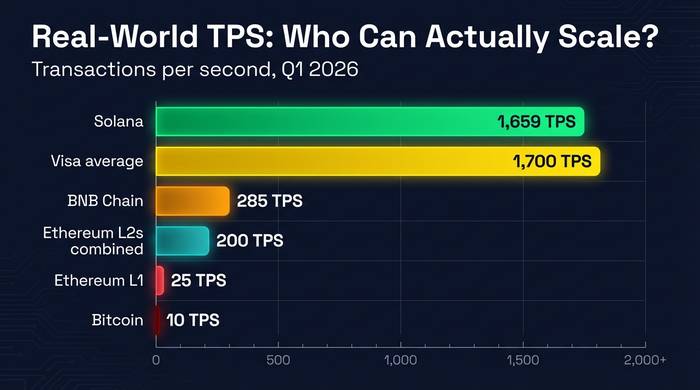
Scalability means the blockchain network can handle a large volume of transactions fast and cheap. Transaction speed matters. Visa processes about 1,700 transactions per second on a normal day and can surge to 24,000+. Like Bitcoin, most public blockchains are far slower: Bitcoin does about 10 TPS, Ethereum L1 does 25. When demand spikes, fees go up and the number of transactions that get through slows to a crawl. The scalability challenges are real -- if a blockchain network can't scale, mainstream blockchain adoption stays a dream.
The trilemma says you cannot max out all three. Build a scalable blockchain? You probably sacrificed some decentralization or security to do it. Make it maximally decentralized? Consensus gets slow. Optimize for security and scalability at the same time? Something else gives. Every blockchain technology project picks its spot on this triangle.
| Property | What it means | Who optimizes for it | The trade-off |
|---|---|---|---|
| Decentralization | No single point of control | Bitcoin, Ethereum | Slower consensus, lower throughput |
| Security | Resistant to attacks and censorship | Bitcoin, Ethereum | Expensive, energy-intensive (PoW) or high capital requirements (PoS) |
| Scalability | High throughput, low fees | Solana, BNB Chain | Fewer validators, centralization risk |
Where every major chain sits on the triangle
The trilemma is abstract until you look at real numbers. Here is where the biggest blockchains land as of early 2026.
Bitcoin picks decentralization and security. Around 10 TPS. Thousands of full nodes. Fees between $1 and $10 depending on demand. Nobody controls it. Nobody can modify it. But the blockchain network can't scale on its own. The Lightning Network, a state channel layer 2 solution, pushes Bitcoin's off-chain capacity higher -- the network hit an all-time high of 5,637 BTC in channel capacity in late 2025 -- but the main chain will never be fast. That is by design.
Ethereum L1 picks decentralization and security too, but is actively trying to bolt on scalability through Layer 2s. The base layer does about 25 TPS with over 1.1 million validators and 35.86 million ETH staked. The L2 ecosystem (Arbitrum, Base, Optimism, zkSync) adds another layer on top. Total L2 TVL hit $32-33 billion by March 2026. Arbitrum alone holds $16.2 billion. After the March 2024 Dencun upgrade introduced blob transactions (EIP-4844), L2 fees dropped 50-90%. A swap on Arbitrum now costs $0.05-0.30 versus $1-5 on Ethereum L1.
Solana picks scalability and goes all in. It does about 1,659 TPS in practice -- right up there with Visa's real-world average of ~1,700. Fees are nearly free: $0.00025 per transaction. You can swap tokens on a Solana DEX for less than a tenth of a penny.
The cost of that speed? Network security and reliability. The chain has gone down eight times in five years. Seventeen hours dark in September 2021 when bots flooded the network during a token launch. Nineteen hours in February 2023 after a large block choked the system. No confirmed outages since February 2024, but third-party monitoring flagged at least nine unacknowledged disruptions between October 2024 and February 2025. Solana's Firedancer client, targeting 1 million TPS, could change the equation. But it has not shipped in full yet. Right now, Solana trades decentralization and stability for speed. About 1,300 validators run the network -- way more than BNB Chain's 45, way less than Ethereum's 1.1 million.
BNB Chain picks scalability too, with a different flavor. About 285 TPS, fees under $0.04, but just 45 validators. The chain can be (and has been) halted by Binance when things go wrong. In October 2022 they froze the entire network to contain a $100 million bridge hack. Try doing that on Bitcoin. You cannot. That is the trade-off in action: fast, cheap, and stoppable.
Polkadot tried something different. Instead of one chain doing everything, it splits work across 65 parachains connected by a central relay chain. Each parachain makes its own trade-offs. The system is modular by design, with about 300 validators on the relay chain and $1.2 billion in TVL. Smart architecture, but limited adoption so far.
| Chain | TPS (real) | Avg fee | Validators | DeFi TVL | Trade-off |
|---|---|---|---|---|---|
| Bitcoin | ~10.8 | $1-10 | 1000s of nodes | N/A | Slow but maximally decentralized |
| Ethereum L1 | ~25.5 | $1-5 | 1,100,000 | $53-55B | Slow, expensive, but very secure |
| Ethereum + L2s | 200+ combined | $0.05-0.50 | Inherited from L1 | $32-33B on L2s | Better UX, some trust assumptions |
| Solana | ~1,659 | $0.00025 | ~1,300 | ~$8B | Fast but outage-prone |
| BNB Chain | ~285 | $0.04 | 45 | $5.6-6.6B | Fast but centralized |
| Polkadot | Varies per parachain | Low | ~300 | ~$1.2B | Modular but limited adoption |
The Layer 2 bet: Ethereum's answer to the trilemma
Ethereum's approach to address the trilemma is the most ambitious and the most debated. Instead of making the main blockchain faster (which would require sacrificing decentralization), Ethereum pushes transaction execution to Layer 2 solution rollups while keeping the Layer 1 as a secure settlement layer.
The logic: the main chain stays decentralized and secure. Layer-1 and layer-2 solutions work together. L2s handle the speed and cost. You get all three corners of the triangle, just across two layers instead of one. This is how Ethereum tries to tackle the trilemma without compromise on the base layer.
In practice, this means the Ethereum ecosystem now has over 65% of all new smart contracts deploying directly on L2s, not the main chain. Scaling upgrades like EIP-4844 push transactions off the main chain and onto rollups where fees are a fraction of L1 costs. Arbitrum and Base together hold 77% of L2 DeFi TVL. PeerDAS, which went live in December 2025 through the Fusaka upgrade, lets nodes download just 1/16 of blob data -- an 8x boost to data availability that makes L2s even cheaper.
Full danksharding, the endgame in Ethereum's scaling roadmap, is still years away. It promises to push combined L2 throughput to 100,000 TPS through 2D erasure coding and heavy data availability sampling. The Glamsterdam upgrade is planned for the first half of 2026. Hegota follows in the second half. But full danksharding? Vitalik's own timeline says "several years."
But is this solving the trilemma or just relocating it? Solid question. L2s bring their own trust baggage. Optimistic rollups work on the assumption that someone honest is always watching for fraud. If nobody checks? Bad things can happen. ZK rollups are more trustless in theory but most of them still run centralized sequencers -- one company decides the transaction order. Arbitrum has a 12-member security council that can override the entire protocol. That is 12 people, not 1.1 million validators.
When you zoom out, Ethereum's answer to the trilemma looks less like a solution and more like a clever redistribution of where the risks sit.
Modular chains: the new approach to old trade-offs
The blockchain trilemma assumed one chain does everything. The modular thesis says: why?
Celestia, a dedicated data availability layer, launched in 2023 with a radical idea for solving the blockchain trilemma. Instead of one chain handling execution, consensus, and data availability, split those jobs across specialized layers. Let rollups handle execution. Let Celestia handle data. Let each layer optimize for what it does best. The future of blockchain might not be one chain that does everything. It might be a decentralized ecosystem of chains that cover for each other.
By mid-2025, 56+ rollups were pushing data to Celestia (37 on mainnet, 19 on testnet). It holds about half the data availability market. Daily volume: around 2.5 GB. The Matcha upgrade coming in Q1 2026 doubles block size to 128 MB. A newer protocol called Fibre targets 1 terabit per second -- 1,500x the old roadmap target. EigenDA and Avail are racing to catch up. The DA wars are on.
Does the modular approach solve the trilemma? Not in the classic sense. It reframes the question. Instead of one chain sacrificing something, you get multiple layers, each making its own trade-off. The stack as a whole might be scalable, secure, and decentralized. But peel back any single layer and the compromise is right there.
It is like asking whether a car is safe. The whole car with airbags, crumple zones, and ABS? Pretty safe. Any single component by itself? Not so much. The system works because the pieces cover for each other.
The decentralization problem nobody wants to talk about
Here is the uncomfortable part. Even the chains that claim to be decentralized have concentration problems.
Ethereum has 1.1 million validators, which sounds great. But Lido alone controls 24.2% of all staked ETH. The top 10 staking entities hold over 60%. Client diversity has improved -- Nethermind now slightly leads Geth at 39.8% vs 37.1% of execution clients -- but 62% of validators are in Europe and 20% in North America. That is not "globally distributed" in any meaningful sense.
Bitcoin's Lightning Network tells a similar story. It is supposed to be the decentralized payments layer. But the top 10 operators hold 62% of all liquidity. Active channels dropped from 80,000 to around 42,000 since mid-2023. Small operators are leaving. Big ones are getting bigger. Transaction volume grew 266% year-on-year, which is great for usage and terrible for the decentralization argument.
Solana's validator set is bigger than BNB Chain's but smaller than Ethereum's. And the chain's history of outages raises questions about whether its architecture can handle stress without falling over. Eight major incidents in five years is a lot.
The honest assessment is that decentralization exists on a spectrum, and every chain is farther from the "fully decentralized" end than its marketing suggests.
Has the trilemma been solved?
Vitalik says yes. Specifically, he says Ethereum has solved it through the combination of PeerDAS (data availability sampling, live since December 2025) and zkEVMs (zero-knowledge virtual machines, in alpha). He described this as 10 years of work that started with his 2017 data availability research.
CryptoSlate published a counter-argument: Vitalik's own 2030 roadmap "exposes a massive ideological risk." The tension between decentralization ideals and practical centralization pressures is real. L2 sequencers are centralized. Staking is concentrated. Client diversity is improving but not where it needs to be.
The real answer is more boring than either side wants to admit. The trilemma has not been "solved" like a math problem. It has been managed. The tools to overcome the blockchain trilemma are better than they were in 2017. L2s give Ethereum something closer to scalability and decentralization together than Bitcoin or Solana can offer on a single layer. But the tradeoffs have not vanished. They have been pushed into new corners: sequencer centralization, staking concentration, geographic clustering of validators. In the context of blockchain design, progress is real. Perfection is not.
The blockchain trilemma is a concept that will not go away, not a puzzle waiting for a solution. It is a permanent tension in distributed system design, a characteristic of blockchain technology itself. Every chain picks its spot on the triangle. Many blockchain projects claim to have cracked it. So far, none fully have. The adoption of blockchain by mainstream users depends on resolving the trilemma well enough that people stop noticing the trade-offs. Blockchain developers are getting closer. They are not there yet. The industry's job is to keep pushing that spot closer to the center, knowing it will never quite get there.
Which trade-off can you live with? That is the only question that matters.
Need maximum security and do not care about speed? Bitcoin. Need cheap, fast transactions and can stomach some centralization? Solana or BNB Chain. Want the middle ground? Ethereum plus an L2 is probably the best available option in 2026. Messy, layered, imperfect -- but closer to all three corners than anything else running right now.
A quick timeline of how the trilemma evolved
The trilemma is not a static concept. It has changed shape as the tech improved. Here is how:
| Year | What happened | Impact on the trilemma |
|---|---|---|
| 2009 | Bitcoin launches | Proof that decentralization and security work together. Scalability not even a concern yet (10 users). |
| 2015 | Ethereum launches | Smart contracts open new use cases but inherit the same scaling limits |
| 2017 | CryptoKitties clogs Ethereum | First mainstream proof that scalability is a real blocker, not a theoretical one |
| 2017 | Vitalik names the trilemma | Gives the industry a framework to talk about design trade-offs |
| 2020 | DeFi Summer | Gas fees hit $50-100+. The trilemma goes from concept to crisis |
| 2022 | Ethereum Merge (PoS) | Moves from PoW to PoS. Security model changes. Scalability stays the same |
| 2024 | EIP-4844 (Dencun) | Blob transactions cut L2 fees 50-90%. First real progress on the scalability corner |
| 2024 | Runes launch spikes Bitcoin fees | $128 avg fee on halving day. Bitcoin's scalability weakness on full display |
| 2025 | PeerDAS goes live (Fusaka) | 8x more data availability. L2s get even cheaper |
| 2026 | Vitalik claims trilemma "solved" | The debate is far from over. But the tools are better than they have ever been |
The next few years will add more rows to this table. Full danksharding. Solana's Firedancer client (targeting 1 million TPS). Celestia's Fibre protocol. Bitcoin's Lightning growth. The trilemma is not going away, but the boundaries of what is possible keep shifting.
And that might be the most honest way to think about it. The trilemma is not a problem to solve. It is a dial to keep turning.