SOXL Stock: How the 3X Semiconductor ETF Really Works
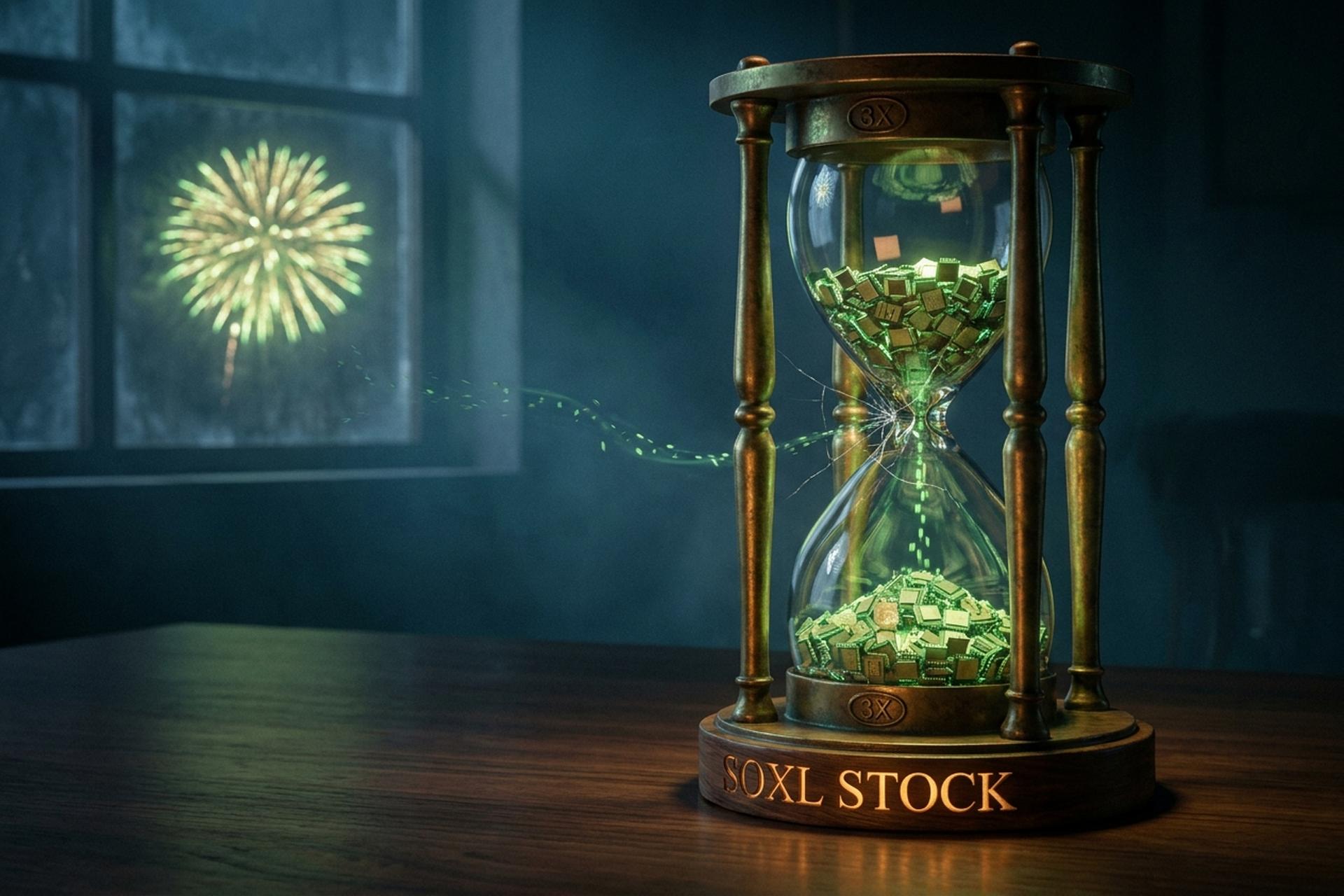
Over the past year, SOXL stock returned roughly 1,565%. That number should make you suspicious, not greedy. SOXL is the Direxion Daily Semiconductor Bull 3X Shares, a fund built to deliver three times the daily move of a semiconductor index, and the word "daily" is the part almost every buyer skips right past. The headline return is real. It is also close to the wrong thing to look at. The honest question, the one most quote pages never ask, is what this product actually does to an investor who buys it and holds, day after day, through the chop. Answer that and you understand SOXL better than most people who own it.
What SOXL Stock Actually Is, in Plain Terms
SOXL, formally the Direxion Daily Semiconductor Bull 3X ETF, is not a stock, and it is not a normal exchange-traded fund either. It is a leveraged daily bet, and its full legal name spells out every moving part if you read it slowly.
A 3x daily bet on the semiconductor index
The fund seeks daily investment results equal to 300% of the daily performance of the NYSE Semiconductor Index, a basket of about thirty large U.S.-listed semiconductor companies. To do that, Direxion does not simply buy the stocks; it uses swaps and other derivatives to manufacture three-times exposure. The critical word is daily. The fund promises 3x of one day's move, then resets. It makes no promise whatsoever about three times the index over a week, a month, or a year. That single design choice is the source of every surprise SOXL hands its holders, good and bad.
It helps to picture what the fund is doing behind the scenes. To hold $26 billion in assets but control three times that in market exposure, SOXL enters swap agreements with big banks that pay it the index's daily return on a multiplied notional amount. Those swaps cost money to maintain, which is part of why the fee is higher than a plain fund, and they have to be reset every single day to keep the leverage at exactly three times. You are not buying chip stocks. You are buying a daily-renewed contract on their collective one-day move.
What's inside: NVIDIA, Broadcom, AMD
Underneath the leverage sits a concentrated bet on the AI chip cycle. The largest holdings track the index weights, with NVIDIA around 8.4%, Broadcom near 8.3%, Micron about 7%, and AMD close behind. When people ask how much of SOXL is NVIDIA, the answer is meaningful but not dominant: NVIDIA is the top holding, yet no single name controls the fund. What controls SOXL is the semiconductor index as a whole, amplified three times every day.
The fund facts: assets, fee, and liquidity
SOXL is large and heavily traded. Its net assets ran around $26 billion as of June 3, 2026, though that figure swings hard with the price, on roughly 112 million shares outstanding. Its fees and expenses run to a 0.75% expense ratio, according to Direxion, which is steep next to a plain index fund but ordinary for a leveraged product. Daily volume is enormous, often tens of millions of shares, so getting in and out at a fair price is not the problem. Holding is the problem. That is an unusual thing to say about a fund: with most investments, time is your ally and patience is rewarded. With SOXL, time is working against you in any market that is not rising in a straight line, and the longer you hold, the more the structure can cost you.
The Daily Reset: Why 3x Isn't 3x Over Time
This is the section the quote pages skip, and it is the only one that truly matters. The daily reset is not a footnote. It is the whole personality of the fund.
How the daily reset works
Each trading day, the fund rebalances so that its exposure starts at exactly three times the index. That means you do not earn three times the index's return over your holding period. You earn the compounded series of three-times daily returns, which is a different animal. In a smooth, straight-up market, that compounding actually works in your favor and can beat a naive 3x, because each day's gains build on a larger base. This is why SOXL looks miraculous during a strong, low-volatility rally, and it is exactly the stretch of chart that lures buyers in. The trouble is that markets do not trend smoothly for long. The moment the index starts chopping sideways, the same compounding that helped you reverses and quietly grinds you down.
Volatility decay, with a number
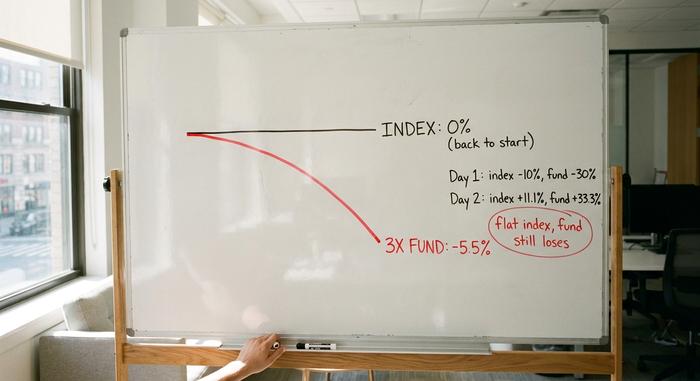
Here is the math made concrete. Suppose the index falls 10% one day, then rises 11.1% the next, landing exactly back where it started. You, the index investor, are flat. The 3x fund is not. It drops 30% on day one, then gains 33.3% on a smaller base, and ends down about 5.5%. The index went nowhere; the leveraged fund lost 5.5%. Repeat that pattern across the dozens of choppy days every year, and the bleed compounds. This is volatility decay, and it is not a bug Direxion can fix — it is the inevitable price of amplifying market volatility through a daily-reset structure, and it is pure arithmetic.
Why SOXL fell about 90% when chips fell 46%
The decay is not theoretical. In 2022, the underlying semiconductor index fell roughly 46% over the year, a brutal but survivable drop. SOXL fell about 90%, as 24/7 Wall St. documented. A holder who reasoned "chips will recover, so I'll just hold the 3x" discovered that the daily-reset math had eaten most of their capital on the way down, leaving far less to recover with. Three times the risk did not deliver three times the loss. It delivered roughly double. And recovery is its own trap: after a 90% loss you need a 900% gain just to break even, while the index investor down 46% needs only about 85% to recover. The leveraged holder is not just deeper in the hole; the hole is mathematically harder to climb out of.
SOXL Stock Price and Performance
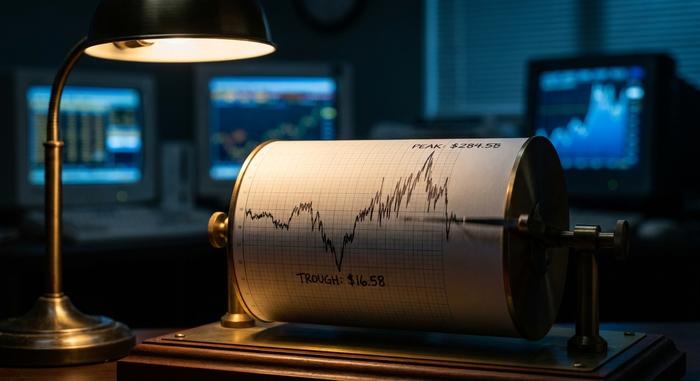
Read the range before you read the return. Over the past 52 weeks, SOXL stock traded between about $16.58 and $284.58. That is not a typo. The low came during an April 2026 collapse driven by tariff fears across the chip supply chain, and the recovery rode the renewed AI buildout back toward the highs near $280. The price chart looks less like an investment and more like a seismograph. Even the pre-market and after-hours sessions can swing several percent before the regular day begins, so the real-time quote you check at night is rarely the price you trade at in the morning. For a 3x fund, those gaps matter more than they would for an ordinary share.
The widely quoted 1,565% one-year gain is mostly a base effect: it measures from near that crushed low, so it flatters the fund enormously, per StockAnalysis data as of June 3, 2026. Pick a different start date a few weeks earlier or later and the number changes completely, which is the tell that you are looking at volatility, not skill. Since inception in 2010, the average annual return is a more sober figure in the mid-40s percent, and even 2025, an up year of roughly 56%, contained an intra-year drawdown near 80%. Sit with that: a holder could have been up for the year and still watched four-fifths of their money evaporate at some point along the way. The fund's beta sits well above three, often measured at five or higher, because leverage and decay together make it move more violently than the index it tracks. SOXL has split forward twice, in 2015 and 2021, a sign of past price strength, not a reverse-split rescue.
| SOXL snapshot (as of June 3, 2026) | Figure |
|---|---|
| Share price | ~$280.54 |
| 52-week range | $16.58 – $284.58 |
| Net assets | ~$26 billion |
| Expense ratio | 0.75% |
| 1-year return | ~+1,565% (base effect) |
| Since-inception avg | ~46%/year |
| 2022 drawdown | ~−90% (index ~−46%) |
Is SOXL High Risk? The Suitability Question
Regulators already answered this question; the only issue is whether you will listen. FINRA's Regulatory Notice 09-31 and repeated SEC investor alerts warn that leveraged ETFs, along with their inverse counterparts, are generally unsuitable for retail investors who plan to hold longer than a single trading session, per FINRA. That disclosure is not boilerplate. It is the regulator looking past the label and telling you what the security actually does over time.
So who is SOXL for? A disciplined trader expressing a short-term, high-conviction bullish view on semiconductors, with a defined exit, proper position sizing, and a portfolio allocation they can afford to lose entirely. Such a trader uses SOXL the way it was designed: enter on a clear signal, hold for hours or a few days, then close the position before the daily reset has time to compound against them. Who is it not for? Anyone treating it as a long-term investment, anyone using retirement money, and anyone who plans to buy and forget. The danger is that SOXL trades like an ordinary share, so it is trivially easy to buy and just as easy to misunderstand. For that buy-and-hold investor, SOXL is not a faster version of a chip fund. It is a slow leak with occasional fireworks, and the fireworks are what get remembered while the leak does the real damage.
SOXL vs SOXX vs SOXS: Picking the Right Tool
Most people who reach for SOXL actually want SOXX. SOXX is the plain, unleveraged semiconductor ETF: one times the index, a much lower fee near 0.34%, and a product you can hold for years without decay quietly working against you. SOXL is its 3x bull cousin, built to be held for days and closed out before a week is up. SOXS is the 3x inverse, designed to profit when chips fall, and it carries the same daily-reset decay in the opposite direction. Dividends are negligible across all three; nobody buys these for income.
| ETF | Leverage | Expense ratio | Built to hold |
|---|---|---|---|
| SOXX | 1x (long) | ~0.34% | Years |
| SOXL | 3x daily (bull) | 0.75% | Days |
| SOXS | 3x daily (inverse) | ~0.90% | Days |
The choice is really about horizon. If you want long-term semiconductor exposure, the unleveraged equity fund is the adult option: you capture the AI chip cycle without the daily-reset tax, and you can actually hold through a downturn and wait for the recovery. If you want a precise short-term trade, the leveraged share class exists for exactly that, and for nothing longer. The mistake almost nobody admits to is reaching for the 3x fund because the recent returns look better, then holding it like the 1x fund and wondering why the math stopped cooperating. Match the tool to your horizon and most of the danger disappears.
Is SOXL Stock a Buy? The Verdict
Here is my honest read. SOXL stock is a precise short-term instrument. Treat it as one and it has real uses; treat it as a long-term holding and the structure slowly takes you apart. The +1,565% headline is the survivorship of a bounce off a tariff-driven low, and the daily-reset decay all but guarantees that a long hold through choppy markets bleeds value even when the chip index ends flat. If you choose to trade SOXL, define your exit before you enter, size it as money you can lose, and never marry the position. If your style is buy and hold, this is simply not your fund, and SOXX is sitting right next to it on the shelf. None of this means SOXL is a scam or a bad product; it does exactly what it says on the label. The damage comes from buyers reading the label as something it is not. The question to settle before you click buy is not whether semiconductors will rise. Over years, they probably will. It is whether you will still be holding, and still solvent, on the scattered brutal days they fall, because those are the days the daily reset collects its toll.