What Is Solana (SOL)? How the High-Speed Blockchain Platform Works
Solana went down for 17 hours straight on September 14, 2021. Bots spammed a token launch, the validators choked, and the whole chain froze. The team had to get validators on the phone and restart the thing manually, like rebooting a Wi-Fi router except the router had billions of dollars in it. People on crypto Twitter wrote it off. Dead chain. Can't trust something that just turns off.
Then SOL ran to $250 six months later. And two years after that, Solana was handling more daily transactions than Ethereum and its L2s combined. The developers who left after the FTX collapse came back and brought friends. Over 7,600 new devs started building on Solana in 2024 alone.
I've used Solana dApps regularly since 2022. Swapped on Jupiter, staked through Marinade, watched the memecoin mania of 2024 happen mostly on Solana because the fees were low enough to make $15 trades worth doing. The network is genuinely fast. It also genuinely crashes sometimes. Both things are true, and understanding why requires looking at how Proof of History works and what tradeoffs Anatoly Yakovenko made when he designed this thing.
What Solana is: the short version
Solana is a Layer 1 blockchain designed for speed and low cost. It launched its mainnet in March 2020, founded by Anatoly Yakovenko, a former Qualcomm engineer who spent years working on distributed systems and wireless protocols before coming to crypto. His core insight: blockchains are slow because validators waste time agreeing on what happened when. If you give them a shared clock first, everything speeds up.
That shared clock is Proof of History. We'll get to the mechanics in a minute.
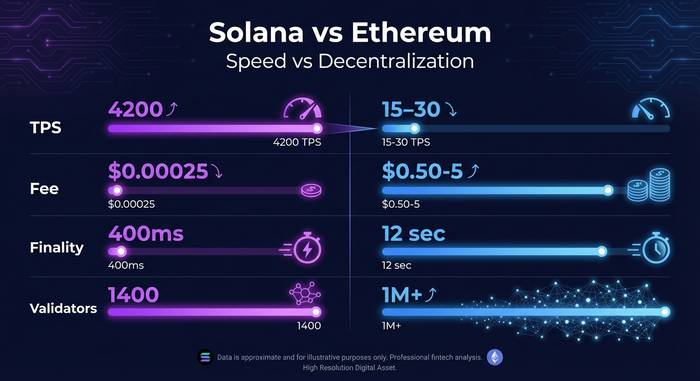
The numbers that matter for a quick overview: Solana processes 400-4,200 transactions per second in real-world conditions (the theoretical maximum is 65,000 TPS). Average transaction fee: about $0.00025. Block finality: roughly 400 milliseconds. For comparison, Ethereum does 15-30 TPS on mainnet and a basic swap costs $0.50 to $5 depending on congestion. Solana is orders of magnitude cheaper and faster.
The SOL token is the network's native cryptocurrency. You pay fees in SOL, you stake SOL to help validate the network, and you earn SOL rewards for staking. Current circulating supply is over 570 million tokens with no hard cap. Inflation starts at about 5.4% annually and declines toward a long-term rate of 1.5%. Half of every transaction fee gets burned (permanently destroyed) and the other half goes to validators.
How Proof of History works
Proof of History (PoH) is Solana's signature innovation and the thing most articles explain badly, so I'll try to do better.
Why are blockchains slow? Because validators spend most of their time arguing about what happened when. Bitcoin miners don't know what other miners are doing until somebody finishes a block and broadcasts it. Ethereum validators go through a committee process every 12 seconds. All that coordination is where the latency lives.
Yakovenko looked at this from a telecom engineer's perspective. At Qualcomm he'd worked on systems where timing was everything. His fix: give validators a shared clock before they even start agreeing on state. If everyone already knows the order of events, consensus becomes a confirmation step instead of a negotiation.
PoH is that clock. It runs a continuous SHA-256 hash chain where each hash takes the previous one as input. Hash 50,000 leads to hash 50,001 leads to 50,002. The sequence is deterministic but can only be computed one step at a time. You can't skip ahead or fake it. When a transaction arrives, the leader (the current block-producing validator) stamps it into this hash chain at a specific position. Transaction A happened at hash 50,000. Transaction B at 50,500. The gap between the hashes proves time passed. No need to ask anyone else to confirm it.
Other validators verify by replaying the hash chain. If the math checks out, the ordering is accepted. This collapses the communication overhead from "broadcast to everybody and wait for responses" to "check the hash chain locally."
On top of PoH sits Tower BFT, Solana's consensus layer. It's a modified version of Byzantine Fault Tolerance where validators vote on the chain state using PoH timestamps as reference. Votes are weighted by SOL stake (Solana uses delegated proof-of-stake, so regular holders delegate to professional validators). The whole thing is designed to be fast enough that a $5,000 server can keep up. Whether it actually needs to be a $5,000 server rather than a $200 Raspberry Pi is... the centralization debate in a nutshell.
The eight innovations inside Solana's architecture
Solana's speed doesn't come from PoH alone. The team built eight distinct components that work together. Most articles list them without explaining why they matter, so here's the version that actually makes sense.
Gulf Stream forwards transactions to the expected next leader before the current block finishes. Instead of waiting for a block to complete and then finding the next leader, Gulf Stream pre-routes transactions. This reduces confirmation time and keeps the mempool small.
Sealevel is the parallel transaction processing engine. While Ethereum's EVM processes transactions sequentially (one after another), Sealevel runs transactions that don't touch the same accounts simultaneously across multiple cores. A Solana validator with a 12-core CPU can process 12 independent transactions at the same time.
Turbine breaks block data into small packets and distributes them across the network like BitTorrent. Instead of every validator downloading the full block from the leader, each validator gets a piece and reconstructs the full block from pieces received from neighbors. This makes block propagation scale with the number of validators rather than choking on bandwidth.
Pipeline is a transaction processing unit that assigns different hardware stages to different steps: data fetching, signature verification, banking, and writing. Like a factory assembly line, each stage works on a different transaction batch simultaneously.
Cloudbreak is the accounts database, designed for concurrent reads and writes across solid-state drives. It supports the parallel processing that Sealevel needs by allowing multiple threads to access account data without locking.
Archivers handle long-term data storage. Historical blocks and transaction data get offloaded from validators to dedicated storage nodes. This keeps the hardware cost of running a validator from growing unbounded over time, though "manageable" is relative when a Solana validator still needs 256 GB of RAM and 1 TB or more of SSD space.
All six components work in a pipeline where transactions flow from submission to finality in under a second. The whole setup is deeply optimized and completely unlike any other blockchain architecture. Ethereum's approach is simpler by design (one step at a time, everybody verifies everything). Solana's approach is faster but more fragile. More moving parts means more things that can break, which is exactly what happened during every major outage. The question that keeps coming up in conversations with devs I know who build on Solana: is the complexity worth the speed? Their answer is usually "yes, but barely, and I wish the documentation was better."
Solana vs Ethereum: the comparison everyone wants
This is the comparison that drives 90% of crypto arguments on Twitter, so let's just put the numbers side by side.
| Metric | Solana | Ethereum (mainnet) |
|---|---|---|
| TPS (actual) | 400-4,200 | 15-30 |
| TPS (theoretical) | 65,000 | ~100,000 (with sharding, roadmap) |
| Transaction fee | ~$0.00025 | $0.50-$5+ |
| Block finality | ~400 ms | ~12-15 seconds |
| Consensus | PoH + Tower BFT + DPoS | Proof of Stake (Casper) |
| Validators | 1,400+ | 1,000,000+ (including home stakers) |
| TVL | ~$9.5 billion | ~$50+ billion |
| Smart contract language | Rust, C | Solidity |
| Developer count (new, 2024) | 7,600+ | ~6,000+ |
Solana is faster and cheaper. Ethereum is more decentralized and has a larger ecosystem. That's the honest summary. Anyone who tells you one is strictly better than the other is selling something or hasn't thought hard enough about the tradeoffs.
Ethereum's validator count (over 1 million including solo stakers) dwarfs Solana's 1,400. Solana's Nakamoto Coefficient (the minimum number of entities that could collude to halt the chain) is 19. Ethereum's is much higher. This matters because decentralization is the whole point of running a blockchain instead of a database. If 19 validators can shut down your chain, that's a concentration of power you should be aware of.
On the flip side, Solana surpassed Ethereum in new developer acquisition in 2024 with 7,600+ new developers versus Ethereum's ~6,000. The ecosystem has 700+ protocols and growing. Jupiter (the leading DEX aggregator), Raydium, Drift, Marinade (liquid staking), Jito, and Kamino are all major protocols. The memecoin explosion of 2024-2025, love it or hate it, happened primarily on Solana because the fees were low enough to make $20 trades viable.
The outage problem: Solana's biggest weakness
Let me be real about this: Solana has crashed. A lot. Eight major outages and ten partial ones since launch. Here's the hit list of the worst.
September 2021, 17 hours dark. Bots flooded an IDO launch. Validators ran out of memory. Team had to coordinate a manual restart through Discord and phone calls. The image of a blockchain that needs a phone tree to reboot is not great.
May 2022, 7 hours down during an NFT mint. Same story. Bots. The community was starting to notice a pattern.
February 2023, 18 hours degraded. Transactions technically processing but slow enough that many timed out. Longest period of partial dysfunction.
February 2024, 5 hours offline. By this point the response was faster and the fix more surgical, but the headline still looked bad.
The criticism writes itself: a chain that stops processing blocks is just a database with a token attached. And I won't pretend that criticism is unfair. If 19 validators going down can halt a network, that network has a single-point-of-failure problem regardless of what the marketing materials say.
What changed: QUIC networking replaced UDP to filter spam at the protocol level. Priority fees (like Ethereum's gas market) gave real users a way to outbid bots during congestion. And Firedancer, a second validator client built from scratch by Jump Crypto, is live in production. Having two independent clients means a bug in one doesn't take the whole network down, the same principle that keeps Ethereum running even when one of its clients (Prism, Lighthouse, etc.) has issues.
Since mid-2024, no major outage. The memecoin traffic of late 2024, which was arguably the highest sustained load Solana has ever seen, didn't crash it. That's encouraging. But one good year doesn't erase eight bad incidents. The trust rebuild takes longer than the fixes.
The SOL token: supply, staking, and economics
SOL is inflationary by design. There's no hard cap on total supply (unlike Bitcoin's 21 million). The initial inflation rate was 8%, declining by 15% per year until it reaches a terminal rate of 1.5%. As of early 2026, the inflation rate is around 5.4%.
The deflationary counterbalance: 50% of every transaction fee gets burned. In periods of high network activity, a meaningful amount of SOL gets permanently removed from circulation. During the memecoin frenzy of late 2024, daily fee burn exceeded the daily inflation issuance for several stretches, making SOL briefly net-deflationary.
Staking yield runs about 6-7% annually for SOL validators, depending on the current inflation rate and total staked. Over 65% of circulating SOL is locked in staking, which is one of the highest participation rates in crypto. That's good for security but it also means a lot of SOL supply is effectively illiquid.
Liquid staking solved part of the lockup problem. Marinade Finance and Jito let you stake SOL and receive a receipt token (mSOL or jitoSOL) that can be used in DeFi. You earn staking yield and can also lend, borrow, or LP with the receipt token. It's the same concept as Lido's stETH on Ethereum but Solana had less friction adopting it because the low fees make the extra transactions cheap.