Crypto OTC in Dubai: How to Trade Cash, USDT, BTC in 2026
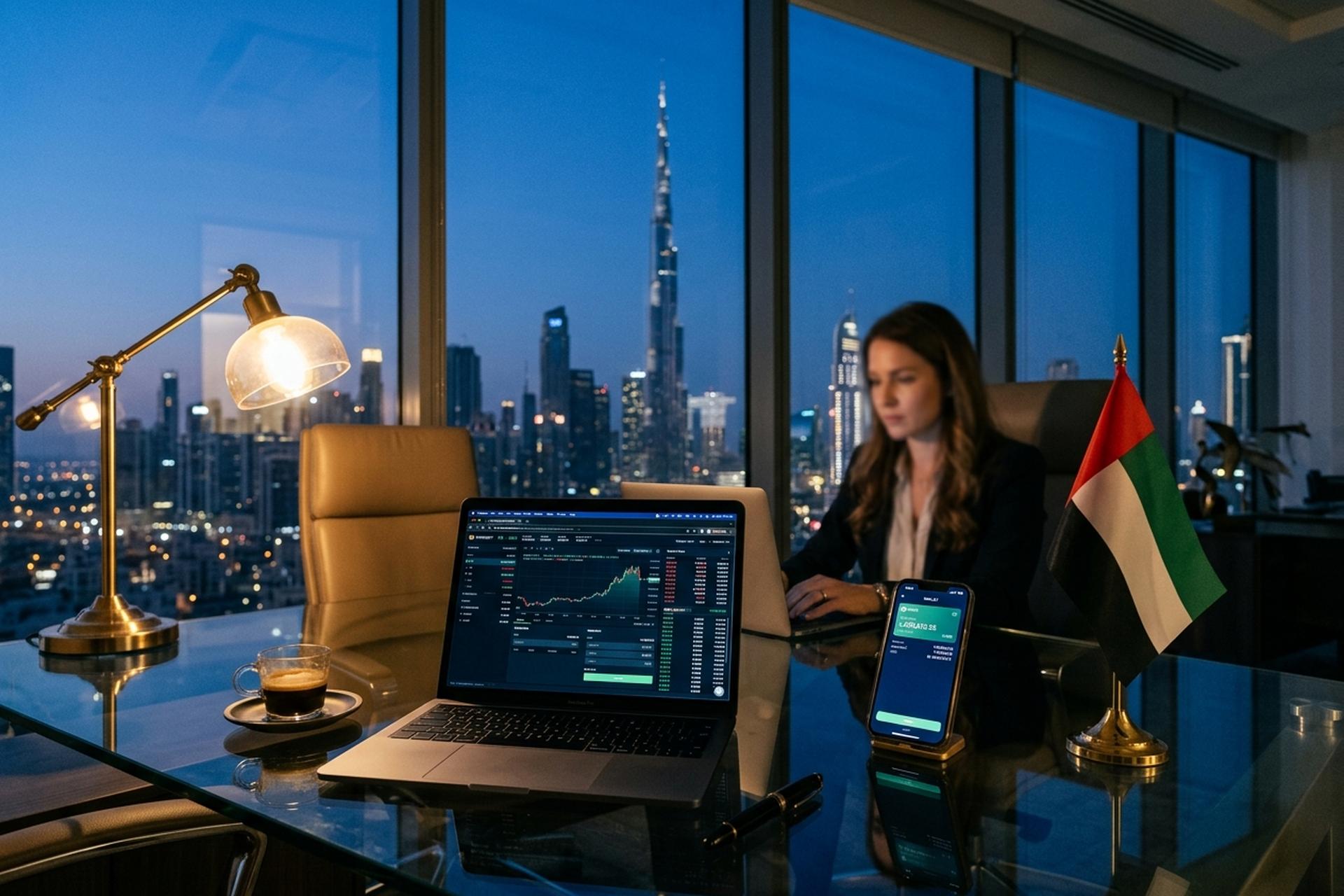
It is 11 PM in Business Bay. A trader at a VARA-licensed desk has just closed a $5 million USDT block at a locked price, settling in stablecoin before the wire to a Swiss counterparty clears on Monday. No order book. No slippage. No screenshot of the trade ever hits Twitter. That is what the crypto OTC business in Dubai actually looks like in 2026. This guide explains how that trade happens, who is allowed to broker it, what it costs, and why so much of the global high-ticket crypto flow now moves through the United Arab Emirates rather than through Singapore or Hong Kong.
What Crypto OTC Is and Why Dubai Cares
Crypto OTC means trading large blocks of cryptocurrency directly with a desk, not on a public order book. The trade is quoted, agreed, and settled bilaterally. Minimum ticket at most institutional desks: $100,000. Premium desks: $250,000 and up. The reason this exists is mechanical. A $10 million market buy of Bitcoin on a major exchange typically eats 200 to 500 basis points of slippage, according to industry data. The same trade through an OTC desk gets a locked quote for the entire block. Dubai matters here because crypto OTC in Dubai offers something most other major OTC venues do not. A single regulator with a fast track. Low headline tax. And a clear license category for the activity.
Dubai as a Global Crypto OTC Hub: The Numbers
The Dubai story is not aspirational. It is measurable.
The United Arab Emirates processed roughly $56 billion in on-chain crypto transactions during the 2024-2025 reporting window, making it the second-largest crypto market in the Middle East and North Africa region, behind Turkey. The growth rate was 33 percent year-on-year. Institutional flows did the heaviest lifting. Large institutional transactions climbed 54.7 percent. Large institutional transfers rose 37.2 percent. Retail caught up fast: small-ticket transfers under $1,000 grew 88.1 percent. The numbers come from the Chainalysis 2025 MENA Crypto Adoption report.
Regulatory and tax conditions are doing most of the work. The Financial Action Task Force removed the UAE from its grey list in February 2024. Personal income tax is zero. Corporate tax sits at 9 percent above an AED 375,000 profit threshold. And on November 15, 2024, the UAE Federal Tax Authority exempted crypto transfers and conversions from VAT, applying the exemption retroactively to January 1, 2018. That last move closed the final tax leakage between exchange and OTC settlement.
The regulator that matters for OTC trading is the Virtual Assets Regulatory Authority, known as VARA. It was established by Dubai Law No. 4 of 2022 and oversees all virtual asset activities in the Emirate of Dubai outside the Dubai International Financial Centre. VARA's public register lists 49 licensed virtual asset service providers as of May 2026. Major exchanges and OTC desks operating in Dubai include Binance FZE, Crypto.com, OKX Middle East Fintech FZE, and the institutional brokerage Relm, which received its full Broker-Dealer license on April 2, 2026.
The next-tier regulatory venue is the Abu Dhabi Global Market, governed by the FSRA. ADGM is technically a separate jurisdiction inside the UAE, with a $250,000 minimum capital for broker-dealer activity, separate licensing fees, and a stricter custodial regime after the June 2025 amendments. Binance secured a full ADGM license covering exchange, clearing, and brokerage including OTC. It went live on January 5, 2026 under the Nest brand.
VARA Licensing: What an OTC Desk Actually Needs
The plain-language version of the VARA rulebook is short and useful for any reader trying to verify a desk.
A desk that brokers OTC trades operates under the Broker-Dealer Services license. The application fee is AED 100,000. The annual supervision fee is AED 200,000 per licensed activity. Minimum paid-up capital sits at roughly AED 400,000 (about $109,000) if the desk uses a VARA-licensed custodian, or AED 600,000 (about $164,000) otherwise. Alternatively, the desk must hold 15 to 25 percent of its annual overheads as capital, whichever is higher. Those are the headline numbers from VARA's Rulebook Schedule 2. Compared with Singapore's MAS regime, where the SGD 250,000 minimum capital comes with a SGD 10,000 annual fee, VARA fees look high in absolute terms but cover the full scope of activity. ADGM's $250,000 capital sits between the two.
The pilot framework is worth knowing about because it is where the next generation of OTC activity lives — and where I keep watching for the next regulatory firsts. On August 6, 2025, Laser Digital, Nomura's digital assets arm, became the first firm anywhere in the world to receive a regulated OTC crypto options license under VARA's Pilot Framework. Counterparties have to be institutional or qualified, and trades execute under ISDA documentation. This was not a pilot in the experimental sense. It was a controlled production launch.
Enforcement is real. On October 7, 2025, VARA fined 19 unlicensed entities between AED 100,000 and AED 600,000 each and issued cease-and-desist orders. The most cited cautionary tale comes from the ADGM side. In April 2025, the ADGM/FSRA imposed $12.45 million in total penalties on Hayvn Group, cancelled the firm's license, and banned co-founder Christopher Flinos indefinitely from ADGM financial services and for 15 years as a director. The message that ran across the local crypto press: the UAE will license fast, but it will also act fast when a desk breaks the rules.
| VARA Broker-Dealer Services | Number |
|---|---|
| Application fee | AED 100,000 |
| Annual supervision fee | AED 200,000 per activity |
| Minimum capital (VARA-custodied) | AED ~400,000 ($109,000) |
| Minimum capital (other custody) | AED ~600,000 ($164,000) |
| Alternative — % of annual overheads | 15% (VARA-custodied) / 25% (other) |
| Licensed VASPs on public register (May 2026) | 49 |
How a Dubai Crypto OTC Trade Actually Works
There is a sequence to every OTC transaction. It starts long before the price is quoted.
A new client onboards with corporate documents, ultimate beneficial owner identification, source-of-funds evidence, and a counterparty risk file — the full verification stack a regulated desk requires before quoting. KYC depth at a regulated Dubai desk is closer to what a private bank requires than what a retail exchange asks for. Once approved, the client requests a quote (a request-for-quote, in industry shorthand). The desk responds with a single all-in number good for a defined window, usually a few seconds. The client accepts, and the desk locks in the position by hedging across its own venues. Settlement instructions follow.
Settlement is where Dubai has a slight edge. USDT and USDC are the dominant rails because they settle T+0 against the desk's own crypto inventory. AED bank wire settlements typically run T+2. A new option is on the way: RAKBANK received in-principle approval from the UAE Central Bank on January 7, 2026, to issue a fully AED-backed stablecoin, 1:1 reserves held in segregated accounts. That is a missing piece that will, once live, give Dubai its own native on-chain dirham, complementing the USD-backed token (USDU) the central bank already approved under the Payment Token Services Regulation.
Spreads on majors (Bitcoin and Ethereum) typically sit in a 10 to 50 basis-point range. The exact number depends on the size of the trade, the desk's inventory position, and time of day. Spreads on altcoins widen substantially. Most desks charge no explicit fee on top of the spread for cleared trades; some add a small commission on derivatives or non-USD settlement.
Cash-to-Crypto: Physical Desks in Dubai
There is a parallel world of cash-to-crypto and P2P desks where the trade happens face-to-face.
These are the physical AED ↔ BTC/USDT venues. Coinsfera, established in Dubai in 2015, operates multi-currency exchange with settlement in roughly 10 to 15 minutes. Several smaller desks operate around Business Bay and DIFC. The compliance picture here matters more than at any institutional desk, because cash carries higher risk under UAE Federal Decree-Law No. 10 of 2025, the country's updated AML and counter-terrorism financing framework. The decree explicitly covers virtual assets. And the rule that most catches people out: there is no minimum threshold for filing a suspicious transaction report. All amounts. All providers. The AED 55,000 cash threshold sometimes cited online applies to real estate and precious-metal dealers, not to virtual asset service providers, whose KYC requirements are set by VARA directly.
This is the segment where the gap between licensed and unlicensed operators is sharpest. If a cash desk cannot show you a VARA license entry, it is operating illegally. And the trader is exposed too.
Dubai vs Singapore vs Hong Kong
The three big Asia-Gulf crypto hubs are not equivalent. They sit on different curves.
| Hub | Regulator | OTC license | Min capital | Annual fee | Corp tax | Personal tax |
|---|---|---|---|---|---|---|
| Dubai (VARA) | VARA | Broker-Dealer Services | AED 400-600K | AED 200K/activity | 9% (>AED 375K) | 0% |
| Abu Dhabi (ADGM) | FSRA | Broker-Dealer + OTC permissions | $250,000 | $15K+ | 9% | 0% |
| Singapore | MAS | DPT MPI license | SGD 250K (~$185K) | SGD 10,000 | 17% | up to 24% |
| Hong Kong | SFC | VATP + proposed OTC dealer | HK$10M (proposed) | not finalised | 16.5% | up to 17% |
Dubai wins on fee structure, speed, and tax. Singapore retains the edge in global trade banking and treasury depth. Hong Kong has the largest pool of Chinese-mainland-adjacent crypto wealth but the slowest regulatory clock. The OTC dealer rule there is still in consultation as of mid-2026, after the FSTB and SFC closed their joint consultation paper on August 29, 2025. Until that regime is enacted, Hong Kong's OTC market operates in a permissioned-but-not-licensed grey zone, which is exactly the condition Dubai exited four years ago.
Major OTC Desks Operating in Dubai in 2026
The list that follows includes only desks where licensing is confirmed from primary regulator sources.
Binance FZE holds VARA Broker-Dealer authorisation across multiple activities and additionally operates institutional OTC through its ADGM-licensed Nest entity. OKX runs OTC trades through OKX Middle East Fintech FZE, which holds a VARA MVP Preparatory license and staffs more than 100 people in Dubai. Bybit was the first exchange to secure a full SCA license at the UAE mainland level in October 2025, covering operations beyond the Dubai VARA zone. Crypto.com holds the full VARA Broker-Dealer category, alongside exchange and lending licenses. Laser Digital sits on the OTC derivatives side under the pilot framework. Relm, an institutional broker focused on regulated OTC, received its full Broker-Dealer license on April 2, 2026. On the cash side, Coinsfera, Dubai OTC at the Binary Tower in Business Bay, and Koto Crypto Exchange handle the bulk of public-facing AED-to-stablecoin volume.
Hayvn is the obvious omission. It was once one of the larger ADGM-licensed OTC players. BitOasis, once a prominent UAE OTC and exchange platform acquired by Crypto.com in 2024, is another name that no longer operates independently in the Dubai OTC market. After the April 2025 enforcement action, the license is gone and the founder is barred. The takeaway for any client is the one VARA quietly tells everyone. Verify the register entry before you fund a trade.
What to Check Before You Wire $1M to a Dubai OTC Desk
A simple checklist beats a long checklist. Walk through six items.
Confirm the desk's VARA or ADGM/FSRA register entry by name. Confirm the license category covers Broker-Dealer Services or the equivalent ADGM permission. Ask for the desk's segregated client account structure and the name of the settlement bank. For any derivative trade, require ISDA documentation. Review the AML onboarding pack: KYC depth, source-of-funds evidence, periodic reviews. Read the Hayvn cancellation order published on the ADGM website. It is the cheapest hour of due diligence available for any first-time OTC client. For merchants who need a crypto payment rail rather than a full institutional Dubai OTC desk, a separate category of providers (gateways such as Plisio) handle business-to-customer flows in USDT and USDC under different rules entirely.