Dubai Currency 2026: The UAE Dirham and Crypto Guide
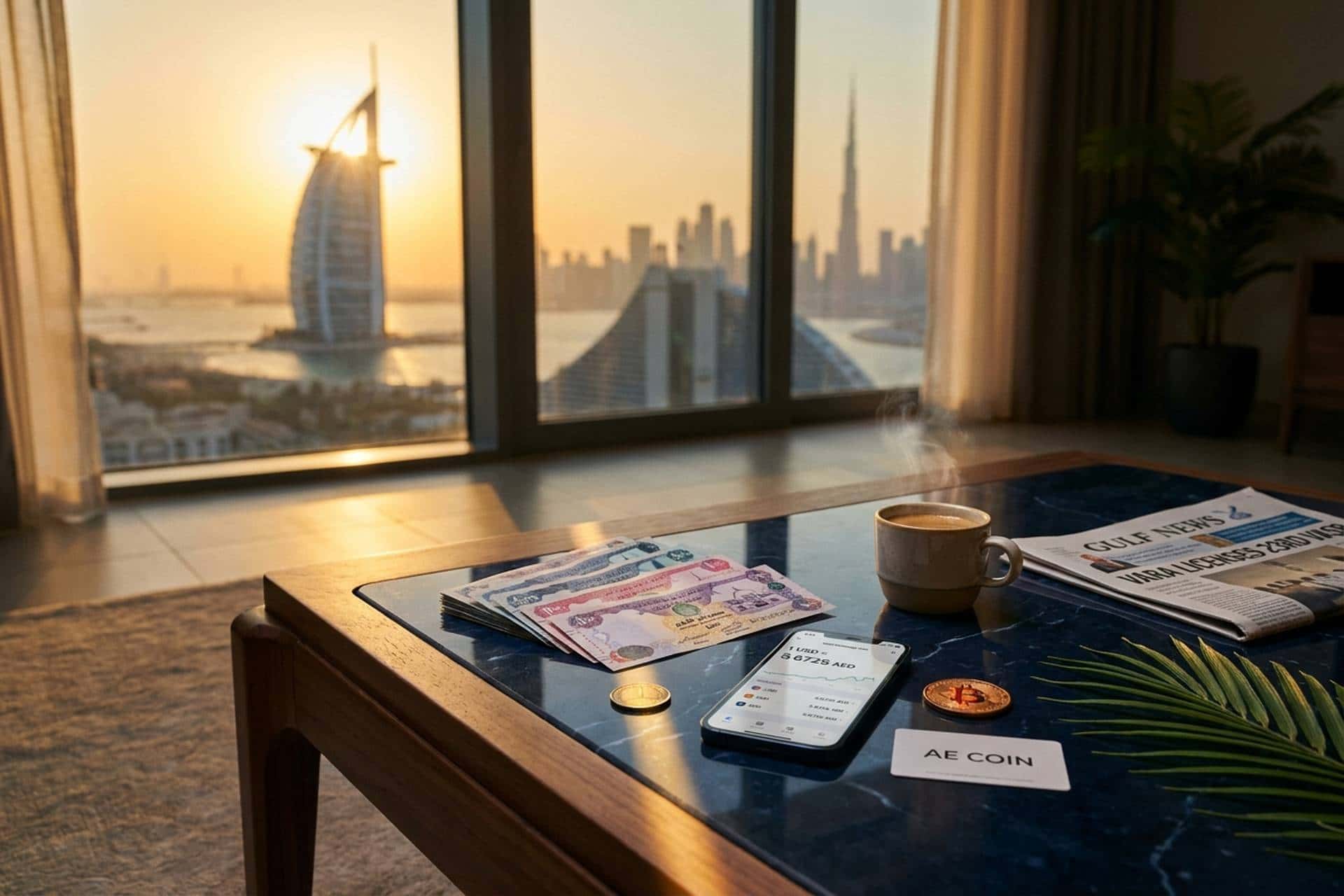
Dubai uses the United Arab Emirates dirham. Code: AED. Symbol: د.إ. You'll also see Dhs or Dh on menus. Since November 1997 the dirham has been pegged to the US dollar at exactly 3.6725 AED per 1 USD. Nothing about Dubai money makes more sense once you know that one number. It basically turns the dirham into a USD proxy, which is why Dubai has been able to build itself into the financial hub it is today.
Now the second story. Crypto. Chainalysis's 2025 Global Adoption Index: UAE ranked #1 in the world for crypto ownership, 25.3% of the population. Dubai's Virtual Assets Regulatory Authority, VARA, was literally the first dedicated virtual-assets regulator anywhere. In October and December 2024, the Central Bank approved AE Coin, which became the country's first regulated AED stablecoin. By 2025, about 3% of Dubai's off-plan real estate deals were settling in crypto. This is not a side note. Dubai fused fiat dirham with regulated crypto rails on purpose. If you are spending or investing there in 2026, both halves matter.
Here is what I'll cover. What the dirham is. How to exchange it. The live 2026 rates. Card spending. The full Dubai crypto scene. Tax. And the practical travel details, with specific numbers so you can plan.
What is Dubai currency? Meet the Emirati AED
OK, the basics. Dubai currency is the United Arab Emirates dirham. Short form: AED. It's the official currency of all seven emirates, not just Dubai. You'll see it written several different ways. د.إ if you're looking at Arabic signage. AED as the ISO code. Dhs or Dh on restaurant receipts and shop price tags. "UAE dirham" in news and financial reports. Same coin, many labels.
Here is the structure. One dirham is subdivided into 100 fils; the dirham is subdivided into 100 fils the same way across every emirate. Now the quirk. Cash transactions round to the nearest 25 fils in practice. Nobody actually uses the 1, 5, or 10 fils coins anymore. That makes the currency of the United Arab Emirates feel weirdly clean to spend day to day, no tiny change clutter. The Emirati dirham currency is the currency of Dubai, and the federal currency board doesn't sanction any other tender. Price check so you can translate menus: karak tea in a mall food court, 4 dirhams. Taxi ride across Dubai Marina, 30-40 dirhams. Mid-range dinner for one person, somewhere in the 120-180 dirham range.
So who runs all this? The Central Bank of the United Arab Emirates, usually written CBUAE, founded 1980. Every AED denomination is issued through this central bank of the United Arab Emirates system. As of January 2026, foreign reserves sat at about $295.2 billion. That's serious backing for the USD peg. One more detail. March 2025, CBUAE unveiled a new AED currency symbol, a Latin D crossed with two horizontal lines, due in Unicode 18.0. Mostly a cosmetic update. Nothing about daily use of the dirham changed.
The United Arab Emirates dirham and USD peg
The peg dates to November 1997. Exactly 1 USD = 3.6725 AED. CBUAE maintains it through forex interventions, and for 28+ years it has held. Oil crashes, financial crises, the 2020-2022 rate-hike cycle. Straight through all of it. Straight line.
Why should you care? Because your dirhams quietly inherit the stability, interest-rate environment, and purchasing power of the US dollar. Fed raises rates, AED deposit rates usually follow. US dollar strengthens against the euro or yuan, your AED gets stronger too. In practical terms Dubai feels like a USD economy with local tax and spending advantages layered on top.
If you travel or live there, here's the short version. Hold USD? Your Dubai spending is predictable. Earn in EUR, GBP, INR, or something else not pegged to the dollar? Your Dubai prices move with that currency's USD cross-rate, not with the UAE economy itself.
AED coins, fils, and banknotes
Two forms, same currency. Coins, then banknotes.
Coins. On paper? The complete set is 1, 5, 10, 25, 50 fils, and 1 dirham. In your actual wallet? Three pieces: 25 fils, 50 fils, and 1 dirham. That heptagonal 50 fils coin? Redesigned in 1995 to its current shape. The three tinier coins are functionally extinct. You won't see them unless somebody hands you ceremonial change.
Neighboring Gulf currencies? Forget them. Cashiers in Dubai are not going to take your Kuwaiti dinar, your Bahraini dinar, your Omani rial, your Qatari riyal, or your Saudi riyal. Only AED works. You will most often handle only 25 fils, 50 fils, and 1 dirham coins.
Current banknote denominations and their colors:
| Note | Color | Polymer / paper | Notes |
|---|---|---|---|
| AED 5 | Brown | Polymer (April 2022) | Common for small purchases |
| AED 10 | Green | Polymer (April 2022) | Metro ticket ballpark |
| AED 20 | Light blue | Paper | |
| AED 50 | Purple | Polymer (Dec 7, 2021; golden jubilee) | Cab fares, light meals |
| AED 100 | Pink | Paper | Most common note |
| AED 200 | Green/brown | Paper | |
| AED 500 | Navy blue | Polymer (Nov 30, 2023) | |
| AED 1,000 | Greenish blue | Polymer (H1 2023) | Large payments |
Quick history. The polymer switch began with that AED 50 jubilee note. Then it marched through the series, note by note, on De La Rue Safeguard substrate. A falcon watermark anchors every note for anti-counterfeit purposes. Rewind to 1973: the original launch used paper notes of 1, 5, 10, 50, and 100 dirhams. The AED 1,000 joined the family in 1976. Earlier Gulf currencies (Gulf rupee, Qatar and Dubai riyal) are long gone. Not legal tender today.
AED exchange rates in 2026: USD, EUR, INR, RUB
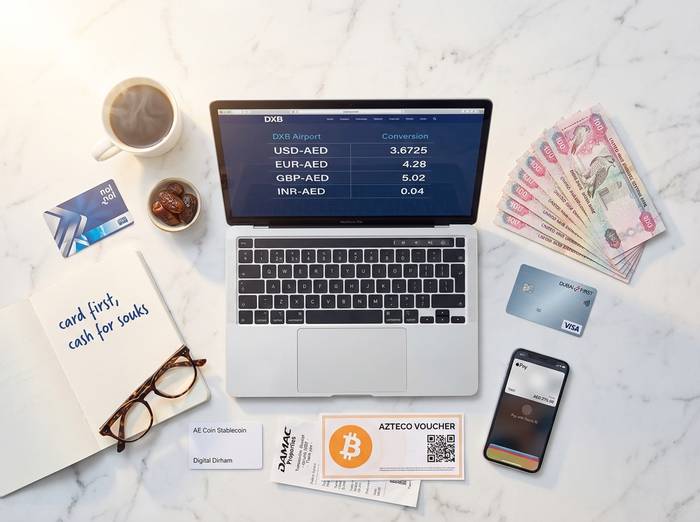
The AED exchange rate pairs you will care about most, all dated April 17, 2026.
| Pair | Rate | Notes |
|---|---|---|
| 1 USD | 3.6725 AED | Fixed peg since 1997 |
| 1 AED | 0.2722 USD | Reciprocal of peg |
| 1 EUR | ~4.28-4.34 AED | Floats with EUR/USD |
| 1 GBP | ~4.98-5.05 AED | Floats with GBP/USD |
| 1 AED | ~25.21 INR | Popular remittance pair |
| 1 AED | ~20.61-20.82 RUB | Floats with RUB/USD |
| 1 CNY | ~0.51 AED | Chinese tourist flows |
The USD pair is literally constant. Everything else moves day to day as the other currency shifts against the dollar. For practical purposes, check Revolut, XE, or Wise the morning of any significant conversion, and expect a mid-market rate within 1-2% of what a bank will quote you.
Currency exchange and cash in Dubai
Currency exchange in Dubai is easy, competitive, and heavily regulated. The CBUAE licenses all exchange houses, so the main providers are safe and transparent. The biggest chains include Al Ansari Exchange, Al Fardan Exchange, Wall Street Exchange, GCC Exchange (which operates 29 branches and processes salaries for 80,000+ employees), Travelex, LuLu Exchange, and UAE Exchange.
Where to exchange:
- City exchange houses usually offer the best rates, within 0.5-1% of mid-market. Look for branches in Deira, Bur Dubai, and mall food courts.
- Airport exchange counters work in a pinch but typically mark up 3-5% above city rates. Use them only for small amounts.
- Hotel desks are the most expensive, often 5-8% over mid-market. Avoid unless you have no alternative.
- ATMs with international cards work well. Withdrawal fees range 15-30 AED per transaction plus your home bank's foreign-currency markup.
- Dynamic currency conversion at POS terminals almost always loses money; choose to pay in local AED rather than your home currency.
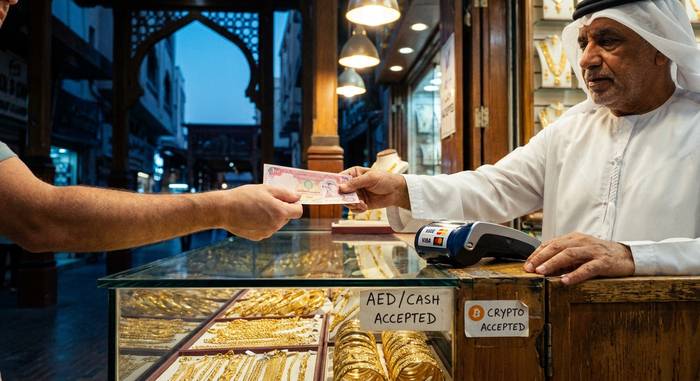
Do you need cash in Dubai? Less than you used to. Card acceptance is essentially universal across Dubai Mall, Dubai Marina, JBR, Downtown, and all tourist-facing businesses. Taxis accept Apple Pay and cards. Metro cards load from vending machines with international cards. You can realistically spend a week in Dubai with zero cash, although carrying 200-400 AED for small vendors in older souks (Deira Gold Souk, Spice Souk) is still useful.
Using a card in Dubai: the cashless push
Can you pay by card in Dubai? Basically, yes, everywhere. The Dubai Department of Finance announced a 90% cashless target for end of 2026, back in 2024. And the infrastructure to hit that target is already in the city.
Hotels take cards. Restaurants take cards. Every mall, every taxi, every metro turnstile. Visa, Mastercard, Amex. Apple Pay and Google Pay work on every modern terminal you'll touch. Contactless is standard. Where cash still has use: small souks (think Gold Souk and Spice Souk), independent taxis working the smaller routes, some souvenir stalls, and a handful of older local cafes in Satwa or Karama.
Foreign cards work straight out of your wallet. Two things to watch. One, your home bank might tack on a 1.5-3% foreign-transaction fee, so check before you fly. Two, every so often a POS terminal will offer "dynamic currency conversion" (DCC), which means it asks whether you want to pay in AED or your home currency. Always pick AED. DCC rates are always worse than the card network's rate. Always. Decline, pay in AED.
Staying longer? A local Emirates NBD, Mashreq, or ADCB debit card tied to a UAE bank account gives you the cleanest rates and no FX markup at all. Non-residents cannot open those accounts. Anyone on a UAE resident visa can.
Dubai currency converter and forex tools
A quick currency converter is a survival tool in Dubai, especially if you don't think in dollars. Here are the ones that actually get used:
- XE Currency Converter: industry standard for mid-market rates. XE.com also powers many bank apps.
- Revolut: competitive FX plus a multi-currency wallet if you already hold their card.
- Wise (formerly TransferWise): transparent pricing, good for transfers over 1,000 AED equivalent.
- Google Search: type "100 usd to aed" and you get a live rate. Fine for rough mental math.
- CBUAE official rates: published daily at centralbank.ae for reference only.
For active forex trading or larger transfers, DIFC-licensed brokers and Dubai FX desks trade AED against all major pairs. Not relevant to individual travelers, mostly a corporate thing.
Crypto in Dubai: VARA and the legal side
Crypto status in Dubai? Legal. Regulated. And I'd argue, quietly, it's one of the four or five pillars holding up the financial-hub narrative of the city in 2026.
First piece: VARA. That's the Virtual Assets Regulatory Authority, born out of Dubai Law 4/2022 in March 2022. It was the first dedicated virtual-assets regulator anywhere on Earth. Literally. By December 2024, VARA had licensed 23 VASPs. Names you probably recognize: Binance FZE. OKX MENA. Bybit. Crypto.com. Jumping forward. Rulebook v2.0 activated June 19, 2025, with tougher standards on capital, custody, and disclosure. Then August 2025, VARA and the UAE federal Securities and Commodities Authority signed the CMA-VARA mutual-recognition framework. In practice, that gave the UAE effectively one regulatory surface across all seven emirates.
For a normal person living or visiting, here is the practical part. Licensed crypto businesses operate legally. You as an individual hold, buy, sell, and spend crypto freely, provided you clear the normal KYC step at a licensed exchange. Now the sweetener. A VAT exemption on virtual assets went live November 15, 2024. It was applied retroactively to January 1, 2018. Tax-free virtual-asset transactions, in other words. Most other financial capitals slap on some form of tax. Dubai deliberately does not.
AE Coin: the regulated AED stablecoin
AE Coin. First Central Bank-regulated AED stablecoin ever. Here is the timeline.
- October 14, 2024: CBUAE hands out in-principle approval.
- December 11, 2024: full license lands. AE Coin is now the only fully regulated AED-pegged stablecoin in the market.
- April 2025: the second consortium steps out of stealth. IHC plus ADQ plus FAB. They are going after institutional flows with a competing product.
So why care? Simple. An AED stablecoin means you can hold dirham exposure on-chain. Move value across borders at crypto speed. Keep the USD peg that makes AED worth holding in the first place. For remittances, B2B settlement, and tokenized real estate, that is a real upgrade over SWIFT or even PIX-style payment rails in Brazil.
Supervision? Both AE Coin and the IHC/ADQ/FAB product sit under CBUAE. Reserves are mandatory. Audits are regular. Consumer protections are explicit. This is not Tether. Think Circle, but built native to AED from the first line of code.
Crypto payments in Dubai real estate
Dubai is, on most metrics, the most crypto-accepting real estate market on the planet right now. Hard number? Per Dubai Land Department data, roughly 3% of every off-plan property deal in 2025 settled in crypto. Developers who'll take BTC, ETH, or USDT include DAMAC, Emaar (via select partners), and Nakheel.
Two 2025 moves stand out. Move one: in January 2025, the DAMAC-MANTRA $1 billion real-world asset tokenization deal went public. Fractional property ownership, on-chain. Move two: Prypco Mint launched May 2025. Minimum ticket? AED 2,000. For the first time, Dubai property became retail-accessible to international buyers worldwide.
Then came the airline piece. On July 9, 2025, Emirates Airlines signed a Memorandum of Understanding with Crypto.com. They will accept AED-settled crypto payments for flight bookings. Rollout scheduled for Q4 2025. Dubai's own Department of Finance signed a parallel MoU with Crypto.com on May 12, 2025, which feeds directly into the city's cashless-by-2026 plan.
Bottom line for a buyer. Hold USDT, USDC, or BTC, and you are planning a Dubai purchase above AED 100,000? Crypto settlement is now a real choice. Through a licensed venue, not a back-alley arrangement.
Send money to Dubai: remittance corridors
Dubai is one of the world's biggest remittance sources, sending $40+ billion per year mostly to India, Pakistan, the Philippines, Egypt, and Bangladesh. The dirham exchange corridor to INR alone processes tens of millions of transactions per month.
Options for sending money:
- Exchange houses (Al Ansari, LuLu, GCC, Wall Street): lowest spreads for AED to INR, PKR, PHP, BDT, EGP. Branches across Dubai and instant transfer. The Emirati dirham into Indian rupee is the biggest volume corridor.
- Banks (Emirates NBD, Mashreq, ADCB, FAB): reliable, higher fees, slower.
- Digital transfer apps (Wise, Revolut, Instarem, Remitly): best for money transfers from Europe, UK, US into AED.
- Crypto stablecoin rails (USDT via Binance P2P, AE Coin once mainstream): growing quickly, especially for AED outbound to any country. Lower cost, but counterparty risk on unregulated P2P.
For receiving money in Dubai as a visitor, international wire transfers land in 1-3 business days; Revolut and Wise deliver to a local AED account in hours. Cash pickup at exchange houses is instant with sender reference and ID.
Tax on AED and crypto for residents and visitors
Personal income tax in the UAE? None. Zero. Not on salary, not on wages, not on investment gains. Doesn't matter if you're Emirati, an expat, or a short-term visitor. You hold AED, you earn the risk-free rate (tied to USD rates), you keep every coin of interest. That's the whole rule.
Corporate tax is the one carve-out. From June 2023, any business making more than AED 375,000 a year pays 9% corporate tax. Below that threshold, small-business relief kicks in. Free zones (DIFC, ADGM, JAFZA, DMCC) still offer 0% on qualifying income for residents who qualify.
VAT runs at 5% on most goods and services. Crypto got a special carve-out. Virtual assets are VAT-exempt since November 15, 2024, and the exemption goes all the way back to January 1, 2018. Retroactive. That's why every serious crypto OTC desk, every stablecoin issuer, every tokenized-asset platform ends up in Dubai sooner or later. The VAT treatment alone saves real money on high-volume flows.
Leaving Dubai? No exit tax on dirhams. No exit tax on crypto. Pull cash, send stablecoins, or pack up and fly. Nothing triggers UAE-side. Your home country's rules are a different conversation entirely, and if you're moving serious amounts, call someone who understands your jurisdiction before you send.