Is Revolut Really a Bank? UK Licence, Status Explained

Type "is Revolut a bank" into a search engine and you'll get conflicting answers — because they're all correct, depending on where you are. In the UK, Revolut became a fully licensed bank in 2026. In the US, it isn't one. Across much of Europe, it's been operating as a bank for years already.
What Revolut is, legally, varies by country. And that gap between how the app looks and what it actually is from a regulatory standpoint matters more than most users realise.
What Kind of Financial Company Is Revolut?
When Revolut launched in July 2015, it wasn't a bank. It was an e-money institution, which is a regulated financial services category that lives somewhere between a payment app and a proper bank. You'll often see it called a digital bank or neobank, but that's technically only accurate in countries where Revolut actually holds a banking licence — and for most of its history, that wasn't the UK or the US.
E-money institutions have a narrower permission set. They can hold your money and let you move or spend it. Lending, paying interest on deposits, deposit protection schemes — none of that comes with an e-money licence.
The FCA regulated Revolut in the UK under this e-money framework from the start. By 2026, Revolut had picked up full banking licences in the EU, UK, and Mexico. So today the answer to "what is Revolut" genuinely depends on where you're asking from. Some customers are with Revolut Bank. Others are still on the e-money side.
For context on where Revolut fits in the broader payments landscape, see our fintech industry overview.
Revolut's Banking Licence: A Brief History
Getting from fintech startup to regulated bank took Revolut about a decade. The key milestones:
- 2015 — Revolut launches as an e-money institution, regulated by the FCA in the UK
- December 2018 — Receives EU banking licence from the Bank of Lithuania; becomes authorised to operate as a bank across the EU
- 2019 — Applies for a UK banking licence; the application enters a years-long regulatory review
- 2021 — Begins rolling out full banking services to EU customers in waves, covering 28 countries under the Lithuania licence
- January 2022 — Completes the EU banking rollout; Revolut Bank UAB is now the entity serving most of Europe
- January 2026 — Receives banking licence in Mexico
- March 2026 — The PRA (Prudential Regulation Authority) lifts restrictions and grants Revolut a full UK banking licence; UK bank officially launches
The UK process was unusually drawn out. Revolut had 13 million customers waiting while the UK bank licence application sat in review, making it one of the longest-running UK bank licence applications in British financial history. The new UK bank now serves those customers with full banking protections.

Is Revolut a Bank in the UK?
Yes, since March 2026. The PRA granted Revolut its full UK banking licence, ending the "restricted" period that had capped what services Revolut could offer UK customers.
What changed with the full banking licence:
- FSCS protection — deposits up to £85,000 are now covered under the Financial Services Compensation Scheme, the same safety net behind Barclays, HSBC, and every other UK-authorised bank
- Interest-bearing accounts — Revolut can now offer savings accounts with interest directly, without routing through third-party partners
- Lending products — overdrafts, personal loans, and potentially mortgages become possible under the full licence
- Stronger regulatory standing — UK customers are now under full banking regulations, not just e-money rules
Before the full licence, UK funds were safeguarded — a weaker protection than FSCS and not covered by deposit insurance. The jump to full bank status is a real improvement in how securely your deposit sits with Revolut.
Is Revolut a Bank in the US?
No. In the United States, Revolut is a financial technology company. Its US product runs through partnerships with licensed US banks, not through any banking licence Revolut holds itself.
What that means in practice:
- Funds in the Revolut app are held by partner institutions like Metropolitan Commercial Bank, not Revolut
- FDIC insurance applies through those partners, but the coverage depends on the partnership structure — it's not equivalent to a direct FDIC-insured bank account with Revolut
- Revolut cannot offer lending, credit, or mortgages in the US
- The Revolut app in the US works more like a fintech wallet legally than a bank account
The app looks identical globally. The regulatory reality underneath it does not.
Where in the World Is Revolut a Bank?
Revolut's banking status by region:
| Region / Country | Revolut's Status | Deposit Protection |
|---|---|---|
| United Kingdom | Full bank (PRA licence, March 2026) | FSCS up to £85,000 |
| EU / EEA (28 countries) | Full bank (Bank of Lithuania licence) | DGS up to €100,000 |
| Mexico | Full bank (CNBV licence, Jan 2026) | IPAB up to ~400,000 MXN |
| United States | Not a bank — fintech / money services | FDIC via partner banks (indirect) |
| Australia | Not a bank — AFSL holder | No direct deposit guarantee |
| Singapore | Not a bank — Major Payment Institution licence | No deposit guarantee |
| India | Not a bank — prepaid payment instrument licence | No deposit guarantee |
| Other markets | Varies — typically e-money or licensed partner | Depends on local regulation |
For EU and UK customers, Revolut Bank provides full banking protection. For everyone else, especially US users, Revolut's product carries the limitations of a non-bank financial product.
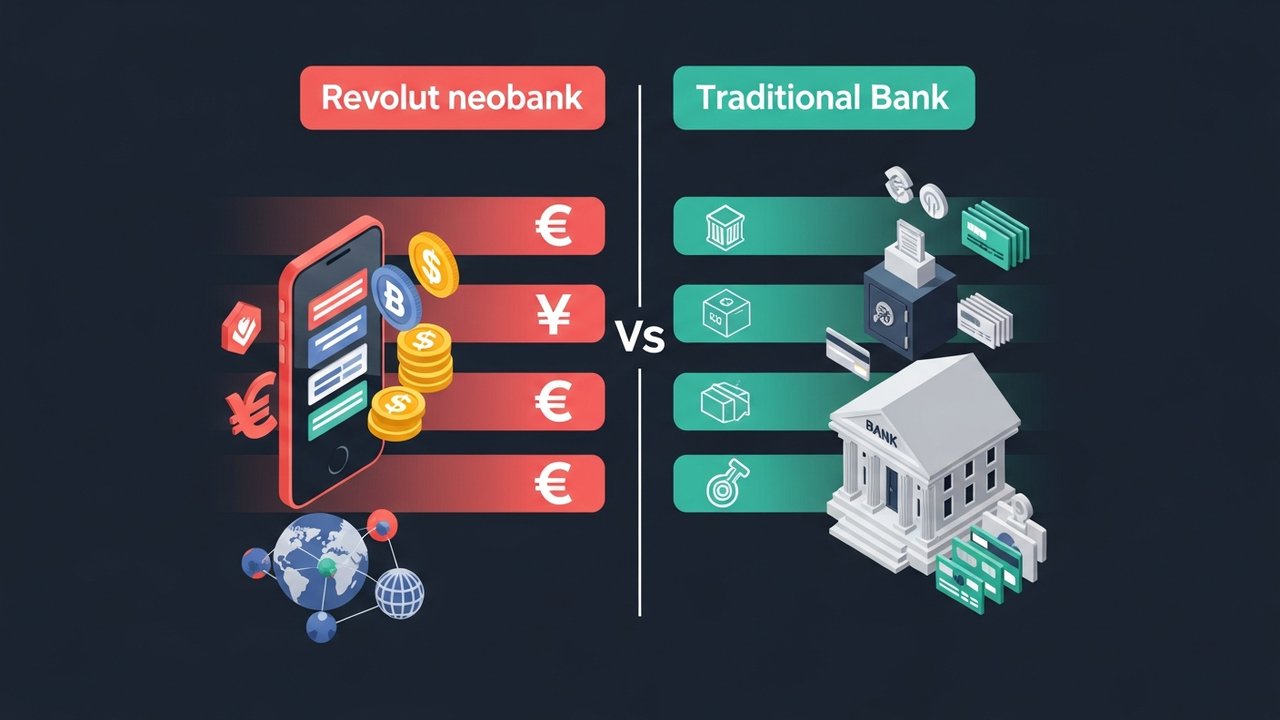
Revolut vs Traditional Bank: Key Differences
Both offer bank accounts, debit cards, and the ability to deposit money. But beneath that surface, Revolut and a traditional bank are built quite differently.
| Feature | Revolut | Traditional Bank |
|---|---|---|
| Physical branches | None | Yes (most banks) |
| Deposit protection (UK) | FSCS £85,000 (full bank markets only) | FSCS £85,000 |
| Currency exchange | 25+ currencies, interbank rates | High fees, poor FX rates |
| Crypto trading | 50+ cryptocurrencies | Rarely available |
| Stock trading | Available in app | Separate brokerage needed |
| Overdraft / credit | Limited (bank markets only) | Standard product |
| Mortgages | Not available | Standard product |
| Customer support | App-based, slower response | In-branch + phone |
| Monthly fee | Free plan available; paid tiers from ~£3/mo | Often free (basic) |
| Interest on savings | Available in bank markets | Yes, widely available |
Revolut wins on international money movement, multi-currency accounts, and app-based features like crypto and stock trading. Traditional banks hold the edge on credit products, physical presence, and deposit protection in markets where Revolut isn't licensed as a bank.
For a head-to-head on neobanks specifically, see our Monzo vs Revolut comparison.
Can You Use Revolut as Your Main Bank Account?
For many people, yes. But the honest answer depends on where you live and what you actually need from your bank accounts.
Revolut works well as a primary account for people who:
- Are based in the EU or UK, where full bank status and deposit protection apply
- Travel frequently or deal in multiple currencies
- Want crypto access, stock trading, and budgeting tools in one place
- Work as freelancers or remote workers receiving international payments
- Are comfortable with a fully digital banking experience and have no need for branches
It gets harder to rely on Revolut as your only account when:
- You're in the US, where Revolut isn't a bank and lacks direct FDIC protection
- You need a mortgage, car loan, or overdraft
- You want in-person service for anything complicated
- You've experienced account suspensions — Revolut's compliance checks occasionally lock accounts with little warning
Most users end up running a hybrid setup: Revolut for travel spending, currency exchange, and crypto; a traditional bank account for salary, direct debits, and longer-term financial products.
Revolut Business Account: What to Know
Revolut Business targets companies, freelancers, and entrepreneurs. In the EU and UK, where Revolut operates as a full bank, the product has genuine depth.
Key features of the revolut business offering:
- Multi-currency accounts in 25+ currencies
- Bulk payments and expense management dashboards
- Integrations with Xero, QuickBooks, and other accounting tools
- Physical and virtual debit cards for team spending
- API access for custom financial workflows
In the US, Revolut Business doesn't carry full banking product status. EU and UK businesses get the complete stack; US businesses work with a more limited fintech product.
For businesses handling cryptocurrency payments across borders, Revolut and traditional banking often don't cover digital asset flows cleanly. A dedicated crypto payment processor like Plisio handles those transactions outside your standard banking structure, which keeps the accounting simpler.
Businesses pairing Revolut with crypto tools should also check our guide to the best crypto-friendly banks.