Trade Republic Review 2026: German Broker and Bank in One App
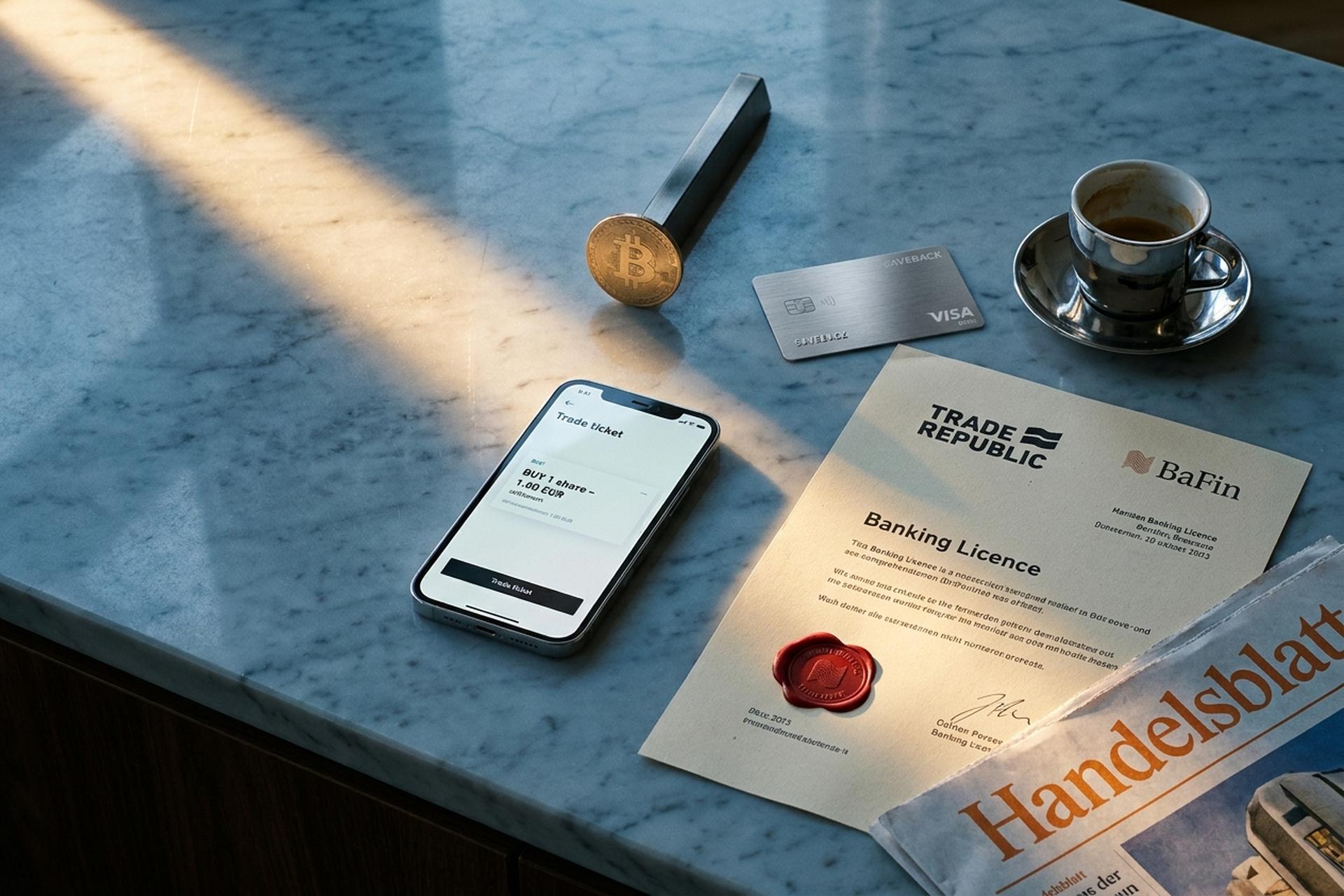
Ten million Europeans now hold money inside a mobile app that was put together by three friends from Munich a decade ago. Trade Republic, headquartered in Berlin, manages about €150 billion in client assets, runs a full European banking licence, and lets you buy a fractional Tesla share, a Bitcoin slice, and a savings plan with the same €1 settlement fee. That mix is unusual — and it is the reason this review exists. The app is cheap, the regulatory paperwork is unusually heavy for a fintech, and the catch lies in the small print of how money flows between the bank, its partner banks, and its custody partners.
This Trade Republic review looks at safety, fees, the crypto side in detail, the saveback card, and how the broker compares with eToro, Revolut, Bitpanda, Scalable Capital, and Interactive Brokers for an investor based in the EU.
What Trade Republic Is (the German broker and bank)
Trade Republic was founded in 2015 in Munich, originally under the name Neon Trading, by Christian Hecker, Thomas Pischke, and Marco Cancellieri (Trade Republic Bank GmbH is the current legal entity). The company moved its headquarters to Berlin and now employs about 1,100 people. Venture capital firms including Founders Fund, Sequoia, Accel, and TCV bankrolled the growth. It received a full banking licence from the European Central Bank in December 2023, which is the rare credential that separates Trade Republic from most other neobrokers in Europe. By April 2026 it served roughly ten million customers across 17 EU markets plus Poland and managed close to €150 billion in client assets and uninvested cash, according to company disclosures cited in EU Investing Hub's 2026 review. A €1.2 billion secondary share sale in December 2025, led by Founders Fund and Sequoia, valued the firm at €12.5 billion.
Is Trade Republic Safe? BaFin Banking License and Partner Banks
Safety on Trade Republic has three different layers, and the marketing copy tends to blur them.
The first layer is the banking licence itself. Because the ECB granted Trade Republic a full credit-institution licence in December 2023, the firm sits under direct supervision by BaFin (Germany's Federal Financial Supervisory Authority) and the Bundesbank. That is the same supervisory regime that applies to Deutsche Bank or Commerzbank, not the lighter electronic-money licences used by Revolut or PayPal. In January 2026 BaFin also granted Trade Republic a Multilateral Trading Facility licence, which lets it route orders on its own venue instead of relying on third-party market makers.
The second layer is cash. Cash sitting in your Trade Republic account is covered by Germany's statutory deposit guarantee scheme, Entschädigungseinrichtung deutscher Banken, up to €100,000 per customer. Anything above that is swept to partner banks like Deutsche Bank, JPMorgan, and Citi; the relevant question is whether each of those balances stays inside their own respective deposit-protection limit, because protection does not stack across institutions. The Verbraucherzentrale, Germany's consumer-protection association, filed a lawsuit in February 2025 arguing that Trade Republic's advertising blurred where exactly that €100k cover applied; the case is still ongoing.
The third layer is securities. Stocks, ETFs, and bonds in your portfolio are held in an omnibus trust at the depository, with HSBC and Citi acting as custodians. The assets sit separately from Trade Republic's own clearing account. They are not covered by the bank's deposit guarantee because they are not deposits at all: they are customer funds. If Trade Republic ever failed, those holdings would move to another broker rather than be divided up among creditors.
Where safety has wobbled, in practice, is during stress events. In January 2021, Trade Republic restricted trading on GameStop and other meme stocks; BaFin received more than 4,000 customer complaints. In April and October 2025, the app went down or showed broken portfolio values during volatile sessions. None of those incidents put money at risk, but they showed that the engineering operates closer to fintech-startup tolerances than to clearing-bank tolerances. Trusted by millions or not, plan for the app to fail during the trading day at least once a year and keep a second broker for emergencies.

How to Open a Trade Republic Account in 2026
You need to be a resident of one of the supported countries (Germany, Austria, Belgium, France, Italy, Spain, Portugal, Ireland, the Netherlands, Greece, Sweden, Finland, Denmark, Czechia, Slovakia, Slovenia, plus Poland from September 2025) and have a SEPA bank account in your name. There is no minimum deposit; the first SEPA inbound transfer is free, after which a 0.7% fee applies for additional deposits. ID is verified through PostIdent or a video call. US, UK, and Swiss residents cannot open an account.
Fees in the Trade Republic App: €1 Trades and FX Spreads
Trade Republic charges €1 per stock, ETF, or derivative trade, regardless of order size. That is a settlement fee, not a commission, and it is the same whether you buy ten euros' worth of ETFs or stocks or ten thousand. Savings plans run for free, which is the engine that drew most of the customer base. The fees that catch users out are the ones outside the trade ticket.
| Item | Cost |
|---|---|
| Stock / ETF / derivative trade | €1 settlement |
| Bonds (from €1) | €1 settlement |
| Savings plan (Sparplan) execution | Free |
| Cryptocurrency trade | €1 + spread (~1%) |
| FX on non-euro stocks | ~0.25% spread |
| Inbound SEPA (first per period) | Free |
| Inbound SEPA (additional) | 0.7% of deposit |
| Outbound SEPA | Free |
| Outbound portfolio transfer | €25 per position + custodian costs |
| ATM withdrawal under €100 | €1 |
| ATM withdrawal €100 and above | Free |
The structural fee question is the ban on PFOF. Payment for order flow, the practice where a broker is paid by a market maker to route orders, is being banned across the EU under the Listing Act, with Germany's national exemption expiring on 30 June 2026. Trade Republic told Curvo in January 2026 that PFOF now accounts for less than 30% of revenue, down from roughly a third when it received its banking licence; the new MTF venue and interest income on deposits are the planned replacements. For users, the practical effect is that the cheap fee schedule is being kept; the part that changes is who pays for it.
Stocks, ETFs, Bonds, and Savings Plans on the Broker
The catalogue is broad for a retail investor and narrow for a trader. More than 10,000 stocks and 2,800 ETFs are tradeable, most of the ETFs eligible for a savings plan starting from €1 per execution. Fractional shares are supported, which lets you put €25 into a single Berkshire-A position. Bonds, both government and corporate, have been available from €1 minimum since 2023, alongside a selection of money market funds for short-duration cash parking. Derivatives such as knock-out certificates and warrants are offered for the audience that wants leveraged exposure. What is not offered: listed options, futures, CFDs, and margin lending. If your trading style involves selling cash-secured puts or carrying overnight borrowed positions, Trade Republic will frustrate you within a week. If your style is "buy the index every month and forget", the savings plan engine is the cleanest in Europe.
Crypto on Trade Republic: 50+ Coins, Custody, EU Tax Rules
Crypto on Trade Republic is built like a bank product, not like Binance, and that has trade-offs.
The catalogue is around 50 cryptocurrencies, dominated by the obvious names (Bitcoin, Ethereum, Solana, the major Layer 1s) plus a curated set of stablecoins, DeFi tokens, and a few memes. Trades run commission-free with the same €1 settlement and a spread that the broker does not officially publish but that BrokerChooser and Datawallet estimate at roughly 1% in 2026. Minimum buy is €1, the market runs 24/7, and BaFin granted Trade Republic a full MiCA crypto-asset service provider licence in May 2025, covering all 30 EEA countries.
| Category | Examples |
|---|---|
| Layer 1 | BTC, ETH, SOL, AVAX, ADA, DOT |
| Layer 2 / scaling | MATIC, ARB, OP |
| Stablecoins | USDT, USDC |
| DeFi / infra | UNI, LINK, AAVE |
| Memes (selected) | DOGE, SHIB |
Custody is the interesting bit. The actual private keys are held by BitGo Europe GmbH, a BaFin-licensed crypto custodian, with Trade Republic Custody GmbH acting as the user-facing layer on top. Until late 2025, that meant you could buy and sell crypto on Trade Republic but you could not send a coin to an external wallet. The new Crypto Wallet, announced in November 2025, opens on-chain transfers and adds ETH and SOL staking; the full coin list for staking is being rolled out gradually.
The tax angle is where Trade Republic crypto users in Germany have a quiet advantage. Stocks, ETFs, and interest income are taxed under the Abgeltungssteuer at 25% plus 5.5% solidarity surcharge, an effective 26.375%. Crypto sits under §23 EStG and is treated as a private asset. Gains are taxed at the investor's personal income tax rate (up to 45%) if held under twelve months. After twelve months, gains are fully tax-free, with an additional €1,000 annual exemption (Koinly Germany Crypto Tax Guide, 2026). For a long-term Bitcoin holder — and especially one who buys monthly through a Sparplan and then forgets the position for a year — this is something no US-based investor can match without a Roth IRA workaround.
The Card: Saveback, Earn While You Spend, Partner Banks Interest
The Trade Republic Visa debit card launched in January 2024, on the company's fifth anniversary. The mechanic that gets attention is the Saveback on card payments. One percent of every card purchase is automatically invested into a savings plan of your choice. That plan can hold an ETF, an individual stock, or, since 2025, a crypto basket. It is "earn while you spend and bank" turned into a flywheel, with the caveat that Saveback is capped at €15 per month, equivalent to about €1,500 of monthly card spend.
ATM withdrawals are free above €100; below that, you pay €1. Customer support sits inside the app via call or live chat with a human agent, although users complain that the live chat often defaults to an AI assistant before escalation.
The interest account works alongside the card. Trade Republic offers cash interest tied to the ECB deposit facility rate, which has held at 2.00% since June 2025 and remains at 2.00% as of the ECB's April 2026 meeting. The slogan "save now for later" sits on top of a real annual interest and earn money loop: customers receive interest from partner banks like Deutsche Bank AG, JPMorgan, and Citi, with Trade Republic sweeping balances for yield. Interest itself is covered by the deposit guarantee up to €100,000, but only up to that ceiling.
Trade Republic vs eToro, Revolut, Bitpanda, Scalable, IBKR
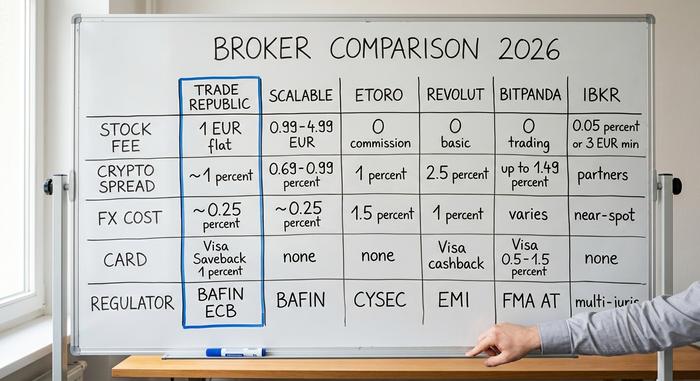
The competitor question depends on what you actually want to do. For an EU investor buying ETFs every month plus some crypto plus a card, Trade Republic wins on banking-licence safety and a single €1 flat-fee structure. For a US-style active trader, Interactive Brokers is the answer and Trade Republic is not.
| Broker | Stock fee | Crypto spread | FX cost | Card | Regulator |
|---|---|---|---|---|---|
| Trade Republic | €1 flat | ~1% | ~0.25% | Visa, 1% Saveback (cap €15/mo) | BaFin/ECB (full bank) |
| Scalable Capital | €0.99–€4.99 | 0.69%–0.99% | ~0.25% | None | BaFin |
| eToro | $0 commission | 1% | 1.5% | None (EU) | CySEC |
| Revolut | €0 basic | 2.5% standard | 1% above plan limit | Visa/Mastercard cashback (tiered) | EMI (LT/IE) |
| Bitpanda | €0 trading | up to 1.49% | varies | Visa, 0.5–1.5% cashback | FMA (Austria) |
| IBKR (EU) | 0.05% / €3 min | spot crypto via partners | near-spot FX | None retail | multi-jurisdiction |
Three picks for typical use cases. Beginner doing monthly ETFs and a Bitcoin nibble: Trade Republic. Heavy crypto buyer who wants tight spreads and an Austrian banking-grade licence: Bitpanda. Active investor placing larger trades and using options: Interactive Brokers — IBKR's percentage fee beats Trade Republic's flat €1 only above roughly €2,000 per ticket, but the platform and product range are in a different league. Scalable Capital is the closest direct rival; the choice between them often comes down to which ETF list you prefer and whether you want crypto inside or outside the brokerage.
Withdrawal, Dividends, and Risks: Investments Subject to Market Risk
Cash withdrawals to your linked SEPA account are free and usually arrive in one to two business days. Outgoing portfolio transfers cost €25 per position plus any costs the receiving custodian charges. Dividends from partner banks and dividends from stocks generally land on the payment date. A 2024-2025 internal system migration produced visible delays for some users. The broker also reissued an apology in early 2025 after an Nvidia stock split caused excess tax debits on customer accounts in September of that year. None of this changes the basic risk picture: investments involve risks, the value of your portfolio is subject to market risk, and past performance is no guarantee of future results — the boilerplate exists because the underlying risk is real.
Verdict on Trade Republic in 2026
Trade Republic in 2026 is the cleanest single-app answer for an EU resident who wants to start investing in ETFs every month, hold a crypto position inside a regulated EU custodian, earn ECB-rate interest on cash, and use a card that routes spend back into the portfolio. The banking licence and the MiCA licence are real moats. The downside is concentration risk in one app that has shown it can break under stress, no options or margin for active traders, customer support that runs mostly on chat, and a list of unsupported countries that excludes US, UK, and Swiss residents. Honestly, I keep coming back to the question of how much I trust a single app with a six-figure portfolio — the answer for most people will be "up to a point", and that point is exactly where a second broker enters the picture.