Czech Republic Crypto Tax in 2026 : Capital Gains Exemption Guide

The Czech Republic spent most of the 2010s as a quiet member of the EU's crypto club. That changed on 15 February 2025, when Act No. 31/2025 Coll. (the Digitalisation of the Financial Market Act) came into force and added a long-term capital gains tax exemption for crypto held more than three years. The Czech President, Petr Pavel, signed the bill on 6 February 2025, ten weeks after Parliament passed it unanimously on 6 December 2024. From that moment, Czechia jumped into Europe's most attractive crypto-tax tier, alongside Germany, Portugal and Malta. Coincub's 2025 European ranking placed Czechia in the top tier of EU crypto-friendly jurisdictions on the back of this single reform.
This guide walks through how Czech Republic crypto tax actually works in 2026: the rates, the famous three-year hold rule, the CZK 100,000 reporting floor, the CZK 40 million cap most articles forget to explain, mining vs staking treatment, and what DAC8 and MiCA mean for crypto investors filing their next tax return. The aim is to give you both the headline numbers and the small print that catches long-term investors out, with the underlying tax laws and tax legislation explained in plain English. The favorable tax regime that emerged from the 2025 reform is now one of the most-quoted reasons foreign cryptocurrency investors in the Czech Republic are restructuring their portfolios, and there are real legal issues to walk through before assuming the new exemption of income provisions automatically apply to your specific crypto activities.
Legal status of cryptocurrencies in the Czech Republic
Bitcoin is not legal tender in the Czech Republic. Neither is Ether. Neither is USDT. The Czech National Bank (ČNB) made the position clear in its 2014 white paper and has not budged since. Czech law treats crypto as intangible movable property: legally recognised, freely transferable, but without the consumer protections that come with fiat currency.
Three operational consequences flow from that classification:
- Private holding is fully legal. Residents and non-residents can buy, sell and hold crypto without a licence.
- Czech businesses can accept crypto as payment. The CZK fair value at the ČNB exchange rate of the transaction day is the accounting basis for both bookkeeping and VAT purposes.
- Every disposal (sale, swap, payment in goods) is a potential taxable event for Czech tax purposes under the Czech Income Tax Act (Act No. 586/1992 Coll.). Any sale of cryptocurrencies that fails one of the exemption tests flows into your taxable income for the calendar year.
The Czech Cryptocurrency Association (Česká kryptoměnová asociace) lobbied from 2018 onward to extend the existing §4 ITA carve-out for long-held securities to crypto. That campaign closed with the February 2025 amendment.
How Czech tax authorities classify crypto assets
Finanční správa, the Czech Financial Administration, classifies crypto assets along two axes that determine how income is taxed.
- Personal vs business holdings. Crypto held outside any business activity falls under §10 of the Income Tax Act ("other income"). Crypto used as part of trade or self-employment falls under §7 (self-employment income).
- Type of crypto-asset. Following MiCA terminology, Czech law now distinguishes between e-money tokens, asset-referenced tokens and other crypto-assets. The 3-year exemption covers most fungible "other crypto-assets" but excludes e-money tokens from the value test.
Czech Republic also designates the Czech Financial Administration and the Czech National Bank as the joint authorities for crypto matters: the ČNB licenses crypto-asset service providers under MiCA, and Finanční správa enforces the income tax act on individual filers.
Taxable events triggering crypto tax in the Czech Republic
The biggest single mistake Czech crypto holders make is assuming only fiat off-ramps trigger tax. They do not. Each of the following is a taxable disposal at fair value in CZK:
- Selling cryptocurrency for fiat (CZK, EUR, USD)
- Crypto-to-crypto swaps (each swap is a disposal of the outgoing coin)
- Using crypto to pay for goods or services
- Receiving mining rewards (taxable on receipt)
- Receiving staking rewards, airdrops or hard-fork coins (taxable on receipt at fair market value)
- Receiving DeFi yield, governance tokens or LP fees
When you swap one token for another, the Czech tax authority treats the outgoing coin as sold at the CZK fair value on the swap date and the incoming coin as acquired at the same value. The difference between the disposal value and the cost basis forms the tax base for that disposal. The 3-year holding clock for the new coin starts on that date, and you only pay tax once the gain falls outside the value test or the time test described in the next sections.
For valuation, taxpayers convert each transaction into CZK using the ČNB exchange rate for the day, or alternatively the annual unified rate published by Finanční správa. The chosen method must be applied consistently for the whole calendar year.
The 3-year holding capital gains tax exemption explained
This is the headline of the 2025 reform and the reason Czech crypto tax now reads so differently from most of Europe. Section §4 of the Income Tax Act, as amended by Act No. 31/2025 Coll., grants a full personal income tax exemption on crypto disposals that pass the time test: the asset was held by the same individual for more than three years before disposal.
Two parallel tests can deliver an exemption, and they work independently:
| Test | Threshold | What it covers |
|---|---|---|
| Value test | CZK 100,000 / calendar year | Total gross income from crypto disposals up to CZK 100,000 in a year is exempt and not reported. E-money tokens excluded. |
| Time test | 3-year holding | Crypto held more than three years before disposal is exempt, capped at CZK 40 million of aggregate qualifying income per year. |
A few details that matter:
- The exemption applies only to individuals. Companies (s.r.o. or a.s.) pay corporate tax on crypto profits regardless of holding period.
- The asset must not be in business assets at the moment of disposal. If the crypto was ever booked as a business asset, the 3-year clock effectively restarts when it leaves the books, standard §4 ITA practice for securities is applied analogously.
- The reform is partially retroactive. Crypto bought before 15 February 2025 still qualifies if disposed of after that date and the 3-year hold is met by the disposal date.
- Czech accounting practice accepts FIFO or weighted arithmetic average for tracking the 3-year clock and the cost basis. Pick one, apply it consistently across the portfolio.
The CZK 100,000 threshold for crypto income tax reporting
Below the value-test threshold, life is easy. Here is the rule in plain numbers. Annual crypto disposal income at or under CZK 100,000 (about EUR 4,000 at mid-2026 rates) is fully exempt and not reportable. This holds regardless of holding period, and regardless of whether the disposals would otherwise have triggered short-term taxation.
Two practical points worth flagging:
- The threshold is on gross disposal income, not realized gain. Sell BTC worth CZK 95,000 that you bought for CZK 30,000? Gross is CZK 95,000. Under the cap. Fully exempt. Push gross sales to CZK 105,000 instead, and the entire CZK 105,000 is reportable, not just the CZK 5,000 excess.
- E-money tokens are excluded from the value test. USDC, USDT and similar stablecoins classified as e-money under MiCA are reportable from the first koruna of disposal.
The CZK 40 million cap on crypto capital gains exemption
This is the part most articles either misstate or skip. The 3-year time-test exemption is capped at CZK 40 million of qualifying income per taxpayer per year, and that ceiling is shared with the existing securities and business-share exemption under §4(1)(x) of the Income Tax Act.
In practical terms: if you sold long-held shares for CZK 30 million in the same year you sold long-held bitcoin for CZK 15 million, only CZK 40 million of the combined CZK 45 million is exempt. The remaining CZK 5 million falls back into normal taxation at 15% or 23% depending on your overall bracket. Most Czech retail crypto holders will never come close to this cap, but anyone with a meaningful securities portfolio plus serious crypto exposure should map the two together before disposing of either.
The cap also explains why some commentators describe the regime as "0% capital gains tax for long-term holders" while others are more cautious. Both can be true. Most filers will see 0%; large holders will see a hybrid.
Personal income tax rates on crypto: 15% and 23% brackets
When crypto disposal income falls outside the exemptions, meaning the assets were held under three years, gross income exceeded CZK 100,000, or e-money tokens were involved, it feeds into the ordinary personal income tax brackets at one of two rates. A rate of 15% applies to annual gross income up to CZK 1,762,812, which is the 2026 threshold, and a rate of 23% kicks in on the portion above that threshold.
The threshold itself is set at 36 times the average monthly wage and is recalculated each year by Finanční správa, so for tax year 2025 returns it sat near CZK 1,676,052, while for 2026 income it has moved up to CZK 1,762,812. The two-bracket structure replaced the old "solidarity surcharge" in the 2024 consolidation package, which means anyone who filed crypto in or before 2023 is dealing with a slightly different framework than the older guides describe.
One detail every Czech crypto investor should internalise is that crypto gains stack with employment, self-employment, and rental income for the purpose of crossing the bracket. If your annual salary alone already sits in the 23% zone, every koruna of taxable crypto gain is taxed at 23% rather than 15%, and the reverse holds too — a year of low employment income gives you a wider 15% runway for taxable crypto disposals.
Crypto mining, staking and NFTs in Czech tax law
The §7 vs §10 distinction is where the Czech regime gets technical, and where most competitor articles wave their hands. Here is the cleaner version.
Mining. Conducted systematically and for profit, mining is treated as self-employment income under §7. That means 15%/23% income tax plus mandatory social security (29.2%) and public health insurance (13.5%). The 2026 minimum monthly assessment bases sit near CZK 14,196 for social and CZK 22,597 for health. Hobby mining at very small scale can fall under §10 "other income" without the social/health hit, but the line is fact-dependent and the burden is on the taxpayer to justify it.
Staking. Small-scale staking by an individual is usually taxed as other income under §10. Professional or systematic staking moves into §7. Either way, the reward is recognised at fair market value in CZK on the date of receipt, not on later sale. A subsequent sale is a separate event with cost basis equal to the receipt-date value, and the 3-year exemption clock starts on the receipt date.
Airdrops and forks. Same logic as staking: taxable on receipt at fair value, new clock starts.
DeFi yield. Finanční správa has not issued formal DeFi guidance as of mid-2026. Default treatment from advisory firms: rewards, governance tokens and LP fees are §10 other income at receipt; adding or removing liquidity is treated as a disposal of the deposited tokens.
NFTs. No standalone NFT regime. Default treatment is identical to other crypto disposals: 15%/23% personal or 21% corporate. Czech tax advisers typically read the §4 exemption as extending to NFTs that fall within MiCA's broad definition, but the conservative position is to claim exemption only for fungible tokens until Finanční správa clarifies. NFT VAT is a separate question covered below.
Crypto taxes for businesses: 21% corporate income tax
The Czech Republic's corporate income tax rate now stands at 21%, a climb from 19% that took effect on 1 January 2024 under that year's consolidation package, and it has stayed flat ever since; this 21
When an investor in Czechia weighs personal versus corporate crypto holding, several practical points kick in: companies skip the §4 ITA three-year personal exemption, so corporate crypto profits remain taxable at 21% regardless of how long the asset is held, and the §19
On the practical setup side, the s.r.o. minimum share capital has been CZK 1 since the 2014 Business Corporations Act reform, although most operating companies still capitalise at CZK 50,000 to CZK 200,000. Setup cost typically runs CZK 15,000 to CZK 30,000 all-in for notary, trade licence, and bank account opening, with ongoing accounting at CZK 3,000 to CZK 10,000 per month.
The honest summary is that for pure long-term holding, the individual three-year exemption beats any corporate structure outright, and corporate wrappers only earn their keep when the activity is genuinely operational. Three typical scenarios where the wrapper does pay off are a mining farm that needs to deduct electricity and hardware, a professional trading desk that already runs payroll, or crypto bolted onto an existing non-crypto operating business that already files through a Czech s.r.o.
How to file crypto tax returns in the Czech Republic
Cryptocurrency income from the sale of crypto assets, mining, staking and DeFi activity all enters the standard personal tax return form (daňové přiznání, Form 25 5405 MFin 5405). The way you file a tax return for crypto under the Czech crypto tax framework depends on classification:
- §10 other income (most retail holders, casual stakers): Annex 2 of the personal return.
- §7 self-employment (commercial miners, professional traders): Annex 1.
Filing deadlines for tax year 2025 returns are 1 April 2026 for paper filing, 2 May 2026 for electronic filing through the DIS+ portal, and 1 July 2026 if a registered tax adviser handles the return. The same calendar shifts forward by exactly one year for tax year 2026 returns.
If your only crypto activity in the year is fully covered by the value test (CZK 100,000 or less), you do not need to file solely because of crypto. If you have other income that requires a return, the exempt crypto activity does not need to be declared on the form.
Czech tax authorities require source records (exchange CSVs, wallet histories, transaction dates, fees, FMV conversions) for at least three years from the end of the tax period. For crypto held in business assets the retention period extends to ten years. CASPs operating under MiCA / DAC8 will report user transactions to Finanční správa starting in 2027 (covering tax year 2026), but that reporting does not relieve the taxpayer of filing obligations.
DAC8 reporting and MiCA rules for crypto investors in Czechia
Two EU regulations are reshaping Czech crypto tax in 2026, and together they reset Czech cryptocurrency taxation around mandatory reporting and proper tax obligations while closing most of the obvious tax evasion routes that worked in the 2017 to 2022 era.
The EU's MiCA, the 2023/1114 Markets in Crypto-Assets Regulation, now puts the Czech National Bank in charge of every crypto asset service provider operating in Czechia, meaning your current cryptocurrency exchange will demand stricter KYC, fuller source-of
The second is DAC8, Council Directive (EU) 2023/2226, which was transposed into Czech law on 31 December 2025. From 1 January 2026 every CASP must collect tax identification numbers and begin logging crypto transactions for Finanční správa, with the first annual reports due in 2027 covering all of tax year 2026, and Czech authorities then exchange that data with the other 26 EU member states.
In plain English, your exchange will hand Finanční správa the same transaction data you should already be putting on your tax return, which means the compliance posture that worked for Czech crypto holders in 2022, namely "report only when I cash out", is no longer realistic.
VAT on cryptocurrency in the Czech Republic
VAT is the one corner of Czech crypto tax that the EU effectively settled back in 2015, when the Court of Justice of the European Union handed down its decision in Hedqvist (Case C-264/14) on 22 October 2015 and ruled that the exchange of cryptocurrency for fiat is a VAT-exempt financial service. Czech Republic codified that holding into §54 of the VAT Act (Act No. 235/2004 Coll.), and the General Financial Directorate confirmed the position in 2022 guidance with no subsequent change.
The key VAT corollaries for Czech crypto holders:
- Crypto-to-fiat exchanges. VAT-exempt.
- Fiat-to-crypto exchanges. VAT-exempt.
- Crypto-to-crypto exchanges. VAT-exempt by extension of the same logic.
- Mining. Outside VAT scope when there is no identifiable customer for the block reward.
- Crypto-as-payment. When a Czech VAT-registered business accepts crypto for goods or services, VAT applies to the CZK fair value of the underlying supply, not to the crypto itself. Standard rate 21%, reduced rate 12% on qualifying goods.
- NFTs. Typically VAT-able as a supply of digital goods or services at the 21% standard rate. The Hedqvist currency-style exemption does not apply automatically.
- Cross-border B2C NFT sales. Follow the OSS place-of-supply rules under the EU one-stop-shop regime.
Czech crypto tax vs Germany, Portugal, Malta and Slovakia
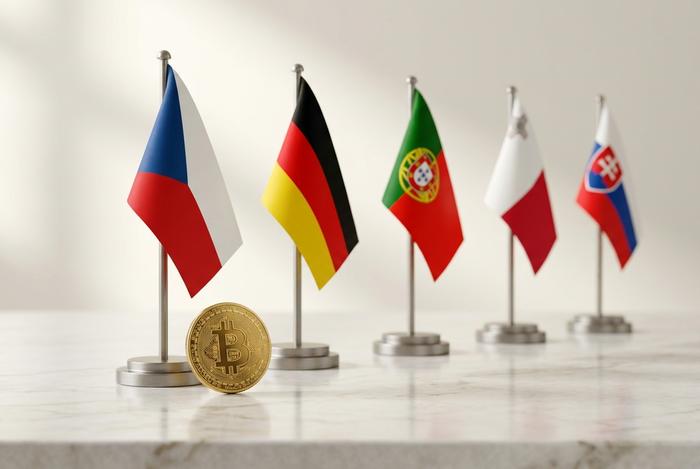
How does Czech crypto tax stack up against the rest of the EU after the 2025 reform? Coincub's 2025 European ranking placed Czechia in the top tier of EU crypto-tax-friendly jurisdictions. Here is the side-by-side for long-term private holders:
| Country | Short-term rate | Long-term rate | Holding period | Annual cap |
|---|---|---|---|---|
| Czech Republic | 15% / 23% | 0% | 3 years | CZK 40M (≈ EUR 1.6M) |
| Germany | up to 45% + soli | 0% | 1 year | None (private sale rule §23 EStG) |
| Portugal | 28% flat | 0% | 1 year | None (since 2023 reform) |
| Malta | 0% on long-term | 0% | n/a | None, but professional traders pay up to 35% |
| Slovakia | up to 25% + 14% health | 7% | 1 year | None |
| Italy | 26% | 26% | n/a | EUR 2,000 de minimis |
| France | 30% PFU flat | 30% | n/a | None for occasional traders |
Czech Republic's three-year holding period is the longest in the top tier (Germany requires only one year for full exemption), but the CZK 40M cap is generous enough that it never bites for almost any retail-scale investor. For professional or operational crypto activity, Malta still has the most flexible regime, but the Czech Republic crypto tax system is now genuinely competitive on the long-tail HODL strategy. The combined tax benefits and tax policy direction also reduce the overall tax burden for foreign investors in the Czech Republic considering relocation, especially when paired with the 183-day residency rule.
This favorable tax positioning is a deliberate piece of Czech tax policy that nudges global taxation discussions on crypto in the EU. The government chose to forgo short-term revenue from long-term holders to attract crypto talent and capital, and so far the cryptocurrencies in the Czech Republic conversation has shifted noticeably toward residency planning and away from the older "where do I cash out cheapest" framing.
Common mistakes crypto investors make on Czech tax returns
A short field guide to the things that catch Czech crypto holders out, drawn from Czech tax-advisory experience and our own competitor research.
1. Treating only fiat off-ramps as taxable. Crypto-to-crypto swaps and crypto-as-payment are also taxable disposals.
2. Ignoring receipt valuation. Staking rewards, airdrops and mining income must be booked at fair market value in CZK on the receipt date, not on later sale.
3. Mixing cost-basis methods. Switching FIFO and weighted average mid-year creates audit risk.
4. Forgetting the CZK 40M aggregate cap is shared with securities exemptions.
5. Assuming the 3-year exemption applies to business assets. It does not, because the asset must be in personal hands at the moment of disposal.
6. Missing the e-money-token carve-out of the value test.
7. Late filing or wrong form. Crypto belongs on Annex 2 (other income) for most filers, Annex 1 only for self-employment.
8. Inadequate transaction records. Three-year retention is the legal minimum, ten years if the crypto is in business assets.
9. Wrong CZK conversion. Use the ČNB rate for the transaction day, or apply the annual unified rate consistently for the whole year.
10. Assuming a MiCA-licensed exchange relieves filing obligations. It does not. DAC8 simply means the exchange shares your data with Finanční správa while the taxpayer still has to file. Specialised legal services from Czech tax advisers can help if your crypto position is large or structurally complex.