Venice AI vs ChatGPT: The Private AI Platform

Erik Voorhees spent a decade building ShapeShift to take banks out of the act of moving money. Venice AI is the same bet pointed at a different target: taking the corporation out of the act of thinking out loud. Most chatbots log every word you type, attach it to your account, then reserve the right to train on it. Venice AI is built on the opposite promise, that a private, uncensored AI platform should keep nothing. Whether you find that liberating or reckless depends on what you plan to type. Either way, it is one of the few AI tools where the design, not the marketing, is the story.
This guide covers what Venice AI is, how its privacy actually works, what "uncensored" really means, the models and pricing, the VVV token that powers it, and how it compares to ChatGPT.
What Venice AI Is and Who Built It
Venice AI is an access layer to open-source AI models, wrapped in a privacy guarantee. It does not train its own frontier model. Instead it runs established open weights, such as Llama, DeepSeek, and Qwen for text, and Flux for images, and lets you talk to them without an account trail. The platform launched in May 2024 and was founded by Erik Voorhees, the crypto entrepreneur behind the early exchange ShapeShift.
That pedigree explains the worldview. Voorhees frames the project as the "separation of mind and state," the idea that your conversations with a machine should be as private as your own thoughts. The pitch has found an audience: Venice reported more than two million registered users by early 2026 and around three million signups by May. It is not the biggest chatbot, not close. But for a privacy-first product with no marketing budget to speak of, that is real traction.
How Venice AI Keeps Your Chats Private
Most "private" labels in tech are policy promises, a company pinky-swearing not to peek. Venice tries to make the promise structural, so that the server cannot peek even if it wanted to.
Local storage and zero data retention
Your conversation history lives in your browser, on your device, not on Venice's servers. When you clear it, it is gone, because there was never a second copy in a data center. Venice states it does not store prompts and does not use them for training. That is the core of the model: the company holds as little about you as the architecture allows.
The SSL proxy and stripped IPs
There is a second layer. Because Venice itself runs open models on third-party GPUs, it proxies requests so the underlying compute provider never sees your identity. Your IP address is stripped before the prompt reaches the model, and traffic is encrypted in transit. In practice, the inference happens, but no one in the chain has both your question and your name.
What private does not mean
Privacy is not magic, and it pays to be precise. Your chats are only as safe as the browser and device holding them, so a shared computer undoes the whole thing. Deleting history is your job, not Venice's. And "private" is not the same as "anonymous billing" unless you pay in crypto rather than a card. The protection is genuine, but it has edges, and pretending otherwise would be the kind of overclaim Venice was built to avoid.
Uncensored AI: What No Filters Really Means
The word "uncensored" does a lot of marketing work, so it is worth being exact. On Venice, uncensored — or unfiltered, as many users call it — means the model gives unrestricted answers and will not refuse a question because the topic is politically awkward, medically frank, legal-but-adult (the NSFW category mainstream tools block outright), or simply uncomfortable. It will not lecture you about why it cannot help. For users asking about taxes, health symptoms, sensitive research, or controversial politics, that alone is the selling point.
But uncensored is not lawless. Venice forbids genuinely illegal content, content involving minors, non-consensual material, doxxing, and defamation. Reviewers who pushed the limits found real guardrails there. So the honest description is "far fewer filters than ChatGPT," not "anything goes." The line sits at the law, not at corporate comfort.
Why does this matter beyond the obvious? Because filters are not free. A model trained to refuse anything sensitive also tends to hedge, water down, and add disclaimers to questions that deserve a straight answer — a tax edge case, a frank read on a medical symptom, a politically charged history question. Venice's wager is that adults can handle direct answers. For some people that distinction is the entire reason to switch; for others it will sound like a liability. Both reactions are fair, and which one you hold says more about your use case than about the tool.
Venice AI Models, Image Generation, and AI Chat
The clearest way to understand Venice is that one subscription buys a menu, not a single model. The menu is the feature.
On the text side, you pick among open models like Llama, DeepSeek, Qwen, and GLM, or let Venice auto-select. AI chat comes with web search for real-time answers and document analysis, so you can upload a PDF and question it privately. The mobile app adds photo analysis from your camera roll. Image generation is built on Flux, with upscaling, background removal, basic editing, plus a social feed where users share prompts. The results are solid but not at the level of a dedicated tool like Midjourney.
Through 2025, Venice widened the menu further. It added pay-per-use access to proprietary models, including ChatGPT, Grok, Gemini, and Google's Veo, alongside video generation and an API for developers. The API matters more than it sounds: it lets builders wire Venice's private, uncensored inference into their own apps, billed through the same token system rather than a corporate contract. The trade is straightforward — you give up a little raw quality against the frontier labs in exchange for choice, privacy, and the creative freedom that the mainstream apps will not offer.
Venice AI Pricing and Free Tier Limits
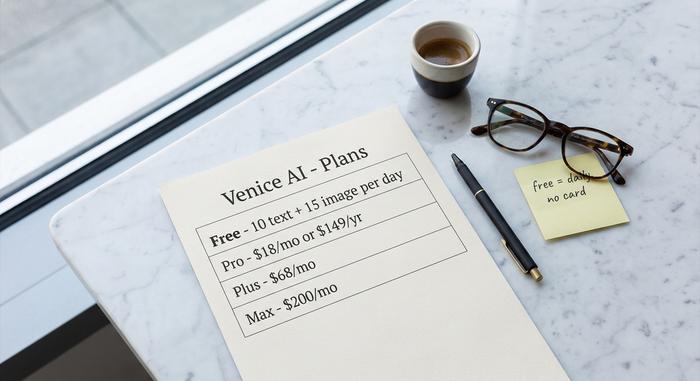
Venice runs a freemium model, and the free tier is unusually usable. It is a daily allowance, not a seven-day trial that expires. The catch is that credits reset monthly and do not roll over, so an unused balance simply vanishes.
| Plan | Price (2026) | What you get | Best for |
|---|---|---|---|
| Free | $0 | 10 text + 15 image prompts/day, no card | Trying it daily |
| Pro | $18/mo or $149/yr | Unlimited prompts, image upscaling, API, no watermarks | Most paying users |
| Plus | $68/mo | Higher limits, more compute | Power users |
| Max | $200/mo | Top compute tier | Heavy/business use |
The pricing is published on Venice's pricing page. At $18 a month, Pro undercuts ChatGPT Plus, and the annual plan works out to roughly $12 a month. Pro is also where the advanced features live: unlimited prompts, image upscaling, the API, and watermark-free output. For a casual user, the free daily allowance is genuinely enough to decide whether the privacy trade is worth it before paying anything.
Venice AI's VVV Token and Crypto Engine
Here is where Venice stops looking like a normal app. Its compute is metered by a crypto token, VVV, and that design is either the most interesting thing about the company or the most off-putting, depending on your tolerance for tokens.
What VVV is and how staking buys inference
VVV launched on January 27, 2025, on Base, Coinbase's Ethereum layer-2. The mechanic is unusual: stake 1% of the total VVV supply and you receive 1% of Venice's daily API inference capacity, on an ongoing basis, without paying per call. Day-to-day compute is measured in "Diem," where one Diem equals roughly one dollar of daily compute, and the network issues a fixed pool of about 18,148 Diem per day. In effect, the token turns AI inference into something you can own a permanent share of rather than rent.
Tokenomics and the $100 million burn
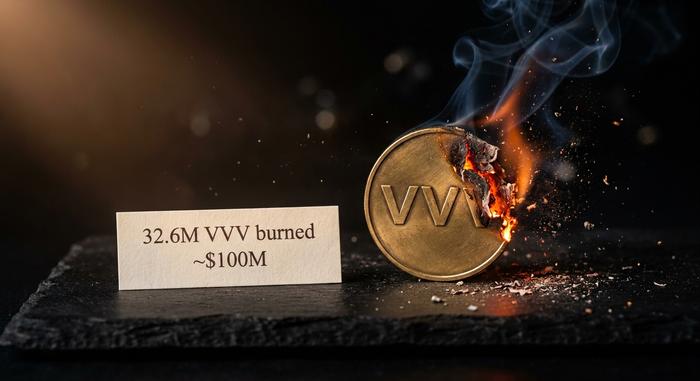
The launch produced one of the stranger numbers in the space. Venice minted 100 million VVV at genesis and earmarked 50 million for an airdrop to crypto holders. But only about 17.4 million were ever claimed, by roughly 40,000 wallets. So in March 2025 Venice burned 32.6 million unclaimed tokens, worth around $100 million at the time. By April 2026, total burns reached 33.7 million, about 42.9% of the original supply, with subscription revenue funding an ongoing buy-and-burn.
Price, controversy, and risk
The token has been volatile in the way crypto usually is. VVV hit an all-time high of $22.58 the day after launch, then fell about 50% within 48 hours amid insider-trading allegations, and eventually bottomed near $0.92 in December 2025. As of mid-2026 it trades around $16 with a market cap near $760 million, according to CoinGecko, and about 66% of the circulating supply is staked — an unusually high lock-up that suggests holders are using the token for inference, not just trading it. The deflation is real, but so is the risk: the supply has no hard cap, and the price history is a reminder that this is a speculative asset bolted to a software product.
| VVV metric | Value (as of mid-2026) |
|---|---|
| Genesis supply | 100 million |
| Burned to date | 33.7 million (42.9% of supply) |
| Circulating supply | ~46.8 million |
| Price | ~$16 (ATH $22.58, ATL $0.92) |
| Market cap | ~$760 million |
| Staked | ~66% of circulating |
The pattern worth noticing is the burn. Venice routes a slice of subscription revenue into buying VVV on the open market and destroying it, so paying customers quietly shrink the supply over time. That ties the token's fate to the product's, not just to speculation — a cleaner link than most AI tokens manage, even if it does not remove the volatility.
Venice AI vs ChatGPT and Other Chatbots
So should you actually switch? The useful way to answer is to stop asking which is "better" and ask which fits the job. Venice and the mainstream chatbots optimize for different things.
Venice vs ChatGPT and Claude
ChatGPT and Claude win on raw capability. Their frontier models reason better and code better, wrapped in polished apps, voice modes, and integrations Venice cannot match. What they will not give you is local-only history or a model that answers a blunt medical or legal question without a disclaimer. Venice trades quality for privacy and freedom — a trade that is obviously worth it for some tasks and obviously not for others. If you are debugging a large codebase, use ChatGPT. If you are working through your own finances or health and would rather no server kept a copy, Venice is the safer room. On price, Pro at $18 a month sits just under ChatGPT Plus at $20, so cost is not the deciding factor either way.
Venice vs Grok and Perplexity
Grok markets itself as the edgy, less-filtered option, but it is centralized and logs your activity to an account, which defeats the privacy case. Perplexity is the better tool for cited web research and speed. Venice AI's claim is narrower and sharper: no other private AI platform combines open-model choice, structural privacy, and uncensored output in one place.
| Tool | Privacy | Censorship | Model choice | Price |
|---|---|---|---|---|
| Venice AI | Local storage, no retention | Minimal (legal floor) | Many open models | Free / $18+ |
| ChatGPT | Account-logged | Strict | OpenAI only | Free / $20 |
| Claude | Account-logged | Strict | Anthropic only | Free / $20 |
| Grok | Account-logged | Looser | xAI only | Via X plans |
| Perplexity | Account-logged | Moderate | Mixed, web-focused | Free / $20 |
Risks and Limits of the Venice AI App
The honest caveats, in one place. Open-source models still trail the frontier, so answers can be weaker than ChatGPT or Claude on hard tasks, and image generation sits below Midjourney. There is no native desktop app, support is thin, and the non-rolling monthly credits frustrate users, reflected in a middling 3.7-star app rating across 250,000-plus downloads. The VVV token adds a layer of volatility most people will not want. And uncensored output cuts both ways: the same freedom that helps a researcher can be misused.
Venice AI is not trying to beat ChatGPT at being ChatGPT. It is selling something the giants structurally will not: a private, permissionless, lightly filtered place to think with a machine, with a crypto token wired into the engine. The model quality is good enough, not best in class, and the token is a genuine risk rather than a gimmick. My suggestion is simple. Spend a week on the free daily allowance, decide whether privacy is worth the quality gap for the way you use AI, and only then worry about Pro or VVV.