What Is the NCMC Card: India’s One Card for Metro and Beyond
Ask any regular metro rider in India and they'll tell you the same story. Delhi Metro card for Monday, a separate token for the Mumbai trip on Wednesday, a different card again for Chennai buses on Friday. Three cities, three systems, three top-up queues. The NCMC card came out of that frustration. Tap once. Travel anywhere. No extra cards, no city-specific wallets eating up your pocket.
What Is the National Common Mobility Card
So what exactly is the NCMC card? Short answer: it's a contactless smart card backed by the Government of India that you can use at metro stations, on city buses, at toll plazas, and at regular retail stores — all with the same card. The full name is National Common Mobility Card.
It runs on the RuPay EMV NFC standard, built by NPCI (National Payments Corporation of India). PM Narendra Modi launched it on March 4, 2019, in Ahmedabad as part of the "One Nation, One Card" push.
The card operates offline at the point of tap. No Wi-Fi, no mobile data — the chip handles the transaction directly. That matters on a metro platform or inside a bus where connectivity is spotty at best. City-specific cards do this too, but only within their own city. The NCMC does it everywhere.
How the NCMC Card Works
The NCMC runs on a two-layer architecture that keeps transit payments separate from your bank account.
The card carries an offline chip wallet that stores a preloaded balance. This is what gets deducted when you tap at a metro gate or board a bus. No server ping, no internet. The chip handles everything locally. Maximum balance on this wallet: ₹2,000.
For larger transactions, the card links to your bank account. Contactless payments up to ₹5,000 go through without a PIN — just tap. This limit applies to online bank account transactions, not the chip wallet.
Here is how a payment actually flows from top-up to tap:
- Add money to your NCMC card via your bank app, UPI, or at a metro counter.
- The balance lands on the bank's server, not yet on the card's chip.
- Tap the card at an AFC (Automatic Fare Collection) gate or kiosk. This pushes the balance from the server to the chip.
- The chip now holds the loaded amount and deducts the correct fare each time you tap.
- At retail POS terminals, the transaction routes through the RuPay network like any standard contactless payment.
In February 2024, RBI dropped the KYC requirement for NCMC cards with a wallet limit of ₹3,000 or below. That opened the card to users without full bank documentation — daily-wage commuters and others who had been excluded from the system.
Where Can You Use the NCMC Card
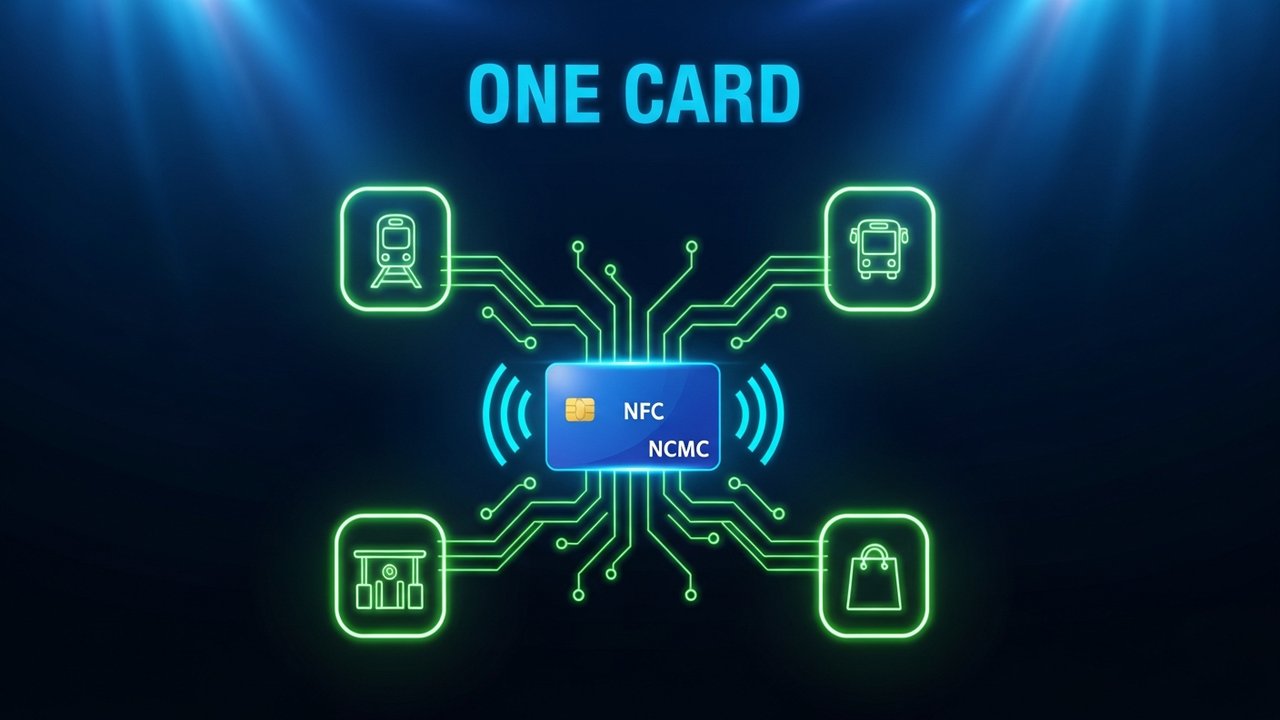
The NCMC card covers a wide range of transit and retail use cases. Rollout speed has varied significantly by city, but the list of supported networks has grown steadily since 2019.
| Use Case | Supported Networks | Notes |
|---|---|---|
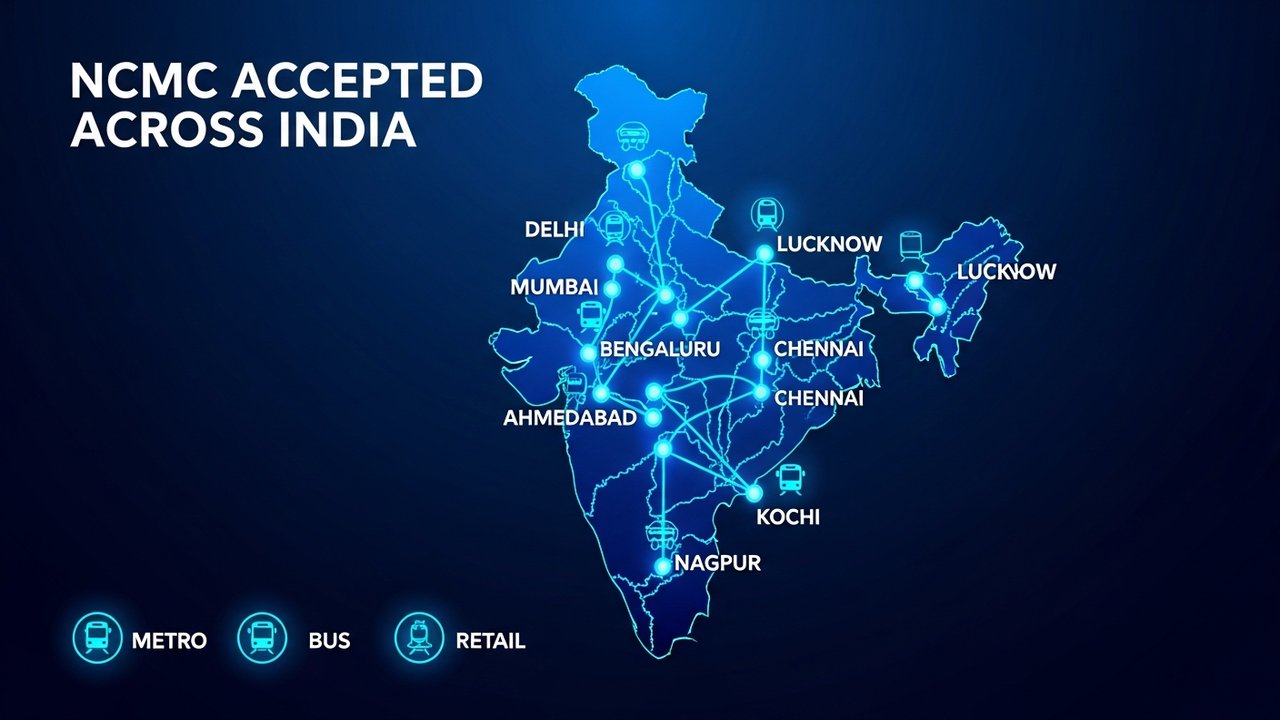
| Metro rail | Delhi, Mumbai, Bengaluru, Chennai, Ahmedabad, Pune, Kochi, Nagpur, Lucknow | Most major metros now accept NCMC |
| City buses | DTC (Delhi), BMTC (Bengaluru), MTC (Chennai) | Rollout ongoing in other cities |
| Toll plazas | Select FASTag-compatible corridors | NCMC integration with toll infrastructure is expanding |
| Parking lots | Government-run and select private lots | Available in cities with NCMC-enabled parking systems |
| Retail POS | Any RuPay contactless terminal | Works as a standard debit/prepaid card |
| ATM withdrawals | For NCMC debit card variants only | Prepaid-only cards do not support ATM cash withdrawals |
Take a commuter who works in Delhi but visits Mumbai monthly. With the NCMC card, there is no need to pick up a separate card at CSMT. The same tap that works at Rajiv Chowk works at any NCMC-enabled metro station in Mumbai.
Which Banks Issue the NCMC Card
More than 25 banks in India can issue NCMC cards. The card comes in two forms.
A prepaid NCMC card is a standalone wallet not tied to a savings account. Good for commuters who just want a dedicated transit card. Some variants require minimal or no KYC for limits up to ₹3,000.
An NCMC debit card is a standard RuPay debit card with NCMC built in. It handles ATM withdrawals, online transactions, and all regular debit functions alongside transit use.
Banks currently issuing NCMC cards include:
- State Bank of India (SBI)
- Bank of India (BOI)
- Punjab National Bank (PNB)
- Canara Bank
- HDFC Bank
- ICICI Bank
- Axis Bank
- Kotak Mahindra Bank
- Indian Overseas Bank (IOB)
- Airtel Payments Bank
Applications go through a bank branch, net banking portal, or mobile app depending on the bank. Processing times range from a few days to two weeks.
One thing worth noting: Paytm Payments Bank had been a popular NCMC issuer among digital-first users. When Paytm Payments Bank shut down in 2024, existing cardholders were told to transfer balances and move to another bank. Remaining balances were refunded through the closure process.
How to Get and Recharge the NCMC Card
Getting the card is simple. Recharging has one gotcha that catches a lot of first-time users.
Getting your card:
- Decide between a prepaid or NCMC debit card based on whether you want bank account access.
- Apply at a branch, via net banking, or through the mobile app. Some metro stations issue prepaid cards directly.
- Complete KYC if your wallet limit exceeds ₹3,000. For smaller limits, KYC has been waived since early 2024.
- Receive the card by courier or pick it up at the branch — typically 3 to 7 business days.
Recharging your card:
- Open your bank app or a UPI app and add funds to your NCMC wallet or linked account.
- Or visit a metro station kiosk or ticket counter to top up with cash.
- After any online top-up, tap the card at an AFC gate or metro station kiosk. This step syncs the new balance from the server to the chip. Skip it and the balance sits on the bank's server, unavailable for transit.
- After that first sync tap, the card deducts fares automatically until the next recharge.
If your card shows zero at the gate after a successful online top-up, the sync tap almost always fixes it. That step trips up more users than anything else.
NCMC Card vs. City-Specific Transit Cards
Before the NCMC, each major city built its own closed-loop mobility card. Those cards worked fine within their own network. Crossing into another city meant starting from scratch with a new card, new app, new recharge point.
| Feature | NCMC Card | Delhi Metro Smart Card | Mumbai Metro One Card | Chennai Singara Card |
|---|---|---|---|---|
| Works across cities | Yes | No | No | No |
| Reusable | Yes | Yes | Yes | Yes |
| Retail payments | Yes | No | No | No |
| ATM withdrawals | Yes (debit variant) | No | No | No |
| Offline wallet | Yes (₹2,000 max) | Yes | Yes | Yes |
| Interoperable standard | Open-loop RuPay | Closed-loop | Closed-loop | Closed-loop |
| KYC-free option | Yes (≤₹3,000) | Varies | Varies | Varies |
The interoperable design is what sets the NCMC apart. City-specific mobility cards are cheaper to deploy and work well inside one operator's system. But the moment a commuter crosses city lines, those cards become useless. Any city that installs a RuPay-compatible AFC reader can accept NCMC without custom integration work.
Benefits and Limitations of the NCMC Card
The NCMC card solves real problems. It also has real friction that is worth knowing upfront.
What works well:
- One card, all transit — metro, bus, toll, and retail from a single wallet
- Offline payments — the chip processes transactions without any internet connection
- Contactless speed — tap-and-go entry, no fumbling for cash or tokens
- Financial inclusion — the no-KYC prepaid option brings transit access to the unbanked
- No city lock-in — the same card travels with you to Delhi, Mumbai, Bengaluru, and any new city that comes online
- Full banking on one card — NCMC debit cardholders get ATM access and online transactions alongside transit
Where it falls short:
- Patchy rollout — Bengaluru had around 5,000 active NCMC cards in its first six months (August 2023). Kolkata had no deployment at all as of 2022. The card only works where the hardware has actually been installed.
- The two-step recharge — online top-ups require a physical sync tap before the balance hits the chip. Closed-loop city cards update instantly; this one does not.
- ₹2,000 wallet cap — fine for daily commuting, but heavy users will recharge often.
- Bus coverage lags metro — many bus operators have not deployed NCMC readers even in cities where metro acceptance is complete.
For commuters in cities with solid rollout, these gaps are manageable. In cities where infrastructure is still catching up, the card's promise runs ahead of its reality.
The move toward benefits of accepting digital payments that reach beyond transit is pushing interoperable, contactless infrastructure further into the mainstream.
The Future of NCMC — Digital Payments in India
The NCMC card is infrastructure. NPCI and the Government of India keep building on top of it.
UPI linking is the biggest item on the roadmap. NPCI has been working to connect UPI accounts directly to NCMC wallets. That would let commuters top up through any UPI app and would kill the two-step sync process entirely. It would also bring the NCMC experience closer to the QR-code transit payments common in other countries.
Wearables are already moving. NPCI has enabled NCMC on select smartwatches and wearable devices. Tap to pay at a metro gate without a physical card. Similar wearable rollouts have happened in transit systems globally, and India is following the same path.
BBPS integration would put NCMC recharges on the Bharat Bill Payment System, opening the top-up process to any BBPS-enabled platform far beyond bank apps and metro counters.
India's digital payments stack is consolidating. UPI, RuPay, NCMC, BBPS — all NPCI products, all moving toward tighter integration. The policy direction is clear even when individual timelines are not.
For merchants and payment operators, this convergence matters. Businesses that accept multiple payment rails reach more customers. That principle holds globally, not just for Indian transit. Platforms that support diverse methods — from RuPay contactless to cryptocurrency — stay ahead of fragmentation rather than fighting it. A cryptocurrency payment gateway like Plisio works the same way: accept payments where your customers actually are, not just where it is easy. Merchants building a crypto payment strategy alongside traditional payment acceptance are drawing from the same logic the NCMC was built on — interoperability wins.