Jordan Belfort: Net Worth, Wolf of Wall Street, and Crypto Views
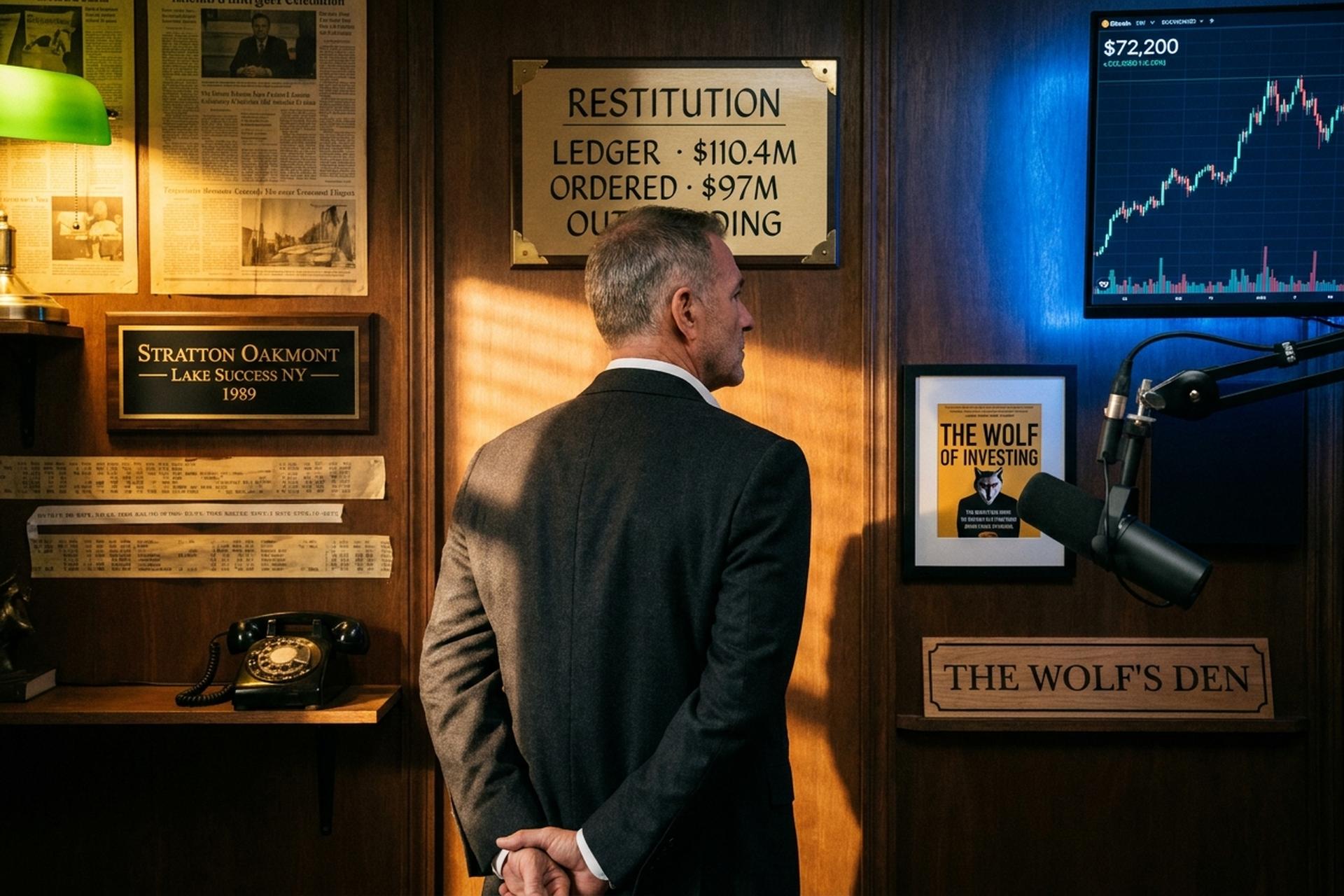
Jordan Belfort owes his victims roughly $97 million as of 2024 court filings. That is the number court filings still cite as the outstanding balance on his original $110.4 million restitution order from 2003 — the bill for what Stratton Oakmont, the brokerage he founded in 1989, did to about 1,513 retail investors through a textbook pump-and-dump operation on Long Island. Belfort served 22 months in federal prison after cooperating against 29 former associates. He has been a motivational speaker, author, podcast host, occasional Bitcoin commentator, and the central character of an Oscar-nominated Martin Scorsese film since.
This rewrite covers Belfort's life and net worth honestly: where the money came from, where it went, what court records actually say about his finances today, and how his views on crypto have shifted from "the biggest scam ever" in 2017 to a much more nuanced position by 2023. The article appears on Plisio, a crypto payment gateway, because Belfort's Stratton Oakmont playbook is, mechanically, identical to the meme-coin pump-and-dump schemes that show up daily in the crypto market — and his warnings about that mechanic are some of the most credible coming from inside the fraud world.
Early Life: Queens, Door-to-Door Sales, and a Brief Try at Dentistry
The Bayside, Queens kid who would become the Wolf was the son of two accountants, Max and Leah. Wikipedia lists his birthplace as the Bronx; pretty much every other source puts the family in Queens by the time anyone was paying attention. Either way, the formative years are Long Island suburbs in the 1970s.
What he likes to tell interviewers is the Italian-ice story. He and a childhood friend pushed coolers around Jones Beach during the summers and supposedly cleared $20,000 across one of them. Treat the figure with caution. The pattern is what matters: a kid who would rather hustle for cash than wait for his weekly allowance.
He went to American University, got a biology degree, then headed to the University of Maryland School of Dentistry. He quit on day one. The dean had opened orientation by warning the class that dentistry no longer paid like it used to. To most students that was a useful caveat. To Belfort it was a deal-breaker. He drove back to Long Island that afternoon.
What followed was a year selling meat and seafood door-to-door, personal bankruptcy at twenty-five, and a trainee stockbroker job at L.F. Rothschild. Black Monday came in October 1987. Rothschild laid off most of the floor including Belfort. Two years later he opened his own shop.
Stratton Oakmont: The Pump-and-Dump Machine
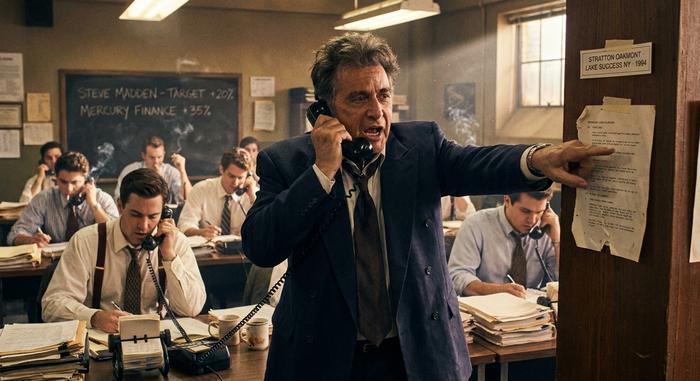
Stratton Oakmont was a boiler room. Lake Success, New York, opened in 1989 with Danny Porush as co-founder. The mechanics ran on penny stocks. Buy cheap. Pump hard through cold-callers reading high-pressure scripts to retail buyers across the country. Dump inflated shares from insider accounts. Repeat. By the firm's count and the prosecution's, Stratton ran this play on at least 34 manipulated IPOs, including some household names — Steve Madden, the footwear company, sat in that mix.
Headcount hit four digits mid-decade. More than a thousand brokers wearing suits and reading from binders, the way the Scorsese film later showed. Regulators noticed. The SEC banned Belfort personally in March 1994. NASD, FINRA's predecessor, killed Stratton itself on December 5, 1996. Two years after that the prosecutors moved.
The indictment landed in 1998 out of the Eastern District of New York. Twenty-seven counts. Securities fraud, money laundering, perjury, conspiracy. Total proceeds across all 1,513 individual victims came to roughly $200 million. Belfort pleaded guilty in 1999 and started cooperating immediately. The sentencing took until July 18, 2003 because the cooperation kept paying.
He got four years. He served twenty-two months at Taft Correctional Institution in California. He wore a wire. He testified against twenty-nine former associates including Porush. He walked out of Taft in April 2006 with a manuscript half-written and an idea about what to do next.
Net Worth: What Court Records Actually Say
The honest answer to "What is Jordan Belfort worth?" is that it depends on which set of numbers you use, and both are real.
Celebrity Net Worth lists him at negative $100 million. That figure reflects his legal liability: $110.4 million in court-ordered restitution to his Stratton Oakmont victims, of which roughly $12.8 million has been paid over two decades. About $11 million of that came from real estate seized at the time of his arrest. Voluntary payments since release total well under $2 million. Outstanding balance as of 2024: approximately $97 million.
Mainstream business press cites $30 million to $100 million for Belfort's working assets: speaking fees, book royalties, Straight Line System course sales, and his stake in private ventures. The largest single observed event was his pledge in 2013 to assign 100 percent of book and film royalties to the victim fund. The actual transferred amount has never been publicly itemized.
| Metric | Value |
|---|---|
| Restitution ordered (2003) | $110.4M to 1,513 victims |
| Amount paid (cumulative) | ~$12.8M |
| Outstanding balance (2024) | ~$97M |
| Celebrity Net Worth listing | -$100M |
| Mainstream press estimate (working assets) | $30M–$100M |
| Speaking fee per engagement | $75K–$200K |
| Film The Wolf of Wall Street worldwide gross | $407M |
In 2013, Belfort's payment plan was modified from 50 percent of gross earnings to a flat minimum of $10,000 per month for life. In December 2018, Judge Ann Donnelly ordered him to surrender his entire stake in Delos, a wellness-real-estate venture, to the victim fund. The Mandatory Victims Restitution Act gives federal prosecutors a 20-year collection window from his release, which means active collection continues through roughly 2026.
The Wolf of Wall Street: Book, Film, and the Speaking Economy
The manuscript got finished. The Wolf of Wall Street came out in 2007 to mixed reviews but solid sales. Catching the Wolf of Wall Street followed in 2009. Both were profitable. Neither would have mattered without Scorsese.
The 2013 film grossed $407 million worldwide against a budget north of $100 million. Five Oscar nominations including Best Picture. DiCaprio as Belfort. The role pushed both the book sales and the speaking-career bookings to numbers that someone fresh out of federal prison should not realistically reach. Whether the film made Belfort a cautionary tale or a Halloween costume depended entirely on which audience was watching.
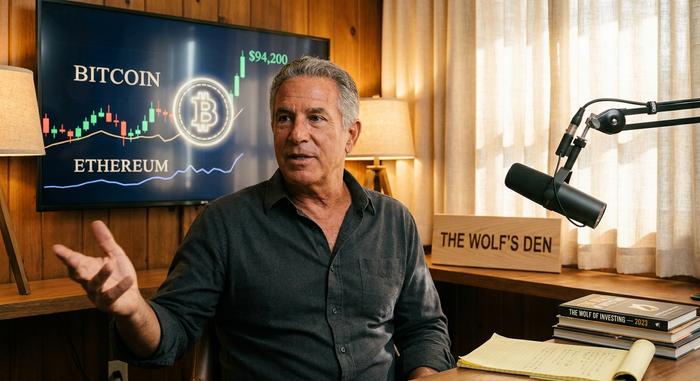
What Belfort built on top of that recognition is a working business. Straight Line System is the flagship course — Stratton scripts, sanded down, rebranded as ethical persuasion. Straight Line Persuasion is the companion product. Keynote speaking fees through All American Speakers Bureau run from $75,000 at the floor to about $200,000 at the high end, depending on the venue. Two podcasts run on regular schedules: a daily Sales School, and a long-form interview show called The Wolf's Den that started in 2019.
The third major book was The Wolf of Investing, published in 2023. It is not a sales-technique book. It is a retail-investing primer, and the crypto chapters are sharper than anything in his television interviews. Bitcoin and Ethereum get treated as legitimate asset-class allocations. Ninety-nine percent of the rest of the token universe gets framed as Stratton Oakmont with a wallet address.
Belfort and Crypto: From Biggest Scam Ever to Bitcoin Convert
Belfort has been wrong about crypto in public on camera multiple times. He has also been right. The arc runs through four phases, each visible in a separate televised moment.
Phase one was October 2017 on CNBC, with the ICO mania at peak euphoria. He called initial coin offerings "the biggest scam ever, far worse than anything I was ever doing." A defensible position at the time. Most ICOs from that vintage did turn out to be scams.
Phase two arrived two months later. Bitcoin near $20,000. Belfort on CNBC again, calling BTC a "huge danger," a "dark market bubble," predicting "the beginning of the end." He doubled down in June 2018: get out, you will lose everything, this is Greater Fool Theory. That call aged poorly the moment Bitcoin printed $69,000 in November 2021.
Phase three was the reversal. March 2021. CoinDesk interview. Belfort predicted BTC at $100,000 and admitted his earlier dismissal had been a mistake. He had not seen the institutional rotation coming.
Phase four is the current position, which he gave to Benzinga's Raz Report in September 2023. "I was right about crypto being a scam. But Bitcoin is different." He holds both BTC and ETH personally. He recommends a five-to-ten percent portfolio allocation to crypto for retail investors who can handle the volatility. The hardening on meme coins is recent: he calls them flat-out scams and argues that influencers shilling them are looking at potential five-plus-year prison sentences once the SEC works through its enforcement queue.
Whether the legal-exposure prediction holds is anyone's guess. What is clear is that Belfort speaks with unusual authority about how pump-and-dumps work mechanically. He ran one for nearly a decade. He saw most of the warning signs from the inside and then spent twenty-two months thinking about which signs he had ignored.
Lessons for the Crypto-Fraud Era
The mechanics of Belfort's 1990s Stratton Oakmont scheme map cleanly onto current crypto pump-and-dump tactics. Stratton brokers picked a thin-float small-cap, accumulated cheap insider supply, ran coordinated cold-call campaigns to inflate retail demand, then sold into the rally and left buyers holding worthless paper. Substitute "low-liquidity meme coin on Solana" for "penny stock on the pink sheets," and "Telegram trading group" for "boiler room," and the structure is identical.
Belfort has been explicit about this in recent interviews. He calls coordinated crypto-influencer token pumps "the same playbook with a Solana wallet instead of a brokerage account" — a comparison he makes deliberately, since it gives his audience the most direct way to recognize the pattern. The legal exposure runs higher than people assume. Securities-fraud statutes apply to digital assets the SEC classifies as securities, and the 2023-2025 enforcement wave under Gary Gensler and his successors has expanded the threat model.
For readers using crypto payment infrastructure like Plisio, the practical filter is the same one Stratton victims should have used in 1995. If a token is being promoted by paid influencers, has no actual revenue or product behind it, and is being sold with claims of asymmetric returns "before the next bull run," the structure of the pitch is the structure of the fraud. That pattern existed before crypto and will outlast it.
The detail that matters in Belfort's framing is the regulatory consequence. Stratton brokers had ten-plus years to enjoy their fraud proceeds before federal prison caught up. Crypto-influencer pump-and-dumps in 2025 are leaving cleaner on-chain trails through services like Chainalysis and Arkham, with FBI and SEC enforcement now actively pursuing both promoters and large insider sellers. Belfort's argument is not that crypto is uniquely bad. It is that crypto-specific scams will catch their participants faster than his generation's scams caught him.
Personal Life: Four Marriages, Two Children, Miami
Four marriages. The math goes like this. Denise Lombardo was the first, 1985 to 1991, no kids, pre-Stratton. Nadine Caridi came next — the one DiCaprio's wife Naomi is based on in the film. They married in 1991 and divorced in 2005 while everything else was on fire: the federal investigation, the drug habit, the domestic scenes the movie pushed harder than they probably needed to. Caridi and Belfort had two children. Chandler was born on July 29, 1993. Carter came later. Both are adults now, and Chandler has been visible in finance-podcast circuits over the past few years.
Wife number three was Anne Koppe, 2008 to 2020. Twelve years, mostly out of the press. Wife number four is the current one: Cristina Invernizzi, an Argentine model. They married on February 23, 2021 in Las Vegas. Miami is home now. Belfort runs his speaking business and Global Motivation Inc. — the parent of the Straight Line training products — out of South Florida.
One footnote that deserves its own beat. In 2021 someone breached Belfort's personal crypto wallet and walked away with about $300,000 in digital assets. Belfort talked about it on podcast appearances as a self-custody lesson. The Wolf of Wall Street got phished. There is a version of that story that reads as poetic justice. The honest version is that by 2021, getting phished was a normal Tuesday for any visible crypto holder who had not moved long-term positions to hardware. The lesson is the same lesson Stratton victims should have learned in 1995 about putting trust in places they could not verify.