What Does a Pending Transaction Mean? Pending vs Posted Explained

Every time you tap a card, swipe through an ACH transfer, or broadcast a Bitcoin payment, the money goes through a short window where it has been approved but not yet finalised. That window is the pending transaction. For most people it passes without notice. When it stalls, a hotel hold still showing five days later, a Bitcoin deposit at Coinbase that refuses to credit, an Ethereum transaction "stuck pending" on Etherscan, the same question comes up: what does a pending transaction actually mean, and what can I do about it?
This guide answers that for both rails: traditional banks and crypto. Bank pending transactions are increasingly short, Visa caps most authorizations at 5 calendar days, ACH still settles in 1 to 3 business days, and FedNow's instant-payment rail processed roughly $853 billion in 2025, up 460% year on year. Crypto pending transactions follow a completely different model. There is no merchant, no settlement bank, no overnight batch, only a public mempool, a fee market, and a block producer deciding when your transaction gets confirmed. The mechanics are different, but the user-facing question is identical: how long until the money actually moves?
What a pending transaction means in plain English
A pending transaction is a transaction that has been authorised by both parties but has not yet been finalised on the underlying network or ledger. The bank or blockchain has acknowledged the request and reserved the funds, but the final accounting entry, what banks call the posted transaction, has not happened yet. During the pending period, the money is in limbo.
For a credit or debit card purchase, the pending status begins the moment the merchant's terminal receives the authorisation code from the issuing bank. The bank then places a hold on your account equal to the amount of the purchase. Your account balance does not change, but your available balance drops by the pending amount. When the merchant later submits the batch of authorised charges for settlement, usually overnight, sometimes days later, the bank converts the hold into a posted transaction and your account balance updates to the final amount.
In cryptocurrency, the term means something different. A pending transaction is one that has been signed by the sender and broadcast to the network, but has not yet been confirmed in a block. While the bank verifies that funds and identity are valid, in crypto the network's miners or validators do the verifying. Until enough confirmations stack up, the exact number depends on the chain and the receiving service, the transaction sits in the mempool, the public waiting room of unconfirmed transactions.
The same word, two very different mechanisms. That distinction explains almost everything else.
How long do pending transactions take to post?
The duration of a pending transaction depends entirely on which rail the money is travelling on.
For card payments under Visa rules, most card-present and merchant-initiated transactions must be cleared within 5 calendar days of authorisation, and card-not-present customer transactions within 10 days. A debit card authorisation hold typically releases inside 1 to 8 business days according to industry references. Hotels, car rentals, and a handful of similar verticals can stretch a hold for up to 30 calendar days. ACH transfers still run on a 1- to 3-business-day clock, although same-day ACH now offers three Federal Reserve processing windows each business day (10:30 AM, 2:45 PM, and 4:45 PM Eastern) with a $1 million per-transaction cap. Fedwire, the real-time large-value rail, settles within the same business day, and FedNow now clears instantly, 1,600 financial institutions participated as of early 2026, the system cleared $853.4 billion in 2025, and volume grew 460% year on year.
For crypto, "long" can mean less than a minute or several hours. Bitcoin produces a new block roughly every 10 minutes; Ethereum every 12 seconds; Solana every 400 milliseconds. The bottleneck is rarely block time. It is the queue. If you pay a market-rate fee, about $0.42 on Bitcoin and $0.23 on Ethereum in May 2026, your transaction is usually in the next block or two. Pay below market and you wait. On Solana, the bottleneck is not even the queue but failure: an ISSTA 2025 study found 73.4% of bot-driven Solana transactions fail, mostly because of slippage or invalid status.
Some transactions show as pending even after they have technically settled at the network level, because the exchange or wallet credits the deposit only after waiting for a certain number of confirmations. That gap is where most user frustration lives.
How pending transactions affect your available balance
The difference between a pending and a posted transaction is whether the entry has been written to the ledger or is still being held. The pending charge reduces your available balance immediately, but does not change your account balance. The posted transaction does both.
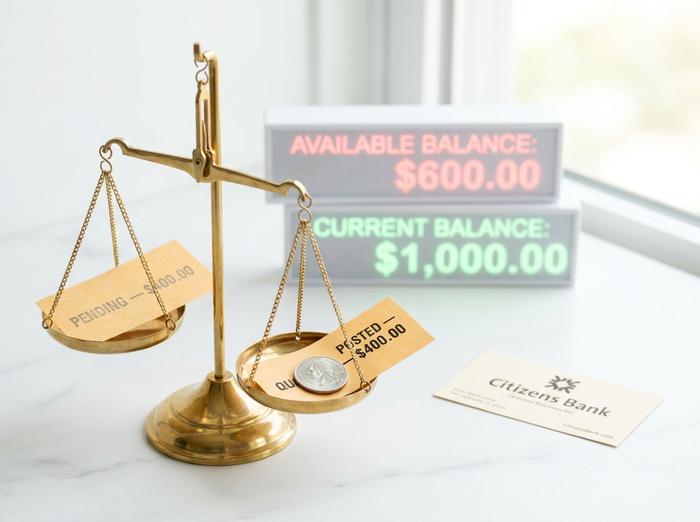
For a worked example, consider a debit card user with a $1,000 checking account current balance. A $400 purchase with a debit card clears authorisation and appears as pending; the bank's system shows that pending transactions work by quietly reducing the available balance while the current balance does not move. The current balance still reads $1,000 but the available balance reads $600. Two days later the merchant submits the batch for settlement. The pending entry disappears, the posted transaction appears for $400, and the current balance now reads $600 as well. From the user's perspective the money moved twice — once in the available-balance display and once when the bank actually deducted it from the account.
A pending amount can also change before it posts. A restaurant tab authorised at $80 might post at $96 if you add a tip; a gas-station pre-authorisation often holds $1 and posts the real amount later, finally being placed on your account at the true fuel cost. Pending transactions can therefore appear, change, and even disappear without posting, which is why a transaction history will sometimes show a hold that quietly drops off the next day. Most banks let you view your account online and see exactly which entries are pending versus which have been posted to your account.
The simple rule: spend from your available balance, not your current balance, and treat the pending status as your real spending power.
Pending transactions impact on account balance and current balance
The pending period has one important consequence for consumer protection: you generally cannot dispute a pending transaction. The Visa and Mastercard standard customer dispute window, 120 days, starts after the transaction posts, not when it is authorised. If you see a pending charge you do not recognise, the practical move is to contact your bank immediately and ask them to flag the item; for non-fraud cases, contact the merchant to void the authorisation before the bank deducts the funds from your account. A bank-side stop-payment order is possible for some bank transactions but usually costs $20 to $30 and is slow.
For business operators, the same gap matters in the other direction. Authorisation holds reduce merchant chargeback rates by an estimated 15 to 20%, because the issuer's risk checks happen before the bank verifies and settles the payment (Solidgate). With global chargeback volume projected at 324 million per year by 2028, the pending-period verification step is doing meaningful work even when consumers never see it. A pending credit, such as a refund issued before the original charge has posted, can also briefly appear in your account online and then resolve once the issuing bank processes it.
Type of transaction that may show as pending: debit and credit card
Almost every type of transaction passes through a pending status at some point — that is when the transaction appears in your account history but has not yet been posted to your account. Debit card transactions are the most visible: a typical debit card transaction clears in 1 to 3 business days, while a credit card transaction can take up to 5 business days under standard Visa rules, and up to 30 in special-industry categories. ACH transfers and pending deposits sit pending for 1 to 2 business days; the funds are not yet available in your account during that window. Wire transfers settle within the same business day in most jurisdictions. Cash deposits at a teller usually post the next business day to your checking account. Cheques are slower and may pend for 2 to 7 business days, depending on the issuing bank and whether the bank verifies the deposit immediately. Each card payment, every debit or credit card swipe, every ACH push — almost always show as pending first before they post to your account.
A pre-authorisation hold is a special case. Hotels, gas stations, and car-rental companies routinely place a hold larger than the final amount expected, then release the difference at checkout. That hold can sit on your account for up to 30 days even though no settlement ever occurs on it. A pending deposit works the same way in reverse: the funds are scheduled but not yet available to spend until the deposit posts. Any of these can show as pending in your account history.
Can you cancel a pending transaction?
Usually not directly. Once an authorisation is in place, only the merchant can void it before settlement. Most banks will not cancel a pending transaction on the customer's request; the standard answer is to wait for it to either post or drop off, then dispute or refund as appropriate. The exceptions are stop-payment orders for cheques and certain ACH debits, which carry a $20 to $30 fee and have to be filed before the item processes.
If the pending charge is fraudulent, contact your bank immediately, freeze the card, and document the time and merchant, the dispute can be filed the moment the transaction posts.
Pending transactions in cryptocurrency and the transaction history
In crypto, a pending transaction is one that has been broadcast to a network but not yet included in a confirmed block. The mechanics are public and verifiable, which is the opposite of the bank model.
Bitcoin transactions enter the mempool, the global pool of unconfirmed transactions, and miners select them by fee rate. In May 2026 the median priority fee sat at the 1 sat per vByte floor and the average transaction cost $0.418, according to BitInfoCharts and BTC.network. Pay above the median and your transaction is usually in the next block; pay below it and you wait. The default Bitcoin node mempool memory limit is 300 MB, so during heavy congestion low-fee transactions can be evicted entirely and need to be rebroadcast.
Ethereum uses the EIP-1559 base-fee model. The base fee adjusts up or down by up to 12.5% per 12-second block based on demand. As of April 2026 the average gas price was 0.052 Gwei and a typical mainnet transaction cost about $0.23, because roughly 95% of throughput now happens on Layer 2 rollups. Full Ethereum finality, the point at which a transaction is functionally irreversible, takes two epochs, about 12 to 13 minutes. Stuck Ethereum transactions usually trace to one of three causes: a gas price below the current base fee, network congestion, or nonce blocking. Ethereum processes a wallet's transactions strictly in nonce order, so a single stuck transaction blocks every later transaction from the same address.
Solana is structurally different. Block time is 400 milliseconds and current finality is about 12.8 seconds, with the upcoming Alpenglow upgrade targeting 150 milliseconds (Helius, QuickNode). The pending experience is dominated less by waiting and more by failure: an ISSTA 2025 paper documented a 73.4% failure rate for bot transactions, with 86.4% of those failures caused by slippage or invalid status.

How crypto exchange confirmations and pending status work
Even after a transaction confirms on-chain, the exchange you sent it to will usually keep it in a pending state until a certain number of additional confirmations have been added. This is a defensive policy against chain reorganisations, and the number varies by exchange.
| Exchange | BTC confirmations | ETH confirmations | Typical wait |
|---|---|---|---|
| Coinbase | 3 (~30 min) | 14 | 30 min BTC, 3 min ETH |
| Binance | 1 (~10 min) | 12 | 10 min BTC, 2.5 min ETH |
| Kraken | 4 (~40 min) | 20 | 40 min BTC, 4 min ETH |
| Gemini | 3 (~30 min) | 64 | 30 min BTC, 13 min ETH |
The takeaway: the same on-chain transaction can be "pending" anywhere from about 10 minutes to over half an hour depending on where you sent it. Higher-value deposits sometimes require additional confirmations on top.
Why a transaction stays pending and how to fix it
For a card transaction, "stuck" usually means the merchant has not submitted the batch for settlement yet, the bank's processor is delayed, or a pre-authorisation hold is sitting on the account longer than expected. The fix is patience, then a merchant call, then in extreme cases a stop-payment order or fraud claim once it posts.
For a Bitcoin transaction stuck in the mempool, two paths exist. Replace-By-Fee (RBF) lets you broadcast a new version of the same transaction with a higher fee, replacing the original; most major wallets enabled RBF by default by 2025. If the original transaction was sent without RBF flagged, Child-Pays-For-Parent (CPFP) is the fallback: you create a new transaction that spends one of the outputs of the stuck one with a fee high enough to make the combined parent-plus-child package attractive to miners.
For Ethereum, MetaMask's "Speed up" function is the simplest fix. It rebroadcasts the same transaction with a higher gas price. If you need to cancel rather than accelerate, send a zero-value transaction to yourself with the same nonce and a slightly higher gas price; the network will mine that one instead, freeing the nonce queue.
Bank pending vs crypto pending: side-by-side
| Aspect | Bank pending | Crypto pending |
|---|---|---|
| Time to clear | 1–5 business days typical | Seconds to ~30 minutes typical |
| Reversibility once posted | Possible via dispute (120 days) | None, transactions are irreversible |
| Visibility | Online banking statement | Public block explorer + mempool |
| Fix when stuck | Merchant void, stop-payment, dispute | RBF, CPFP, Speed Up, custom-nonce |
| Cost to send | Often free for the consumer | $0.23–$0.42 typical (BTC/ETH May 2026) |
| What pending means | Authorised, not settled | Broadcast, not confirmed in a block |
Conclusion
A pending transaction is a real entry in the system, just not the final one. On bank rails, it is shrinking, Visa caps holds at 5 days for most transaction types, ACH operates on three same-day windows, and FedNow now clears instantly for 1,600 institutions. On crypto rails, the pending question becomes "how many confirmations does my counterparty want and what fee did I pay to get there?" In both cases, the practical rule is the same: spend from what is actually available, not from what shows as pending, and learn the fix path for the rail you use most.