Where to Track Blockchain Crypto Transactions: 2026 Explorer Guide
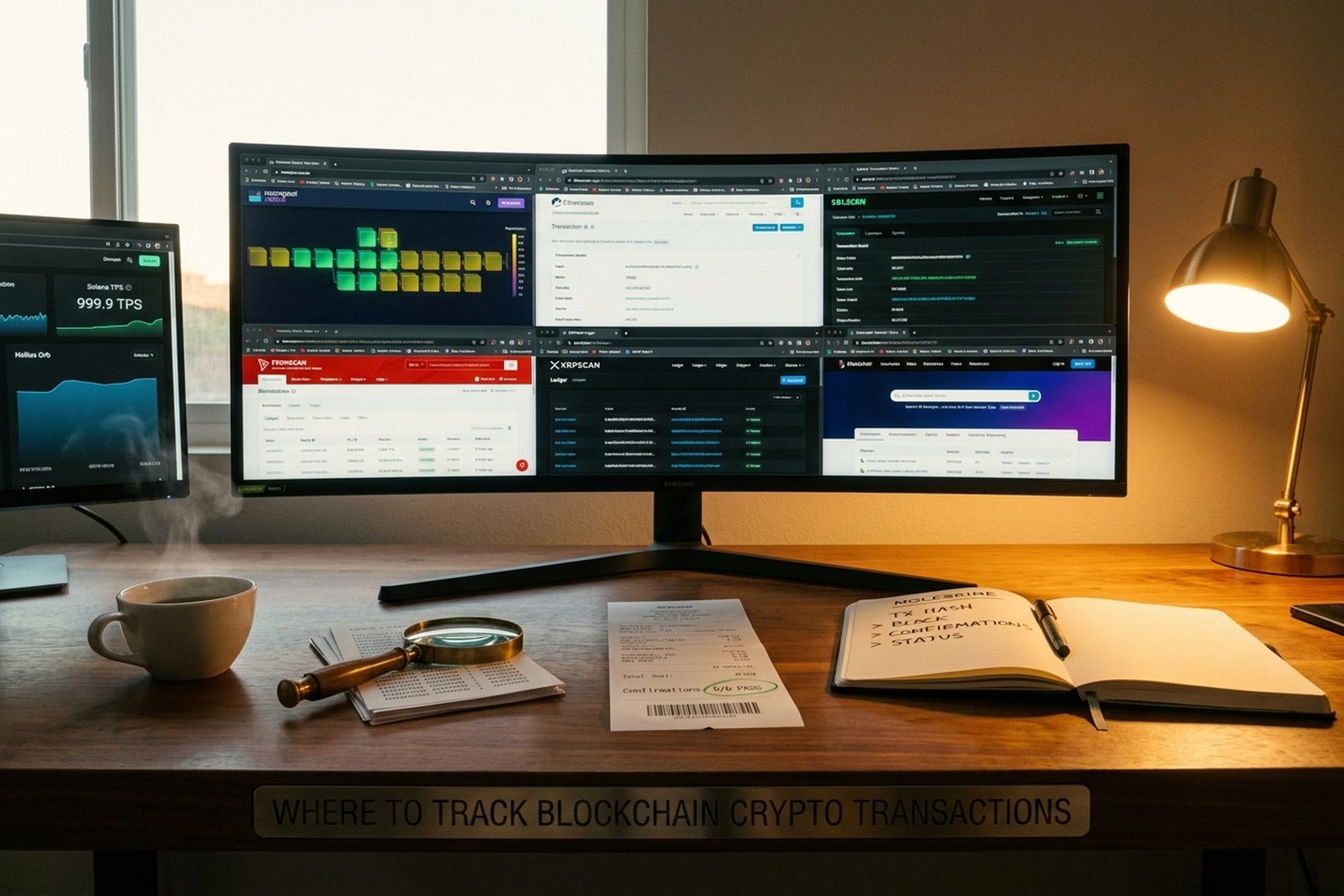
Every cryptocurrency transaction you have ever signed lives on a public ledger that anyone can look up for free. Send 0.05 BTC to a friend, swap USDC on Uniswap, or stake 1 SOL with a validator, within seconds the record appears on a blockchain explorer, with the sender address, the receiver address, the amount, the fee, the block number, and the confirmation count. The system was designed this way. The hard part in 2026 is not finding the data. It is knowing which explorer for which chain, and which fields on the page actually matter.
This guide covers where to track blockchain crypto transactions across the chains that matter in 2026: Bitcoin, Ethereum and its Layer 2 rollups, Solana, Tron, XRP Ledger, and BNB Chain, plus the multi-chain aggregators that pull data from dozens of networks into one screen. It also flags the two real edge cases, privacy coins like Monero and Zcash, where the explorer is intentionally less informative, and pending or failed transactions, where the explorer is telling you something useful even if the money has not moved. The point is to read a transaction page like the on-chain document it is, not the wall of hashes it can feel like at first glance.
How a blockchain explorer reads transaction data
A blockchain explorer is a free to use web tool that connects to a node on a given network, reads the latest blocks, and renders the transaction data into a human-readable page. It does not move funds, sign anything, or hold a wallet. The explorer's job is read-only. Every chain has at least one mainstream explorer, and most also have a chain-team-built one and a community alternative such as blockchain.com or block explorer pages run by hobbyists.
The data you can pull from any modern explorer is consistent across chains. You enter either a transaction ID (the long string of letters and numbers that uniquely identifies a transfer), a wallet address, or a block height into the search bar. The result is a page that shows the sender and receiver, the amount sent, the transaction fees paid, the block in which it was confirmed, and how many blocks have been added on top. That confirmation depth is roughly equivalent to the security of the transaction. EVM-compatible explorers also include an "internal transactions" tab that surfaces contract-level fund flows that the main view hides. The ledger does not publish identities, but it publishes every other piece of transaction information, which is why blockchain analytics companies can attribute wallets to a real entity through pattern recognition rather than through any privileged access.
Best Bitcoin explorers: track a wallet or address
Bitcoin is the simplest case. There are four explorers worth knowing. Mempool.space is the de facto power-user tool, with a real-time visualisation of pending transactions, fee histograms, miner statistics, and a Lightning Network section. Blockstream.info offers a cleaner, ad-free interface from the Liquid Network team. Blockchain.com runs one of the oldest consumer-facing explorers and is widely linked from wallets. BTC.com still operates as the explorer arm of the mining pool of the same name.
Reading a Bitcoin transaction is largely about three numbers. First, the fee in sats per vByte — the per-byte price you paid the miner. In May 2026 the range across mempool conditions runs from roughly 0.10 sat/vByte during quiet periods to 8 sat/vByte or more when block space is congested. Bitcoin builds a new block every 10 minutes, so even a high-priority transaction needs that minimum interval before its first confirmation. Second, the confirmation count. A typical exchange credits a deposit after 1 to 4 confirmations, which translates to 10 to 40 minutes. Third, the mempool status. The Bitcoin Core default mempool expiry is 14 days. A transaction priced below the rolling minimum can sit, get evicted, and need to be rebroadcast manually, and that whole life cycle is visible on mempool.space. Bitcoin's UTXO model also means each transaction consumes one or more unspent transaction outputs (UTXOs) and creates new ones, including a change address that returns leftover BTC sent above the recipient amount to the sender.
Glassnode counted 733,349 active Bitcoin addresses on February 3, 2026. Those addresses generate every transaction you see on any of these explorers.
Etherscan family for ETH and Layer 2 transaction data
Ethereum is the chain where one explorer family has effectively standardised the user experience. Etherscan is the mainnet tool. The same team operates Arbiscan for Arbitrum, Basescan for Base, Optimistic Etherscan for OP Mainnet, Polygonscan for Polygon, BscScan for BNB Smart Chain, and SnowTrace for Avalanche C-Chain. Identical interface, identical contract verification flow, different chain. Blockscout is the main open-source alternative used by many rollup teams.
Two things make Etherscan-family explorers the standard. First, they verify smart-contract source code, so when you read a token transfer you can also read the contract that produced it. Second, they have a robust gas tracker that prices the next-block, near-block, and slower-block fee tier in real time. Etherscan's gas tracker showed average mainnet gas at 0.394 gwei on May 13, 2026, daily average across the past week was around 2.032 gwei (YCharts). Base ran at roughly 0.006 gwei. EIP-1559's base fee model and EIP-4844 blob space mean Ethereum mainnet fees are now measured in fractions of a cent for most transactions.
The Layer 2 picture is concentrated. L2BEAT and DeFiLlama track 73 rollups with combined TVL above $48 billion in May 2026. Arbitrum One holds $15.9 to $16.9 billion (40 to 44% of the L2 pie), Base sits at $10.7 to $12.8 billion, Optimism at roughly $8 billion. Arbitrum and Base together control about 77% of all L2 liquidity (The Block, 2026 Layer 2 Outlook). For any user transacting on a major L2, the right explorer is the chain-specific Etherscan variant.
Solana explorers: Solscan, Helius Orb, Solana FM
The Solana explorer field is more fragmented and has shifted noticeably in the last year. Solscan remains the everyday default for most users, with a clean interface and full coverage of SPL tokens, NFTs, and DeFi positions. Solana Explorer is the chain team's official tool, useful for debugging but lighter on retail features. Helius's Orb, the rebrand of XRay, launched on October 29, 2025, and offers archival RPC queries that run 2 to 10 times faster than Google BigTable plus AI-generated plain-English transaction explanations. SolanaFM is functional but described as "largely unmaintained" since Jupiter's September 2024 acquisition. Solana Beach remains the go-to validator and staking dashboard.
The chain produces more raw transaction volume than any other network. Chainspect logs Solana at about 999.9 TPS in real time with measured maxima above 6,000. Solana processed 25.3 billion transactions in Q1 2026 versus BNB Chain's 1.7 billion in the same quarter. The failure-rate story is more nuanced than the social-media version. The ISSTA 2025 paper "Why Does My Transaction Fail?" analysed more than 800 million failed transactions across 3 million blocks and found bots failed 58.43% of the time, while humans failed at 6.22%. That is meaningfully different from the viral 73% number. Two error categories, "price or profit not met" and "invalid status", explain roughly two-thirds of failures.
The 2026 upgrade to watch is Alpenglow. Co-founder Anatoly Yakovenko said at Consensus Miami that mainnet rollout could land as early as Q3 2026 (CoinDesk, May 5, 2026). Validator-side testing went live around May 11. Finality drops from about 12.8 seconds to roughly 150 milliseconds.
Tronscan, XRPSCAN: track crypto across other chains
The non-EVM, non-Solana chains each have a community-standard explorer. Tronscan is the dominant TRX explorer, and TRON reported 2.8 million daily active users in Q4 2025 according to CoinDesk Research, with USDT-TRC20 as the largest single use case. XRPSCAN and Bithomp cover the XRP Ledger, with full visibility into XRPL's account model and the recent spot ETF on-chain settlement flows. Cardano Explorer (IOHK official, in beta) and the community alternative Cardanoscan both work for ADA. Aptoscan covers Aptos, which now processes 3 to 5 million transactions per day. The Sui ecosystem uses Suiscan and Suivision interchangeably. Dogechain.info is the standard DOGE explorer. Each of these renders the same transaction primitives, hash, sender, receiver, amount, fee, block, confirmations, through the conventions of its native chain.
Multi-chain aggregators and analytics tools
When you transact across more than one network, single-chain explorers stop being enough. A handful of aggregators specialise in covering many chains at once.
| Tool | Chains supported | Best for | Pricing |
|---|---|---|---|
| Blockchair | 42–48 networks | Privacy-respecting, anonymous search | Free |
| OKLink | 170+ networks | Institutional AML and compliance | Free + paid tiers |
| DeBank | 100+ EVM chains | DeFi portfolio + social layer | Free |
| Nansen | Major EVM + Solana | Labeled wallets, smart-money tracking | Paid |
| Dune | Cross-chain SQL dashboards | Custom on-chain analytics | Freemium |
| Arkham Intelligence | Major chains | Wallet-to-entity attribution | Free |
| DefiLlama | All major chains | TVL, protocols, stablecoins | Free |
Use Blockchair when you want a clean search bar that handles BTC, ETH, BCH, LTC, XRP, EOS, BNB, and others in one place. Use OKLink when you need AML-style risk scoring. Use DeBank when you hold a Web3 portfolio across rollups. Use Nansen or Arkham when you want the labels that turn raw hashes into named institutions.

What you can confirm on a transaction page: data and security
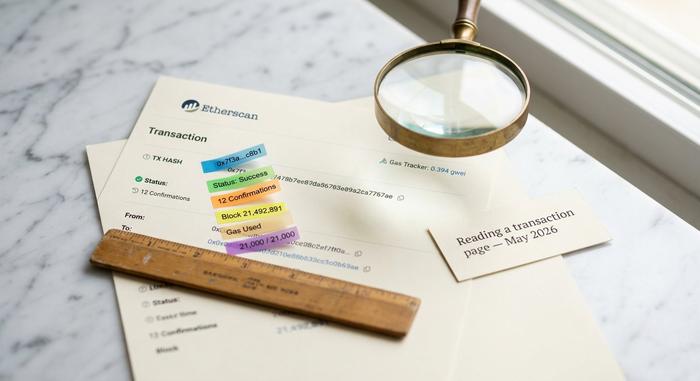
A modern transaction page is dense, but the fields you actually need are few. The transaction hash is the fingerprint — share that hash with anyone who asks where the money went, and they can verify everything on a public explorer they trust. Status reads success, failed, or pending. Block height locates the transaction in chain history. Confirmations show depth and security. Gas used and gas limit on EVM chains tell you whether the transaction ran out of fuel; on Bitcoin the equivalent is the fee paid in sats and the priority that bought. From and to addresses identify the source and destination. Timestamp is the moment it was confirmed.
On EVM chains, the internal transactions tab is the one casual users miss most often. It shows contract-level fund movements, the parts of a transaction that did not happen between two wallets but inside the logic of a smart contract. If you ever wondered why a swap shows you sending USDC to a Uniswap router and not to the seller, the internal transactions tab is where the rest of the picture lives. The logs / events tab exposes the raw event emissions that indexers and analytics tools consume.
Privacy coins, payment trackers and security tools
Two cases break the standard transparency model. Monero explorers like xmrchain.net display block headers and transaction IDs, but no amounts, no usable sender or receiver, and no graph view. The privacy is structural — ring signatures and stealth addresses make the network unauditable by design, which keeps regulators focused on its surveillance-resistance and money laundering risk. Zcash explorers show transparent flows in full but mark shielded transfers as opaque, with only the encrypted reference visible. As of May 2026, about 30% of all ZEC supply sits in shielded addresses, a record high according to Yellow Research.
At the other end of the spectrum, compliance vendors like Chainalysis, Elliptic, and TRM Labs build proprietary intelligence on top of the same public data and add off-chain signals: sanctions lists, exchange KYC records, OSINT records. The goal is to verify which entity controls a wallet. Elliptic raised $120 million at a $670 million valuation in May 2026, backed by Nasdaq Ventures and Deutsche Bank (CoinDesk). Chainalysis announced AI-driven compliance agents in March 2026. The FATF Travel Rule, which requires VASP-to-VASP identity sharing for transfers above $1,000, is now in force in 42 jurisdictions and legislated in 73% of FATF-monitored countries (21Analytics, 2026). Under MiCA, every European authority overseeing crypto-assets now expects ongoing checks on each digital currency transfer. The AML market is projected to grow from $1.4 billion in 2026 to $4.8 billion by 2034, a regulation-driven trajectory that will continue to shape any investment or trade flowing across these chains.
When tracking fails: pending and stuck transactions
When an explorer shows pending or failed, it is still telling you something useful. A pending Bitcoin transaction usually means the fee was below the current mempool minimum, wait, replace with RBF, or accept eviction after 14 days. A pending Ethereum transaction usually means a base-fee miss or a nonce ahead of yours blocking the queue; MetaMask's Speed Up is the standard fix. A failed Solana transaction usually means slippage or stale state; the SOL fee is still consumed but the transfer did not happen.
Conclusion
The same public ledger sits behind every transaction, and a free explorer is enough to read it. Match the explorer to the chain, Etherscan family for EVM, Solscan or Orb for Solana, mempool.space for Bitcoin, Tronscan for TRX, XRPSCAN for XRPL, Blockchair or OKLink for cross-chain, and the dense transaction page becomes a useful document.