Sei Crypto Explained: The Layer 1 Built for Trading
Most blockchains try to be everything. Sei picked one job and bet the whole project on it — be the fastest place to trade. That focus is the most interesting thing about Sei crypto, and also its biggest gamble.
Here is the tension worth sitting with. The technology is genuinely fast and shipping. The flagship upgrade everyone quotes, a 200,000-transactions-per-second monster called Giga, mostly lives in a whitepaper. And the SEI token? Like many cryptocurrencies, it is down roughly 94% from its 2024 high. This guide walks through all of it, honestly: what Sei is, how it actually works, what the token does, who is building on it, and whether any of that makes it worth owning.
What Is Sei and the SEI Token?
Sei is a high-performance Layer 1 blockchain designed around a single workload: trading. Not gaming, not generic apps. Trading. It was built by Sei Labs, founded in 2021 by Jeffrey Feng, who came from Goldman Sachs, and Jayendra Jog, an ex-Robinhood engineer. The mainnet went live in August 2023.
Why build a chain for one job? Because trading punishes slowness. A decentralized exchange that takes seconds to confirm an order, or that lets bots reorder your trade for profit, will never feel like the centralized platforms most people are used to. The pitch here is to close that gap: give traders the speed and fairness of a Binance or a Coinbase, without the custody and the middleman. Everything in the design bends toward that goal.
SEI, the network's cryptocurrency, is the fuel and the glue. It pays gas fees, it secures the network through staking, it votes in governance, and it serves as collateral inside apps. Supply is capped at 10 billion. Investors took it seriously early: a $5 million seed led by Multicoin Capital with Coinbase Ventures, then a $30 million Series A in 2023 at an $800 million valuation. Big names, big expectations. Whether the chain has lived up to them is the rest of this article.
How Sei Network Works: Speed by Design
Sei is fast for a reason, and the reason is not one clever trick. It is three or four engineering choices stacked on top of each other, every one of them aimed at making a busy order book feel instant.
Parallel execution and a built-in matching engine
Most blockchains process transactions one after another, like a single cashier serving a queue. Sei runs them in parallel. Transactions that touch different parts of the chain's state execute at the same time, which is where a lot of the headline speed comes from. The team calls this optimistic parallelization, and they claim it delivers up to 40 times the throughput of sequential processing.
A simple way to picture it: if Alice swaps tokens and Bob lends out a stablecoin, those two actions never touch each other, so why should Bob wait for Alice? On a sequential chain he does. Here they clear together. Multiply that across thousands of unrelated trades a second and the throughput math starts to make sense.
There is a second trading-specific trick. The chain has a native order-matching engine baked into the protocol, designed to batch orders and clear them at a uniform price. The point is to blunt front-running and MEV — the high-frequency trading tactics where bots jump ahead of your order and skim the difference. On most chains that protection is bolted on by individual apps. Here it is part of the floor, which is the kind of detail a serious trader actually cares about.
Twin-Turbo and Autobahn consensus
Underneath all that sits the consensus layer, and the team has rebuilt it twice. The original design, Twin-Turbo, dragged block times down toward 400 milliseconds. How? Pipelining, optimistic execution, parallel validation, the usual bag of tricks, all pushed hard. Trades settle close to real-time, or close enough that the lag is invisible. Storage got the same aggressive treatment. SeiDB lets validators sync roughly 12 times faster and cuts state size by about 60%. The newer work, Autobahn, goes further with a multi-proposer model. Hold that thought. It matters in a second.
Sei V2 and the all-in bet on the EVM
In July 2024, Sei shipped a parallelized version of the EVM, the Ethereum Virtual Machine. That meant Ethereum developers could deploy their Solidity smart contracts on the chain with little friction and get the parallel-speed benefits for free. Then Sei went further than most chains ever would. It announced a plan to drop its Cosmos roots entirely and become EVM-only by mid-2026, deprecating the CosmWasm contracts some of its earliest builders used. Bold, and not without risk. Existing users even have to migrate bridged USDC before the old transfer routes shut off.
Sei Giga: The 200,000 TPS Promise
Now the number you have probably seen on a thread somewhere. Sei Giga, the next big upgrade, targets more than 200,000 transactions per second. It uses that multi-proposer design, letting several validators produce blocks at once instead of waiting in line.
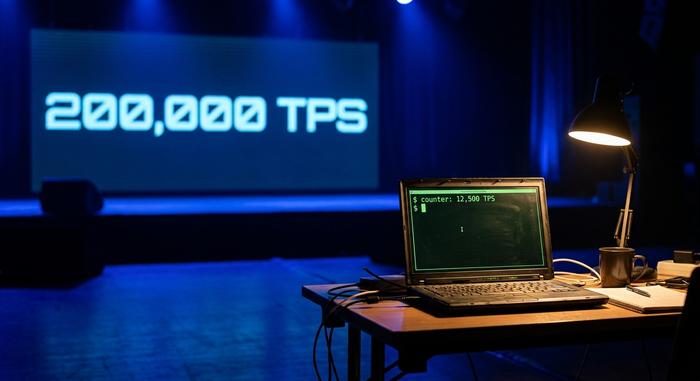
Here is the honest part. That 200,000 figure is a whitepaper target, not a measured result on a live network. The current chain self-reports around 12,500 transactions per second with sub-400-millisecond finality, and even those numbers are not independently audited. Giga is being rolled out in phases through 2026.
This matters because TPS claims are the most abused statistic in crypto. Lab numbers come from idealized conditions: simple transfers, a handful of nodes, no real congestion. Production is messier. Plenty of chains have promised six-figure throughput and delivered a fraction of it once real apps and real load showed up. So treat Giga as a serious ambition with real engineering behind it, not as a fact you can bank on today. The gap between the slide and the running network is exactly where you should keep your skepticism pointed.
The SEI Token: Price, Supply, and Unlocks
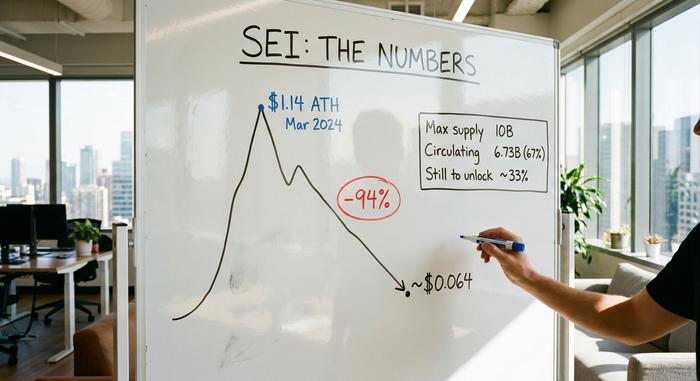
Great engineering, brutal chart. There is no kind way to put it. SEI hit an all-time high of $1.14 in March 2024 and has spent the time since grinding lower.
| SEI stat | Value (June 2026) |
|---|---|
| Price | ~$0.064 |
| All-time high | $1.14 (Mar 16, 2024) |
| Down from ATH | ~94% |
| Market cap | ~$433M |
| Fully diluted valuation | ~$644M |
| Circulating / max supply | 6.73B / 10B |
As of June 2026, SEI trades around $0.064, with a market cap near $433 million. The deeper problem is supply. The circulating supply sits at only about 67% of the 10 billion total supply, which means roughly a third is still scheduled to hit the market, including the full team and private-investor tranches. New supply lands on a price that is already weak. That is the textbook setup for dilution.
It is worth understanding where the pressure comes from. The network runs on proof of stake, so staking rewards are paid partly in freshly emitted tokens — meaning even loyal holders are being diluted unless network demand grows fast enough to soak up the new supply. Unlock cliffs make it worse: when a large team or investor tranche becomes liquid on a set date, the market often front-runs it, selling in advance. None of this means the price has to keep falling. It does mean the token is swimming against a current that the chart already reflects.
| Allocation | Share |
|---|---|
| Ecosystem reserve | 48% |
| Team | 20% |
| Private investors | 20% |
| Foundation | 9% |
| Community / launch | 3% |
The Sei Ecosystem and Real Usage
This is where Sei gets genuinely interesting, because two numbers point in opposite directions and both are true. The chain hosts a growing DeFi ecosystem — decentralized exchanges, perpetuals platforms, and lending markets — and the activity numbers have been climbing fast.
Usage is up. Way up. Through 2025, Sei averaged around a million daily active addresses, a jump of nearly 492% year over year, and on-chain trading volume crossed $1.3 billion in a single stretch that pulled Etherscan into expanding its explorer to the network. The chain also landed deals that most projects only dream about: a partnership to pre-install Sei wallets on millions of Xiaomi phones, a Brevan Howard-backed firm tokenizing real-world assets on it, and a MetaMask integration.
And yet the money tells a colder story. Total value locked, the amount of capital parked in the chain's decentralized finance apps, peaked near $688 million in July 2025, then bled down to roughly $157 million by the end of the year. A 77% drop while users multiplied. Hold both ideas at once: more people are using the network, but less capital is sitting on it. That divergence is the single most important thing to understand about the chain right now.
How to read it? Two ways, and they cannot both be fully right. The optimistic read is that activity leads capital, that traders and apps arrive first and liquidity follows once the chain proves itself. The skeptical read is that the usage is thin and incentive-driven, the kind of churn that evaporates when token rewards dry up. The honest answer is that nobody knows yet, and the next year of data will settle it.
Is Sei Crypto a Good Investment?
Fair question, and the honest answer is a shrug with footnotes. This is not financial advice, just the two sides laid out.
The bull case is real activity. Sei has growing usage, a defensible niche in trading, and institutional toeholds: BitGo offers custody and staking, and a Canary Staked SEI ETF has been filed for SEC review. The bear case is just as real. A 94% drawdown, a wall of token unlocks ahead, a flagship upgrade that has not proven its headline number, and a brutally crowded Layer 1 field. If you do buy, SEI is easy to find on exchanges like Coinbase and Kraken, and you can stake it by delegating to a validator. Just know the unbonding period is 21 days, during which your tokens are frozen and earning nothing.
One more note on framing. SEI is a high-beta bet on a specific thesis — that a trading-first chain wins a real slice of on-chain volume. If you believe that, a small position sized so you could stomach another 50% drawdown is the sane way to express it. If you do not believe it, the speed specs alone are not a reason to own the token. Conviction in the thesis, not the millisecond benchmarks, is what should drive the decision.
Where Sei Stands in the L1 Race
Step back and the positioning is clear. Solana, Aptos, and Sui all pitch some version of "fast chain for everything." Sei pitches something narrower: the fastest place to trade, full stop. That focus is the entire bet. Specialization can be a moat, because a chain tuned for order books may simply feel better for traders than a generalist. It can also be a trap, because rivals can copy speed features, and liquidity tends to pool wherever it already is. Sei is wagering that being the best at one thing beats being good at all of them.
| Chain | Core pitch | Design approach |
|---|---|---|
| Sei | The fastest place to trade | Trading-specialized L1, parallel EVM |
| Solana | A fast chain for everything | High-throughput monolithic L1 |
| Aptos and Sui | Safe, scalable consumer apps | Move-language parallel L1s |
That is a narrow lane, deliberately. The upside of a narrow lane is that you can be unmistakably the best in it. The downside is that if the lane stops mattering, there is nowhere to pivot.
The Bottom Line on Sei Crypto Today
Strip away the price action and Sei is a serious piece of engineering doing something specific and doing it well. The parallel execution is real. The EVM bet is shipping. The usage is climbing. What is not yet settled is the thesis — that traders and builders will keep choosing Sei on purpose, in numbers large enough to matter, once the novelty fades and the unlocks land. The 200,000 number will either show up on mainnet or it won't. So here is the question to carry forward. Does Sei keep winning real activity when speed alone stops being a headline?