Top Crypto-Friendly Banks 2026 : Banks That Support Crypto Trading

Silvergate Capital and Signature Bank between them held over $12 billion of crypto-related deposits in late 2022. By the second week of March 2023, both were gone. Silvergate announced voluntary liquidation on March 8 and the FDIC seized Signature on March 12, ordering its crypto clients off the Signet payments network by April 5. A two-and-a-half-year regulatory winter followed. The 2025 reset was structural: the SEC rescinded SAB 121 in January, Congress passed the GENIUS Act stablecoin framework in July, and the OCC conditionally approved national trust charters for four new crypto banks in December. The list of top crypto-friendly banks in 2026 looks nothing like the 2022 lists still floating online.
What makes a bank crypto-friendly in 2026
The best crypto-friendly bank for any given user clears five tests in 2026. First, regulatory status. Either a federal charter (the OCC national trust for crypto-native banks, a state SPDI in Wyoming) or a recognised license abroad (Swiss FINMA, Liechtenstein FMA, an EEA MiCA authorisation). Second, scope of crypto activity. Holding a crypto exchange wire is not the same as offering native crypto trading, crypto custody, or a crypto debit card. Third, customer focus. Retail bank account, crypto business banking services, and institutional digital asset custody are three very different products. Fourth, deposit protection and segregation. FDIC or DIF insurance on the fiat leg, off-balance-sheet custody for the crypto leg. Fifth, history. A traditional bank that quietly debanked a cryptocurrency exchange in 2023, blocked crypto transactions for retail customers, and now markets to crypto users in 2026 is not the same as a crypto-friendly bank that stayed open the entire time. The list below reflects all five.
How U.S. policy reshaped crypto banking 2023-2026
Start with what broke. Silvergate's SEN network handled billions of dollars a day for crypto exchanges at its 2022 peak. Then the run started. Deposits fell from $12 billion in Q3 2022 to $3.8 billion by December. SEN closed on March 3, 2023, and the parent firm announced voluntary liquidation five days later. The SEC, the Federal Reserve and California regulators settled with Silvergate for a combined $63 million in July 2024 over AML compliance failings.
Signature Bank went three days after Silvergate. New York regulators seized it on March 12, 2023, the third-largest U.S. bank failure on record. The FDIC then told Signet crypto clients to close their accounts by April 5, per Bloomberg's reporting at the time. Almost overnight the two largest crypto-banking rails in the country were gone.
What people later started calling Operation Chokepoint 2.0 ran in the background through all of this. The House Financial Services Committee's November 25, 2025 report listed about 24 FDIC "pause letters" sent to banks serving crypto clients between April 2022 and 2024. A formal congressional hearing came on February 6, 2025.
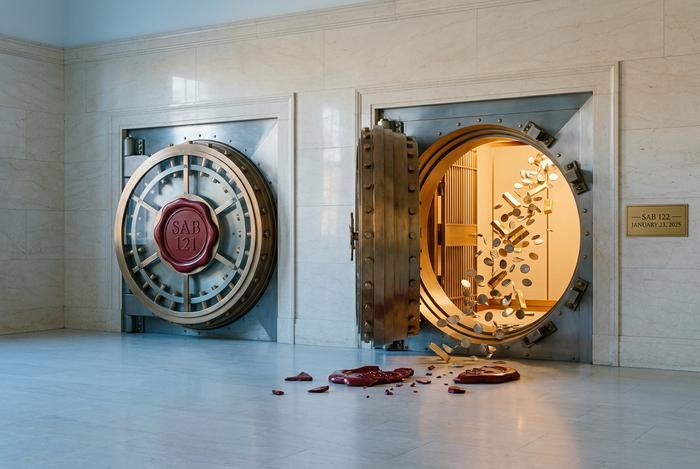
The unlock came in three pieces. First, the SEC. On January 23, 2025 it issued Staff Accounting Bulletin 122, rescinding SAB 121. That repeal was bigger than it sounds: SAB 121 had forced banks to put customer crypto on their own balance sheets, which made bank-grade custody economically impossible at scale. Second, the OCC. In March 2025 it issued interpretive guidance letting national banks do crypto custody, exchange execution and stablecoin work without prior approval. Third, Congress. President Trump signed the GENIUS Act on July 18, 2025 after Senate and House votes of 68-30 and 308-122. It is the first federal payment-stablecoin framework, with 100% reserve backing required and issuance limited to bank subsidiaries, OCC-supervised nonbanks and federally approved state-chartered entities.
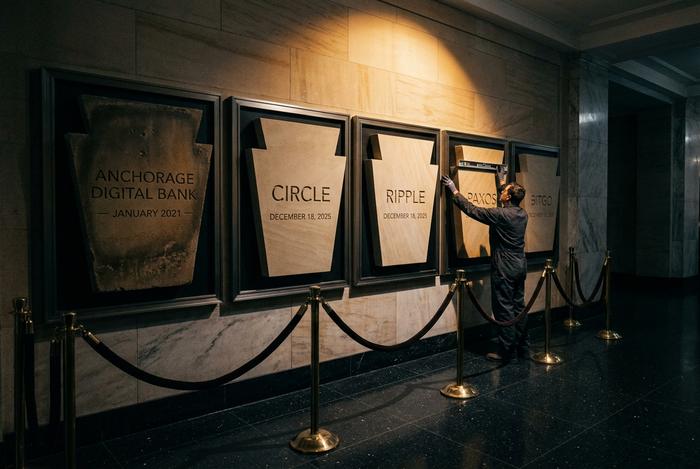
Then came the charters. On December 18, 2025 the OCC conditionally approved national trust charters for Circle, Ripple, Paxos and BitGo. That ended Anchorage Digital Bank's near-five-year monopoly. Custodia Bank, Caitlin Long's Wyoming SPDI, lost again on the same axis: the 10th Circuit affirmed denial of its Fed master account in October 2025, and the district court closed the case in March 2026. The kicker is that Kraken, in the same window, got master-account access through a regional Federal Reserve bank, and the Fed is now writing a narrower nationwide policy. The fight Custodia spent five years on may yet be won by someone who waited.
Top crypto-friendly banks for U.S. retail users
The honest list for U.S. retail crypto users is shorter than most blogs suggest. Here it is.
Revolut. Not a chartered U.S. bank. It is a fintech overlay, FDIC-insured via Lead Bank, but if you want a one-app fiat-and-crypto bank account this is the closest thing. By March 2026 Revolut had 70 million customers globally, 230-plus crypto assets in the main app and an EEA-wide MiCA licence through CySEC, granted in October 2025. The catch: the 1.99% in-app crypto fee. Active traders bleed.
SoFi. A nationally chartered U.S. bank. SoFi quietly shut down crypto trading in late 2023 because the OCC asked it to in exchange for the charter. The CEO confirmed a relaunch for the end of 2025 after the OCC's March 2025 guidance changed the rules, and the relaunch reportedly includes a USD-pegged stablecoin and blockchain remittances. A real bank charter with a public crypto plan is rare in the United States right now.
Quontic. A community bank with one distinctive product. Its Bitcoin Rewards Checking account pays 1.5% back in BTC on every debit-card purchase. FDIC-insured. Small in scale, but it is one of the few traditional banks where a normal user can earn Bitcoin on coffee.
Cash App. Square's consumer fintech. Direct Bitcoin purchases inside the app, BTC withdrawals to a self-custody wallet (unusual for a U.S. fintech), available in the U.S. and U.K. only.
Ally Bank. Not a crypto bank in any direct sense. There is no native crypto trading. But its ACH transfers to Coinbase and Kraken clear without fraud-flag drama, and on most days that is the thing U.S. retail users actually need.
One name worth dropping from older lists: Juno Finance. It shut down on September 30, 2025 and told users to move crypto to self-custody before the cut-off.
| U.S. retail option | Type | Native crypto trading | FDIC | Best for |
|---|---|---|---|---|
| Revolut | Fintech via Lead Bank | Yes, 230+ assets | Yes (partner) | Multi-currency users |
| SoFi | National bank | Re-launching end-2025 | Yes | Long-term banked customers |
| Quontic | Community bank | No (BTC rewards card) | Yes | Bitcoin-only users |
| Cash App | Fintech | BTC only | Yes (partner) | Small recurring BTC buys |
| Ally Bank | Online bank | No | Yes | Reliable on-ramp transfers |
Top crypto-friendly banks for crypto businesses
Crypto business banking is a narrower market. Most banks here serve exchanges, custodians and stablecoin issuers rather than retail crypto users.
Customers Bank. The closest replacement for Silvergate's SEN, via its Customers Bank Instant Token (CBIT) payments network. CBIT deposits peaked around $2.25 billion in Q1 2023, about 13% of total bank deposits. A Federal Reserve enforcement action over AML weaknesses followed in mid-2024, and the bank later capped crypto-related deposits internally at 15%.
Cross River Bank. A New Jersey state-chartered bank that has become a primary banking partner for Coinbase, Circle and Visa's USDC settlement product, which went live for U.S. banks in December 2025. Cross River bank provides the back-end fiat rails for several major crypto firms and processes a large share of their daily crypto transactions.
Mercury. A fintech overlay (not itself a bank) on Choice Financial, Evolve Bank and Column. Useful for web3 startups, crypto funds and DAOs that need standard U.S. business accounts, with FDIC insurance through its Mercury Vault product up to $5 million. Mercury does not service exchanges or money-services businesses, which is sometimes missed in older write-ups.
Evolve Bank & Trust. A small Arkansas-chartered bank that has long been the silent back end for U.S. crypto fintechs. Evolve permits ACH transfers to FinCEN-registered crypto exchanges with minimal friction.
A name to retire: BankProv. The Massachusetts community bank exited crypto entirely in 2023 after roughly $28 million in quarterly losses on crypto-mining loans, and Needham Bank's NB Bancorp closed a $212 million acquisition of the parent on November 15, 2025.
European and Asian crypto-friendly banks 2026
Europe and Asia kept the only chartered crypto-native banks that lived through the 2023 cycle. Switzerland leads the list. Five names matter, three of them Swiss-coded.
Sygnum Bank. Zurich and Singapore. The Swiss financial regulator FINMA has licensed Sygnum since 2019. Sygnum closed a $58 million round in January 2025 at a $1 billion valuation. First crypto-bank unicorn. AUM sits at roughly $5 billion. 2,000 clients in 70-plus countries. Trading volume up over a thousand percent year-on-year in 2024. It is the most aggressive of the Swiss group.
AMINA Bank. This is the bank you might still know as SEBA. The rebrand took effect on December 1, 2023. AMINA holds the second FINMA crypto-banking licence. 2024 revenue came in at $40.4 million, up 69 percent. AUM hit $4.2 billion, up 136 percent. Offices in Zug, Abu Dhabi and Hong Kong. Quieter than Sygnum. Profitable for longer.
Bank Frick. A private bank in Liechtenstein. Frick launched crypto services back in 2018. That was early by Swiss-bank standards. MiCAR-authorised by the Liechtenstein FMA. It custodies and trades BTC, ETH, ADA, DOT, USDC and a few more, and it offers staking. Frick is the option many EU funds use when the Swiss banks are full.
DBS Digital Exchange. Singapore's largest bank operates this one. MAS-regulated. Accredited and institutional investors only, no retail. I cannot think of another large traditional bank that runs its own licensed crypto exchange directly. DBS is the outlier.
BCB Group. Not a deposit-taking bank, strictly speaking. But it earns the label. BCB is Europe's main crypto-dedicated payments rail. FCA-regulated in the U.K. France's ACPR and AMF granted it authorisation in April 2024. Volume in 2025 was north of $230 billion. The client list is a roll call: Bitstamp, Coinbase, Galaxy, Gemini, Kraken.
| Bank | Country | Regulator | What it offers |
|---|---|---|---|
| Sygnum | CH/SG | FINMA / MAS | Custody, trading, lending, tokenisation |
| AMINA (ex-SEBA) | CH | FINMA | Custody, brokerage, structured products |
| Bank Frick | LI | FMA | Custody, trading, staking, business accounts |
| DBS Digital Exchange | SG | MAS | Accredited-investor exchange |
| BCB Group | UK/FR | FCA / ACPR-AMF | Crypto payments, settlement |
Institutional and trust-charter crypto banks
For exchanges, asset managers and ETF issuers, the tier that matters is institutional crypto custody. Five names dominate.
Anchorage Digital Bank. OCC-chartered in January 2021. For nearly five years it was the only federally chartered crypto bank in the country. AUC went past $50 billion in 2024 and the company was last valued at $4.2 billion in a private round. Anchorage banks Aave, BlackRock's tokenised fund desk, and several ETF issuers.
Circle, Ripple, Paxos and BitGo. All four received OCC conditional approval for national trust charters on December 18, 2025. None had completed conversion as of May 2026, but the approvals end Anchorage's monopoly and define the second wave.
BNY. With $59.4 trillion in total AUC, BNY is the world's largest custodian. The SEC's Office of the Chief Accountant gave it a non-objection in September 2024 to safeguard crypto ETP assets off-balance-sheet, which is the technical detail that made bank crypto custody work at all. BNY now supports roughly 80% of SEC-approved spot Bitcoin and Ether ETPs.
State Street. Launched its Digital Asset Platform in January 2026, built on Taurus technology. The Taurus partnership had been announced back in August 2024. State Street is now BNY's only peer at the trillions-of-AUC tier on the crypto side.
JPMorgan Kinexys. JPM's blockchain settlement platform, rebranded from Onyx in November 2024 at the Singapore Fintech Festival. Cumulative volume crossed $1.5 trillion since 2020. The daily average is over $2 billion, and on-chain FX settlement in dollars and euros went live in Q1 2025. Kinexys is not a separate bank, but for JPM's institutional clients it is the front door to tokenised settlement.
How to choose a crypto-friendly bank in 2026
Match jurisdiction to need. U.S. retail crypto users start with Revolut or SoFi. U.S. crypto businesses look at Cross River or Mercury. European clients with material AUM look at Sygnum or AMINA. Asia-based accredited investors look at DBS. Funds, custodians and ETF issuers go to Anchorage, BNY or State Street. Verify the bank's regulatory status directly with the chartering body, not from marketing pages. Read the deposit-insurance fine print. And weight history: a bank that quietly exited crypto in 2023, returned in 2026, and may exit again at the next downturn is not the same as one that held the line.
Conclusion: what crypto-friendly banking means in 2026
"Crypto-friendly bank" stopped meaning "bank that doesn't reject your wire" some time during the 2023-2025 reset. In 2026 the term implies a specific regulatory licence (OCC trust, FINMA, MiCA, FCA payments) and a published list of supported services. That is the substantive shift. The list above will move again, especially once Circle, Ripple, Paxos and BitGo complete their OCC conversions and the Federal Reserve finalises its narrower master-account policy. I'd revisit the names every six months.