Best Dogecoin Wallet 2026: Top Doge Wallet Picks Compared
Picking the best dogecoin wallet matters more than the coin choice itself. Dogecoin trades at about $0.11 in May 2026. Market cap: $16.75 billion. Top ten by value. The network fee for sending DOGE averages four cents per transaction. That number matters. It means people actually spend Dogecoin rather than hoard it, the way they hoard Bitcoin — and the meme-coin label has stopped matching the reality. Where you store DOGE depends on whether you hold it or use it. The wrong wallet either eats your coins through fees or hands them to whoever cracks your seed phrase. This guide walks through what a Dogecoin wallet actually is, the three main types, the strongest 2026 hardware and software picks, and a short framework for matching a wallet to how you use the coin.
What a Dogecoin wallet actually does
Here is the first misconception, common even among people who already own DOGE. The wallet does not hold the coins. The coins live on the Dogecoin blockchain — a public ledger recording every transaction since December 2013. What sits on your phone or hardware device is a pair of cryptographic keys. A public key (the address you share to receive doge). A private key (the secret used to sign outgoing transactions). The wallet is essentially a key manager with a polite user interface.
That distinction matters. Custody is determined by who controls the private key. Hold it yourself and the wallet is self-custodial. You can send and receive doge without permission and nobody can freeze your account. If an exchange holds it, the wallet is custodial. The exchange owes you DOGE the way a bank owes you cash. Andreas Antonopoulos coined the line "not your keys, not your coins" — in 2014 Mt. Gox vanished with hundreds of millions of dollars of customer crypto. In 2022 FTX did the same. Neither was a flaw in the underlying blockchains. Both were custody failures.
A Dogecoin wallet, then, has three jobs. Generate and store the keys. Sign transactions and broadcast them. Read the blockchain to show balance and history. Every wallet on this page does those three things. What they differ on is where the key lives and how it is protected.
Dogecoin wallet types: hardware wallet vs software wallet
Three families of Dogecoin wallets. The right one depends on threat model and habits.
Hardware wallets keep the private key on a dedicated offline device. Usually a USB stick or NFC card. The key never touches an internet-connected computer. Every transaction is signed inside a tamper-resistant chip, then handed back to a host app for broadcast. This is the cold wallet (or cold-storage) option. Serious holders use it to store their dogecoin. Ledger and Trezor dominate. Tangem and SafePal are credible alternatives. Prices: $49 to $399.
Software wallets run as mobile apps on a phone, a desktop wallet on Windows or Mac, or a browser extension. Sometimes called hot wallets — the key lives on a device that is online. Trade-off: speed against attack surface. Exodus, Trust Wallet, MyDoge and Dogecoin Core are the leading options for doge holders. All free. Mobile wallets win for daily spending. The desktop wallet variant wins for setup convenience. Full-node clients like Dogecoin Core suit users who want to verify the chain themselves.
Custodial wallets are the ones inside exchanges. Coinbase, Binance, Kraken and others hold the keys. You hold a claim. The convenience is real (no seed phrase, instant trading, email recovery), but so is the counterparty risk. Robinhood understood this and pivoted DOGE to self-custody in August 2023, letting users withdraw to external addresses. Before that, "your DOGE" lived only as a number on Robinhood's books. A 2025 user survey put non-custodial preference at around 59%, up roughly 22 points from 2023.
| Property | Hardware (cold) | Software (hot) | Custodial |
|---|---|---|---|
| Key control | You | You | Exchange |
| Always online | No | Yes | Yes |
| Setup cost | $49-$399 | Free | Free |
| Counterparty risk | None | None | High |
| Best for | Long-term storage | Daily use | Trading and beginners |
There is no universal winner. Most experienced doge holders run two or three at once: a hardware wallet for the savings, a software wallet for the spending money, and maybe an exchange account for trading.
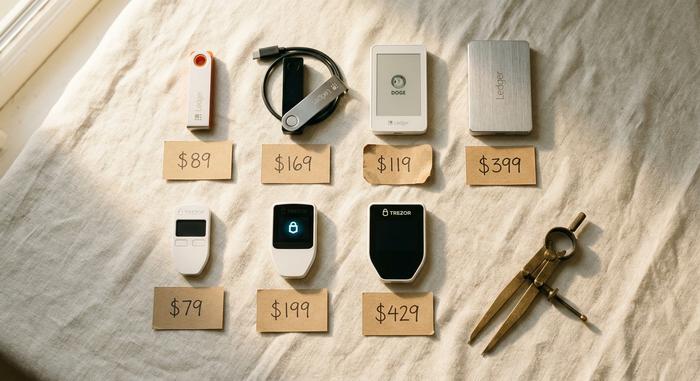
Best Dogecoin hardware wallet picks for 2026: Trezor and Ledger
Hardware wallets are the strongest answer if your DOGE is meant to sit. The 2026 line-up has narrowed to four credible vendors. Prices and certifications below are current as of mid-2026.
Ledger offers four models with native Dogecoin support through the Ledger Live app. The Nano S Plus at $79 is the budget entry, with a small screen and a CC EAL5+ secure element. The Nano X at $149 adds Bluetooth and a larger battery for mobile use. The Flex at $249 ships a curved E-Ink touchscreen with a CC EAL6+ chip, and the Stax at $399 takes the same chip into a premium aluminium body designed by Tony Fadell. All four support over 5,500 coins, including DOGE, and integrate with Ledger Live for buy, swap, and send. The December 2023 Ledger Connect Kit incident, which drained about $600,000 through a compromised npm package, did not affect the device-stored keys themselves; it was a supply-chain attack on a JavaScript dependency used by some third-party dapps.
Trezor is the open-source alternative, and as of 2026 it supports DOGE natively in Trezor Suite, the desktop and web companion app. The Safe 3 sells for $79 and uses an EAL6+ secure element. The Safe 5 at $169 adds a colour touchscreen and biometric protection. The Safe 7 at $249 is the flagship, with the largest screen and a Shamir Backup option for splitting the seed across multiple cards. All three support DOGE without needing a third-party wallet.
Tangem sells a credit-card-shaped wallet that signs transactions over NFC by tapping a phone. The card has no battery, no screen, and no recovery seed by default; instead it uses a card-set model (typically three cards) where any one can sign. DOGE is one of the 87+ networks supported. Pricing starts around $54 for a two-card set.
SafePal S1 Pro is the budget air-gapped option, around $89-$129 depending on bundle. It signs offline via QR codes scanned from a paired phone, which means it never connects to anything physically.
| Hardware wallet | Price (USD) | Secure element | Native DOGE? |
|---|---|---|---|
| Ledger Nano S Plus | $79 | CC EAL5+ | Yes (Ledger Live) |
| Ledger Nano X | $149 | CC EAL5+ | Yes (Ledger Live) |
| Ledger Flex | $249 | CC EAL6+ | Yes (Ledger Live) |
| Ledger Stax | $399 | CC EAL6+ | Yes (Ledger Live) |
| Trezor Safe 3 | $79 | EAL6+ | Yes (Trezor Suite) |
| Trezor Safe 5 | $169 | EAL6+ | Yes (Trezor Suite) |
| Trezor Safe 7 | $249 | EAL6+ | Yes (Trezor Suite) |
| Tangem (2-card set) | ~$54 | EAL6+ | Yes (Tangem app) |
| SafePal S1 Pro | ~$89-$129 | EAL5+ | Yes (SafePal app) |
For most DOGE holders the Trezor Safe 3 or Ledger Nano S Plus at $79 is enough. The pricier models add convenience features rather than fundamentally better security; the secure element is the load-bearing part, not the screen.
Best Dogecoin software wallet picks: Exodus, MyDoge and more
Software wallets are where doge actually moves. Four worth knowing in 2026. Each fills a different niche.
Exodus is the polished multi-asset hot wallet. Available on desktop, mobile and as a browser extension. Supports DOGE plus more than 380 assets. Built-in swap. Integrates with Trezor for users who want a hot interface on top of cold keys. The wallet is closed-source — a real critique — but the user-friendly interface keeps it popular with new users.
Trust Wallet is the mobile-first option. Owned by Binance, operating as a non-custodial wallet. Covers DOGE plus more than 100 other chains. Supports staking for some assets (not DOGE). Runs on iOS and Android. Source code partially open. For people who already have a Binance account, it is the natural self-custody step up.
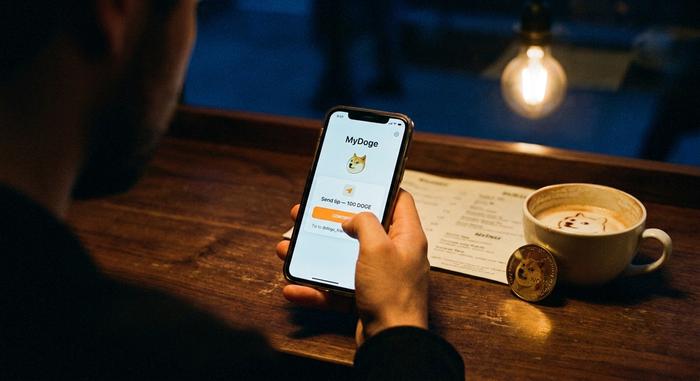
MyDoge is the DOGE-specific dogecoin wallet app, available on the App Store and Google Play. Only major option built around the dogecoin community rather than multi-asset trading. You can tip other users in DOGE, mint or trade DRC-20 token assets, connect Twitter/X, and pay supported merchants. If you actually spend DOGE rather than hold it, MyDoge is the closest thing to a native experience — the user-friendly choice for daily use.
Dogecoin Core is the official full-node client from the Dogecoin Foundation. It downloads the entire blockchain (about 50 GB and growing) and verifies every transaction locally. The wallet inside is barebones, but you get the strongest guarantee that nobody is lying about your balance. Recommended only for desktop users with the disk space and patience.
A reminder on software-wallet risk: in June 2023, Atomic Wallet lost more than $100 million across roughly 5,500 user accounts after a breach attributed by Elliptic to North Korea's Lazarus Group. Atomic was non-custodial. The hack drained users whose private keys were generated or stored on a device that turned out to be compromised. Non-custodial is not the same as bulletproof. For balances above pocket-change, a hardware wallet remains the safer place.
Custodial and exchange wallets vs self-custody
Custodial wallets are the right call for two situations: when you trade DOGE actively and need it on an exchange anyway, or when you are starting out with $50 and a hardware wallet does not pencil out. The major US-accessible exchanges (Coinbase, Kraken and Binance.US) all support DOGE deposits, withdrawals and trading. Robinhood does too, and since August 2023 lets users withdraw to external addresses, which it did not before; the change pulled it from "synthetic exposure" into the real-doge category.
The risk is well documented. Mt. Gox in 2014 destroyed roughly 850,000 BTC of customer assets. FTX in November 2022 went insolvent with $8 billion missing. Neither was a problem with the underlying coins. Both were custody failures with bookkeeping fraud underneath. Proof-of-reserves attestations from Coinbase and Kraken reduce that risk but do not eliminate it; an attestation says "we have the coins on this date," not "the coins will still be here next week." For DOGE balances above a few hundred dollars, custodial storage is borrowed time. Move the keys.
How to choose the best wallet for Dogecoin: HODL or spend
The decision is rarely "what is the best wallet" in the abstract. It is "what is the best wallet for the way you use DOGE." Four user profiles cover most cases.
Long-term holders with more than $500 in DOGE should run a hardware wallet. Trezor Safe 3 or Ledger Nano S Plus at $79 is enough for most balances. The transaction fee is irrelevant for someone moving funds once a quarter.
Daily spenders are the audience MyDoge is built for. Pair it with a hardware wallet for the savings portion and only keep a few weeks of spending money in the hot wallet. The four-cent network fee makes daily use practical.
Active traders should keep the active position on an exchange (Coinbase, Kraken, or Binance), and the long-term portion in cold storage. Mixing the two on one device is a common, costly mistake.
Beginners should start with a custodial wallet on a major exchange, learn the workflow, and graduate to self-custody once the balance crosses a few hundred dollars. Skipping straight to a hardware wallet on day one is the cause of most lost-seed-phrase stories.
The decision should also account for multi-coin needs. If you hold ETH, SOL and BTC alongside DOGE, a hardware wallet with broad support (Ledger, Trezor) wins. If DOGE is your only crypto, MyDoge plus a Trezor Safe 3 is a leaner stack.
Security best practices: how to protect your DOGE securely
Most lost coins were not lost to clever exploits. They were lost to bad habits.
Write the seed phrase on paper. Store it offline. Never photograph or type it into a cloud-synced note. Most reported losses of the past decade trace back to seed phrases stored in iCloud, Google Drive, or screenshots. The 2014 Doge Vault breach lost 280 million DOGE worth roughly $127,000 at the time. That was a hot-wallet server compromise — and the same logic applies to seeds on your phone today.
Verify receive addresses on the hardware-wallet screen, not on your laptop. Clipboard-hijacking malware that swaps a DOGE address mid-paste has been around since 2018. Hardware wallets show the address on a small built-in screen. You confirm before signing. That confirmation step is the entire reason the device exists.
Treat browser extensions like loaded guns. The Ledger Connect Kit incident in December 2023 was a supply-chain attack on an npm package used by some third-party dapps. Device-stored keys were not exposed. Users who approved a malicious transaction lost about $600,000 in aggregate. Lesson: read every signing request. Refuse anything you do not recognise.
Two-factor authentication on exchange accounts should use an authenticator app. Never SMS. SIM-swap attacks against high-balance accounts are still the single most common attack vector for custodial losses.
Last point. Do not buy hardware wallets from third-party Amazon resellers. Buy direct from ledger.com, trezor.io, or tangem.com. Tampered hardware with pre-generated seed phrases has been documented multiple times. In 2021 Ledger's customer-database leak led to phishing emails and counterfeit devices being mailed to customers.