Ethereum vs Bitcoin: Key Differences Between BTC and ETH in 2026

Bitcoin's market cap sits near $1.62 trillion. Ethereum's is around $284 billion. The five-to-one gap is the first thing people notice when these two cryptocurrencies get lined up next to each other, and also the headline that explains the least. Bitcoin and Ethereum share a common ancestry in blockchain technology, even though they are two cryptocurrencies that answer very different questions about what a public blockchain ought to do. The price gap mostly tells you which of those two questions has attracted more capital so far. Reading one cryptocurrency next to another off the market-cap chart alone misses the design intent on both sides.
So what follows is the Ethereum vs Bitcoin comparison in the shape that actually matters in 2026. Where each network came from. How they reach consensus. What changed after Ethereum's Merge and Bitcoin's fourth halving. What ETH does that BTC can't (and where Bitcoin has quietly caught up). How the spot-ETF era rewired institutional access. And how the payments use case slid from "BTC vs ETH at checkout" into a stablecoin-dominated reality riding on top of both chains. There is a short verdict at the end, for anyone who only wants the answer.
Bitcoin vs Ethereum at a glance: BTC and ETH key facts
The table below collapses the whole comparison into one screen. Everything else in the article is the explanation behind these numbers.
| Spec | Bitcoin (BTC) | Ethereum (ETH) |
|---|---|---|
| Launch | January 3, 2009 | July 30, 2015 |
| Consensus | Proof of Work | Proof of Stake (since Sep 15, 2022) |
| Supply cap | 21 million | None (mildly inflationary ~0.23%/yr) |
| Circulating supply | ~20.01M BTC | ~120.7M ETH |
| Market cap (May 2026) | ~$1.62 trillion | ~$284 billion |
| Base-layer TPS | ~7 | ~13 (much higher on Layer-2) |
| Avg fee | Demand-driven | $0.24 base, sub-cent on L2 |
| Primary role | Store of value (digital gold) | Programmable platform |
| Regulatory status (US) | Digital commodity (SEC + CFTC, Mar 17 2026) | Digital commodity (SEC + CFTC, Mar 17 2026) |
A short history of Bitcoin and Ethereum cryptocurrencies
Bitcoin came first. The 2008 Satoshi Nakamoto whitepaper described a peer-to-peer cash system as an alternative to traditional currencies. No central authority. No printing press. The Bitcoin network was launched in January 2009 and almost nobody noticed for four or five years. The project lived on a few cryptography mailing lists and the hard drives of a handful of early adopters, and the pitch fit on a napkin: Bitcoin is a digital currency with a hard cap of 21 million coins. End of pitch.
Ethereum showed up later with a much bigger ambition. Vitalik Buterin's whitepaper pulled from Nick Szabo's 2005 smart-contract ideas and a few other lineages. The network shipped in 2015. Co-founders ran it; what became the Ethereum Foundation took on stewardship. Their pitch was not subtle either. Ethereum is a platform. Blockchain technology, reused as a global computer, not just a way to push a digital currency between wallets. Ether and bitcoin still trade like cousins on quiet days. Their intent does not match. Bitcoin is primarily a hedge against inflation. Ethereum enables applications and smart contracts that anyone deploys without the need for a central authority. Two bets, two answers, both fairly priced.
Two later moments locked the framing in. September 15, 2022. Ethereum finished its transition to Proof of Stake (the Merge), and energy use dropped about 99.95% essentially overnight. April 20, 2024. The fourth Bitcoin halving cut the block reward from 6.25 BTC to 3.125 BTC, and new Bitcoin issuance kept walking toward zero. Ether and bitcoin felt similar in 2015. They do not feel similar now.

Proof of Work vs Proof of Stake: how two blockchains reach consensus
Both networks face the same problem. Thousands of independent computers, none of them trusting any other, all agreeing on the same ledger. That agreement is what the consensus mechanism does. It is also the largest technical fork in this whole comparison.
Bitcoin uses proof-of-work. Miners run specialised rigs and race to solve a cryptographic puzzle. Whoever lands the answer first appends the next block and walks off with the reward plus fees. Bitcoin is mined by competing on that puzzle. Security comes from electricity prices. Rewriting history would require out-mining the entire honest network, and the honest network is currently pushing about 870 EH/s of hashrate. The cost shows up as energy. Cambridge's Centre for Alternative Finance puts Bitcoin's 2026 annual electricity demand at 170 to 180 TWh, in the neighborhood of Thailand. Mining is lumpy too. Foundry plus AntPool together account for around 49% of blocks; the top four pools combine for something near 73%. That is the most uncomfortable centralisation number in the Bitcoin ecosystem, and longtime advocates know it.
Ethereum uses proof-of-stake. Validators put up 32 ETH per active key. The protocol picks one pseudo-randomly to propose each block. No electricity burn at the consensus layer. Compared to Bitcoin's mining model, this is much faster than Bitcoin at confirming blocks, and dramatically cheaper to run. Bad behaviour gets slashed: the protocol takes a slice of staked ETH. Around 1.1 million validators are active on Ethereum, locking up about 29% of total supply. After the Merge in September 2022, an independent study by the Crypto Carbon Ratings Institute (commissioned by Consensys) measured a 99.988% drop in electricity and a 99.992% drop in carbon. The trade-off shifts shape. PoS concentrates influence in wallets that can afford to stake, and the big staking pools (Lido especially) attract their own scrutiny.
Both models work. Neither base layer has been broken in production. The honest question is not "which is more secure" but "which is more secure against the specific attacker you care about." Bitcoin assumes the threat is the cost of electricity falling — Ethereum assumes the threat is the cost of capital falling. Reasonable bets, both of them.
Supply, scarcity, and Ethereum's ultrasound money question
Supply is the cleanest split. Bitcoin has a hard cap of 21 million, and that number is the most quoted figure in crypto. By March 2026 about 20.01 million BTC sit in circulation, so 95% of the cap of 21 million has already been minted. The current block reward is 3.125 BTC. Bitcoin is often referred to as digital gold because the hedge against inflation is written into the protocol rather than promised by anyone. The next halving arrives somewhere around April 2028; the reward will fall to 1.5625 BTC. The issuance curve keeps shrinking until somewhere near the year 2140, when the last fraction of a coin gets mined.
Ethereum has no cap and the story gets messier. EIP-1559 added fee-burning in August 2021. The Merge then cut issuance by something like 88%, and for a stretch the network was net deflationary. That stretch produced the "ultrasound money" meme. The narrative cooled through 2025. Activity moved up to Layer-2 rollups, which post compressed data to Ethereum's base layer but burn far less ETH per transaction; the burn rate fell with them. ETH now runs mildly inflationary, about 0.23% a year. Cumulative EIP-1559 burns since 2021 sit near 4.6 million ETH. Real money, but no longer the deflationary engine the 2022 charts implied.
| Supply mechanic | Bitcoin | Ethereum |
|---|---|---|
| Hard cap | 21M BTC | None |
| Circulating | ~20.01M | ~120.7M |
| Issuance | 3.125 BTC per block, halves ~every 4 years | ~1,700 ETH/day net (post-Merge) |
| Burn | None | ~4.6M ETH cumulative since EIP-1559 (Aug 2021) |
| Inflation rate (2026) | ~0.8% YoY and falling | ~0.23% YoY (was negative in 2022–23) |
The takeaway is not that one model is correct. It is that Bitcoin sells scarcity and Ethereum sells utility, and the two pricing mechanisms reward different macro environments.
Smart contracts and DeFi: key differences between Bitcoin and Ethereum
This is the section where Bitcoin and Ethereum part ways on purpose. Ethereum is a programmable blockchain. The Ethereum Virtual Machine (EVM) runs arbitrary code written in Solidity (with a few other languages compiling to the same target). Anyone can deploy a smart contract that holds funds, takes inputs, and pushes payouts when its conditions are met. Ethereum became the default home for smart contracts and dapps because of exactly that: a general-purpose execution environment that Bitcoin's scripting language, on purpose, does not try to match. Bitcoin focuses on monetary settlement; Ethereum sees a much wider surface area.
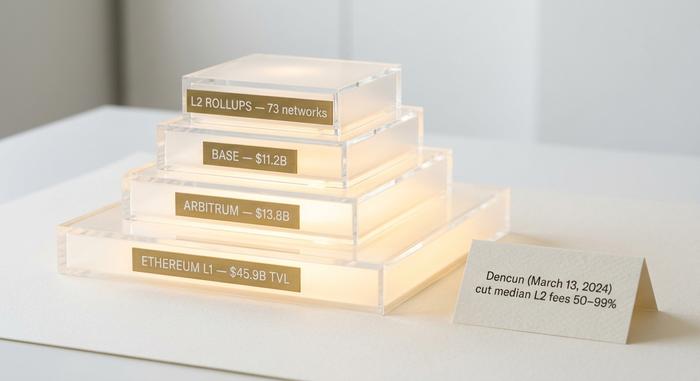
The Ethereum vs Bitcoin gap on functionality is most visible here. The downstream effects of smart contracts and decentralized applications show up in two places. The first is decentralized finance (DeFi). According to DeFiLlama, the Ethereum blockchain holds roughly $45.9 billion in DeFi total value locked as of May 2026, about 53% of all decentralized finance across every chain. Lending markets, decentralized exchanges, liquid staking, and most of the stablecoin infrastructure live there. The second is the Layer-2 ecosystem. Arbitrum holds around $13.8 billion in TVL, Base around $11.2 billion, and the broader rollup ecosystem now totals more than $48 billion across some 73 networks. The Dencun upgrade on March 13, 2024 cut median Layer-2 fees by 50% to 99% the day after, which is the upgrade that finally made on-chain transactions feel cheap.
Bitcoin has caught up on a smaller scale, quietly. Lightning, the payment-channel layer on top of Bitcoin, is narrow but useful. Public capacity sat near 5,600 BTC at the end of 2025, and the routing settles in seconds at a fraction of a cent. Ordinals turned BTC blockspace into a place to embed data and produced more than 100 million inscriptions by October 2025; the BRC-20 token experiments and Bitcoin NFTs came out of that. None of this is close to Ethereum's programmability. But it shows the Bitcoin ecosystem is no longer a settlement layer for one asset only.
The cleanest measure of the gap is developer count. Electric Capital's 2025 Developer Report puts Ethereum at 31,869 active developers and Bitcoin at 11,036 — Ethereum added more new contributors in the first nine months of 2025 alone than Bitcoin has on its entire network. Capital follows builders eventually.
Transaction fees and speed: which network is faster?
Price of bitcoin and price of ether mostly track the same global sentiment, but throughput is a different story. The Bitcoin network mints a block every ten minutes or so and clears about seven transactions per second on its base layer. Fees move with demand. Quiet weeks under a buck, peak weeks well into the double digits. The Ordinals boom held fees up through most of 2024 and early 2025 before things calmed down. Lightning, off-chain, clears in seconds for a fraction of a cent.
Ethereum is quicker on both axes. Blocks every 12 seconds, around 13 transactions per second at the base layer, and an average fee near $0.24 in May 2026. A long way from the $50-plus mania of 2021. The real action runs on rollups now. After Dencun, Arbitrum and Base routinely settle in single-cent territory. For anyone moving stablecoins or touching DeFi, rollups are simply the default. Ethereum's base layer is becoming the settlement floor under them. Both networks end up in oddly similar shapes by 2026: a slow secure expensive base layer, plus a much faster cheaper layer on top.
Institutional adoption and the ETF era
The spot-ETF era reshaped institutional access. Spot Bitcoin ETFs (older filings still call them spot bitcoin ETPs) launched in the US on January 11, 2024 and absorbed roughly $58 billion in net inflows by April 2026. BlackRock's IBIT alone manages around $66.9 billion in AUM, roughly 45% of the category. That is the fastest ETF to that milestone in any asset class. Spot Ethereum ETFs followed on July 23, 2024 and now hold around $12 billion in net assets, with BlackRock's ETHA at $11.64 billion in lifetime inflows. The ETH ETF story is smaller but follows the same trajectory.
Corporate treasuries told the same story from a different angle. Strategy, the company formerly known as MicroStrategy, holds 818,334 BTC at an average cost basis near $66,384 and a total cost of $33.1 billion, the largest single-issuer Bitcoin treasury anywhere. On the Ethereum side a 2025 cohort emerged: BitMine reported 5.18 million ETH in its treasury, and SharpLink disclosed 872,984 ETH in its Q1 2026 financials, including 18,800 ETH in staking rewards over the quarter.
The regulatory question that hung over both assets for a decade closed on March 17, 2026, when the SEC and CFTC issued joint guidance classifying 16 digital assets, including Bitcoin and Ether, as digital commodities. That ruling effectively ended the Howey-test argument for the top two assets and removed the largest legal overhang from US institutional flows.
Using Bitcoin and Ethereum for payments
When people compare Bitcoin vs Ethereum as payment rails, as a medium of exchange in everyday checkout flows, they usually mean transactions denominated in BTC or ETH. In 2026 that framing is incomplete. Most everyday crypto payments now flow through stablecoins that run on top of these chains. DeFiLlama puts Ethereum mainnet's 30-day stablecoin transfer volume at roughly $2.09 trillion against Tron's $714 billion — and the broader stablecoin market cleared more than $28 trillion in Q1 2026 alone, up 51% quarter over quarter.
The practical implication for merchants is straightforward. BTC works well as the asset for invoice value: a fixed unit of account, scarce, widely recognised, easy to hold on a balance sheet. ETH works well for programmable payment flows where a smart contract can hold funds in escrow, release them under conditions, or split a single inbound payment across multiple recipients automatically. Most merchant-facing crypto payment processors handle both. Plisio, for example, lets merchants accept Bitcoin, Ethereum, and the major stablecoins through a single checkout, settles in the asset the buyer chose, and supports the L2 rails that make ETH-side transactions cheap enough for small invoice sizes. Picking sides between BTC and ETH at the checkout layer is no longer the trade-off it used to be.
Which cryptocurrency should you choose: Bitcoin or Ethereum?
In the Ethereum vs Bitcoin choice, most serious crypto investors hold both, which is the honest answer. Bitcoin is the cleaner store-of-value play: fixed supply, the deepest liquidity in the asset class, accessible through a US-regulated spot Bitcoin ETF wrapper, less volatile than Ethereum historically. Ethereum is the platform exposure with optional yield from staking; it carries more downside in drawdowns but more upside if the on-chain economy keeps expanding. If you want a third comparison, like Solana sits below both in market cap but offers higher throughput at a different trust trade-off. The decision is less "Bitcoin or Ethereum" and more what question you are trying to answer with this allocation.