DeFi 2.0: Liquidity, Tokens and the Future of Decentralized Finance
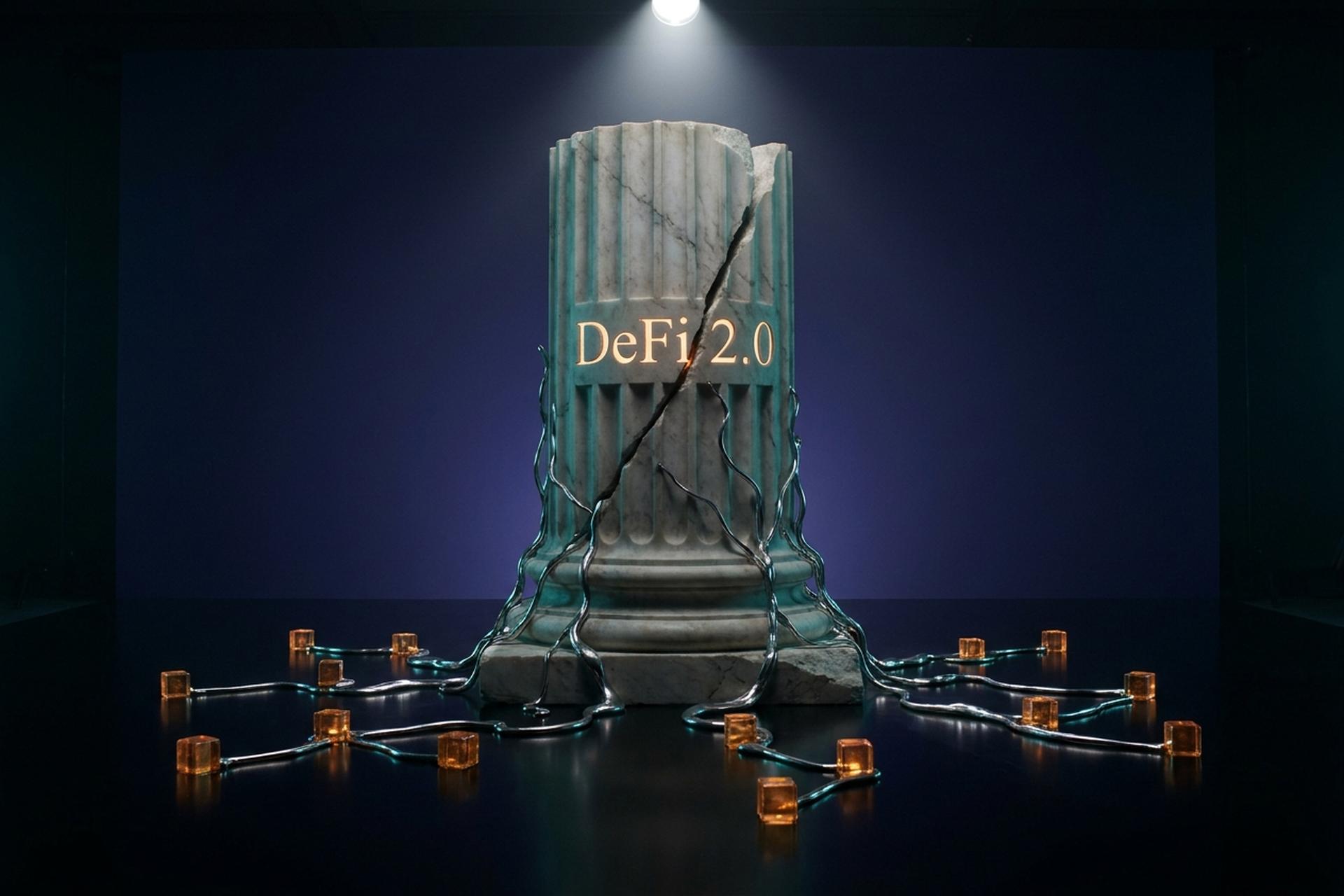
DeFi peaked at roughly $178 billion in total value locked in November 2021, fell below $50 billion after the FTX collapse, and clawed back to around $135 billion by early 2026. That roundtrip is the real story of DeFi 2.0. It is not a fresh cycle but the painful rebuild after the first one broke. Most explainers freeze the topic in 2022, when bonding tokens looked like the future. Four years on, the picture is sharper. Some mechanisms became standard plumbing. Some flagship projects lost more than 99% of their token value. And new layers, including restaking, delta-neutral stablecoins, and tokenized money-market funds traded on a decentralized exchange, now run on the rails that DeFi 2.0 laid down.
Where DeFi 1.0 went wrong: mercenary liquidity and dumb LP tokens
The first wave of decentralized finance solved a real problem. Before 2019, swapping ERC-20 tokens meant centralized order books or thin Bancor pools. Uniswap's automated market maker, paired with Aave and Compound's lending pools, gave Ethereum a working financial stack. The early DeFi protocol set (Uniswap, Aave, Compound, MakerDAO, Curve) became the foundation of DeFi 1.0.
The problem was how those defi protocols attracted liquidity. Synthetix ran what is generally considered the first liquidity-mining program in July 2019: deposit assets into a liquidity pool, receive a stream of native tokens on top of trading fees from yield farming activity. Compound's COMP launch in June 2020 turned that mechanic into a stampede. DeFi total value locked rose from a few hundred million dollars to more than $20 billion across the second half of 2020, the summer of 2020 the industry came to call DeFi summer. By November 2021 the figure hit $178 billion across thousands of defi projects on Ethereum and other blockchain networks.
Underneath the surface, the model was fragile in three places. First, the liquidity was mercenary. A yield-farming liquidity provider would provide liquidity to whatever pool offered the highest APY, harvested the native token, sold it on a decentralized exchange, and rotated out. The moment a protocol cut incentives, total value locked evaporated, sometimes by 70% or more within weeks. Second, the act of providing liquidity carried impermanent loss, the gap between holding two tokens versus pooling them, and on volatile pairs that loss often dwarfed the swap fees. Third, the LP tokens that liquidity providers received in exchange for deposits sat idle in wallets. The capital was locked twice over: once in the pool, once in a token that no other defi protocol would accept as collateral. Scalability was its own headache, since gas on Ethereum L1 frequently made the cheapest cryptocurrency swap uneconomic for retail users, and user experience suffered accordingly.
By late 2021, the cost of renting liquidity through emissions had become absurd. Some protocols were spending more on token emissions in a month than they earned in fees in a year. Something had to change.
| Dimension | DeFi 1.0 (2019–2021) | DeFi 2.0 (late 2021 onward) |
|---|---|---|
| Liquidity source | Rented from yield farmers via token emissions | Owned by the protocol or locked long-term |
| Native token role | Inflation reward to LPs | Bonding currency, vote-escrowed governance |
| LP token use | Sat idle in user wallets | Collateral inside the same defi ecosystem |
| Governance | One-token-one-vote, often captured by whales | Locked ve-tokens with multi-year commitments |
| Chains | Mostly Ethereum L1 | Multi-chain plus Layer-2 (Polygon, Arbitrum, Base) |
| Headline failure mode | TVL evaporates when incentives stop | Token model collapse despite working contracts |
How DeFi 2.0 changed liquidity, tokens and protocols
DeFi 2.0 is not a single protocol or upgrade. The DeFi 2.0 movement is a wave of mechanism redesigns that emerged in late 2021 and 2022, aimed at one question. Can liquidity be owned rather than rented? Five ideas defined the answer and pushed sustainable liquidity past the inflationary farming model.
Protocol-owned liquidity (POL) flipped the script: instead of paying farmers to deposit, the protocol itself buys and holds the LP position. Bonding, pioneered by OlympusDAO, gave users discounted native tokens in exchange for LP tokens, transferring liquidity ownership to the treasury. Vote-escrowed tokenomics (ve-tokenomics), introduced by Curve, let token holders stake and lock their tokens for years in exchange for boosted yields and governance weight inside a decentralized autonomous organization. Self-repaying loans, popularized by Alchemix, used yield generated by collateral to automate debt repayment and amortize it without manual intervention. And LP tokens, once dead weight, became tokens as collateral inside decentralized lending protocols and stablecoin mints.
Together, these moves repositioned defi protocols away from short-term subsidy and toward sustainable liquidity. Whether that worked in practice depended on whose token model you bought into.
Notable DeFi 2.0 projects: which crypto protocols survived
The four-year postmortem on each notable DeFi 2.0 project is less flattering than the 2022 marketing around these 2.0 projects.
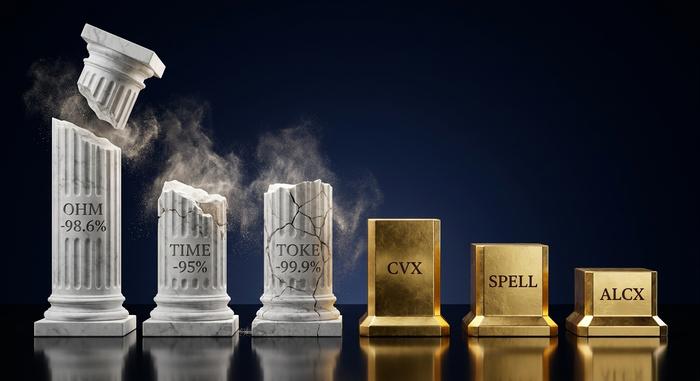
OlympusDAO was the flagship. Its (3,3) game-theory model and bonding mechanism let the treasury accumulate so much OHM-DAI liquidity that, at one point, it controlled over 99% of that pair. OHM hit an all-time high of $1,415 in April 2021. By May 2026 the token traded around $19, a 98.6 percent drawdown from the high, with a market cap near $290 million. The mechanism survived and got copied across dozens of forks. The OHM token did not.
Wonderland (TIME) was the most aggressive Olympus fork on Avalanche. In January 2022, the protocol's pseudonymous treasury manager "Sifu" was unmasked as Michael Patryn, a co-founder of the defunct Canadian exchange QuadrigaCX. Around $8.4 million had moved from the protocol's multi-sig to a personal wallet, according to the Quadriga Initiative case study. TIME fell roughly 95% from its $10,000 peak.
Convex Finance is the cleanest survivor. Built as a yield optimizer on top of Curve, Convex collects CRV from liquidity providers, locks it as veCRV, and uses the voting power to boost yields across the Curve pool ecosystem. As of September 2025, Convex controlled around 53% of all veCRV supply, according to Curve's own reporting, with roughly 40% of its native CVX token vote-locked. The Curve wars, the multi-year contest among Convex, Yearn, StakeDAO and others to accumulate veCRV, became the most-studied case of ve-tokenomics working as designed.
Tokemak promised "liquidity-as-a-service," meaning that protocols would direct TOKE-controlled liquidity to wherever it earned best. The TVL hit $1 billion in late 2021. The TOKE token collapsed from a $79 all-time high to roughly $0.05 by April 2026, a 99.9% drawdown.
Abracadabra and Alchemix kept niche relevance. Abracadabra's Magic Internet Money (MIM) is still a tradeable stablecoin and the SPELL governance token still has a market. Alchemix's self-repaying loans, where a deposit of yield-bearing collateral pays down its own debt, remain one of the more original DeFi 2.0 primitives still in production.
| Project | Launched | Peak metric | State in May 2026 |
|---|---|---|---|
| OlympusDAO (OHM) | Mar 2021 | $1,415 ATH; mcap ~$4B late 2021 | Token -98.6%, mechanism widely forked |
| Wonderland (TIME) | Sep 2021 | ~$10,000 ATH | -95%, Sifu/Patryn scandal Jan 2022 |
| Convex (CVX) | May 2021 | ~53% of veCRV supply held | Active; dominates Curve governance |
| Tokemak (TOKE) | Aug 2021 | $1B TVL Q4 2021 | TOKE -99.9% from $79 ATH |
| Abracadabra (SPELL/MIM) | Apr 2021 | MIM mcap > $4B in 2021 | Smaller but operational |
| Alchemix (ALCX) | Feb 2021 | Self-repaying loans pioneer | Niche but live |
Liquidity, tokens and the ve-model that actually worked
Strip out the failed token launches and one mechanism stands out as the durable contribution of DeFi 2.0. It is vote-escrowed tokenomics. Curve introduced it. Convex weaponized it. Frax, Balancer, Pendle, Velodrome and Aerodrome all run on variants of the same idea, and each has its own native token feeding the model.
The mechanic is simple. Lock the native token for up to four years and receive non-transferable "ve" tokens that grant voting power and boosted rewards on liquidity pools. Vote-locked holders direct where future emissions go. That decision is worth enough that other protocols pay bribes, meaning direct cash incentives to ve-holders, to attract liquidity to their pools. Bribe markets like Votium and Hidden Hand emerged as a layer on top.
Why does this work when liquidity mining did not? Because the lock concentrates governance among people who cannot rotate out quickly. A four-year veCRV lock is illiquid by design. The holder's incentives are aligned with the long-term health of the protocol rather than next week's yield. In December 2025, on a single major Curve emissions vote, Convex and Yearn together cast roughly 90% of votes.
The clearest current evidence sits on Coinbase's Layer-2 chain Base. Aerodrome, a ve(3,3) DEX built by the Velodrome team, captured between 50% and 63% of Base's DEX volume in 2025. Aerodrome processed $22.9 billion of monthly volume in August 2025, about 7.4% of all DEX activity, according to The Block. Uniswap was still first at $111.8 billion (35.9% share), and PancakeSwap second at $92.0 billion, but Aerodrome was the first ve-model DEX to crack the top three.
Across the broader market, DEX share of all spot crypto trading reached 20% in 2025 (a16z State of Crypto 2025), up from low single digits during DeFi 1.0. The ve-model is part of how that gap closed.
DeFi 2.0 in 2026: restaking, real yield and institutional rails
The label "DeFi 2.0" faded from headlines around 2023. Its DNA did not. Three things happened on the rails it laid down.
Restaking. EigenLayer let stakers reuse their ETH (or LSTs like Lido's stETH) to secure additional services. TVL ran from $1.1 billion in early 2024 to over $18 billion before its April 2025 slashing launch. It crashed to roughly $7 billion when slashing went live and risk became material, then recovered above $25 billion through 2026 (Mitosis University, The Block). EigenLayer now sits on roughly 85% of the restaking market. Liquid restaking tokens (EtherFi at around $7.8 billion, Renzo near $3.3 billion, plus Kelp and Puffer) built a second layer on top. The pattern rhymes with the LP-token-as-collateral loop from DeFi 2.0. Only the substrate changed.
Real-yield stablecoins. Ethena's USDe is the most successful "DeFi 2.0 native" launch since Olympus. The token captures funding-rate spreads from perpetual futures, with the spread paid to sUSDe stakers. TVL ran from zero to a peak of $14.8 billion in August 2025, halved to $7.4 billion after the October 2025 market crash, and sat near $4 billion on Ethereum in May 2026 according to DefiLlama. sUSDe yield has compressed from a 4–15% range in 2025 to roughly 3.7% in Q1 2026 per Messari, lower than DeFi 1.0 farming but structurally non-inflationary.
Institutional rails. BlackRock's BUIDL tokenized money-market fund reached around $2.9 billion in assets by mid-2025 and has expanded across Aptos, Arbitrum, Avalanche, Optimism, Polygon, Solana and BNB Chain. On February 11, 2026, BlackRock began trading BUIDL through UniswapX, the first time a tier-1 asset manager has executed directly on a decentralized exchange (Fortune). Total tokenized money-market AUM reached $7.4 billion in 2025 across BUIDL and JPM's MONY.
None of this is what the original DeFi 2.0 proponents pitched. It is, however, what the plumbing they built ended up being used for. The traditional financial system is now arriving on the same rails Olympus and Tokemak built three years earlier, and Web3 infrastructure is hosting it.

Risks of DeFi 2.0 that the new ecosystem did not fix
The technical risks improved. The human risks didn't. Chainalysis's 2026 crypto-crime report counted $3.41 billion in stolen crypto for 2025, but $1.5 billion of that was the Bybit centralized-exchange hack; DeFi-specific losses stayed modest even as TVL recovered. Audits, formal verification and bug bounty programs all matured.
What didn't change is token-model failure. Olympus, Wonderland and Tokemak each lost most of their token value while their smart contracts kept working as designed. Governance capture, hidden multi-sig keys and treasury misappropriation are not smart-contract vulnerabilities. They are people problems wearing a DAO label. Regulatory uncertainty is a third pressure point. US enforcement still treats unregistered token issuance as a securities matter, and individual DeFi protocols have absorbed enforcement actions.
Future of DeFi: will DeFi 3.0 actually be different from 2.0?
"DeFi 3.0" already has marketers, but the working definition is unclear. The candidates most often mentioned, including intent-based execution, agent-driven trading, real-world asset (RWA) on-chain, and deeper cross-chain composability, are extensions of DeFi 2.0 infrastructure rather than ruptures from it. The BlackRock-Uniswap moment in February 2026 is closer to DeFi 2.0 reaching adulthood than to a 3.0 reset. I'm not convinced the version-number framing helps; what matters is whether the next set of mechanisms survives a serious risk-off cycle better than Olympus survived the 2022 one.
Conclusion: what the DeFi 2.0 experiment really proved
The mechanism wins; the token rarely does. DeFi 2.0's bonding curves, ve-locks and self-repaying loans outlived almost all the tokens that launched them. The real test now is whether the institutional flows arriving in 2026 (BUIDL on UniswapX, Ethena's basis-trade stablecoin, EigenLayer's restaking economy) stick when the next downturn hits, or unwind like 2021's farm-and-dump did. Watch the TVL chart and which use cases actually attract sticky capital, not the next "3.0" announcement.