MoonPay 2026 : Buy Crypto, Bitcoin, Solana, Full Review

On the morning of May 5, 2026, MoonPay announced its sixth acquisition in eighteen months: $100 million in stock for DFlow, a Solana DEX router that handled more than $12 billion in trading volume in the first quarter alone. The same week, CEO Ivan Soto-Wright told Fortune the company is preparing for public market entry. That story sits on the same homepage as the one for a Bristol teenager buying his first $40 of Bitcoin with Apple Pay in ninety seconds. Both versions of MoonPay are real, and this review covers both: how the consumer onramp works, what it costs, where it is regulated, how it stacks up against Coinbase, Ramp, Transak, and Mercuryo, and what the IPO-track expansion means for everyone who has used the little Buy button at the bottom of their crypto wallet.
What is MoonPay? Crypto, Bitcoin, and Solana onramp explained
MoonPay started in Miami in 2019. Three founders. Ivan Soto-Wright, Victor Faramond, Maximilian Crown. They built a non-custodial crypto payment processor, which means MoonPay never touches your digital assets in transit. It takes dollars or euros, converts them into a token you picked, and ships the token straight to a wallet address you control. The address can sit in MetaMask, Phantom, Ledger Live, Trust Wallet, or any of the other major crypto wallets people already keep on a phone. Buying and selling cryptocurrencies through MoonPay is as close to one-tap as the regulated crypto market lets it be.
The scale grew faster than the marketing. The company's own homepage cites more than 35 million verified accounts across 180 countries, with 500 partner wallets, dApps, and exchanges plugged in. The Series A in November 2021 closed at $555 million on a $3.4 billion valuation, co-led by Coatue Management and Tiger Global. By December 2025 MoonPay was reportedly in funding talks with Intercontinental Exchange, the parent of the New York Stock Exchange, at a $5 billion valuation. IPO chatter has only intensified through 2026.
What started as a retail onramp now has two faces. The consumer version is the one most readers know. A payment widget embedded in MetaMask, OpenSea, Trust Wallet, Ledger Live, and the rest. The institutional version, MoonPay Institutional, launched April 29, 2026, on the Sodot key-management infrastructure MoonPay bought the same month.
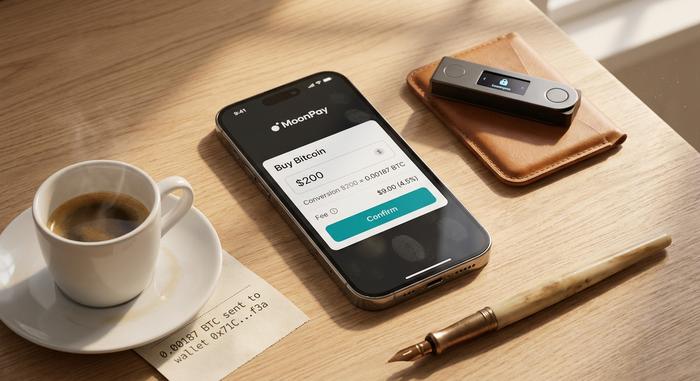
How MoonPay works: payment method to crypto wallet
The mechanic is unusually simple for a fintech product. You pick the cryptocurrency you want, paste a wallet address that is yours, choose a payment method, complete know-your-customer verification on your first use, pay, and the asset arrives in your wallet within seconds to a few minutes depending on which payment rail you used. Crypto using MoonPay travels through the same rails any tokenized payment would, but the partner takes the compliance load instead of the user. MoonPay never holds the funds in its own account. It runs the conversion and pushes the output to the address you supplied.
A small caveat to that purity: in 2024 MoonPay added an optional MoonPay Balance, a hosted wallet for users who want to keep funds inside the app between buys and sells. The default flow is still a pass-through to your own wallet. Most users never enable Balance.
Three integration patterns matter for partners. Embedded widgets place the MoonPay flow inside another app, the dominant integration; that is what you see when you tap "Buy" inside MetaMask. Direct API calls let merchants build custom checkout pages. The standalone moonpay.com site exists for users who land directly without a partner app. The same KYC and compliance stack runs underneath all three.
A first-time purchase will trigger identity verification. MoonPay uses tiered KYC: a basic tier verifies email and phone for small purchases, and a full tier requires government ID and a selfie. Verification typically completes in under five minutes for clean documents and routes to manual review when something flags. The same documents unlock higher daily and lifetime limits.
How to buy crypto with MoonPay: step by step
The flow is short enough to memorize. Open moonpay.com on a phone or laptop. Or tap the Buy button you can probably already see inside MetaMask, Phantom, Trust Wallet, or Ledger Live. Both routes hit the same backend.
Pick the asset. Buy Bitcoin, Ethereum, Solana, USDC, USDT, AAVE, Chainlink, Dogecoin, Cardano, XRP, Litecoin, or any of the smaller tokens MoonPay carries that day in your jurisdiction. Type the amount in dollars or euros or whatever your local fiat is. The screen shows what you will receive in crypto, the service fee, and the embedded spread, before anything is committed.
Paste the wallet address. If you opened MoonPay through a partner app, this is auto-filled. If you came in through the website directly, copy it from your wallet and double-check the chain matches.
Pick a payment method:
- Apple Pay or Google Pay: fastest, settles in seconds, around 4.5 percent fee
- Credit or debit card: same speed and fee, more friction at first use
- Bank transfer (ACH in the US, SEPA in the EU, Faster Payments in the UK): cheapest at 1 percent, settles in one to three business days
- PayPal: added for US users on May 2, 2024 and rolled out to UK and EU later that year, similar fee to cards
- Venmo: US only
- Regional rails: Revolut Pay, Interac, Paysafe, Yellow Card, depending on country
First-time users hit a KYC screen. Photograph your government ID. Take a selfie. Wait. Clean documents clear in under five minutes. Anything ambiguous routes to a human reviewer and can take a day. Once approved, the same KYC stays valid across the partner network, so a buy through OpenSea later that week skips the wait.
Approved purchases land in your wallet in seconds for Apple Pay and cards. Bank-rail buys land in hours to a few days. Withdrawals work in reverse. Sell, pick a fiat destination, KYC clears, the cash arrives. Fees on the way out mirror the fees on the way in.
MoonPay fees: debit card, PayPal, bank, plus the spread
MoonPay's fee story has two layers, and most newcomers only see the first. The visible service fee runs ~4.5% on cards, Apple Pay, Google Pay, PayPal, and Venmo, and ~1% on bank transfers. A minimum of $3.99 (or the local equivalent) applies to small orders. The fee is shown clearly on the confirmation screen.
The second layer is the FX spread baked into the conversion price. Independent reviews and 2026 Milkroad coverage place this at roughly 0.5% to 1.5%, depending on the asset's liquidity and the day's volatility. The spread is not a separate line item; it is embedded in the quoted exchange rate. On a $1,000 purchase that is another $5 to $15 on top of the visible fee.
| Payment method | Service fee | Minimum | Settlement |
|---|---|---|---|
| Card / Apple Pay / Google Pay | ~4.5% | $3.99 | Seconds |
| PayPal / Venmo (US, UK, EU) | ~4.5% | $3.99 | Seconds to minutes |
| Bank transfer (ACH / SEPA / Faster Payments) | ~1% | $3.99 | 1-3 business days |
| Regional rails (Revolut Pay, Interac, Yellow Card) | varies | varies | minutes to days |
| Plus FX spread | 0.5%-1.5% | embedded | n/a |
| Plus network gas | variable | embedded | depends on chain |
The all-in cost on a $200 card buy is therefore closer to 5.5% to 6%, not 4.5%. That is roughly twice what you would pay on a maker order at a major centralized exchange, which is the trade-off the convenience model exists to provide.
MoonPay vs Coinbase, Ramp, Transak, Mercuryo
Four direct competitors, four niches. None dominates every dimension.
Coinbase Onramp wins on US trust and brand. It has the most aggressive consumer marketing in North America and the widest mainstream awareness. It is also the most expensive on small spread orders, and its fee disclosure is famously layered.
Ramp Network is the cheapest of the major onramps in 2026, typically 1.99 percent on cards versus MoonPay's 4.5 percent. Its country coverage is narrower and its partner roster is smaller, but if a user just wants the cheapest path to ETH, Ramp is the answer.
Transak has the broadest chain support of the four, claiming over 170 supported networks, which makes it the default integration for many multichain wallets and L2 ecosystems where MoonPay is a step slower to add.
Mercuryo is strongest in Europe, integrated into Trust Wallet, MetaMask, Bybit, and others as the default EU rail. Its KYC is sometimes friendlier on edge-case European jurisdictions where US-anchored providers refuse.
| Provider | Country reach | Card fee | Bank fee | Best at |
|---|---|---|---|---|
| MoonPay | 180+ | ~4.5% | ~1% | UX speed, 500+ partners, NYDFS-licensed |
| Coinbase Onramp | 100+ | ~3.99% | ~1.49% | US trust, Coinbase exchange link |
| Ramp Network | ~150 | ~1.99% | varies | Lowest card fees |
| Transak | 165+ | ~3.5% | ~1% | Widest chain support (170+) |
| Mercuryo | ~170 | ~3.95% | ~1% | EU coverage, Trust Wallet default |
The right choice usually depends on your wallet's default integration. If you bought a Ledger and you live in Boston, MoonPay is the path of least friction. If you trade weekly on Solana with a Phantom wallet, the cheaper integration may already be Ramp or DFlow under MoonPay's roof.
Trust and risks: regulation, lawsuits, and complaints
MoonPay is regulated where it matters in 2026, but the company has a paper trail worth knowing.
On the regulatory side: FinCEN MSB registration in the US, money transmitter licenses across 47 US states, FCA registration #928920 in the UK, MiCA authorization secured via the Netherlands in December 2024, an NYDFS BitLicense received in June 2025, and a New York Trust Charter granted in November 2025. The Trust Charter in particular put MoonPay among the small group of firms permitted to custody digital assets for institutional clients in New York.
On the controversy side, three things matter. The first is the December 2022 class-action lawsuit alongside Yuga Labs, alleging that celebrity promotion of Bored Ape NFTs through MoonPay artificially inflated prices and harmed retail buyers. The case has been litigated since. The second is a Fortune report from May 2023 that MoonPay executives sold roughly $150 million in equity in late 2021, weeks before the crypto market collapse, with Soto-Wright reportedly buying a $38 million Miami home. The third is the steady drip of consumer complaints. Trustpilot shows roughly 4.2 out of 5 across 95,000+ reviews, solid for a payments processor but not free of grievances. The Better Business Bureau lists a B+ rating, unaccredited, with 154 complaints filed, most concerning KYC freezes that lock up small balances and slow customer support.
For a user buying $200 of Bitcoin, none of this is decisive. For an institution moving treasury funds through MoonPay's new institutional layer, due diligence on each item is appropriate.
Recent moves: Helio, Sodot, DFlow, MoonPay Institutional
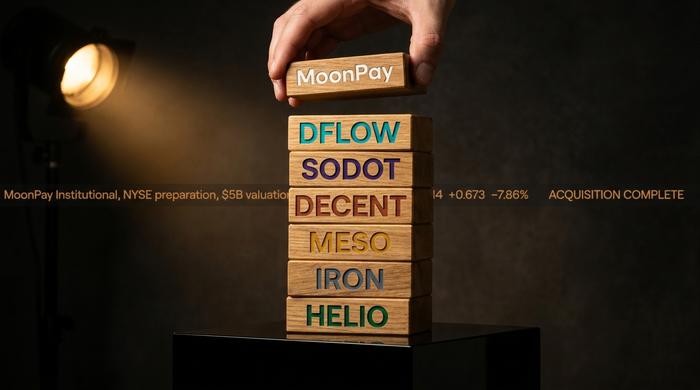
Six acquisitions in eighteen months. MoonPay went from a retail onramp to a vertically integrated crypto-infrastructure firm in less time than most fintechs spend choosing a logo. The shopping list reads in order: Helio in January 2025 for $175 million, picking up a Solana payments processor; Iron in March 2025, a stablecoin platform; Meso and Decent through the rest of 2025, plumbing for cards and rails; Sodot on April 29, 2026, an Israeli MPC and TEE key-management firm that had already secured over $50 billion in transactions for eToro, BitGo, Flow Traders, and Exodus; and DFlow on May 5, 2026, the Solana DEX router that handles 60 percent of Solana volume on Coinbase and pushed past $12 billion in Q1 2026 alone.
Sodot is the structural one. Buying the company already keeping client funds safe at eToro and BitGo matters more than the price tag. It anchors MoonPay Institutional, the new B2B arm. Caroline D. Pham, the former acting CFTC chair, runs it as CEO of Moon Global Markets. The product targets banks, asset managers, and trading firms moving into crypto, with custody under the New York Trust Charter, MPC wallets, an API vault, OTC liquidity across 200 chains, and white-label stablecoin issuance in 120 fiat currencies. Soto-Wright's framing to Fortune was a four-pillar pitch. Fund. Tokenize. Trade. Spend.
Should you use MoonPay to buy and sell crypto?
If you value speed, partner integrations, and a consumer-friendly UX, yes. MoonPay is a reasonable default for occasional buys, particularly if you already use a wallet that has it embedded or the MoonPay app on iOS or Android. If you only care about minimum fees, Ramp Network beats it on cards and a centralized exchange beats both on bank-rail buys above a few hundred dollars. The product is purpose-built for convenience, not cost optimization, and the math reflects that. For most users, MoonPay's processing fees are the price of skipping account creation on a full exchange and getting back to whatever they actually wanted to do.
The MoonPay app, IPO track, and the onramp future
MoonPay sits in an unusual spot. It is small enough to remain a single-tap fiat-to-crypto button inside a Phantom or MetaMask wallet, and big enough to be on the desk of bankers preparing public-market documents. Use the Apple Pay flow if it saves you a Saturday afternoon. Use a real exchange if you are moving five-figure sums every month. The label on the box is the same; the right answer depends on the math.