Gold Bar Worth and Weight: Sizes, Prices, Bullion Guide 2026
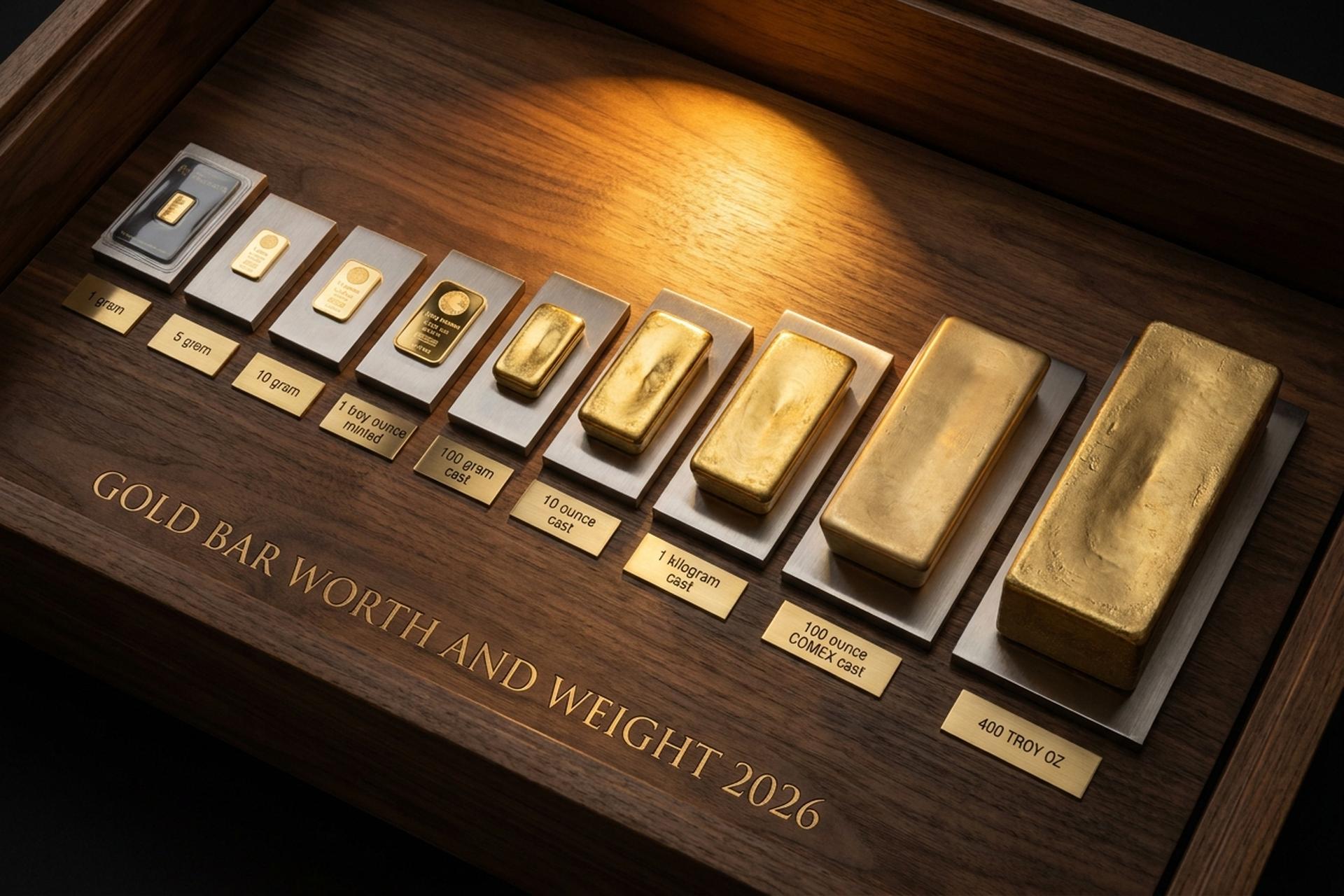
The largest gold bar on the planet weighs 300.12 kilograms. The Emirates Minting Factory struck it in November 2024. Worth roughly $45 million at today's spot. It sits in a vault as an exhibition piece. Nobody trades it.
The bars investors and central banks actually move are different. They span from a single gram to the 400-troy-ounce Good Delivery brick. And the price of any bar comes down to three things at once. The live spot price of gold. The premium dictated by bar size and refiner. Cast versus minted. Get those three right and the rest is arithmetic. Get one wrong and you overpay. This guide covers what those bars weigh, what they cost in May 2026, and where the small print does the damage.
Why gold bar weight and worth track different things
The worth of a gold bar is not just its melt value. The gold price sets the floor: the LBMA PM fix on 13 May 2026 came in at $4,675.70 per troy ounce. How much a gold bar weighs sets the premium above that floor. A 1 gram minted gold bar typically carries a 15-25% retail markup, 1 oz gold bars around 3-7%, and a 1 kilo cast bar as little as 2%. Refiner brand sets resale liquidity. A PAMP Suisse or Valcambi bar sells back to almost any dealer at full spot plus a small premium; a no-name bar of the same weight and purity often discounts on the buy-back side. Cast versus minted production sets the look and the cost to make. Put those three components together and you get a retail price that drifts noticeably from melt value, especially at the small end. That gap is what the guide below addresses.
Standard gold bar weight units and what they mean
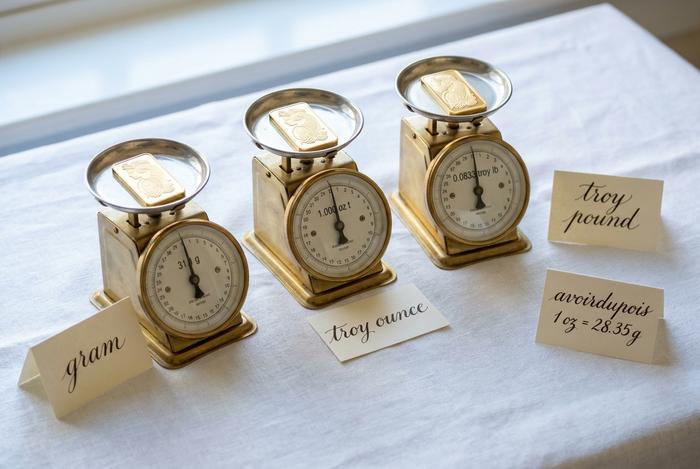
Walk into a bullion dealer and you will run into three different weight systems before the conversation is over. They sit on top of each other. Anyone serious about buying needs to keep them straight.
The first is the troy ounce. This is the working unit for precious metals worldwide, and it tends to ambush first-time buyers. People hear "ounce" and reach for the kitchen-scale version. The troy ounce is heavier, at exactly 31.1034768 grams. Skip past the conversion and the price quotes never line up.
The second system is the metric one. At retail, gram bars come in 1, 2.5, 5, 10, 20, 50 and 100 grams, then jump to the 1 kilo bar that is also exactly 32.15 troy ounces. The metric tier dominates European dealer stock and almost all of the Asian retail market.
The third system is regional. Indian and Pakistani dealers still price in tola, which is roughly 11.66 grams. Hong Kong and parts of mainland China use the tael, which is closer to 37.5 grams. Both predate the metric system and neither shows any sign of disappearing.
Above retail is the institutional layer, where the units shift again. London Good Delivery bars are held by central banks, LBMA clearing members and ETF custodians, with a nominal weight of 400 troy ounces. The specification, however, lets actual fine content vary between 350 and 430 troy ounces, requires at least 995.0 fineness, and sets dimensions near 250 by 70 by 35 millimetres. COMEX-deliverable bars run tighter still, between 95 and 105 troy ounces and at Four Nines (99.99 percent) gold.
| Bar weight | Grams | Troy oz | Approx. retail @ $4,675/oz |
|---|---|---|---|
| 1 g | 1 | 0.0322 | $180-195 |
| 10 g | 10 | 0.3215 | $1,560-1,650 |
| 1 oz | 31.10 | 1.00 | $4,800-4,950 |
| 100 g | 100 | 3.215 | $15,200-15,800 |
| 10 oz | 311.04 | 10.00 | $47,800-49,500 |
| 1 kg | 1,000 | 32.15 | $153,000-156,000 |
| 100 oz COMEX | 3,110 | 100.00 | ~$478,000 |
| 400 oz Good Delivery | 12,440 | 350-430 | ~$1.95M-2.01M |
How much a gold bar is worth in 2026
Spot behaved like a different animal in 2025. The metal closed at a record high 53 times during the year. Then it broke its all-time high again, at $5,589.38 per troy ounce, on January 28, 2026. The pullback to the mid-$4,000s by mid-May still leaves gold up roughly 189 percent over five years on a WGC measurement basis. The S&P 500 over the same window: about 72 percent. Bitcoin: 27 percent. Different stories, very different periods.
What does it mean for the price on an actual bar? At the May 2026 spot of $4,675.70, the math roughly looks like this. A 1 gram bar from a recognised refiner lists for $180-195 retail. The markup runs north of 20 percent, because production costs, packaging and dealer margin do not scale down. A 10 g bar lands at $1,560-1,650. A 1 ounce gold bar at PAMP Suisse pricing was running $4,889 at APMEX in May 2026, about 1.8 percent over spot. A 100 g bar costs near $15,400 (premium 3-4 percent). A 10 oz bar runs $48,000 or so (~3 percent premium). A 1 kilo bar lands at $154,000-156,000 (a 2-3 percent premium). The 100 oz COMEX bar trades close to $478,000 at institutional spreads. The 400 oz Good Delivery bar prices anywhere from $1.92 million to $2.06 million, depending on the actual fine-gold content the LBMA tolerance allows.
Same metal, different per-ounce prices. That is the punchline. Small bars travel easily and sell badly. Large bars sit in vaults and price beautifully. The bullion market is built around that trade-off.
Cast versus minted gold bars: how the production method matters
A cast bar comes out of a mould. Molten metal in, bar cools, surface stays rough and slightly irregular. Cheap to make. Standard for the larger weights, typically 100 g and up, all the way to the 400 oz Good Delivery brick. Cast bars also carry the lowest premium over spot. Sometimes as low as 2 percent on a 1 kg cast format. Most gold bars come off a casting line at this size for one reason: per-gram production cost is minimal.
A minted bar works the opposite way. The refiner rolls a gold sheet to exact thickness. Blanks get punched out. Each blank goes under a die. Out comes a sharp-edged, mirror-finish bar. Usually sealed in tamper-evident assay packaging, with a printed certificate of fineness and a serial number printed on the card. Minted gold bullion dominates the small end of the market: 1 g, 5 g, 10 g, 20 g, 50 g. Premiums sit higher too, from 5 percent up to 15-25 percent on a 1 g bar. The premium pays for rolling, blanking, stamping, the assay-card packaging. A cast bar gets none of those steps.
Choosing between the two is mostly a question of use case. Storage at a vault for long-term holding favours cast bars in 1 kg increments because the lower premium and easier stacking matter and the appearance does not. Carrying a gift, hedging a portfolio at the gram level, or keeping a small allocation at home favours minted bars because the assay card, the security hologram and the resale recognisability are worth the extra few percent.
Trusted gold bar refiners and gold bullion brands
LBMA accreditation is the gating standard that any gold bullion needs to clear before a wholesale buyer will look at it twice. Roughly 70 refiners worldwide hold Good Delivery accreditation, but most retail bars trace back to a much smaller subset inside that list.
The Swiss four set the tone: PAMP Suisse, Valcambi, Argor-Heraeus and Metalor. Heraeus in Germany and Umicore in Belgium round out the continental European tier. The Royal Canadian Mint and the Perth Mint dominate British-Commonwealth retail, and between them they stamp out some of the most counterfeited (and therefore most security-marked) 1 oz bars in circulation. South Africa's Rand Refinery sits on the institutional list, and TD Precious Metals has built its retail business largely on Royal Canadian Mint inventory.
One refiner that retail buyers still ask about is Credit Suisse, and that one belongs to the past tense. UBS absorbed Credit Suisse in 2023 and the Credit Suisse-branded bar line stopped production. A quieter detail tends to surface here: most of the Credit Suisse retail bars were physically struck by Valcambi all along, so an older Credit Suisse 1 oz bar with an intact assay card still trades as bullion at full spot plus a thin premium today.
| Refiner | Country | Typical retail product |
|---|---|---|
| PAMP Suisse | Switzerland | 1 oz Lady Fortuna, Cast Bar 1 kg |
| Valcambi | Switzerland | CombiBar, 1 oz, 1 kg cast |
| Argor-Heraeus | Switzerland | Kinebar, 1 oz, 100 g |
| Heraeus | Germany | 1 oz, 100 g, 1 kg cast |
| Royal Canadian Mint | Canada | 1 oz Maple, 10 oz cast |
| Perth Mint | Australia | 1 oz, 1 kg cast, kangaroo series |
| Rand Refinery | South Africa | Krugerrand-linked bars |
| Umicore | Belgium | 100 g, 1 kg cast |
How to buy gold bars in 2026: dealers, authentication, storage
Reputable online dealers handle most retail volume. APMEX, JM Bullion, Kitco, Money Metals, BullionStar. They all carry the major refiners, publish live prices linked to spot, ship insured. Bank precious-metals desks at UBS, Vontobel and a handful of European universal banks sell directly to clients holding custody accounts. And then there is the surprise of the 2024-2025 cycle: Costco. Wells Fargo analysts pinned monthly Costco gold-bar sales at $100-200 million through the back half of 2024. By October 2024 the warehouse club was hitting a 77 percent stock-out rate on its 1 oz bars.
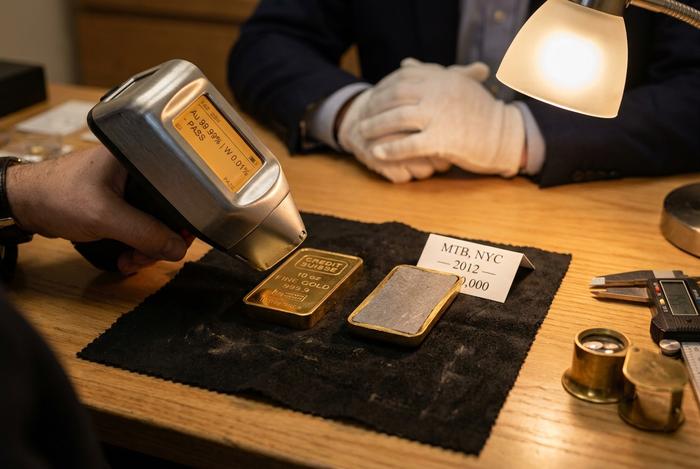
Two things matter on the buy side. Authentication first. Insist on the LBMA-accredited refiner stamp, a matching serial number, an unbroken assay card on a minted bar, a paper certificate of fineness for cast. On resale, dealers verify with X-ray fluorescence (XRF) on the surface, ultrasound or precision-density tests for the interior, sometimes a destructive fire assay if the chain of custody is broken. The tungsten counterfeit story is real and recent. Back in 2012 a New York refiner named MTB caught four tungsten-cored 10-ounce fakes worth roughly $72,000 over a single weekend. The Secret Service investigated. Retail authentication practice changed.
Storage is the second decision. A home safe is cheap, often uninsured by homeowner policies. Bank deposit boxes are cheap, not insured by the bank itself. Private allocated vault services (Brink's, Loomis, Malca-Amit, Singapore's Free Trade Zone vaults) cost 0.5-1.5 percent of value per year and cover the contents in your name. Unallocated storage runs as low as 0.1 percent, but you own a claim on a pool rather than a specific bar.
Investing in gold bars vs ETFs and tokenized gold
Physical gold bars compete with two paper formats that track the same gold price minus the weight. Control versus friction. That is the trade-off in one phrase.
On the central-bank side, the demand stays concentrated. The reserves data make the point. The US Treasury sits on 8,133.5 tonnes. Germany holds 3,350. Italy 2,452. France 2,437. Russia 2,333. China 2,313. Beijing extended a 13-month buying streak through November 2025. Central banks pulled down 1,044.6 tonnes in 2024 and another 863 tonnes in 2025, per the World Gold Council. A structural bid running across years. It filters quietly into retail bar premiums, whether anyone notices or not. Gold ETFs took in $89 billion of net inflows in 2025, a record figure, pushing total AUM from $559 billion to $615 billion and holdings from 4,025 tonnes to 4,137 tonnes (World Gold Council). Tokenized gold is the newer category: PAXG and XAUT together back most of a roughly $6 billion market capitalisation as of February 2026, and on-chain Q1 2026 trading volume of $90.7 billion already exceeded all of 2025. Either gives you price exposure without the storage cost. Neither gives you the bar in your hand. US sellers should note the IRS 1099-B threshold (reportable for sales of 1 kg or more at fineness ≥99.5%, with American Gold Eagles exempt) and the IRA rule that bars must be ≥99.5% fine and held with an approved custodian, not at home.
Conclusion: matching the gold bar to the buyer
So what does it all add up to. At May 2026 spot, a single 1 oz gold bar runs roughly $4,800. A 1 kg bar lands around $154,000. The 400 oz Good Delivery bar from heist films is worth close to $2 million. The 300-kilo Emirates bar nobody trades is $45 million on paper.
The real numbers for a retail buyer, though, are not the spot price. They are the premium, the refiner brand and the cast-versus-minted choice. Match the bar to the use case. Portability for some buyers. Vault efficiency for others. Resale liquidity matters more than people expect until the moment of sale. Skip the marketing line. The metal is the same; the format is where the money sits.