
What is a decentralized crypto wallet? A guide to DeFi self-custody
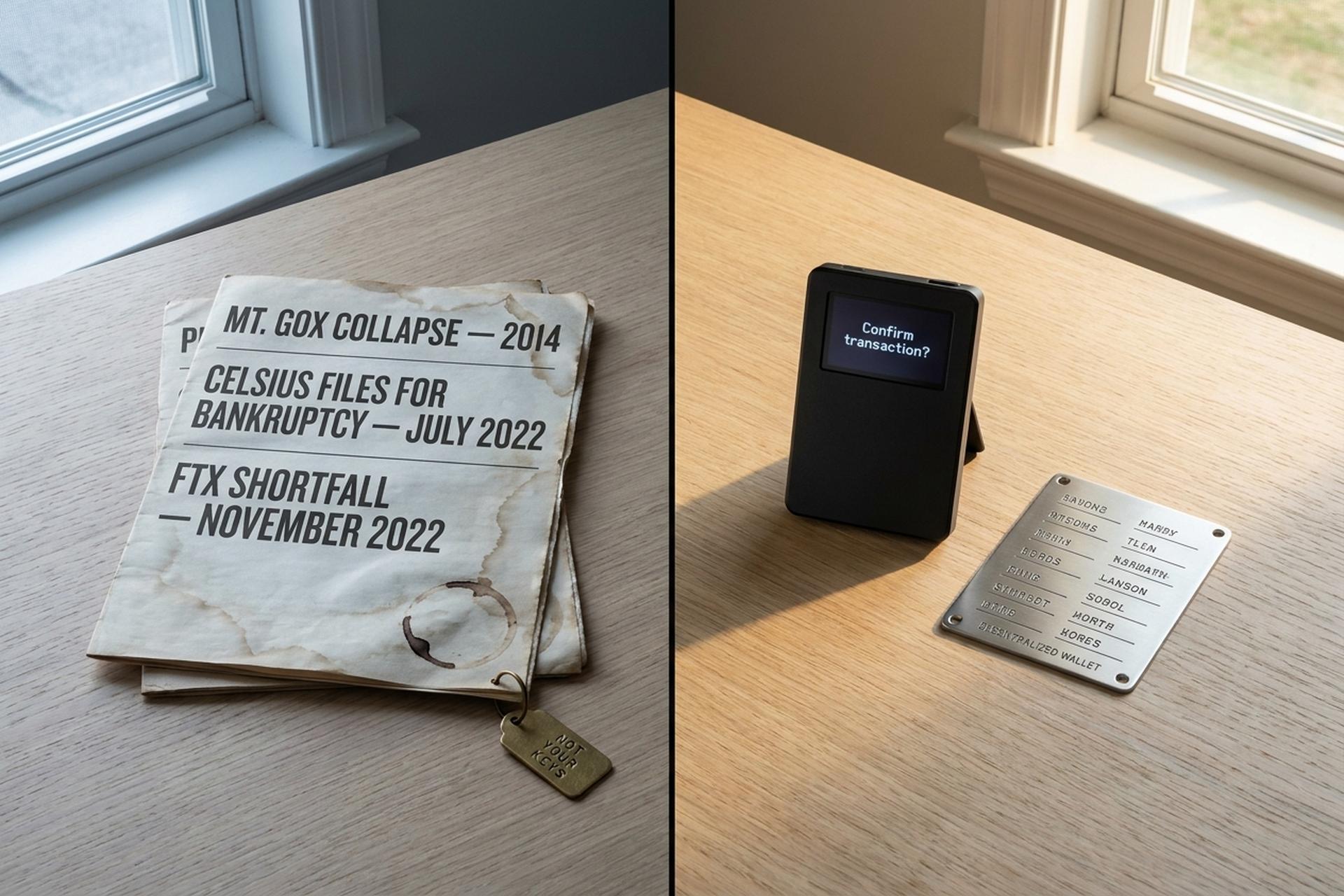
Three crypto exchanges. One bankruptcy filing each. A combined hole in customer funds north of twenty billion dollars. Mt. Gox, Celsius, and FTX did more to push retail crypto users toward decentralized wallets than any whitepaper ever did. A decentralized wallet is the simplest answer to a recurring question: who actually holds your crypto when an exchange goes under? The short answer: with a decentralized (or non-custodial) wallet, the answer is "you." This guide explains what a decentralized wallet is, how the keys work, the difference between custodial and self-custodial setups, and how the same tooling underpins crypto payments and business treasuries today.
What is a decentralized wallet? The simple definition
A decentralized wallet is software, or a small piece of hardware, that stores the cryptographic keys to your cryptocurrency on a device you control. Plenty of people call it a non-custodial cryptocurrency wallet; the names refer to the same tool. Decentralized cryptocurrency wallets sign transactions on the user's own device, so no exchange, no broker, and no third party signs on your behalf. You sign every transaction yourself, and the company that wrote the wallet code has no ability to freeze, return, or seize your balance.
The wallet does not "hold" your crypto assets in the traditional banking sense. Your digital assets live on a public blockchain. Wallets store private keys, and that key is what proves you own the address those assets are recorded against. Lose the key and lose the crypto. Hold the key and the funds are yours under any conditions, including the bankruptcy of the company that made the wallet.
The vocabulary varies. Decentralized wallet, non-custodial wallet, self-custodial wallet, and self-custody wallet all describe the same thing. The opposite, where a company keeps the keys for you, is a custodial wallet or, in practice, an exchange wallet. Coinbase's main app, Binance's exchange interface, and Kraken's account are all examples of custodial wallets, regardless of how the marketing describes them.
How decentralized wallets work: private keys, seeds, signatures
Three concepts do all the work behind a decentralized crypto wallet. Public address. Private key. Seed phrase. That is the whole stack.
The public address is a long string of letters and numbers, usually displayed as a QR code. Anyone can send crypto to it. Think of it as an account number with no name attached. The private key is a much longer string. It mathematically authorizes spending from that address, and nothing else does. The seed phrase is a human-readable backup of the private key. Twelve or twenty-four English words, drawn from a standardized 2,048-word list known as BIP-39.
Press "send" in a wallet app. Three things happen in roughly the same second. The wallet builds the transaction in memory: destination, amount, fee, nonce. It signs the transaction with the private key, producing a digital signature that anyone with a copy of the blockchain can verify but only the holder of the key can produce. It broadcasts the signed transaction. Validators or miners pick it up and include it in the next block. Done.
The seed phrase is the backup of everything above. Write those twelve or twenty-four words down and you can restore the wallet on a new phone, a new laptop, or a different brand of wallet software entirely. Lose the seed and lose the device, and the funds are not deleted; they sit on the blockchain forever, unreachable. That permanent loss is the price of self-custody. Most wallet onboarding screens repeat the warning at least three times for that exact reason.
Custodial vs decentralized wallets: who actually holds your crypto
The gap between centralized and decentralized wallets begins with a single design question: who keeps the key? A custodial wallet is more like a bank account than a wallet. You log in with email and password, the company signs transactions on its servers, and your "balance" is a database entry on their side. A decentralized wallet inverts the relationship. You sign, the company has no keys, no ability to freeze your balance, and crucially no exposure to your funds if their corporate accounts get hacked, sanctioned, sued, or filed into bankruptcy. The benefit is straightforward: full control over your crypto, with control of your crypto staying in your hands no matter what happens to the wallet vendor.
That last point is not theoretical. Mt. Gox lost roughly 850,000 BTC in 2014 in what was, at the time, the largest crypto exchange failure on record; the trustee is still distributing about nine billion dollars in BTC and BCH to roughly 24,000 creditors, with the latest repayment deadline pushed to 31 October 2026. Celsius Network filed for bankruptcy on 13 July 2022 and later faced a $4.7 billion FTC judgment for misrepresenting how it handled customer deposits. FTX collapsed in November 2022 with what Bloomberg called an eight-billion-dollar shortfall in customer funds. In each case, the asset owner had a "balance" that turned out to be a claim on a bankrupt estate.
| Property | Custodial wallet (CEX) | Decentralized wallet |
|---|---|---|
| Who holds private keys | The exchange | You |
| KYC required | Usually yes | Usually no |
| Account freezes possible | Yes | No |
| Exposure to exchange bankruptcy | Yes | None |
| Lost password recovery | Customer support | Seed phrase only |
| Trading inside the app | Native | Via DEX or bridge |
Hot wallets, cold wallets, and hardware wallets in plain English
Three flavours. One axis. How much of the private-key handling lives on an internet-connected device.
A decentralized hot wallet, sometimes called a software wallet, lives online. Browser extension, mobile wallet app, desktop client. Fast and free. The catch is real: the key material sits on the same machine that runs your web browser and email client. That same machine catches phishing pages and malicious downloads.
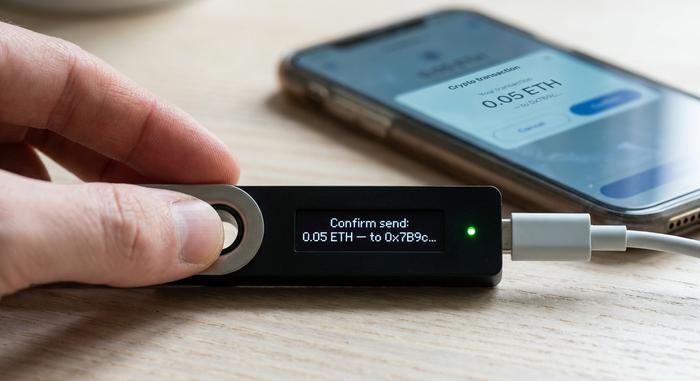
A cold wallet keeps the private key offline. Signing happens on an air-gapped device, and only the finished signed transaction ever touches the internet. A decentralized hardware wallet is the most common kind of cold wallet. A USB-stick-sized device, usually a Ledger or Trezor, with the keys hidden behind a physical confirmation button. Ledger has shipped more than seven million units cumulatively. Hardware-wallet sales rose roughly 31 percent year over year through 2025.
Phishing data tells the same story from the other end. Scam Sniffer counted $494 million stolen from wallet-drainer phishing across 2024. That number fell to $83.85 million in 2025. An 83 percent drop in a year, driven mostly by hardware-wallet adoption and better wallet UX warnings. Hot-wallet attack surface is still the dominant loss vector for everyday users, and it will stay that way as long as most people sign from a laptop.
| Type | What it is | Best for |
|---|---|---|
| Hot wallet | App or extension on a connected device | Daily spending, dApp use |
| Cold wallet | Offline signer (paper, air-gapped) | Long-term holdings |
| Hardware wallet | Pocket-sized cold signer with button confirm | Most users with > $1,000 of crypto |
Popular decentralized wallet apps you will run into
A beginner does not need to memorise fifty options. Five names cover almost every real-world use case.
MetaMask is the default decentralized wallet for Ethereum and EVM-compatible chains. Roughly thirty million monthly active users sit in the app. The wallet stores keys locally, and the wallet offers built-in token swaps. Trust Wallet is the most-downloaded mobile non-custodial wallet. A wallet that supports more than seventy chains and over four million tokens, depending on which networks the user toggles on. Phantom is the de facto Solana wallet, with a few million MAU of its own. Rabby is a security-focused EVM extension that previews transactions before signing; the wallet comes with a transaction-simulation engine that warns about risky approvals before the signature ever leaves the device. A wallet like Coinbase Wallet, which has to be flagged separately from the Coinbase exchange, is a non-custodial wallet app from the same company. The wallet gives users full control of keys stored on their device, no Coinbase database in the middle.
For hardware the field is much smaller. Ledger and Trezor remain the two reference brands. Both ship signing devices in the same price range, both support BIP-39 seed phrases, both pair cleanly as cold-storage signers behind a hot wallet UI like MetaMask. A new hardware device costs in the range of $79 to $250 depending on the model. That is the price of treating self-custody as a discipline rather than a tab.
Decentralized wallets in DeFi and decentralized exchanges
A decentralized wallet is the login system for everything outside a centralised exchange. Decentralized exchanges. Lending markets. Staking interfaces. NFT marketplaces. Anything that needs a user signature. Uniswap, Curve, dYdX, Jupiter for DEX trading. Aave, Compound, Morpho for decentralized finance lending. Plus a long tail of decentralized applications. Each one expects a wallet connect at the front door.
The flow is the rough DeFi equivalent of OAuth, with one important difference. The dApp asks your wallet to sign a message proving ownership of an address. You sign each on-chain transaction individually after that. No standing permission, no session token.
A good DeFi wallet exposes that primitive to the user clearly. See what you are about to sign. Confirm the destination address. Approve. Better wallets simulate the transaction before signing and flag suspicious approvals. Rabby is the canonical example. MetaMask added similar warnings via the Blockaid integration in 2023. The reason it matters: a single bad signature can drain an entire wallet through a malicious token-approval transaction, the same mechanic that powered most of the wallet-drainer phishing losses cited above.
Multi-sig decentralized wallet apps for business treasuries
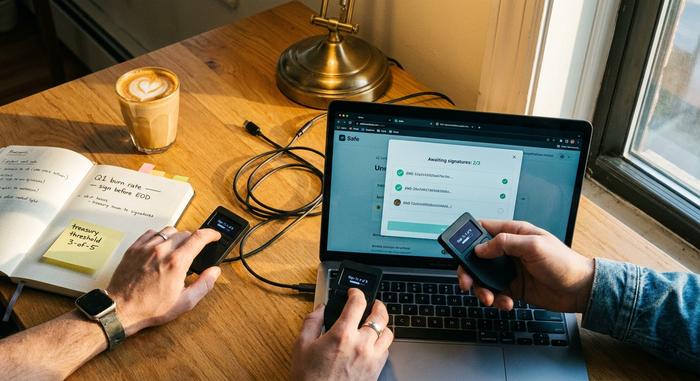
The corporate version of self-custody is multi-signature, or multi-sig. A single-sig decentralized wallet puts one person, or one compromised laptop, between a company's entire treasury and a thief. A multi-sig wallet requires N of M signers to approve a transaction. Three of five is a common setup for a small startup; four of seven scales up for a DAO. Safe, formerly known as Gnosis Safe, is the dominant Ethereum multi-sig contract; it currently secures around sixty billion dollars in assets and processed roughly $189.6 billion in transactions in the first quarter of 2025 alone, with about 68 percent multi-sig market share among DAOs.
The multi-sig setup turns the wallet itself into a tiny board-of-directors contract that helps manage your crypto with policy-level controls. A signer who is fired or whose key is compromised can be rotated out by the remaining signers. The change in policy, say raising the spending threshold from three of five to four of five, is itself an on-chain transaction. The audit trail is public by default. The advantages of decentralized wallets at the business tier are the same ones that protect individual users, just enforced through a more secure wallet contract.
Decentralized wallets for crypto payments and merchants
The same private-key model that protects an individual's holdings is what makes decentralized wallets useful to a merchant. A non-custodial payment gateway routes incoming crypto directly into a wallet the merchant controls. There is no exchange in the middle holding the merchant's funds, no withdrawal limit, no "your account has been flagged for review" email arriving on a Friday afternoon. The merchant's wallet receives the payment as soon as the transaction confirms on the blockchain.
BitPay, the longest-running mainstream crypto-payments processor, served roughly 130,000 merchants in 2025 and processed more than 600,000 transactions in 2024. Stablecoins climbed from 30 percent of its payment volume to 40 percent year over year — the same shift that has pushed Visa, Stripe and PayPal into their own stablecoin pilots. Non-custodial gateways such as Plisio and NOWPayments settle in BTC, ETH, USDT and USDC and route each payment straight to the merchant's wallet address.
Pair a non-custodial payment gateway with a Safe multi-sig at the receiving end and a merchant has a complete crypto-payments stack that never depends on a single exchange staying solvent. Payments enter a wallet the business controls. Treasury rules (who signs, what threshold, which addresses are allowed) are set in code rather than in a customer-service queue.
Crypto security best practices for a decentralized wallet
The benefits of decentralized wallets only hold if the user actually treats key handling seriously. Self-custody trades one risk for another. There is no exchange holding the bag; there is also no support line to reverse a mistake. To secure your crypto over the long term, decentralized wallets offer a clear toolkit. Chainalysis recorded roughly 158,000 personal-wallet compromises in 2025, totalling $713 million stolen — about 23 percent of all crypto theft that year. Five rules keep most ordinary users above that line.
Write the seed phrase on paper or stamp it into metal, twice, and store the copies in different physical locations. Never type a seed phrase into a website, ever — no legitimate wallet asks for it after setup. Verify the destination address on the hardware-wallet screen, not the host computer screen, because malware can rewrite what the browser displays. Sign anything of real value with a hardware wallet, kept separate from the device used to browse. And keep a small daily-driver hot wallet thin, treating it as a checking account rather than a vault. None of these rules require technical skill. All of them are dropped by users at exactly the moment they matter.
How to use a decentralized wallet without losing the keys
Three steps. That is the whole start. Pick the wallet that fits the situation: a mobile non-custodial wallet for daily spending, a hardware wallet for savings, a Safe multi-sig if a business is involved. Back the seed up. Twice. On physical paper or stamped steel, stored in two different locations, never photographed. Run a practice recovery on a clean device before sending any real funds in. Once the recovery works the wallet is not a single point of failure anymore. It is just a tool.



