Brain Rot: Oxford Word of the Year and Brain Health
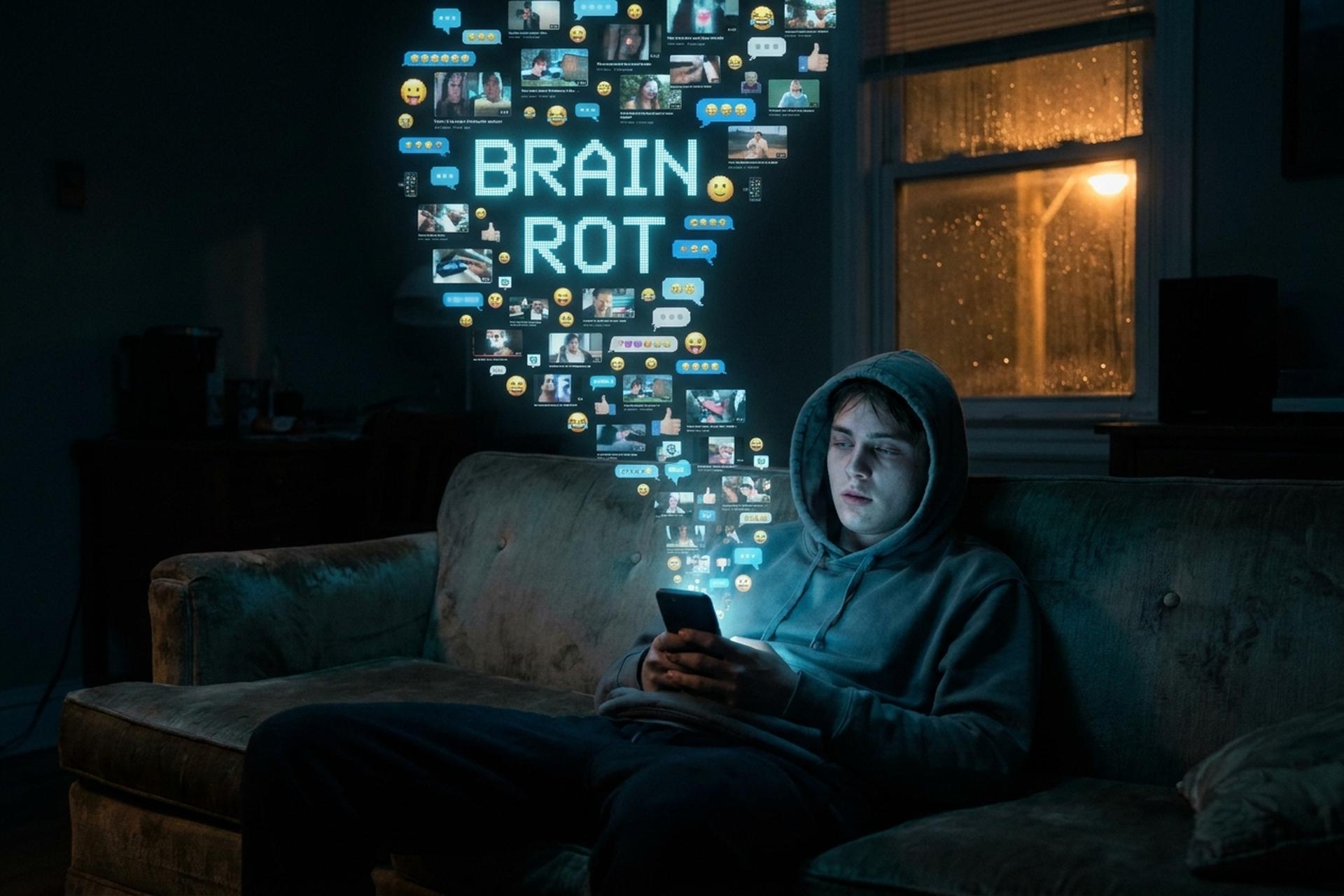
A 19th-century essayist coined the phrase that now captions skibidi-toilet videos. Henry David Thoreau used "brain-rot" in 1854 to mock a society he thought was going soft in the head, and in 2024 the same two words won Oxford's Word of the Year. The joke writes itself: the people most fluent in brain rot are usually the ones marinating in it, posting about their own decaying focus between scrolls. This article unpacks what brain rot actually means, where the term came from, what the science actually says about screen time and your attention span (spoiler: it is split), why crypto is the phrase's natural habitat, and how worried you should really be.
What Brain Rot Means as 2024 Slang
Brain rot carries two meanings at the same time, and that double life is why it caught on. Oxford University Press defines it as the supposed deterioration of a person's mental or intellectual state, especially from overconsuming online content considered trivial or unchallenging. That is the worried meaning, the one parents and op-eds reach for.
The other meaning is a joke. Among Gen Z and Gen Alpha, "brain rot" is an ironic badge, a self-aware label slapped on the very content people choose to watch. Calling a video "pure brain rot" is closer to a compliment than a warning. The slang describes the disease and celebrates the symptom in the same breath.
It is worth saying plainly: brain rot is not a medical diagnosis. No doctor writes it on a chart. The term is cultural shorthand for a feeling — the mental fog that follows an hour of low-quality scrolling — and like most slang it is doing emotional work more than clinical work. The irony is part of the point. By naming their own habit and laughing at it, younger users get to acknowledge the problem without quite committing to fixing it — a very human move, and one Thoreau would probably have recognized.
From Thoreau to the Oxford Word of the Year
The term is not new. What changed in 2024 was not the idea but the scale of the thing it describes.
Thoreau coined it in 1854
Go back to Walden. In 1854, Henry David Thoreau wrote: "While England endeavours to cure the potato-rot, will not any endeavour to cure the brain-rot, which prevails so much more widely and fatally?" His gripe was that people preferred easy ideas to hard ones. Swap the prose for a comment section and it lands today. Then the phrase went quiet. For roughly 170 years almost nobody reached for it, until the internet handed it a second life.
Why Oxford crowned it in 2024
Then 2024 happened. Oxford University Press crowned brain rot its Word of the Year on December 2, after the term's usage jumped 230% in a single year. A public vote sealed it, beating out "demure" and "romantasy." Oxford's language team read the result like a mood ring for the year. The culture had finally named something it was already feeling.
The slang it travels with
Brain rot rarely arrives alone. It travels with a whole vocabulary: skibidi toilet, the absurd animated series that became shorthand for nonsense; "only in Ohio," a tag for anything bizarre; and Italian brainrot, a wave of AI-generated characters with mock-Italian names. Add doomscrolling, the compulsive intake of bad news, and zombie scrolling, the glassy-eyed version where you are not even reading. Together they describe a single online texture: fast, weird, and engineered to keep your thumb moving. What makes this generation of slang different is how fast it jumps from screen to schoolyard. A nonsense phrase can go from a niche video to a global catchphrase in days, then back into new videos, in a loop that feeds on itself. The words are not just describing brain rot; they are part of the machinery that spreads it, which is why a term like "skibidi" can feel inescapable even to people who have never watched the source.
What Screen Time and Doomscrolling Do
The honest answer most articles dodge is this: the science is split, and anyone selling you certainty in either direction is overselling. There is real evidence that heavy short-form digital media hurts, and real evidence that the broader panic is overblown.
The case that it's real
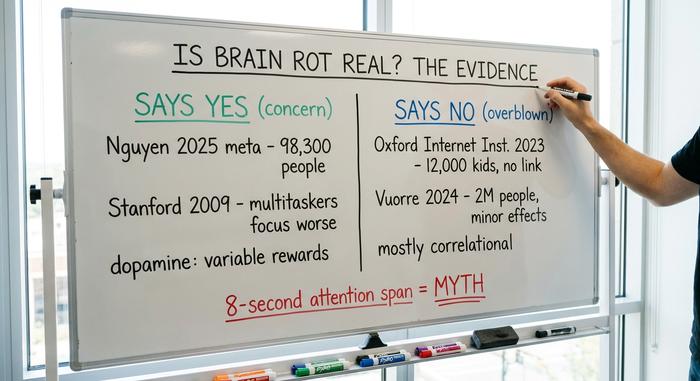
Start with the strongest evidence. In 2025, a meta-analysis in Psychological Bulletin pooled about 70 studies and nearly 98,300 people. The finding: a moderate negative link between short-form video and both cognition and mood. That is a large sample. Hard to wave away. Older work agrees too. A 2009 PNAS study by Ophir, Nass, and Wagner showed that heavy media multitaskers were worse at filtering out noise and worse at holding things in working memory. Why would scrolling do that? The usual answer is dopamine. Likes, pings, and a feed that never ends hand you tiny, unpredictable rewards, and the brain learns to chase the next one instead of grinding through something slow. A 2025 review in the journal Brain Sciences pulled together 35 studies and described the same loop: fragmented attention, compulsive checking, a drift toward whatever takes the least effort. One detail stuck with me. In that review, more than half the popular TikTok clips sampled carried misinformation. So attention does not just shrink. Worse stuff rushes in to fill it.
The case that it's overblown
Now the other side, which is just as serious. A 2023 Oxford Internet Institute study tracked about 12,000 American kids. It found no meaningful link between screen time and cognitive development. None. A 2024 analysis by Vuorre and Przybylski went bigger still: two million people, 168 countries, two decades of internet adoption, and only minor, inconsistent shifts in well-being. Then there is what the experts say. Dr. Andreana Benitez, who works in neurology at the Medical University of South Carolina, put it bluntly: "There really isn't a coherent science around it." Screens, she argues, do not appear to structurally damage the brain. They displace. They eat the hours you would have spent sleeping, moving, or talking to someone in the room. And here is the catch the headlines skip. Almost every study is correlational. No long trial has shown that TikTok causes your attention to rot, only that the two show up together. Maybe people who already struggle to focus just scroll more. That is the reverse of the scary version.
The 8-second attention span myth
One number deserves a quiet funeral. The claim that humans now have an attention span of eight seconds, shorter than a goldfish, is the single most-cited brain rot statistic, and it is fabricated. The figure was attributed to Microsoft, but it actually tracked webpage dwell time, not attention, and traces back to a source with no underlying study behind it. Repeating it is itself a small act of brain rot.
| Study / source | Finding | Sample | Verdict |
|---|---|---|---|
| Nguyen et al., 2025 (Psychological Bulletin) | Short-form video linked to poorer cognition and mood | ~98,300 across 70 studies | Supports concern |
| Ophir, Nass & Wagner, 2009 (PNAS) | Heavy multitaskers filter and remember worse | 262 students | Supports concern |
| Oxford Internet Institute, 2023 (Cortex) | No link between screen time and cognition | ~12,000 children | Against panic |
| Vuorre & Przybylski, 2024 | Minor, inconsistent well-being effects | 2M people, 168 countries | Against panic |
| "8-second attention span" | Fabricated; measured dwell time, no study | none | Myth |
Spotting Brain Rot: Symptoms and Overload
The symptoms are easy to recognize, even when the mechanism behind them is not proven. You know the feeling. Focus that used to last an hour now taps out after ten minutes. A slow, foggy quality creeps into your thinking. Small things slip your mind. And there is that restless itch to grab the phone and scroll mindlessly the second a task turns boring. People call the bigger version cognitive overload, the scattered feeling that follows too much novelty too fast. For a lot of us, heavy social media use has just become the background hum of the day, always running, barely noticed.
Two numbers give the habit a scale. Worldwide, people average roughly 141 minutes a day on social media. And in the United States, 48% of teens now say they are online "almost constantly," nearly double the share a decade ago, according to Pew Research Center. None of this is a clinical syndrome. The symptoms are self-reported, correlational, not measured in a lab. Still, when millions of people independently describe the same feeling, it is worth taking seriously, even before the studies catch up.
| Brain rot slang | What it means |
|---|---|
| Skibidi toilet | Absurd viral series; shorthand for chaotic nonsense |
| Only in Ohio | Tag for anything bizarre or surreal |
| Italian brainrot | AI-generated characters with mock-Italian names |
| Doomscrolling | Compulsively consuming bad news |
| Zombie scrolling | Glassy-eyed, purposeless browsing |
| Goblin mode | Unapologetically lazy, self-indulgent online behavior |
Brain Rot Goes Crypto: Memecoins and Degens
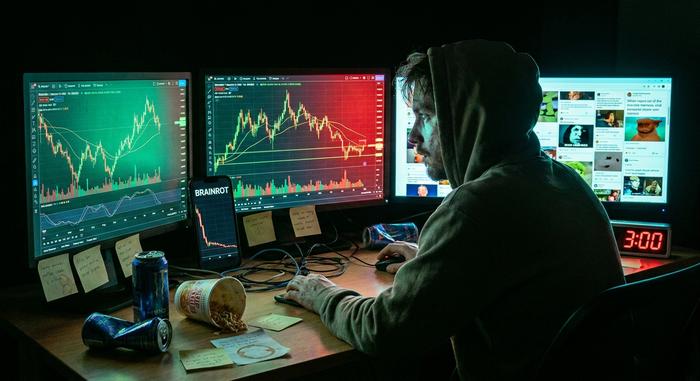
If brain rot has a natural habitat, it is crypto. The market never closes, the charts update every second, and the same variable-reward loop that powers a social feed powers the urge to refresh a portfolio at 3 a.m. Crypto Twitter is doomscrolling with money attached.
The overlap goes deeper than mood. Memecoins are often minted directly from brain rot itself, spun out of the same Italian-brainrot and skibidi memes that flood the feeds. There is even a literal token called BRAINROT, trading at a market cap of roughly $28,000, which is less an investment than a punchline about the whole genre. The "degen" trader, glued to a feed of green and red candles and posting cryptic memes between trades, is arguably the purest expression of attention engineered into compulsion. The structure is identical to a social feed, just with higher stakes: an endless stream of updates, a number that might jump at any second, and a community that rewards the most extreme posts with the most attention. Crypto did not invent brain rot, but it might be the most concentrated dose of it available, because here the dopamine loop pays out in real money and real losses. When the reward is financial, the compulsion to check has a far stronger grip than any like button could manage.
How Worried Should You Be About Brain Rot
Here is where I land after reading the evidence both ways: the moral panic is overblown, but the behavior change is real. Those two things can be true at once, and pretending otherwise is how the conversation went silly.
A real signal, not a diagnosis
Brain rot is a useful word for a real habit. It is not a verified disease. The strongest evidence is narrow: it points at short-form video, not screens in general, and at what scrolling crowds out, not at some claim that feeds are rewiring your neurons. The honest mechanism is displacement. Think about your own day for a second. An hour lost to the feed is an hour you did not spend sleeping, reading, moving, or talking to the person next to you. That is worth caring about, and it needs no neuroscience to explain. It is a question of digital habits, not brain health. It also changes the fix. If the harm is mostly about what scrolling replaces, you do not need to quit your phone or fear permanent damage. You just need to guard the things the feed quietly eats. That is a smaller, saner project than "my brain is rotting."
What actually helps
The fixes are unglamorous and they work. Curate the feed aggressively, muting whatever leaves you worse off. Protect attention in blocks, putting the phone in another room while you do anything that demands real thought. Swap infinite scroll for finite media, a book or a film that actually ends, so your brain practices staying with one thing. Skip the miracle "dopamine detox" framing, which oversells a simple idea: do a bit less of the thing that scatters you, and a bit more of the thing that doesn't. Even small friction helps, like logging out after each session or moving the worst apps off your home screen, because brain rot thrives on the path of least resistance.
Brain Rot Is the Mirror, Not the Disease
So where does that leave us? Brain rot named something true. Feeds are built to be hard to put down, and plenty of us feel scattered because of it. But the term is a mirror, not a disease, and the evidence points to concern, not catastrophe. The question that matters is not whether your brain is rotting. It is what the scrolling quietly replaced. Answer that honestly and you already know what to change. So, one last thing: what would your last hour of scrolling have gone to instead?