Cryptocurrency Wallet Types: Crypto Wallets Explained
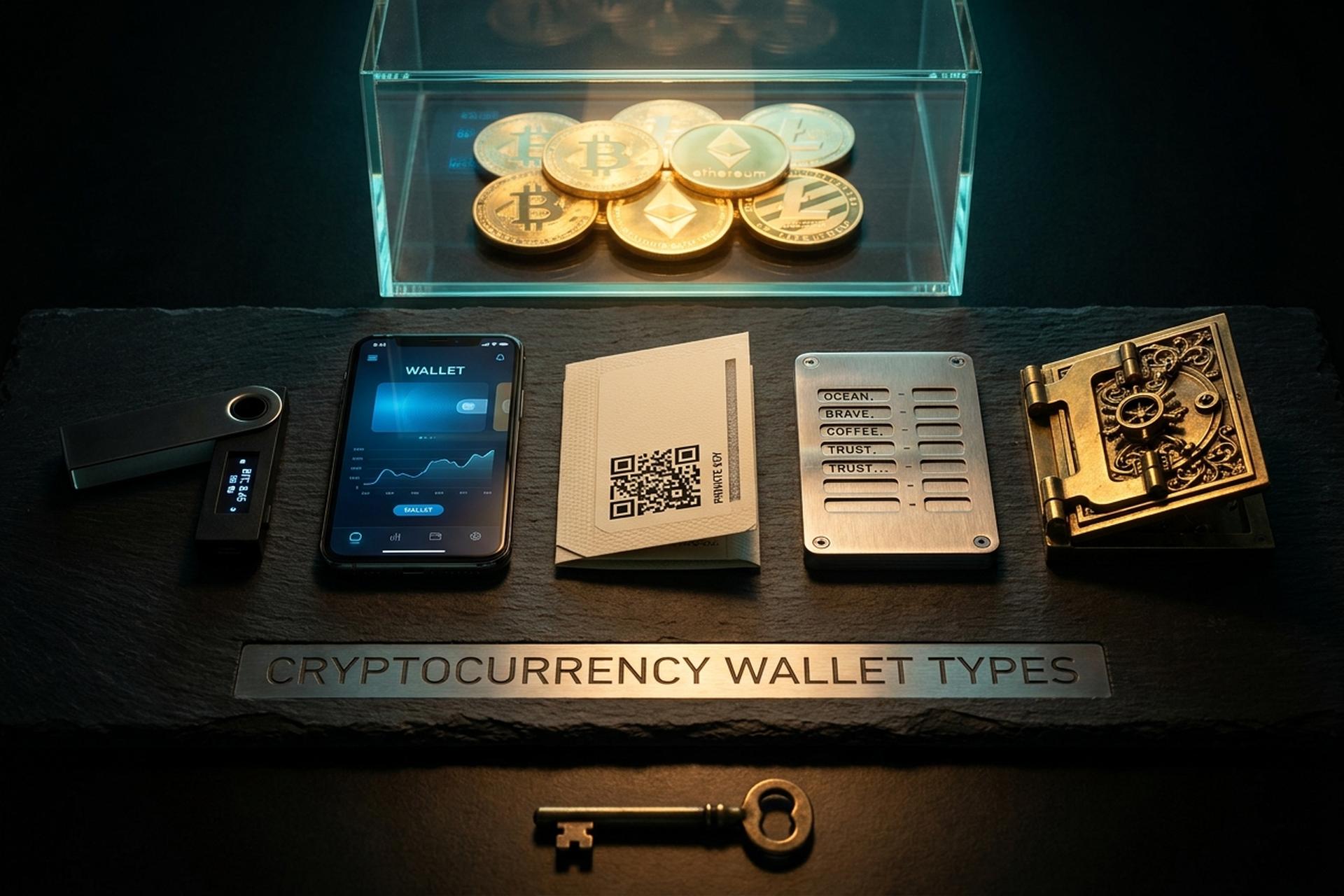
Start with the fact that trips up almost every beginner: a crypto wallet does not hold your coins. It holds your keys. The coins live on the blockchain, and the wallet is just the thing that proves they are yours and lets you move them. That sounds like a technicality. It is not. The type of wallet you choose decides one thing above all else, who can lose your money: you, or someone else. James Howells learned the hard way after tossing a hard drive holding about 8,000 bitcoin into a landfill. FTX customers learned it when roughly $8 billion of their money vanished inside someone else's wallet. With 741 million crypto owners worldwide, this is the security decision most of them never really make. This guide covers the cryptocurrency wallet types that matter. We will walk through the different types of crypto wallets, how they differ, who each one suits, and what most people actually need.
What a Crypto Wallet Actually Stores
Your wallet holds two keys, and the gap between them is everything. One is public: your address, the string you paste when someone pays you. Share it freely. The other is private: the secret that signs off on spending. Never share that one. Put plainly, wallets store your private keys, not your money, and learning to store your private keys safely is the entire game. Lose the private key and the crypto assets behind it are gone, full stop. Picture the blockchain as a glass vault. Everyone can see your balance sitting inside it. Only the private key opens the door.
Most wallets hide that raw key behind a seed phrase. It is just a list of 12 to 24 plain words, and those words can rebuild your whole wallet on any compatible device. Powerful, and fragile. Write them down wrong and you are locked out. Let someone photograph them and the wallet is theirs. Guard them, and your wallet follows you anywhere on earth.
This is where the industry's oldest slogan comes from: "not your keys, not your coins," a line popularized by educator Andreas Antonopoulos. If you do not hold the private key, you do not really hold the crypto. And the keys are unforgiving. An estimated 17% to 23% of all bitcoin is already stranded in wallets nobody can open, according to a 2020 Chainalysis analysis, lost to forgotten passwords and discarded drives. That is the backdrop for every choice that follows.
Custodial vs Non-Custodial Wallets
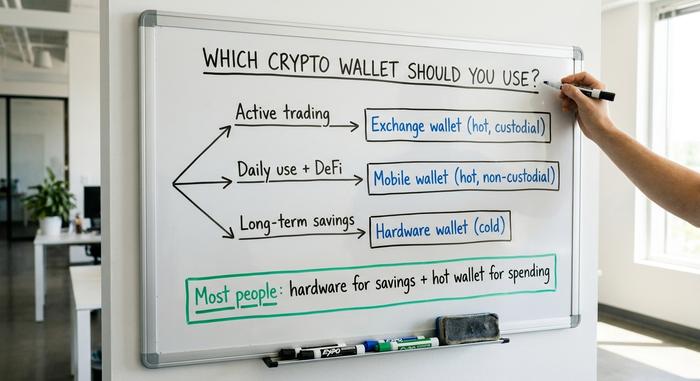
Forget hot and cold for a moment. The split that matters most is custody. Does someone else hold your keys, or do you? Every other label is secondary to that one question.
Custodial wallets: someone else holds the keys
A custodial wallet hands the private keys to a third party, usually a cryptocurrency exchange like Coinbase, Binance, or Kraken. You get an account and a password you can reset. It feels familiar, like online banking, which is exactly why beginners and active traders like it. The catch is trust. You are betting the custodian stays solvent and honest. Sometimes that bet loses. Mt. Gox lost around 850,000 BTC. FTX misappropriated roughly $8 billion of customer money before it collapsed. In both cases, users "had" crypto right up until the moment they did not.
Non-custodial wallets: you hold the keys
A non-custodial wallet puts the private key in your hands and no one else's. Nobody can freeze your funds, and nobody can refund them either. That is the deal. James Howells has spent more than a decade trying to dig roughly 8,000 BTC out of a Welsh landfill, as CNN has reported. Programmer Stefan Thomas has 7,002 BTC sitting in a locked drive with a handful of password guesses left. Self-custody is freedom with the safety net removed.
Not your keys, not your coins
The phrase is a cliche because it keeps being true. When FTX failed, people did not just read the news; they acted on it. Trezor reported its hardware-wallet sales jumped about 300% in a single week. The lesson stuck because the alternative was watching a balance you could see but not touch. Self-custody shifts the risk from the exchange to you, which is either reassuring or terrifying depending on how organized you are.
| Case | Year | Amount lost | Wallet lesson |
|---|---|---|---|
| Mt. Gox | 2014 | ~850,000 BTC | Custodial exchange collapse |
| FTX | 2022 | ~$8B customer funds | Custodial fraud and insolvency |
| Bybit | 2025 | ~$1.5B (401,000 ETH) | Manipulated signing interface |
| James Howells | 2013 | ~8,000 BTC | Lost self-custody key, no backup |
| Stefan Thomas | 2011 | 7,002 BTC | Forgotten password, guesses gone |
Hot Wallets vs Cold Wallets Explained
The second axis separating cryptocurrency wallet types is temperature, and it comes down to one question: is your private key ever exposed to the internet? Hot wallets are connected; cold wallets are not.
Software wallets (hot): desktop, mobile, web
A software wallet keeps your keys on an internet-connected device. A mobile wallet lives on your phone, a desktop wallet on your computer, and web wallets run in the browser. A browser extension wallet is a common variant: MetaMask, the best-known browser extension wallet, sits right in your toolbar. Other popular options include Trust Wallet, Exodus, and Phantom. They are free, fast, and the obvious choice for DeFi, NFTs, and daily spending. Because they hold crypto right where you transact, there is no friction: tap, sign, done. The price is that exposure. Anything connected to the internet can be phished, drained by malware, or hijacked through a SIM swap, where an attacker ports your phone number to intercept your logins. Personal-wallet compromises alone cost users about $713 million in 2025, according to Chainalysis. The rule of thumb is simple: keep only what you are willing to lose in a hot wallet.
Hardware wallets (cold): the gold standard
A hardware wallet is a small physical device, usually from Ledger or Trezor, that stores your keys offline on a secure chip and signs transactions internally so the key never touches your computer. Prices run roughly $30 to $200. It is the gold standard for storing large amounts of crypto, and the market has grown to somewhere around $550 to $600 million a year, with Ledger and Trezor controlling most of it. One nuance gets lost in the marketing, though. A hardware wallet protects your key, not your judgment. If you connect it and approve a malicious smart contract, the device will happily sign away your funds. Cold storage is not a force field.
Paper wallets and brain wallets
A paper wallet is your keys printed or written on paper, completely offline. It is immune to remote hacking, which sounds perfect until the paper burns, floods, fades, or simply gets thrown out. Once a popular cold option, it has faded to a niche, archival method. Brain wallets, where you try to memorize a passphrase, are worse: human memory is a terrible vault, and weak passphrases get cracked.
Newer Types: MPC and Smart Contract Wallets
The old debate between crypto wallet types was binary: trust an exchange, or go it alone with a seed phrase you can lose. A third path has been quietly forming, built to keep self-custody without making a single mistake fatal.
MPC wallets, short for multi-party computation, split your key into encrypted shares spread across devices or parties, so there is no single seed phrase to steal or misplace. Zengo is a consumer example that ditches the seed phrase entirely. Multisignature wallets take a related approach, requiring two or more signatures to move funds, which is why they are popular for company treasuries and shared accounts.
Then there are smart contract wallets, where the wallet itself is programmable. Through a standard called account abstraction, or ERC-4337, these wallets can add features ordinary accounts cannot: social recovery if you lose access, daily spending limits, and someone else paying your gas. Ethereum's EIP-7702 upgrade, which went live in May 2025, lets even a standard account borrow these powers, per Ethereum's own documentation. This is where the most interesting wallet design is happening, and the reason is the lost-key problem. If social recovery had existed a decade ago, a chunk of that stranded 20% of bitcoin might still be reachable. The trade-off is added complexity and, in some designs, smart-contract risk of its own, so these are not yet the default for most users. But they point at a future where self-custody no longer means one slip equals total loss.
Which Crypto Wallet Is Best for You
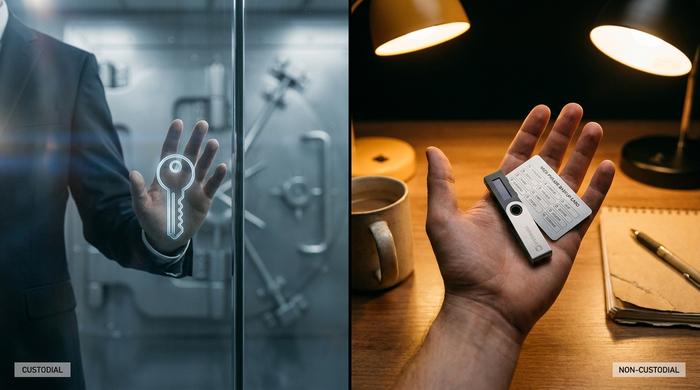
There is no single best crypto wallet. There is a best wallet for a job, and most people honestly need two. Match the type to what you are doing and how much you would hate to lose. The mistake beginners make is hunting for one perfect app, when the smarter move is splitting funds across tools by purpose.
If you trade actively, an exchange wallet keeps your capital liquid and ready, and you accept the custodial risk as a cost of convenience. For daily spending and DeFi, a non-custodial mobile or browser wallet like MetaMask or Trust Wallet is the sweet spot, holding only what you would carry in a real wallet. For long-term savings, a hardware wallet is the answer; this is the crypto you are not touching for a year. If you want self-custody without the seed-phrase anxiety, an MPC wallet such as Zengo lowers the bar. The setup most experienced holders actually use is a hybrid — a hardware wallet as the vault, a hot wallet as the pocket. Savings stay cold, spending money stays warm.
| Wallet type | Hot/Cold | Custody | Best for | Example |
|---|---|---|---|---|
| Exchange wallet | Hot | Custodial | Active trading | Coinbase, Binance |
| Mobile / web wallet | Hot | Non-custodial | Daily use, DeFi | MetaMask, Trust Wallet |
| Desktop wallet | Hot | Non-custodial | Power users | Exodus, Electrum |
| Hardware wallet | Cold | Non-custodial | Long-term savings | Ledger, Trezor |
| Paper wallet | Cold | Non-custodial | Niche, archival | Printed keys |
| MPC / smart contract | Varies | Non-custodial | Recoverable self-custody | Zengo, Argent |
Wallet Security Best Practices That Matter
Here is the uncomfortable truth after all the categories: your wallet type matters far less than how you handle the seed phrase. The biggest threat to your crypto is usually you.
Protect the seed phrase above all
Write your seed phrase on paper or stamped metal, and store it somewhere physical. Never type it into a website, never paste it into a chat, never screenshot it. For large amounts, split it with a Shamir backup or use multisig so no single sheet of paper is a single point of failure. Verify every receiving address before you send, because malware loves to swap it. Phishing is the number one way ordinary people lose funds, and it almost always works by getting you to reveal or approve something yourself. Even the record $1.5 billion Bybit hack in 2025 came through a manipulated signing interface rather than a cracked key, as Chainalysis documented. The attackers did not break the math; they tricked the humans.
What most people actually need
My honest advice is to stop over-engineering. For the vast majority of people, a reputable non-custodial mobile wallet for small, active funds plus one hardware wallet for savings beats both an exchange-only setup and a paranoid five-of-seven multisig you will eventually lock yourself out of. Security that is too complicated to use is not security; it is a slow-motion way to lose access. Pick the simplest setup that protects the amount you genuinely could not afford to lose, and actually back it up. One more thing that gets ignored: tell someone you trust how to find your recovery phrase if something happens to you. A huge share of permanently lost crypto is not stolen at all. It belonged to people who died, forgot, or simply never wrote the words down. Your wallet plan should survive a bad day, not just a hacker.
Choosing Between Types of Crypto Wallets
The wallet question is really a custody question dressed in technical language. Hot or cold, hardware or software, MPC or multisig, all of it reduces to a simpler choice: how much do you trust someone else with your keys, and how much are you holding? Keep small, spendable amounts in something convenient, keep serious savings in cold storage you control, and remember that with self-custody the security is entirely yours — for better and worse. So here is the test worth running tonight. Whatever cryptocurrency wallet types you settle on, ask the simple version: if your phone died right now, could you recover your crypto? If the answer is no, you already know which part of your setup to fix first.