Ledger in Accounting: General Ledger Basics for Small Businesses
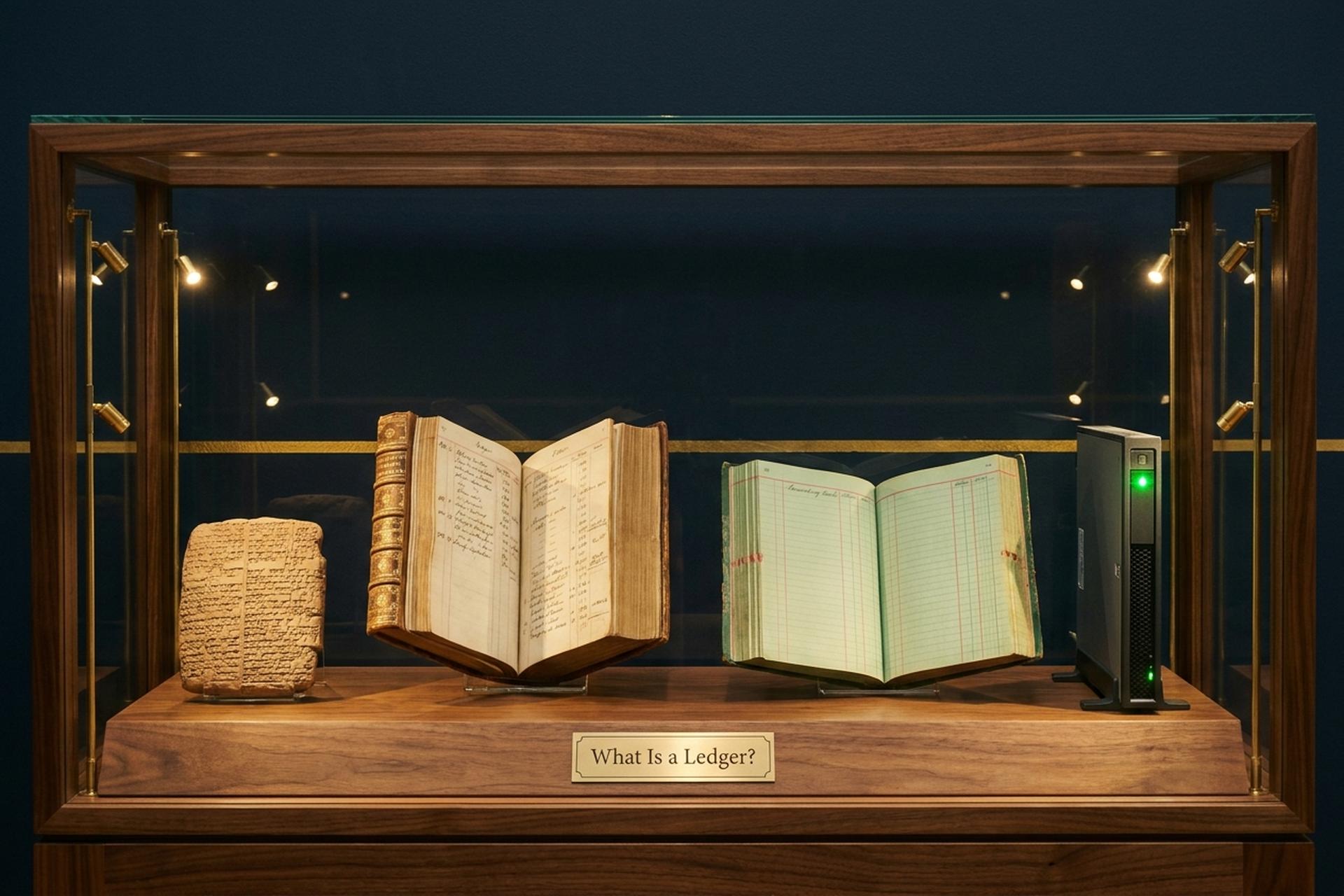
A ledger is older than money in coin form. Clay tablets unearthed at Uruk show grain debts being tracked five thousand years before anyone minted a drachma, and the underlying job has not changed: write down who owes what, who paid what, and what is left. The form keeps shifting. Parchment gave way to bound books, then to spreadsheets, then to enterprise resource planning systems, and now to a database replicated across roughly twenty thousand strangers' computers. Each new substrate has answered the same question in a slightly different way. This article walks the full arc, from the accounting ledger sitting on a small business owner's desk to the Bitcoin blockchain that has logged 1.347 billion transactions since 2009.
What is a ledger? An accounting term explained
The term ledger comes from the Old English "leggen", meaning to lay down. The book was something you laid open on a counter and left there. Every transaction touching the business had to land on its pages before the end of the day. That convention has survived seven thousand years of bookkeeping practice. A ledger today is still a record-keeping system. Its only purpose: to record transactions of an entity, sort each financial transaction by account, and produce a running balance. Whether the format is traditional accounting paperwork or a digital record in cloud software, the contract with the reader is identical. Every entry recorded. Nothing rewritten. Balances available on demand.
The substrate is incidental. A barista's chalkboard tracking regular customers' tabs is a ledger. A spreadsheet of rental income is a ledger. The general ledger inside Oracle NetSuite is a ledger. The Bitcoin blockchain is a ledger. They differ in who holds the book and who is allowed to write in it. The function is the same.
Two figures matter in the history. Around 3,000 BC, Mesopotamian accountants used pictographic tablets to track grain stored in temple silos — the oldest surviving example of formal record-keeping. In 1494, the Italian friar Luca Pacioli published Summa de Arithmetica. That book codified the double-entry method now used by every accountant alive. Workday's own glossary entry for the general ledger acknowledges both milestones in a single sentence, which is rare for a software vendor. The point: the modern accounting ledger is a 530-year-old technology running on a 5,000-year-old idea.

Ledger in accounting: how a modern ledger works
The mechanics of an accounting ledger have been frozen since Pacioli. Each ledger account has two columns. Debits on the left. Credits on the right. Every transaction affects at least two accounts. Pacioli's rule: the total debits posted on a given day must equal the total credits. If they do not, the books are out of balance and something is wrong.
This is the double-entry system, and it is the load-bearing principle of all modern accounting. The accounting equation that falls out of it: Assets equals Liabilities plus Equity. Every entry pushes one side and pulls the other. Transactions are recorded as either a debit or a credit, and the total debits must equal the total credits before the books are considered closed.
A worked example. A small business owner buys office supplies for 500 dollars in cash. Two accounts move. The Office Supplies account (an asset) is debited 500 dollars. The Cash account (also an asset) is credited 500 dollars. Debits equal credits. The balance sheet still balances. This is the smallest possible journal entry. Once posted, journal entries sit inside the general ledger forever, with every paper receipt filed alongside as supporting evidence. If the same business later takes out a loan, the cash inflow is offset by a liability on the credit side. The equation still holds.
| Account category | Normal balance | Examples |
|---|---|---|
| Assets | Debit | Cash, accounts receivable, inventory, equipment |
| Liabilities | Credit | Accounts payable, loans, payroll taxes |
| Equity | Credit | Common stock, retained earnings |
| Revenue | Credit | Sales, interest income, royalties |
| Expenses | Debit | Salaries, rent, advertising |
T-account format is the visual shorthand. Draw a capital T, label the account name across the top, debits go on the left arm and credits on the right. The format is so durable that QuickBooks, Xero, Sage, and every other accounting software still render ledger entries this way under the hood, even though the user never sees the T. The columns just survive better than any redesign anyone has tried.
The reason this matters for small business owners is that the ledger feeds everything else. Preparing tax returns is done from ledger balances. Loan officers look at ledger summaries when deciding whether to extend credit. Auditors trace ledger entries back to the original receipt or invoice that triggered them. The ledger keeps a complete way to track where money is going, and every downstream financial statement starts here. The ledger is essential for an accurate read on the financial health of a business; without it, an owner only sees the cash in the bank, not the obligations behind it.
Types of ledgers: general ledger and subsidiary ledgers
The general ledger is the master record. It holds every account a business uses through a chart of accounts. Five categories. Assets, liabilities, equity, revenue and expenses. That is the whole taxonomy.
Information in a general ledger is what most people mean by "the books". For a single-person consultancy, it may be all there is. For a larger entity, the master file gets too crowded to be useful on its own.
Subsidiary ledgers solve this. Accounts receivable — sometimes called a debtors ledger — holds a page for every customer who owes the business money. Accounts payable, or the creditors ledger, does the same for every creditor or supplier the firm owes. Other common subsidiary records: the cash ledger, inventory, payroll.
Each subsidiary rolls up into one control account inside the general ledger. The control account shows totals. The subsidiary shows per-customer or per-supplier detail. Customer disputes an invoice? You open the subsidiary and find their page. Regulator wants a balance sheet? You read the general ledger and ignore the detail.
Modern systems collapse this distinction at the data layer. Workday, for example, uses an object data model. One transaction gets tagged with customer, supplier, project, region and cost-centre dimensions at once, so the general ledger and its subsidiaries are really one queryable dataset. Enterprise resource planning platforms (ERP systems) made the divide conceptual rather than physical. Accountants still talk in the old vocabulary because audits still read it that way. The practical effect: businesses use one queryable layer for full visibility into your business finances, with subsidiary detail and complete financial information available on demand.
Journal vs ledger and double-entry bookkeeping basics
A journal — sometimes called a general journal — is the chronological raw feed of business transactions. Every transaction lands in the journal first. Date, description, accounts touched, debit and credit entries. The journal is the diary.
The ledger is the sorted version. Once an entry sits in the journal, it gets posted to the relevant ledger accounts. There it joins all the other entries that touched those accounts. The ledger is the encyclopaedia. One transaction creates one journal entry but lands as two ledger postings — one on each side of the books.
Both books exist because they answer different questions. The journal answers "what happened on this date?". The ledger answers "what is the balance of this account right now?". An audit trail needs the journal. A trial balance needs the ledger. You cannot really run a business off one without the other.

Trial balance, balance sheet and financial reporting
At the end of each accounting period, the ledger has to be checked. The trial balance is the proof step. An accountant sums the debit column across every account, then sums the credit column. If the two totals match, the ledger is internally consistent. If they do not, something went wrong — an entry posted on the wrong side, an account missed, arithmetic slipped — and the accountant goes hunting.
Once the trial balance reconciles, the ledger feeds the public-facing financial statements. The balance sheet is a snapshot at a single date. Total assets on one side, total liabilities plus equity on the other. The income statement (sometimes called the profit and loss or P&L) summarises revenue and expenses over the period and arrives at net profit. Both are derived directly from ledger balances. Nothing in the statements exists that is not already in the ledger.
For smaller businesses with fewer transactions, this end-of-period exercise is mostly automated. QuickBooks or Xero closes the books at a button press. The software produces a trial balance in seconds and offers a balance sheet and income statement ready for review. Accuracy still depends on the underlying ledger entries; the software just spares the owner the arithmetic. Accurate financial statements, and the accurate financial reporting they support, are downstream of accurate ledger keeping. There is no shortcut around that. Financial statements like the income statement and balance sheet show profitability and net worth, but every figure used to produce them lives in the ledger first.
From paper ledger to blockchain and crypto ledgers
For the entire history of bookkeeping until 2009, one entity held the book. The merchant. The bank. The company. The auditor. Trust in a ledger meant trust in that custodian. Bitcoin proposed a different arrangement. Instead of one ledger holder, the book is replicated across thousands of independent computers — and no single party can rewrite history without the rest noticing.
Bitcoin is, in the strictest accounting sense, a general ledger. One account category (addresses). One transaction type (transfers). Every transaction since the genesis block in January 2009 has been recorded and never deleted. As of May 2026, the file weighs 739 gigabytes. It holds 1.347 billion transactions. It is replicated on around twenty thousand publicly reachable nodes plus tens of thousands more behind firewalls. Double-entry still applies. The protocol just calls debits "inputs" and credits "outputs".
Ethereum's distributed ledger works on similar principles. It is secured by 892,000 active validators rather than miners, following the September 2022 Merge that cut the network's annual electricity use by about 99.95 percent. Ethereum processes around 1.95 million transactions a day. The combined market value of assets sitting on these public ledgers reached 2.79 trillion dollars by May 2026, according to CoinGecko. Bitcoin alone accounts for 1.62 trillion.
A common misconception: hacks have proven distributed ledgers unsafe. They have proven the opposite. The 2014 collapse of Mt. Gox vanished 850,000 BTC. That was an exchange custody failure. The company's private keys were stolen, but the Bitcoin ledger faithfully recorded every fraudulent withdrawal. The 2016 DAO incident drained 3.6 million ETH through a reentrancy bug in a smart contract on top of Ethereum, not in Ethereum itself. The Bitcoin base layer has never been 51-percent attacked. The apps have failed — the ledger has not.
| Property | Bank general ledger | Bitcoin distributed ledger |
|---|---|---|
| Custody | One institution | About 20,000 nodes |
| Append-only | By policy | By cryptography |
| Visibility | Private | Public, queryable by anyone |
| Settlement | T+1 (US equities since May 2024) | Roughly ten minutes |
| Hours | Business hours | Continuous |
Governments noticed. The Atlantic Council's CBDC Tracker reported in mid-2025 that 137 countries, representing 98 percent of global GDP, were exploring a central bank digital currency, with 49 live pilots and three full launches in the Bahamas, Jamaica and Nigeria. China's e-CNY pilot alone has cycled through roughly 986 billion dollars in cumulative value. Enterprises followed too. Hyperledger Fabric powers Walmart's food traceability system, which cut a contamination trace from days to seconds. Corda, from R3, runs DTCC settlement layers and the Spunta Banca DLT used by Italian banks for interbank reconciliation. Accenture estimated that distributed-ledger settlement could cut post-trade clearing and settlement costs by up to half compared with the T+1 cycle that now governs US equity markets.
What a good ledger account looks like for small businesses
Whether the book is bound in leather or sharded across a continent, three properties define one that works. Completeness: every transaction enters the record, or downstream balances lie. Integrity: total debits equal total credits, whether enforced by a clerk's red pen or by a cryptographic hash chain. Accessibility: the right reader can find the right entry, whether that reader is an auditor, a regulator, a tax authority or a public node operator.
The accounting profession has worked these three properties for five hundred years. The distributed-ledger world has worked them for fifteen. Both lineages now sit side by side, and the most consequential financial systems of the next decade will probably be hybrids that borrow from each.