What is an MCC code? Merchant category codes explained
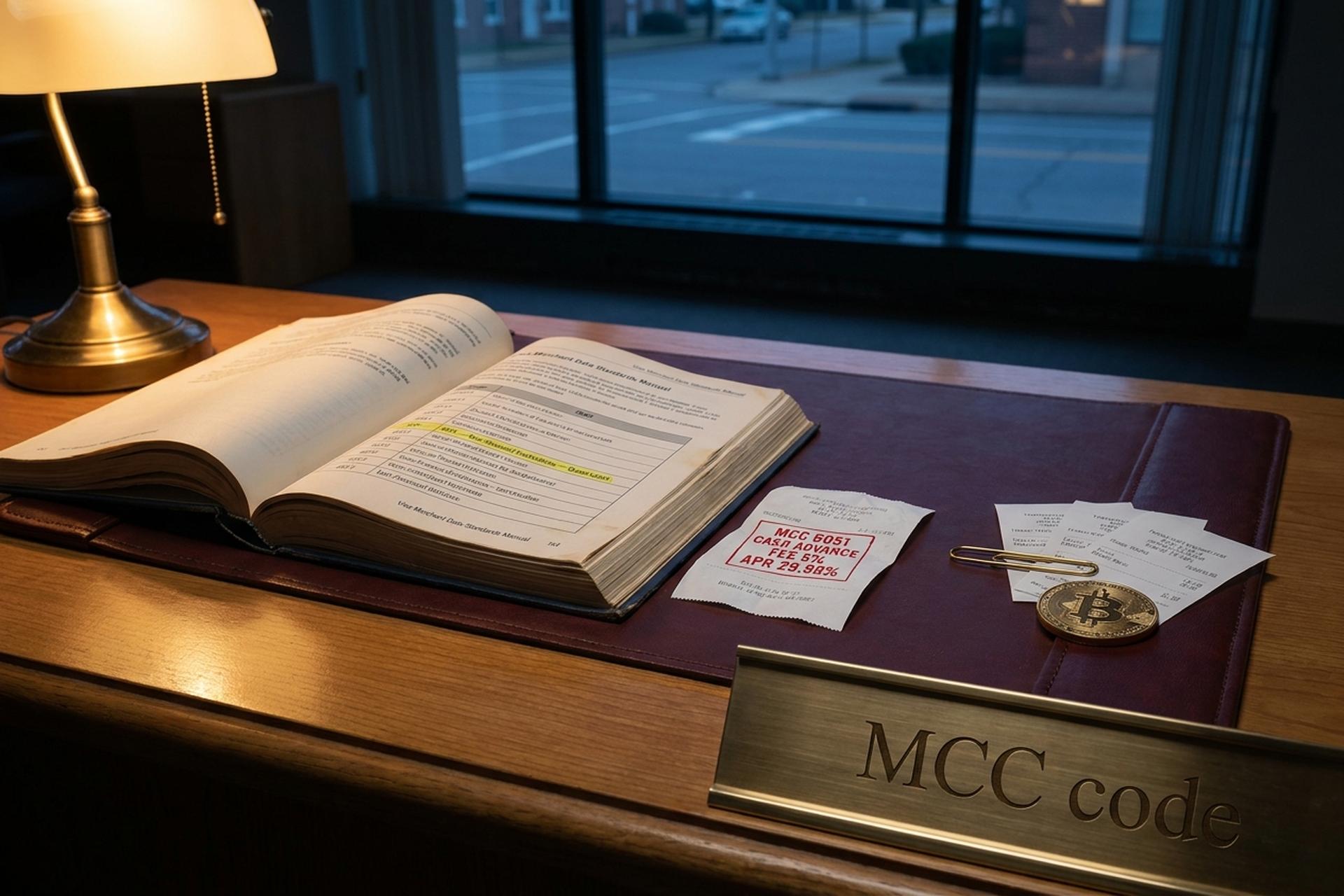
Every card swipe carries a four-digit number the cardholder never sees. That number is a merchant category code, or MCC. It decides three things behind the scenes. Whether a purchase counts toward a credit card's cashback category. How much the merchant pays in interchange fees. How the issuing bank treats the transaction for risk and tax reporting. Mastercard's October 2024 list contains 879 MCCs grouped into twenty categories. Visa, American Express, and Discover keep their own variants. All run on the same international standard, ISO 18245 (first published in 2003 and revised in February 2023).
The MCC matters most when it goes wrong. A movie theater that codes as MCC 7832 (entertainment) instead of 5812 (restaurants) costs a cardholder their dining bonus. A crypto exchange coded as MCC 6051 (Quasi-Cash) turns a $1,000 bitcoin purchase into a cash advance. That means a 5% fee and a roughly 30% APR with no grace period. This article walks through what an MCC is, who assigns it, how the ranges work, why it drives interchange and rewards, what makes an MCC "high-risk," and why crypto MCC 6051 — the quasi-cash code — is the single biggest reason merchants now route payments off the card networks.
What an MCC code actually is in a transaction
An MCC code is a four-digit number. Card networks (Visa, Mastercard, American Express, or Discover) assign it. It identifies the type of goods or services a merchant sells. The code rides on every authorization and clearing message, next to the merchant's name, amount, and card details. Cardholders never see it. Issuers, processors, the IRS, and reward engines all do. ISO 18245 governs the format, published by the International Organization for Standardization. Mastercard's October 2024 list has 879 codes. They fall into roughly twenty groups, from agriculture and utilities to professional services and government. The same code anchors what needs to be reported for tax purposes. The IRS uses it to drive 1099-K categorization.

Who assigns MCCs and what ISO 18245 actually says
The MCC system is older than most fintech. The first edition of ISO 18245 came out in 2003. It was refreshed in February 2023. An ISO Registration and Maintenance Group (the RMMG) administers the standard. The RMMG keeps the master numeric list aligned across the industry. In day-to-day practice, each card network keeps its own list and its own rules on top of ISO 18245. Visa publishes a Merchant Data Standards Manual, refreshed every April and October. Mastercard issues a Quick Reference Booklet. American Express maintains its own MCC catalogue. The same merchant can carry slightly different MCCs on different networks because of those overlays.
Acquiring banks (the merchant's processor) assign MCCs during onboarding. They base it on documentation of the merchant's primary business activity. The acquirer evaluates the types of businesses they onboard. They then assign the closest fit. A business based in a borderline category may sit with the wrong code for years before anyone notices. Merchants cannot self-assign. A merchant who thinks the wrong MCC was applied can ask for a change. They contact the acquirer with proof of the business model. Visa's rules cap how aggressive that request can be. A merchant must select the MCC reflecting its highest sales volume. It must avoid the miscellaneous catch-all when a specific code applies. And it must assign separate MCCs to clearly distinct business lines.
MCC code ranges and how to read them
The numeric blocks of the MCC scheme aren't random. Every hundred-code range maps to a broad vertical, which makes any unfamiliar MCC roughly decodable at a glance.
| Range | Vertical |
|---|---|
| 0001-1499 | Agriculture, forestry, fishing |
| 1500-2999 | Construction and contracted services |
| 4000-4799 | Transportation services |
| 4800-4999 | Utilities and communication |
| 5000-5599 | Retail outlets |
| 5600-5699 | Clothing stores |
| 5700-7299 | Miscellaneous stores |
| 7300-7999 | Business services |
| 8000-8999 | Professional services, membership organizations |
| 9000-9999 | Government services |
So when an unfamiliar 5993 shows up in a transaction trace, the range alone tells you it lives in the "miscellaneous stores" bucket. (It is in fact tobacco retail.) The granularity does not stop there: each code typically describes a specific business activity. MCC 4121 is taxis and limousines. MCC 8062 is hospitals. MCC 7333 is commercial photography and graphics. MCC 5411 is grocery stores. The codes named in the rest of this article all sit somewhere in the table above.
Why MCC matters for interchange fees and cashback
Three big things depend on the MCC. First, interchange. Card networks publish interchange rates in schedules. Visa USA refreshes them every April and October. The MCC is one of the inputs that selects the rate. A high-risk MCC such as a gambling site has to pay higher interchange than a grocery store does. The higher fees apply to every authorized transaction. Second, cash back. Reward engines on consumer cards apply their multipliers by MCC. A card that pays 3% on dining means 3% on MCC 5812 and 5814 transactions. Not 3% on every restaurant-shaped thing the cardholder bought. Third, chargeback exposure. Issuers tune their dispute handling to the MCC. The same dispute pattern looks different at MCC 5411 versus MCC 7995.
The reward overlap is where most consumer-facing MCC stories live. The table below lists the codes that drive the most common bonus categories on US credit cards (per Bankrate's category audit):
| Category | Common MCCs |
|---|---|
| Groceries | 5411 |
| Wholesale clubs | 5300 |
| Superstores | 5310 |
| Gas stations | 5541, 5542 |
| Restaurants | 5812, 5814 |
| Drug stores | 5912 |
Misclassifications are everywhere. A Walmart Supercenter often codes as MCC 5411 (groceries) while a standard Walmart codes as MCC 5310 (discount stores), so the same brand earns very different rewards depending on the location format. A movie theater that runs a kitchen typically still codes as MCC 7832 (entertainment), and the cardholder's dinner there does not trigger a dining bonus. Audible purchases, even though Amazon owns Audible, historically have not qualified for bonus rewards on Amazon-branded cards.
High-risk MCCs and what the BRAM list looks like
A subset of MCCs are flagged "high-risk" by the card networks. The list covers categories with high chargeback exposure or compliance risk. Adult content. Online dating. Gambling. Supplements. Tobacco. Debt collection. Cryptocurrency. Acquirers either refuse to onboard merchants here or charge much more in fees and reserves.
Mastercard runs a programme called BRAM (Business Risk Assessment and Mitigation). It requires special registration for merchants in those categories. According to LegitScript's published BRAM coverage, the codes requiring high-risk registration include:
| MCC | Description |
|---|---|
| 4816 | Computer network services / digital downloads |
| 5816 | Digital goods, games |
| 5912 | Pharmacies (when selling controlled substances) |
| 5967 | Direct marketing inbound teleservices (adult) |
| 5993 | Tobacco / cigar stores |
| 6051 | Quasi-cash (includes cryptocurrency) |
| 7273 | Dating and escort services |
| 7800-7802 | Government lotteries |
| 7994 | Video game arcades |
| 7995 | Gambling: casinos, off-track betting |
| 9406 | Government lotteries |
Visa runs a parallel scheme via its Integrity Risk Program. Effective April 2024, Visa charges $0.10 per card-not-present transaction plus 10 basis points on volume for merchants in MCCs 5967 (adult), 7273 (dating), and 7995 (gambling). On top of that, high-risk merchants typically pay 1-2 percentage points more in core interchange and face cash reserves held against their processing volume.
The reason this section sits where it does in the article is the next one. MCC 6051, the crypto code, entered Mastercard's BRAM list on April 12, 2018. From that point onward, every crypto merchant has lived in the high-risk bucket.
MCC 6051: the crypto cash-advance trap
In February 2018, Visa and Mastercard reclassified crypto purchases under MCC 6051, the "Quasi-Cash" code. Visa's current Merchant Data Standards Manual (October 2025) defines 6051 as "Non-Financial Institutions: Foreign Currency, Liquid and Cryptocurrency Assets, Money Orders (Not Money Transfer), Account Funding, Travelers Cheques, Debt Repayment." That single line of policy reshaped how US credit cards handle crypto.
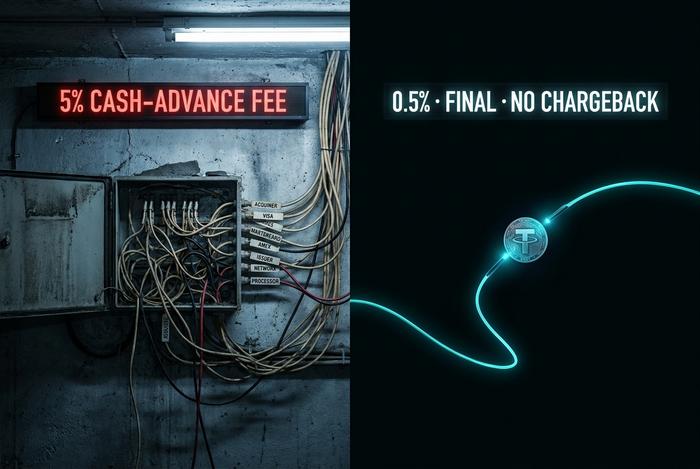
Every US credit card issuer treats MCC 6051 transactions as cash advances by default. Chase lists "purchasing cryptocurrency" under Cash-Like Transactions in its Cardmember Agreement. Citi applies a 5% cash-advance fee (or $10, whichever is greater). Chase applies a 5% fee on top of an APR around 29.99%. The charge starts on the day of the transaction with no grace period. Combine that with exchange-side fees, and the total card cost on a crypto buy often tops 10% before the customer has held the coin for a minute.
Within two weeks of the reclassification, four of the largest US banks banned credit-card crypto purchases outright. JPMorgan Chase, Bank of America, Citigroup, and Capital One (CNBC, February 2, 2018; CoinDesk, February 6, 2018). Lloyds Banking Group and Virgin Money issued the same ban in the UK that month. Discover had quietly blocked crypto card buys all the way back in 2015. All those bans are still in force in 2025.
Card networks keep layering rules on top of the MCC. From April 2024, Visa requires every crypto merchant's checkout page to show the item, the full cost with network fees, the destination wallet, and a volatility warning. From April 12, 2025, Visa bans aggregating non-fiat purchases. Each coin type has to be its own authorization. That multiplies interchange and decline risk for any merchant trying to sell a basket of assets in one session. The Visa MDSM also names the only MCCs through which crypto acquisition is permitted: 4829 (wire transfer money orders), 6012 (financial institution merchandise), 6051 (quasi-cash), and 6540 (POI funding). A merchant has to fit one of those.
Why merchants moved to crypto payment gateways
The card-rail friction has a market-side answer. Crypto payment gateways settle on-chain. They never touch MCC 6051. They generate no cash-advance fees and produce no chargebacks. The market grew accordingly. Allied Market Research and other trackers put the crypto payment gateway market at roughly $2.8 billion in 2025. They project $7.1 billion by 2034, a 13.4% compound annual growth rate. Stablecoins moved $33 trillion in 2025, up 72% year on year (Chainalysis 2025 Geography of Crypto Report). Stablecoins now account for around 70% of crypto payment volume.
The market is consolidating around three names. BitPay holds roughly 20% market share, with an average ticket around $800 and 12% volume growth in 2025. Coinbase Commerce holds around 12% share, charges a flat 1% fee, and ships native Shopify integration through the 2026 Commerce Payments Protocol. Plisio sits at the low end of fees — a flat 0.5% per transaction, no monthly or setup fees, 50+ supported cryptocurrencies, and 19 ecommerce-platform integrations including WooCommerce, Magento, PrestaShop, OpenCart, and WHMCS. On-chain payment finality eliminates chargeback exposure entirely.
Even the card networks now acknowledge the shift. Visa announced an expanded stablecoin settlement programme in July 2025, supporting USDC, PYUSD, USDG, and EURC across four blockchains, with annualized stablecoin settlement volume already exceeding $3.5 billion. Mastercard launched merchant stablecoin settlement pilots in EMEA in June 2025 with Circle, Paxos, Fiserv, and PayPal. Both networks are quietly building the same plumbing the gateways did first.
How to find your business's MCC
There are three ways to look up the MCC of a business, whether yours or anyone else's. Read the source documents. Visa's Merchant Data Standards Manual and Mastercard's Quick Reference Booklet are public PDFs. They list the current code definitions. Call your acquirer or your card issuer's customer service line and ask. Or run an empirical test. Charge a small amount to your card at the merchant. Check the transaction line on your statement. It sometimes displays the MCC. If the assigned code does not match the business, the acquiring bank can reassign it on request, given documentation of the primary activity. Misclassification cuts both ways. A merchant stuck in a high-risk MCC pays inflated interchange. A merchant misrouted into a reward-favoured MCC can end up with chargeback friction it did not expect.
MCC code FAQs and common quirks
The same merchant usually carries the same MCC across Visa, Mastercard, and Amex, but small differences happen because each network maintains its own list on top of ISO 18245. Cashback engines apply category logic above the MCC, so two cards both quoting "3% on dining" may pay out differently depending on which MCCs each issuer counts as dining. And the merchant identification number (MID) is not the same thing as the MCC: the MID is a unique per-merchant account number assigned by the acquirer, while the MCC describes the merchant's business category.