Interlink Network: ITLG Token, Proof of Personhood, AI Blockchain App
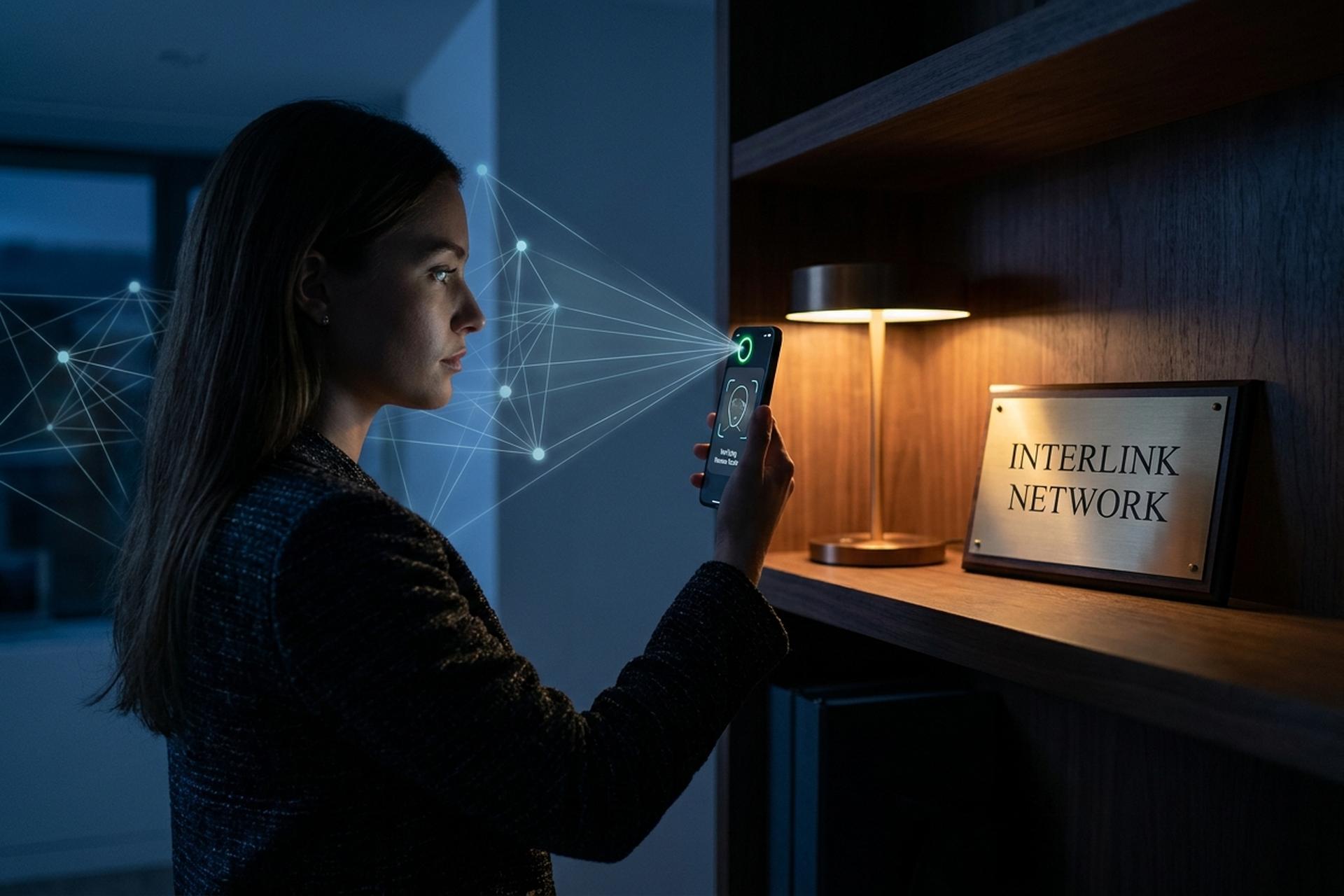
Web3 has a Sybil problem. Bots and farmed wallets scoop up airdrops meant for real users. They swing DAO votes. They inflate engagement metrics. As large language models get better at copying human behaviour, the gap between "wallet" and "person" only gets wider. That is the question Interlink Network is built around. It is also why the search term itself is messy: at least four unrelated crypto projects use some version of the name.
This article focuses on the one that actually ranks for "interlink network" in 2026. It walks through its ITLG token, the dual-token model, and the Proof of Personhood mechanic. It compares Interlink head-to-head with Worldcoin. It ends with a frank rundown of red flags and what to verify before you download the app. It also looks at the other meaning of "interlink network" in blockchain: cross-chain bridges and the protocols that connect today's L1 chains.
What "Interlink Network" actually refers to
A quick name check before the rest of this makes sense. Four distinct projects share some form of the label. Interlink Labs (interlinklabs.ai) is the proof-of-personhood project currently dominating English-language search results for "interlink network" in 2025-2026; that is the one this article unpacks. InterLink (INTL) on BNB Chain is a 2021-era interoperability token with a market cap under $50,000, effectively defunct. Global Interlink Network (GIL) is a Sui-based DeFi launchpad project. A Solana-based memecoin called Interlink also exists. None of those four are affiliated with each other, and Interlink Labs is also not affiliated with Sam Altman's Worldcoin despite both being proof-of-personhood plays.
Interlink Network: the human-centric blockchain project for users
Interlink Labs operates out of Newport Beach, California, with declared offices in Asia. The official site is interlinklabs.ai. The mission, copied almost word for word from the whitepaper, is to build a "human-centric blockchain network to make crypto accessible to everyone," with a stated long-term goal of onboarding 5 billion internet users to what the team calls the world's largest phone-based Human Network. Dr. Benjamin Tran chairs the company; he transitioned to Executive Chairman in October 2025. The team includes Vince Caruso as CMO (also founder of the New to The Street media partnership the project leans on for US visibility).
The first public scale milestone came on 15 June 2025, when a press release confirmed Interlink Labs had passed one million registered users and entered the Google for Startups incubator program. By Q1 2026 the team claimed 3.1 million daily active users and roughly 7 million total registrations. Both numbers are self-reported and have not been independently audited. The X (Twitter) account @inter_link sits at around 322,000 followers. Token Generation Event timing has shifted at least once, from late Q1 2026 to Q2 2026. The project is still pre-listing as of May 2026; there is no public market for either of its tokens yet.
Proof of Personhood, privacy, and the Interlink human network app
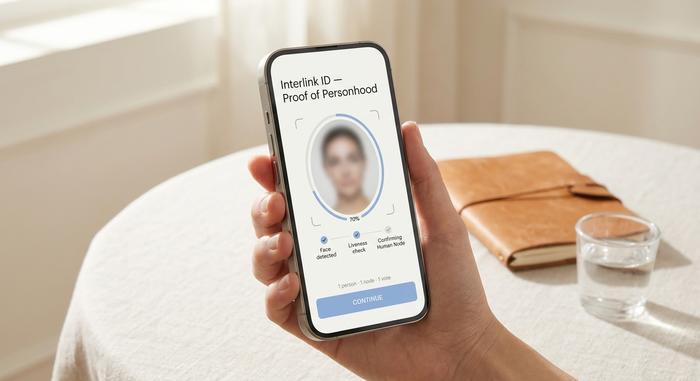
The mechanic at the centre of the project is Proof of Personhood, or PoP. The product name is Interlink ID. Where Bitcoin uses Proof of Work and Ethereum uses Proof of Stake, Interlink Chain treats verified human identity as the consensus primitive. Each successful identity check turns a user into what the docs call a Human Node: one verified person, one node, one vote. The protocol is built around real people. It uses zero-knowledge style proofs that confirm humanness without exposing the underlying biometric.
Authentication happens through the mobile app, not dedicated hardware. After sign-up, the user opens the Interlink app, follows the on-screen prompts for a facial scan, and runs a liveness-detection sequence built to defeat photo, video, and deepfake spoofing. The flow is easy to use by design. Referral campaigns inside the app push users to recruit friends in ways that can feel aggressive. The app does not upload the raw biometric to a server. Instead, on-device processing produces a cryptographic hash. Only that hash, plus the encrypted identity record, lands on Interlink Chain. The whitepaper claims NIST anti-spoofing alignment and ongoing testing against face-presentation-attack benchmarks. No public NIST FRVT (Face Recognition Vendor Test) entry for an "InterLink" submission has surfaced yet, so treat the NIST framing as aspirational rather than certified.
To remain an active Human Node, the user must re-verify roughly every four hours by opening the app. That cadence is also how the project's "mining" works: each successful re-verification accrues ITLG points, which convert to actual ITLG tokens at the eventual TGE. Cross-chain compatibility with Ethereum, BNB Chain, Solana, and Tron is claimed through Chainlink CCIP and BNB Chain integrations, although the deep integration with each network is still in development as the chain itself is.
The deeper bet is that PoP becomes the default Sybil-resistant layer underneath decentralized AI-era Web3 applications. If verified humanity replaces wallet count as the unit of network participation, then airdrops, DAO voting, social platforms, and government-grade ID systems start to converge on something like this. That is a large "if," and Interlink is one of several projects making the bet. The Interlink ecosystem also plans an integrated gaming layer with a gaming leaderboard, mini-apps, and login flows that lean on the same identity verification rather than a separate password.
ITLG token, ITL token, and the dual-token model
The economic structure of the Interlink Network rests on two assets with explicitly different jobs. The ITLG (Interlink Genesis Token) is the user-facing token earned through PoP mining and used for governance and reward distribution. The ITL token is the institutional and ecosystem instrument: a fixed 10-billion supply, intended for strategic partners, large-scale capital, and on-chain payment rails. Up to 180 months of linear vesting is built into the schedule, and the whitepaper describes up to 100 planned halving events that will progressively cut emission as the network matures.
The TGE timing has moved. The first public date pointed at Q1 2026; the team's March 2026 v4.0.5 announcement, which switched on the ITLG claim and verification flow inside the app, also shifted the listing window to Q2 2026. Listing price, according to the project, will be set "directly proportional to user count" at the time of the event — a framing the community reads as "later listing equals higher price," which has obvious incentive implications.
| Token | Type | Supply | Earned via | Status (May 2026) |
|---|---|---|---|---|
| ITLG | Genesis / user governance | Not publicly fixed | PoP mining in the app | Claim live, not yet tradable; TGE Q2 2026 |
| ITL | Core utility / ecosystem | 10 billion (fixed) | Allocated to partners, treasury | Pre-launch; intended for institutional rails |
Interlink Network vs Worldcoin: same bet, different hardware
The comparison readers want is Interlink versus World (formerly Worldcoin). Both projects bet on Proof of Personhood, both claim to be the Sybil-resistant identity layer for AI-age Web3. The execution diverges sharply.
Worldcoin verifies people through proprietary hardware: the Orb, an iris-scanning device deployed at physical locations around the world. Interlink verifies people through smartphone cameras and an app. That single choice ripples through every downstream metric. Worldcoin's Orb count and verified-user numbers are slower to scale but harder to fake at scale; Interlink's phone-based onboarding is faster and cheaper but is the harder of the two to defend against sophisticated deepfake attacks over time.
| Dimension | Interlink Labs (ITLG / ITL) | World / Worldcoin (WLD) |
|---|---|---|
| Verification hardware | Smartphone camera | Proprietary Orb (iris scan) |
| Verified users (early 2026) | ~7M self-reported registrations, ~3.1M DAU | ~10M Orb-verified, ~22M total accounts |
| Backers | Google for Startups (incubator track) | a16z, Bain Capital, Khosla, Sam Altman |
| Token | ITLG / ITL (pre-TGE, Q2 2026) | WLD (live since 2023; Binance, Coinbase, OKX) |
| Chain | Interlink Chain (PoP, in development) | World Chain (OP Stack, live 2024) |
| Standards | Proprietary stack | World ID; AgentKit (Coinbase x402 March 2026) |
The Sam Altman point is worth pinning down because it generates a lot of confusion online. Altman co-founded Worldcoin (now World), not Interlink. Interlink's most-cited backer is Google for Startups, which is an incubator program rather than a direct equity investment from Google or Alphabet. The two projects are competitors in approach but have no shared cap table.
Blockchain network interlink: cross-chain crypto bridges and interop
Step away from a specific project for a paragraph and the phrase "interlink network" also describes the broader problem of connecting blockchains together. Bitcoin does not talk to Ethereum natively — Solana does not talk to Bitcoin either. The infrastructure that lets a USDC token move from one chain to another, or a swap on Arbitrum settle against liquidity on Base, is the cross-chain interoperability layer, and it has been the most-attacked surface in DeFi. Ronin lost $625 million to a validator key compromise in March 2022. BNB Chain's bridge dropped $570 million in October 2022 to a Merkle-proof verifier bug. Wormhole lost $326 million in February 2022. Nomad ran a permissionless drain to roughly $190 million in August 2022. Harmony's Horizon bridge lost $100 million in June of that same year. Cumulative bridge losses through 2021-2023 cleared $2.5 billion, more than any other DeFi primitive.
The infrastructure has improved since. LayerZero claims more than 140 million messages across 46 chains. Wormhole's guardian network has carried over 1 billion cross-chain messages. Axelar holds $142 million in bridge TVL across 53 chains. Chainlink CCIP transferred $7.77 billion in digital assets across 62 chains in 2025, up about 1,972% year over year, with $33.6 billion in cross-chain tokens secured for trading and treasury use. ERC-7683, a cross-chain intents protocol ratified in early 2025, is converging the messaging landscape on a common API. Most analysts expect the field to consolidate sharply by 2027. For builders shipping a wallet, exchange, or merchant-payment product, the upgrade path now usually means picking one of these protocols and trusting its security model rather than running a custom bridge.

Risks, red flags, and due-diligence gaps
Anyone evaluating Interlink Network as a token bet or a daily app should weigh a handful of unresolved items. The "Google investment" line in some coverage refers to Google for Startups, an incubator program with mentorship and cloud credits. It is not an equity investment from Google or Alphabet. No tier-1 venture capital firm (a16z, Polychain, Paradigm, Pantera) has confirmed involvement on its own channels. Third-party articles report different backers, but counterparty confirmation has not surfaced. Public smart-contract audit reports from CertiK, Trail of Bits, Quantstamp, or OpenZeppelin were not available as of May 2026. The user numbers (7 million registrations, 3.1 million daily active) are entirely self-reported. The TGE has already slipped once. Several partnership claims, including Samsung and NIST, lack joint press releases from the named counterparties.
There is also a pattern worth naming. Mobile-mining mechanics, four-hour verification cycles, point accumulation that converts to tokens "later," and aggressive crypto-influencer SEO content all describe Interlink fairly. They also describe several earlier projects that did not deliver, most prominently Pi Network. Reddit r/Scams threads asking whether apps like Interlink are a scheme or trustworthy reflect this exact concern, and it is not unique to this project. None of this is proof of bad intent; it is the due-diligence gap a careful reader should weigh against the upside.
Should you download the Interlink app: trust, internet users, verdict
For most readers the practical answer depends on what you are trying to do. Curious about PoP as a concept and willing to spend a few minutes a day on a phone scan, you can download Interlink free from the app store and the marginal cost of trying it is low; treat the accumulating ITLG points as having zero confirmed market value until the TGE actually lists and the token trades on a reputable exchange. Looking at it as an investment, wait for an exchange listing, a transparent public audit, and a clear roadmap with dependable disclosure on venture backing before sizing any meaningful position. As a developer, the SDK, Mini-App Foundation, and the documented path to decentralized applications on Interlink Chain are still early; track the GitHub for production-grade releases. None of those positions are mutually exclusive, and diversifying expectations is healthier than betting either everything or nothing on a single pre-TGE narrative.