
LayerZero explained: the omnichain protocol connecting 168 blockchains
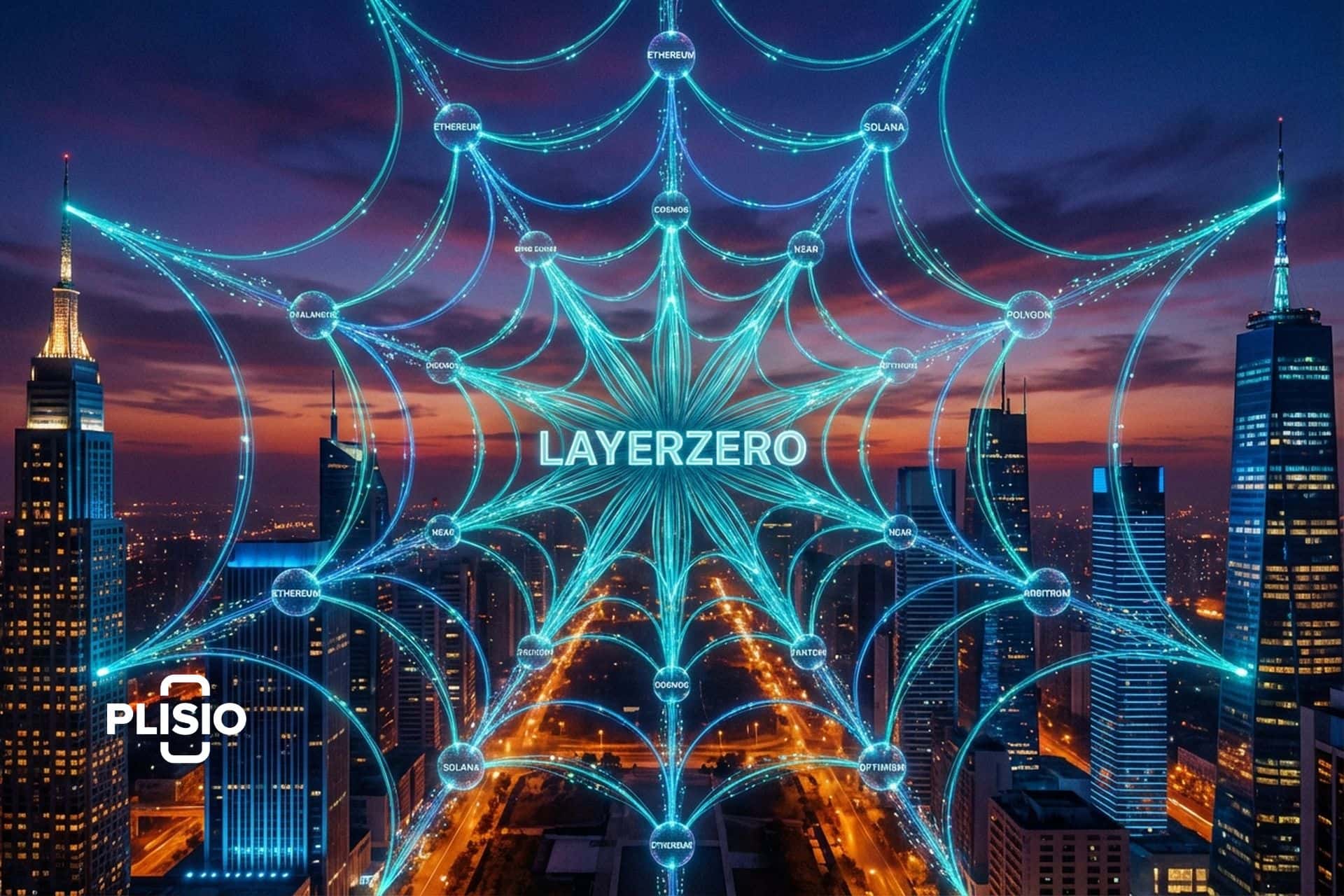
Cross-chain bridges have lost users over $2.8 billion to hacks since 2022. The Ronin bridge lost $625 million. Wormhole lost $320 million. Nomad lost $190 million. Every one of these exploits happened because the bridge had a single point of failure, a small group of validators or a multisig wallet that, once compromised, gave attackers access to the entire treasury.
LayerZero took a different approach. Instead of building another bridge, LayerZero Labs built a messaging protocol. It does not hold your funds. It does not have a central validator set to compromise. It sends verified messages between blockchains and lets each application choose its own security stack. The protocol has moved $225.4 billion across 168 connected chains through 159 million messages. Tether, PayPal, and Ondo Finance run their cross-chain infrastructure on it. Citadel Securities and DTCC invested in 2026.
This article covers how the LayerZero protocol works, why its architecture avoids the problems that killed other bridges, what the OFT standard changed for cross-chain tokens, and what the ZRO token does.
What is LayerZero and how does it work?
LayerZero is an interoperability protocol that enables different blockchains to talk to each other. Not just token transfers. Actual message passing. A smart contract on Ethereum can trigger an action on Arbitrum, Solana, Avalanche, or any of the 168 chains LayerZero supports. That message gets verified and delivered without either chain needing to trust a centralized intermediary.
The architecture in LayerZero v2 has three core components.
Endpoints are smart contracts deployed on each supported blockchain. Think of them as post offices. When an application on Ethereum wants to send a message to Avalanche, it submits the message to the Ethereum endpoint. The Avalanche endpoint receives and delivers it on the other side. Every chain in the network has its own endpoint, creating a fully connected mesh.
DVNs (Decentralized Verifier Networks) are the security layer. When a message leaves one chain, DVNs verify that the message is valid and that the source transaction actually happened. There are 35 DVN operators including Google Cloud, Chainlink, and Polyhedra Network. Here is what makes LayerZero different from every other cross-chain protocol: each application picks its own DVN configuration. An app might require 2 mandatory DVNs plus 3 out of 5 optional ones. Another app might use a single DVN for speed. The security is configurable at the application level, not locked in at the protocol level.
Executors handle delivery. After DVNs verify a message, an Executor submits the transaction on the destination chain. Verification and execution are separate. A compromised Executor cannot fake a message because DVNs already validated it. A compromised DVN cannot execute anything because Executors handle that part. This separation is how LayerZero avoids the single-point-of-failure problem.
The v2 architecture also cut gas costs by roughly 90% compared to v1. Cross-chain transactions that used to cost several dollars in verification fees now cost pennies.
Why LayerZero matters: the bridge problem
Bridges are the most dangerous part of crypto infrastructure. Over $2.8 billion stolen since 2022. In 2025 alone, attackers funneled over $1.5 billion through cross-chain bridges, more than half of all crypto stolen that year.
The problem is structural. Traditional bridges work by locking tokens on one chain and minting wrapped tokens on another. The locked tokens sit in a smart contract controlled by a small group of validators. Hack those validators, drain the contract. Ronin had 9 validators and the attacker compromised 5. Wormhole had 19 Guardians and one buggy verification allowed the exploit.
LayerZero avoids this because it does not hold assets. It sends messages. When you transfer USDT from Ethereum to Arbitrum using Tether's USDt0 (built on LayerZero's OFT standard), no wrapping happens. The USDT is burned on Ethereum and minted natively on Arbitrum. There is no pool of locked tokens to steal. There is no single validator set to compromise. The DVN model means you would need to simultaneously compromise multiple independent verification entities that the application itself chose.
Is it bulletproof? No. Nothing in crypto is. If every DVN an application selects is compromised at the same time, messages could be faked. But that attack surface is radically smaller than "hack one multisig and take everything."
The OFT standard: how cross-chain tokens actually work now
Before LayerZero, sending a token to another chain meant wrapping it. You lock the original, mint a synthetic version on the destination. This creates fragmented liquidity. USDC on Ethereum and USDC on Avalanche are technically different tokens managed by different bridge contracts. Each wrapped version carries the risk of the bridge that created it.
The OFT (Omnichain Fungible Token) standard changes that. A token built as an OFT exists natively on every chain it supports. When you send it cross-chain, the token is burned on the source and minted on the destination. Same token. Same supply. No wrapping. No fragmented liquidity.
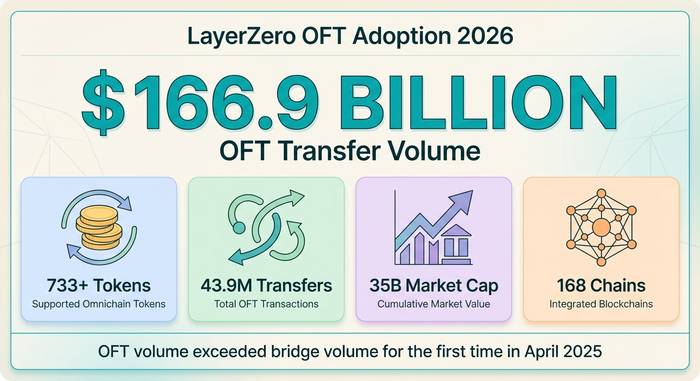
The adoption numbers are hard to ignore. Over 733 OFT tokens exist in the ecosystem. Total OFT transfer volume has hit $166.9 billion across 43.9 million transfers. The combined market cap of all OFT tokens is $35 billion.
The biggest OFT deployment is USDt0, Tether's omnichain version of USDT. Launched in January 2025, USDt0 processed over $70 billion in cross-chain transfers in under 12 months. PayPal's PYUSD expanded to Tron, Avalanche, and Sei using the OFT standard in September 2025. Ondo Finance tokenized over 100 stocks as OFTs. In April 2025, OFT-related volume exceeded traditional bridge volume for the first time.
| OFT metric | Value |
|---|---|
| Total OFT tokens | 733+ |
| Total OFT transfer volume | $166.9 billion |
| Total OFT transfers | 43.9 million |
| OFT combined market cap | $35 billion |
| Stablecoin coverage | 61.2% of all issued stablecoins ($150B) |
| Largest OFT deployment | USDt0 ($70B+ in 12 months) |
LayerZero vs other cross-chain protocols
LayerZero is not the only interoperability solution. Wormhole, Axelar, and Chainlink CCIP all compete in this space. But they work differently and target different use cases.
| Protocol | Chains supported | Messages/transfers | Total volume | Security model | Token |
|---|---|---|---|---|---|
| LayerZero | 168 | 159M+ messages | $225B+ | DVN (app-configurable, 35 entities) | ZRO (~$670M mcap) |
| Wormhole | 40+ | 1B+ messages | $60B+ | 19 Guardian nodes (13/19 threshold) | W |
| Axelar | 64+ | 1.85M+ transactions | $8.66B+ | DPoS with 75+ validators | AXL |
| Chainlink CCIP | 20+ | Smaller scale | N/A | Chainlink oracle network | LINK |
Wormhole has the highest raw message count at over 1 billion, driven partly by its deep integration with Solana. But its Guardian model is a fixed set of 19 entities. If 13 collude or get compromised, the whole network is at risk.
Axelar grew 536% year over year and has strong institutional traction, especially in the Cosmos ecosystem. Its DPoS model with 75+ validators is more decentralized than Wormhole but less flexible than LayerZero's DVN approach.
Chainlink CCIP has the backing of Chainlink's massive oracle network. It is the most conservative option, focusing on enterprise use cases with fewer chains and tighter security requirements.
LayerZero's advantages are chain coverage (168, more than 4x Wormhole) and the configurable security model. Its weakness is that the DVN ecosystem is still growing. Most applications currently use a default DVN configuration rather than customizing their own, which reduces the theoretical security benefit.
The ZRO token
ZRO launched in June 2024 with an airdrop to early protocol users. 85 million tokens (8.5% of total supply) went to about 1.28 million wallets. LayerZero's Sybil filtering was aggressive: 803,273 wallets (59%) were removed as suspected bots.
Total supply is 1 billion ZRO. About 252-313 million are circulating, roughly 25-31% of the max. The token trades around $2.00 in April 2026, down from an all-time high of $7.47, with a market cap of approximately $670 million.
Token allocation: 38.3% to community, 32.2% to strategic partners, 25.5% to core contributors, 4.0% repurchased. Full unlock extends into 2027.
What ZRO does: it pays for protocol fees on cross-chain messages and serves as a governance token. In June 2025, LayerZero rolled out an immutable on-chain voting system giving ZRO holders control over protocol fee settings. Grayscale named ZRO one of five exceptional crypto performers in Q1 2026 based on volatility-adjusted returns.
| ZRO token snapshot | Value |
|---|---|
| Price (Apr 2026) | ~$2.00 |
| Market cap | ~$670 million |
| All-time high | $7.47 |
| Total supply | 1 billion ZRO |
| Circulating | ~252-313M (25-31%) |
| Airdrop (June 2024) | 85M ZRO to ~1.28M wallets |
| Sybil-filtered wallets | 803,273 (59% removed) |
What is coming: Zero, the L1 built by LayerZero
In February 2026, LayerZero Labs announced Zero, a new Layer 1 blockchain. The partner list reads like a who's who of traditional finance: Citadel Securities, DTCC (Depository Trust & Clearing Corporation), ICE (NYSE's parent company), Google Cloud, and ARK Invest. Citadel made a strategic investment in ZRO. ARK became a holder of both LayerZero equity and ZRO tokens. Tether also invested in LayerZero Labs.
Zero claims capacity of up to 2 million transactions per second per zone. Three zones are planned: a general EVM zone, a private payments zone, and a trading zone. Mainnet is targeted for fall 2026.
If those backers follow through, Zero could become the first blockchain where Wall Street firms are directly invested in the infrastructure. That is not normal for crypto. Whether it leads to adoption or just hype depends on what ships by the end of 2026.



