Rule 34 Crypto: The Meme, the Cryptocurrency, the Verdict
The phrase "Rule 34" is more than two decades old. It is instantly recognisable to anyone who has spent time online. The migration of the meme into crypto has produced a long list of memecoins named after it. It has also produced a small adult-NFT corner of OpenSea and a micro-genre of attention-farming on crypto Twitter. What it has not produced is a serious investment thesis. The literal "Rule 34" token on Solana trades at sub-cent micro-cap. The serious adult-crypto economy was built earlier, on different names. This is a 2026 explainer of what Rule 34 crypto actually is and what most of it is worth.
The short answer on Rule 34 crypto in 2026
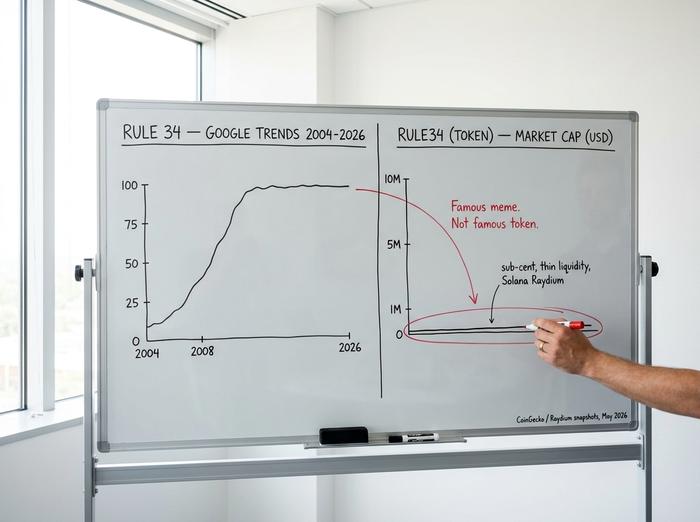
There is a meme called Rule 34. There are crypto tokens that borrow the name. There is a real adult-industry crypto economy that exists for unrelated reasons and rarely uses the term. The intersection of the three is small, fragile, and dominated by short-lived launches. A specific Solana token called RULE34 trades on Raydium at a sub-cent price with thin liquidity. The functional verdict is to treat the entire category as cultural curiosity rather than as an asset class.
Where Rule 34 actually came from
The phrase has a clean, datable origin. British artist Peter Morley-Souter, working under the handle TangoStari, drew a webcomic in August 2003 captioned "Rule #34: There is porn of it. No exceptions." The strip was a reaction to discovering a parody of Calvin and Hobbes online. The drawing itself faded; the caption took on a life of its own. Within a few years, the convention's most common subjects (cartoon properties such as Pokemon, My Little Pony, and a steady supply of anime hentai) became the standard joke material whenever the meme resurfaced online. Encyclopedia Dramatica added an entry in October 2006. Know Your Meme created the page that turned the phrase into shared internet vocabulary on May 18, 2009, marking the entry "Confirmed."
By 2008 the rule was a standard piece of 4chan furniture; by 2009 the Daily Telegraph had it on a top-ten internet rules list; by 2013 CNN called it the most famous of the lot. The phrase is now seventeen years old as an established meme. It has outlasted Tumblr, Vine, Google Reader, and most of the platforms that helped spread it. The slow drift into crypto is the latest stop on a long migration.
How Rule 34 migrated into the crypto market
Three vectors brought Rule 34 into the broader cryptocurrency market. None of them are large.
The first vector is the launchpad memecoin. Solana's Pump.fun and Base's analogous launchpads are designed to make token creation friction-free, with no audit and no team verification. A single-word, attention-grabbing ticker is half the marketing. "RULE34," "R34," and variants appear on these launchpads constantly, the same way "PEPE," "WIF," and any other recognisable meme appear. Most of these tokens are alive for hours, not weeks. The visible Solana RULE34 token, traded through a Raydium liquidity pool, is one of the longer-lived examples; it is also a sub-cent micro-cap with negligible volume. Token launches of this kind do not represent a coherent investment opportunity. They represent a way for the creators of automated launchpads to earn fees on volume.
The second vector is the NSFW NFT marketplace category. OpenSea, the largest NFT exchange, did not ban adult content outright. Its Help Center policy formalises a soft-ban: NSFW-tagged collections are allowed to exist but are removed from search results, trending pages, recommendations, and the verification programme. The practical effect is that adult NFTs have to find their audience elsewhere. Several smaller dedicated platforms have tried to fill that gap, but none has the trading depth of mainstream NFT marketplaces, and many cluster their assets under the broad "Rule 34" umbrella because the term is recognisable.
The third vector is the cultural one. Rule 34 has become a low-effort engagement-farming tag on crypto Twitter. Posting a "Rule 34 of X" joke about whatever protocol is trending will reliably attract impressions, even when the underlying content is innocuous. The pattern matters because it shows the meme functioning as a stable attention currency in the same social-media ecosystem that drives memecoin price action. It does not mean any specific Rule 34 token captures that attention; the attention almost always lands on whatever is in front of the audience that day.
The actual RULE34 coin: a micro-cap on Solana
A specific Rule 34-themed token exists on Solana. It trades through a Raydium liquidity pool whose address ends in J2xw. Aggregators show it priced at a sub-cent level. The thin liquidity means any meaningful buy or sell order moves the price several percentage points. Each on-chain transaction costs a Solana fee fraction of a cent, so the friction is low, but available trading pairs are limited and the spot market depth across exchanges is shallow. The page for Rule 34 on Bitget is informational rather than a curated investment product, and the Bitget swap or Bitget spot interfaces will route most buy orders through small spot trading pools rather than tight institutional books. There is no staking module to stake the token in, no real way to obtain Rule 34 in size, and no reliable way to get Rule 34 for free beyond an occasional airdrop listing. There is no compelling reason for an active trader to maintain a position once the launch-day attention has faded.
The honest framing here is that the absence of traction is the data. If the meme's recognition value translated into investable demand, a coin with the same name would have a measurable market cap and visible volume. It does not. The Rule 34 meme is large; the Rule 34 token is not. That gap tells a reader more about how memecoins actually work than any specific price chart could.
Adult-themed cryptocurrencies: SpankChain to CumRocket
The serious adult-industry crypto economy ran on different names and predates the current Rule-34-named tokens by several years. There were two main waves.
The first wave ran from 2017 to 2018, centred on SpankChain. The project raised about $7 million in a November 2017 Dutch Auction, built a two-token model (SPANK and BOOTY), and went live with Spank.live in April 2018, paying performers in BTC and other crypto. CoinDesk reported in November 2018 that SpankChain had paid roughly $70,000 in crypto to cam performers in its first six months of public operations. Pornhub added Verge to its payment options in April 2018, followed by Tron and Horizen — the first mainstream adult site to accept multiple popular cryptocurrencies side by side with traditional fiat options.
The second wave came in late 2020 and 2021 after a payments shock that had nothing to do with crypto. Visa, Mastercard, and Discover cut Pornhub between December 10 and December 14, 2020, after a New York Times column on illegal content. The site became crypto-only for paid features in the United States, the United Kingdom, and Singapore, supporting thirteen cryptocurrencies including Bitcoin, Litecoin, Ethereum, Dash, and Monero. In August 2021, OnlyFans announced a ban on sexually explicit content under banking pressure; it reversed the decision a week later. CumRocket's CUMMIES token launched in April 2021 in the middle of this saga, briefly hitting a market capitalisation reported above $140 million before settling into a small niche. Plisio and a few other crypto-payment processors quietly built businesses serving merchants the card networks would not.
| Year | Event | Why it mattered |
|---|---|---|
| Nov 2017 | SpankChain Dutch Auction raises ~$7M | First major Ethereum project targeting the adult industry |
| Apr 2018 | Pornhub adds Verge as a payment option | First mainstream adult-site crypto integration |
| Dec 2020 | Visa/Mastercard/Discover cut Pornhub | Site became crypto-only for paid features in major markets |
| Apr 2021 | CumRocket launches CUMMIES token + 18+ NFT marketplace | Peak $140M market cap during the meme-coin frenzy |
| Aug 2021 | OnlyFans bans explicit content, reverses a week later | Demonstrated banking-network leverage over the industry |
The list is short and the asset prices are mostly historical curiosities. The pattern that survives is structural: when card networks deplatform an industry, that industry tries crypto. The economics work when the volume is real and the use case is payments. They do not work when the use case is "we named our token after a meme."

OpenSea NSFW policy and the Rule 34 NFT trade
OpenSea's policy is the single most consequential rule for the Rule 34 NFT trade. The platform allows explicit and sensitive content if it is correctly labelled NSFW, but excludes that content from search, trending pages, recommendations, and verification. A collection can exist on OpenSea, but it cannot be promoted by OpenSea. The practical consequence is that NSFW NFT projects rely on direct links, niche communities, and word-of-mouth rather than discovery surfaces.
Dedicated adult NFT marketplaces have launched repeatedly since 2021 to address this gap. xxxNifty and Nafty are the most-cited examples in mainstream coverage from VICE, Rolling Stone, and The Face. None has approached the trading volume of an OpenSea or Blur. Royalty enforcement, copyright disputes over Rule 34 fan art (much of which uses copyrighted characters without permission), and the limits on payment-processor integration combine to keep these markets small. The trade exists. It does not scale.
Memecoin fragility: why most Rule 34 tokens die in 12 days
The numerical wall around any Rule 34-named token is the broader memecoin fragility problem. Three independent data sources point in the same direction.
Binance Research, in an August 2024 memecoin report, found that approximately 97 percent of memecoins from the 2023-2024 frenzy had already died or fallen to near-zero trading volume. Cointelegraph, citing Chainplay analytics from March 2025, reported that fewer than 2 percent of memecoins launched on Pump.fun survive 90 days, with an average lifespan of 12 days and roughly 10,000 daily launches against 9,900 daily deaths. Chainalysis's 2025 Crypto Crime Report tracked rug-pull losses jumping from $1.3 million in 2022 to $94.8 million in 2024, with 3.59 percent of all new tokens minted in 2024 showing rug-pull behaviour.
| Source | Metric | Number |
|---|---|---|
| Binance Research (Aug 2024) | Memecoin failure rate | ~97% |
| Pump.fun (via Chainplay, Mar 2025) | Survival at 90 days | <2% |
| Pump.fun average token lifespan | Days from launch to inactive | 12 |
| Pump.fun daily launches / deaths | New / dead per 24h | ~10,400 / ~9,900 |
| Chainalysis 2025 Crime Report | Rug-pull losses 2022 → 2024 | $1.3M → $94.8M |
| Chainalysis (2024) | Share of new tokens with rug-pull behaviour | 3.59% |
A December 2025 arXiv paper, Measuring Memecoin Fragility (arXiv:2512.00377), formalises why these numbers are not random. The authors propose a three-factor framework — volatility, whale ownership concentration, and sentiment amplification — that predicts which tokens will collapse, with politically themed tokens ranking as most fragile and DOGE, SHIB, and PEPE as intermediate. Rule 34-named tokens belong to a category the paper does not isolate but plainly fits inside: meme-named launches with thin float, no team, and sentiment-driven price action. Statistically, the expected outcome is collapse within a few weeks.
For an investor weighing a Rule 34-themed token specifically, the prior — the base rate before any analysis of the specific project — is roughly a 97 percent chance of being effectively worthless within a year. Specific project research can revise that prior, but it cannot eliminate it.
Investing in Rule 34 crypto: who it fits, who should pass
For most readers, the honest answer is that Rule 34 crypto is not an investment category. It is a cultural artefact attached to a memecoin economy. That economy fails at the same rate as any other meme-driven launch. A retail investor with a diversified portfolio, a long-term plan, and an emergency fund can choose to spend a small amount of discretionary money on memecoins. Treat it like a hand of poker. That activity should never be more than entertainment-budget money. It should never be on leverage. It should never be a recovery strategy. It should never be confused with the kind of crypto allocation that goes into Bitcoin or Ethereum.
The actual adult-industry crypto economy — payments processing, creator payouts, niche NFT platforms — is a more interesting commercial story than any specific Rule 34 token. It is also one that is mostly served by operators behind the scenes, not by retail-facing speculative assets. The two narratives get conflated in coverage because they share a vocabulary. They do not share a thesis.