
Is Dogecoin a Good Investment in 2026?
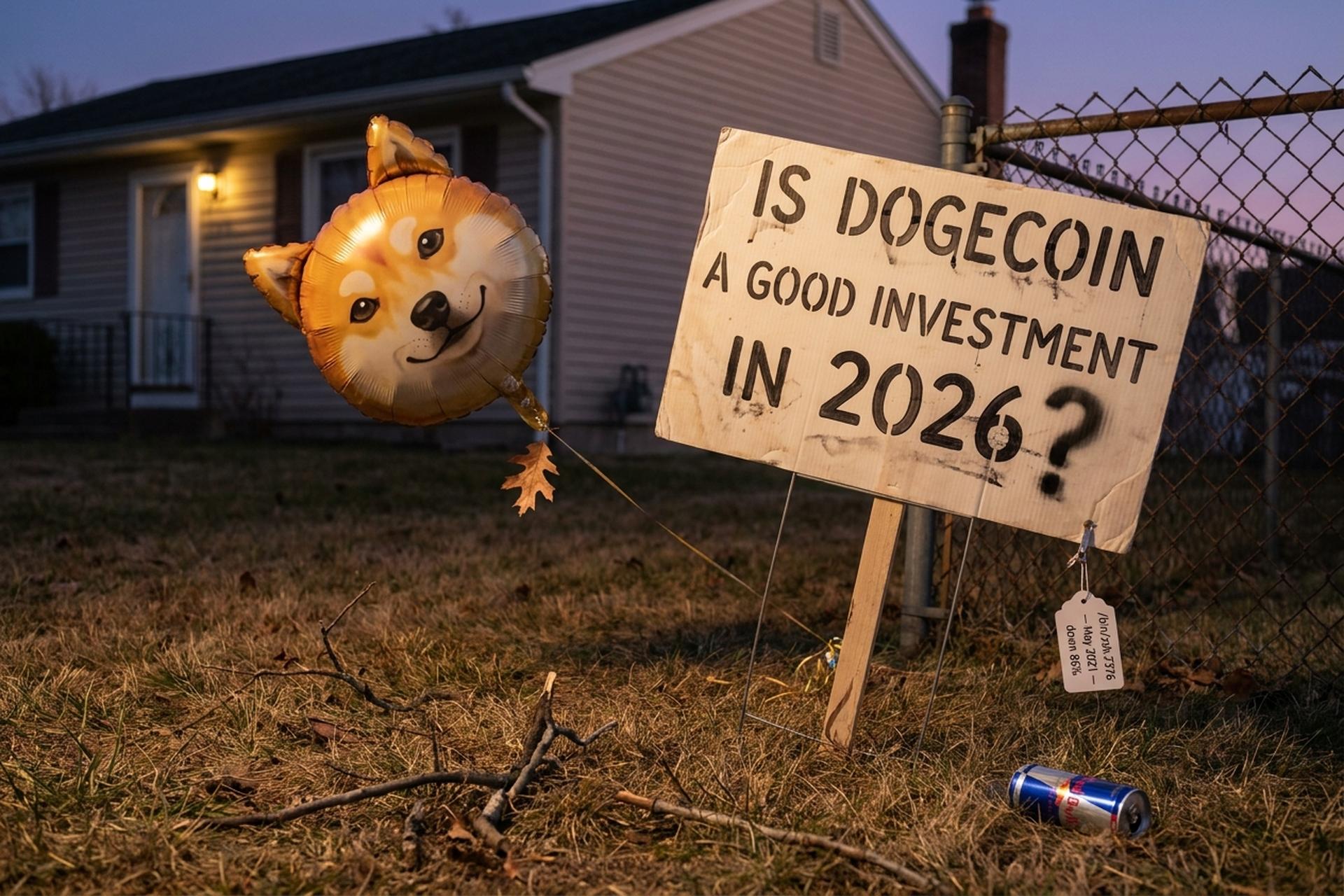
Is Dogecoin a good investment in 2026? Five years after the May 2021 all-time high, anyone who bought near the peak is still down roughly 86 percent on a cryptocurrency that was supposed to lead the meme-coin charge into the mainstream. The first spot DOGE ETF finally launched on Nasdaq in January, and as of May it holds about four million dollars in assets, a rounding error next to the spot Bitcoin funds. X Money, the payments product everyone assumed would be the big DOGE catalyst, went live in April 2026 on Visa rails, with no Dogecoin integration at all. The current price hovers around ten cents, and DOGE remains one of the largest cryptocurrencies by market capitalization. The short answer is that it can be a position-sized trade, but it is not an investment in any conservative sense of the word, and the data below shows why.
The honest verdict on Dogecoin in 2026
Trade it as a sentiment vehicle if you must. Do not invest in it for retirement. DOGE trades at a current price of about $0.103 in May 2026 against an all-time high of $0.7376 set in May 2021. The coin has not reclaimed that level in five years. The 21Shares Dogecoin ETF, ticker TDOG, launched on Nasdaq on January 22, 2026 and has gathered roughly $4.1 million in assets under management. Institutional appetite for spot DOGE exposure is, so far, weak. Dogecoin's supply keeps growing by about 5.256 billion new coins a year, with no cap. The investment potential is real but narrow, and the verdict is plain: trade, don't invest.
Where Dogecoin sits in May 2026, by the numbers
The most useful frame is opportunity cost. Ten thousand dollars put into DOGE at the May 2021 peak is worth roughly $1,400 today. The same ten thousand in the S&P 500 became about $19,000 over the same period, including dividends. That is the comparison most "should I buy Dogecoin" articles avoid making, and it is the one that matters.
Below the price, the structural picture is more interesting than the day-to-day chart suggests. According to BitInfoCharts, on May 18, 2026 Dogecoin had a market cap of about $15.94 billion on circulating supply of 154.3 billion coins, with annual emission of roughly 5.256 billion coins, which works out to a 3.4 percent annual inflation rate, declining as a percentage each year because the nominal emission is fixed at 10,000 coins per minute. DOGE remains among the top ten cryptocurrencies by market capitalization, a notable fact for a digital asset built on a Litecoin-derived blockchain. The network processed about 22,889 transactions in the trailing 24 hours, with 2.9 million addresses holding more than a dollar's worth.
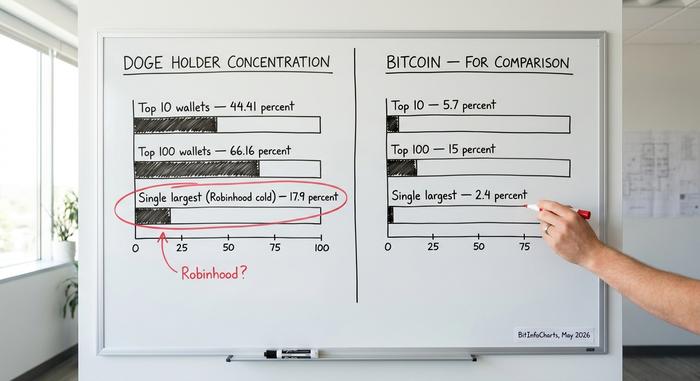
The concentration data is where things get uncomfortable. The top ten DOGE wallets hold 44.41 percent of supply. The top one hundred hold 66.16 percent. A single address — Robinhood's cold storage wallet, holding customer balances in custody — controls about 17.9 percent of every Dogecoin in existence. Most of those big addresses are exchange custodians rather than individual whales, which is technically a comfort. But it also means that if a regulator pressures Robinhood to liquidate, or Robinhood decides to move that custody, a chunk of the float roughly equal to the entire daily trading volume of mid-cap altcoins is suddenly mobile. Bitcoin has the same exchange-custody pattern, but its single-address concentration is nowhere near 17.9 percent.
The snapshot below pulls the headline numbers into one place.
| Metric | Value | Source |
|---|---|---|
| Spot price | $0.103 | BitInfoCharts, May 18, 2026 |
| Market cap | $15.94B | BitInfoCharts, May 18, 2026 |
| Circulating supply | 154.33B DOGE | BitInfoCharts |
| Annual emission | ~5.256B/yr (10,000/min) | KuCoin tokenomics |
| Current inflation rate | ~3.4% | Derived |
| Daily transactions (24h) | 22,889 | BitInfoCharts |
| Addresses holding >$1 | 2,904,208 | BitInfoCharts |
| Top-10 wallet concentration | 44.41% | BitInfoCharts |
| Top-100 wallet concentration | 66.16% | BitInfoCharts |
| Largest wallet (Robinhood cold) | 17.9% of all DOGE | TheCryptoBasic, BitInfoCharts |
None of these numbers are catastrophic by themselves. Taken together, they describe a volatile asset that is liquid enough to trade (the massive liquidity across major exchanges is one of DOGE's most concrete strengths), large enough to attract institutional product wrappers, and structurally dependent on a small number of custodians not moving in unison.
What 2026 changed for Dogecoin — and what it didn't
Two big catalysts were supposed to define this year for DOGE. The first was a spot ETF, the second was Elon Musk's payments product on X. Both arrived. Neither delivered.
The 21Shares Dogecoin ETF (TDOG) began trading on Nasdaq on January 22, 2026 with a 0.50 percent expense ratio, the first U.S. spot DOGE product. Bitwise filed its own DOGE ETF, ticker BWOW, in January 2025 and has amended the S-1 four times through November of that year. TDOG's roughly $4.1 million in assets under management is the part nobody on crypto Twitter wants to dwell on. Spot Bitcoin ETFs crossed a billion dollars in their first week. The DOGE product has not crossed five million in four months. Institutional money is voting, and it is voting with very small allocations.
The X Money story is sharper. Elon Musk spent two years signaling that Dogecoin would be central to payments inside X, the platform he rebranded from Twitter. When X Money actually launched on April 14, 2026, it was a fiat-only product running on Visa card rails, with no crypto integration of any kind. Decrypt confirmed the launch profile. The U.S. Senate Banking Committee sent a follow-up letter on the same date asking X Payments LLC to clarify the absence of crypto. Whatever DOGE bull thesis was riding on the "Musk eventually plugs Dogecoin into X" trade should be re-priced.
There is one regulatory tailwind that is real. On March 17, 2026, the SEC and the CFTC issued a joint guidance document (the first of its kind) explicitly classifying sixteen named crypto assets as digital commodities. Bitcoin, Ethereum, XRP, SHIB and Dogecoin were on that list. The Ropes & Gray client alert summarizes the legal status as cleaner than it has been in years. The catch is timing: that guidance came after the TDOG launch, which means the ETF flows we have are already in a post-clarity world. The price did not move on the news.
So the 2026 ledger reads: one genuine regulatory win, one ETF launch that institutions ignored, and one payments catalyst that did not materialize. The broader crypto market spent the same months grinding through a soft phase, with bullish sentiment around BTC and ETH spot ETFs failing to translate into a similar bid for DOGE. For a coin whose investment case rests almost entirely on narrative momentum, that is a poor set of inputs.
Inflationary supply and the long-term investment problem
Bitcoin's hard cap of 21 million coins is the cleanest piece of monetary architecture in crypto, and the most common point of contrast for DOGE skeptics. Dogecoin has no cap. The protocol mints exactly 10,000 new coins per minute, indefinitely, which adds up to about 5.256 billion DOGE every year.
That sounds like hyperinflation, but the math is gentler than the rhetoric. At 154.3 billion coins in circulation, the current annual inflation rate is roughly 3.4 percent and falling, because the nominal emission is functionally a fixed supply schedule while the base keeps growing. By 2030 the supply will likely exceed 200 billion coins, and the inflation rate will drift toward 2.5 percent. That is not a Weimar chart. It is closer to a developed-market currency, and on a per-block basis the blockchain technology behaves identically to its 2014 design.
The structural issue is that this rate is permanent. Every year, Dogecoin has to find enough new demand to absorb an extra 5.256 billion coins just to keep the price flat. Bitcoin and Ethereum have no such treadmill. For a long-term investor focused on long-term value, the question is not whether 3.4 percent inflation is large in absolute terms — it isn't — but whether DOGE's adoption trends can outrun it every single year, for decades. The price chart since 2021, across two bull markets and one bear, is not encouraging on that question.
Extreme volatility and the Elon Musk feedback loop
Anyone investing in Dogecoin is also implicitly investing in figures like Elon Musk continuing to talk about it. The historical record makes the relationship plain, and the retail enthusiasm that follows each high-profile tweet is the single clearest driver of the next leg up.
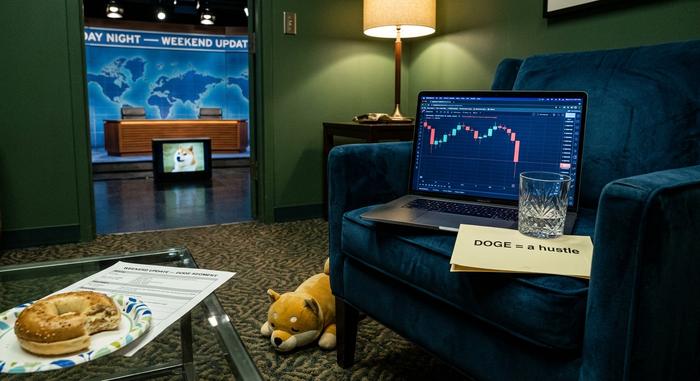
On April 15, 2021, Musk tweeted "Doge Barking at the Moon," and DOGE jumped roughly 30 percent in minutes and roughly doubled within twenty-four hours, according to Decrypt's tick-level summary. Three weeks later, on May 8, 2021, Musk hosted Saturday Night Live; the price fell 29.5 percent during the broadcast as he called Dogecoin "a hustle" in a Weekend Update segment, Fortune reported. The Tesla merch store began accepting DOGE on January 14, 2022, and the price spiked 11 to 25 percent on the news before the option was quietly removed during the 2022 bear market. The Twitter logo swap in April 2023 added 30 percent in hours; the move faded by the end of the week.
The pattern is consistent. Musk speaks, the price reacts, and the reaction fades faster each cycle. The half-life of a Musk-Dogecoin event has shrunk from weeks to days. Historically, DOGE has run at roughly twice Bitcoin's annualized volatility, a level of high volatility that DOGE's own price action reflects in every prior bull market, and that becomes significant volatility when the broader market turns. The maximum drawdown sat at 92.29 percent according to PortfoliosLab; for an investor, that is the worst-case scenario you should be sizing around, not the headline-grabbing 2021 returns from the last crypto bull. Doge's price simply does not behave like a long-term store of value.
Is Dogecoin actually used for payments?
This is the pitch most likely to mislead a first-time buyer. Dogecoin's transactions are technically fast — about one-minute block times — and the fees are usually fractions of a cent. As a decentralized peer-to-peer digital currency, the chain works as advertised; transaction fees stay low even during congestion, and the low fees relative to most Layer 1 networks, with lower transaction fees that would matter in a real retail-payments setting, remain a real feature. The question is whether anyone is using it.
BitInfoCharts shows roughly 22,889 transactions on the Dogecoin network in the trailing 24 hours of May 18, 2026. Bitcoin processes around 300,000 a day, Ethereum well over a million. Solana clears tens of millions. The Cryptwerk directory lists about 2,000 to 2,500 merchants accepting DOGE, and most of them are crypto-native businesses (VPN providers, gaming sites, niche e-commerce) rather than mainstream retail. The Tesla merch experiment quietly ended. The X Money launch did not include DOGE. The "Dogecoin is the people's payment coin" story has been told for twelve years, and the on-chain data has yet to validate it.
This matters because the use-case argument, the question of real-world utility, is what separates Dogecoin from purely speculative meme coins in the marketing pitch. Note also that DOGE has no native smart contract layer, so it cannot host the decentralized finance applications that gave Ethereum and Solana their second wind. The numbers say the payments thesis shouldn't sell.
Dogecoin worth holding vs Bitcoin, Ethereum, and stocks
Five-year returns are the easiest way to anchor an investing decision, because the timeframe is long enough to wash out most of the noise. The S&P 500 returned 13.72 percent on an annualized basis over the five years ending February 2026, according to Trade That Swing. Bitcoin closed at $76,803 on May 18, 2026; Ethereum closed at $2,113, per Yahoo Finance. Shiba Inu, the Shiba Inu dog-themed token launched in 2020 as DOGE's closest meme-coin comparison, sits 93.3 percent below its peak.
The table below shows what $10,000 became across each asset, starting at the May 2021 DOGE all-time high, the worst plausible entry point for a Dogecoin investor.
| Asset | $10,000 in May 2021 | $10,000 in May 2026 | 5-year change |
|---|---|---|---|
| Dogecoin (at $0.7376 ATH) | $10,000 | ~$1,400 | −86% |
| Shiba Inu (at peak) | $10,000 | ~$670 | −93% |
| Bitcoin (~$56,000 in May 2021) | $10,000 | ~$13,700 | +37% |
| Ethereum (~$3,400 in May 2021) | $10,000 | ~$6,200 | −38% |
| S&P 500 (incl. dividends) | $10,000 | ~$19,000 | +90% |
DOGE's five-year return looks dazzling if you measure from January 2021 lows around $0.0075 — that is the +1,270 percent number that gets recycled in bull-case articles. The honest version is that almost nobody bought there. Retail attention arrived in April and May 2021, after the parabolic move, when the price was already between thirty cents and seventy cents. Anyone who bought near the high is sitting on a five-year loss that the S&P 500 has roughly tripled over.
That comparison does not mean DOGE has no place in any portfolio. It means the bar for "good investment" should be set against the alternatives that were actually available at the same moment, not against the ideal entry that almost no buyer caught.
Investing in Dogecoin: who it fits, who should pass
For most readers searching "is Dogecoin a good investment," the honest answer is uncomfortable but simple. If you have a long-term plan, an emergency fund, and a diversified core in indexes or Bitcoin, a small DOGE allocation can sit on top of that as a speculative position. The community-driven nature of the project, the strong community backing that made DOGE survive twelve years where most altcoins did not, is real, but it is not a financial moat. If you do not have those things, Dogecoin is not where you should start, regardless of which crypto influencer told you to buy or sell.
The numerical ceiling is roughly 3 to 5 percent of an investable portfolio, never higher, and never on leverage. Dollar-cost averaging is the only sensible buying method, because nobody, not even Musk, can tell you when the next sentiment spike will arrive. Conservative investors should hold zero. Anyone whose risk tolerance cannot stomach a 90 percent drawdown should also hold zero, because that is the historical worst case and it has happened once already this cycle.
Binance Research has found that roughly 97 percent of meme coins fail or go inactive shortly after launch. Dogecoin is in the surviving three percent, which is a real achievement after twelve years. Survival is not the same as recovery. Holding the line at 3 to 5 percent acknowledges both facts: the coin has earned its place in the conversation, and it has not earned a place at the center of a retirement plan.



