
Kaspa Price and KAS Coin: GHOSTDAG, BlockDAG, and Decentralization
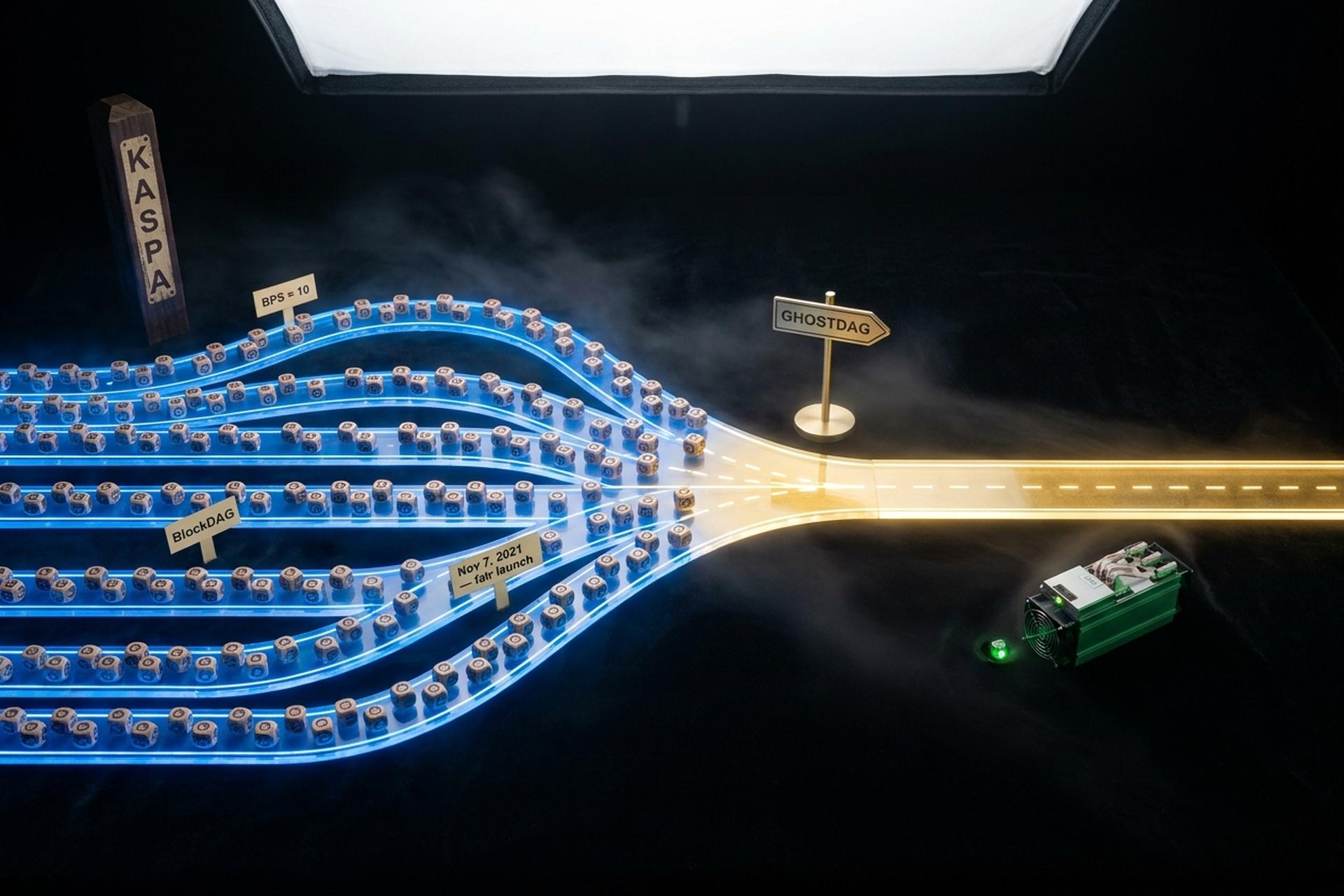
By May 2026 Kaspa runs at 10 blocks per second on proof-of-work — an architecture most engineers said wouldn't survive contact with real network latency. It survived. The network has cleared more than 601 million transactions, active addresses are up 150 percent year over year, and the daily transaction count peaked at 158 million in October 2025. The token, KAS, trades at roughly $0.0368 and sits around a $1 billion market cap, ranked seventieth among cryptocurrencies.
This rewrite covers what Kaspa actually is, how its GHOSTDAG BlockDAG protocol replaces a Bitcoin-style single chain, what the Crescendo hard fork changed in May 2025, the tokenomics and mining picture, and where price stands now without the speculative long-term forecasts the original Plisio article leaned on. It also notes one piece of practical information: Plisio's own payment gateway does not currently support KAS as of May 2026, which matters if you're reading this looking for an on-ramp.
What Kaspa Is and Why People Pay Attention
Kaspa is a decentralized proof-of-work cryptocurrency that launched on November 7, 2021. It has no premine, no ICO, no insider allocation, and no foundation. The token symbol is KAS. The fixed maximum supply is approximately 28.7 billion coins. Marketed as a scalable layer-1 — Kaspa is unique among proof-of-work projects in that it is the fastest one running on Nakamoto-style consensus rather than committee-based block production.
The platform was designed by Yonatan Sompolinsky, who completed a PhD in computer science at Hebrew University and co-authored the 2018 GHOSTDAG paper that underpins the protocol. Sompolinsky is now a Harvard post-doc working on transaction ordering and MEV, with co-founder Michael Sutton handling much of the day-to-day protocol work alongside a small core team.
What makes Kaspa unusual isn't the proof-of-work part. Bitcoin already did proof-of-work. The unusual part is that Kaspa runs proof-of-work at 10 blocks per second.
GHOSTDAG and the BlockDAG: What Actually Replaces Chains
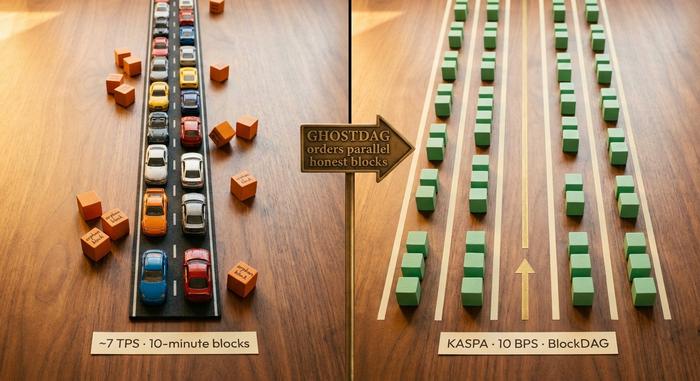
Bitcoin's single-chain design has a structural limit. When two miners find valid blocks at nearly the same time, one of the blocks becomes "orphaned" and is discarded along with all the honest work that produced it. The faster Bitcoin tries to produce blocks, the more often this happens. By around three transactions per second, the orphan rate becomes high enough to compromise security. That ceiling is why Bitcoin block times stayed at ten minutes.
Kaspa replaces the single chain with a BlockDAG — a directed acyclic graph of blocks where many honest blocks can coexist instead of competing. GHOSTDAG (Greedy Heaviest Observed Sub-Tree Directed Acyclic Graph) is the consensus protocol that orders those parallel blocks into a single canonical transaction sequence.
The theoretical version is called PHANTOM. It finds an exact optimal subset of well-connected blocks, which is computationally NP-hard and impractical to run live. GHOSTDAG approximates PHANTOM with a greedy algorithm that is fast enough to operate in real-time. It classifies blocks as "blue" if they are well-connected to the network's honest tip and "red" otherwise, and uses the blue set to determine transaction order.
Kaspa tracks the canonical chain inside the DAG using a structure called the VirtualSelectedParentChain, or VSPC. Each block gets a BlueScore that reflects its position in the ordered set. Importantly, the VSPC is not immutable in the way a Bitcoin block height is. Recent acceptances can reorganize as the DAG resolves. Developers building on Kaspa have to track an `acceptingBlockHash` that updates dynamically rather than assuming a static linear height.
The security model is the same as Bitcoin's: Nakamoto-style consensus, honest-majority hashpower wins. The probability that two confirmed transactions later reorder falls exponentially with the number of confirming blocks, just as Satoshi's 2008 paper described for the linear-chain version. What changes is throughput: by allowing parallel honest blocks rather than discarding them, Kaspa scales proof-of-work without weakening the security assumption that holds Bitcoin together.
The Crescendo Hard Fork: Kaspa at 10 Blocks Per Second
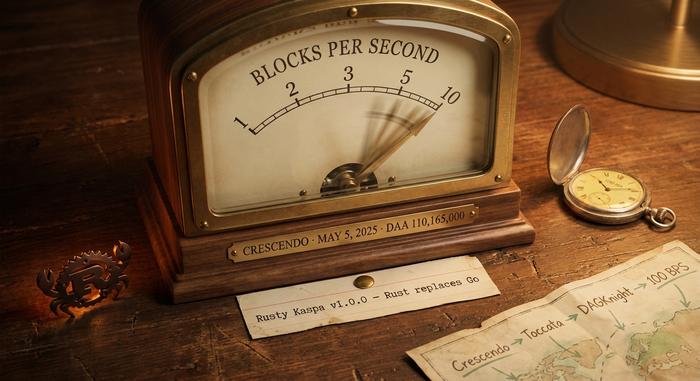
The single biggest engineering event in Kaspa's history was the Crescendo hard fork, activated on May 5, 2025 at approximately 15:00 UTC, DAA score 110,165,000. It increased block production from 1 to 10 blocks per second, with block times dropping from one second to 100 milliseconds. Per-second token emission stayed identical — block rewards shrank tenfold, with ten times as many blocks.
Throughput went with it. Sustained transaction rates after Crescendo run around 4,000 TPS, with a recorded peak of 5,584 TPS. For comparison, Bitcoin handles roughly 7 TPS and Ethereum mainnet around 15. Solana, the throughput leader on proof-of-stake, claims north of 50,000 in optimal conditions but in practice clears a few hundred to a few thousand sustained.
Crescendo shipped as Rusty Kaspa v1.0.0, the new Rust-language node implementation that replaced the previous Go codebase. Performance on Rust was the precondition for the BPS jump. Go was hitting CPU and memory limits the Rust rewrite removed. Version 1.1.0 followed on April 8, 2026 with further mempool and database optimizations.
The roadmap from here is staged:
| Milestone | Target | What it brings |
|---|---|---|
| Crescendo | May 2025 (done) | 1 → 10 BPS, Rusty Kaspa v1.0.0 |
| Toccata hard fork | June 2026 | Native L1 tokens, ZK proofs, KIP-17/20/16/21 opcodes |
| DAGKnight upgrade | Q3 2026 | Parameterless consensus, network-condition-adaptive |
| 100 BPS + vProgs | 2027 | Higher throughput, programmable scripts |
Code freeze for Toccata landed April 15, 2026. The activation date is targeted for June 2026 but, as with any large protocol upgrade, the team has signaled that conservative testnet validation will gate the mainnet switch.
KAS Tokenomics: Fair Launch, 28.7B Cap, Monthly Halving
KAS is one of the few proof-of-work assets launched in the post-2017 era with no premine, no founder allocation, and no ICO. DAGLABS, the company that incubated the project, formally renounced ownership six months before the mainnet went live. Initial Polychain Capital backing predated mainnet and bought no KAS.
The total maximum supply is approximately 28.7 billion KAS, fixed. Circulating supply in May 2026 sits around 27.23 billion, putting the network well into the late stages of issuance. Emission follows a two-phase schedule. The pre-deflationary phase ran from launch through May 8, 2022 and emitted KAS at a constant rate to bootstrap the network. The Chromatic phase began that same day and continues today.
The Chromatic schedule is unusual. Rather than halving block rewards every four years like Bitcoin, Kaspa applies a smaller cut every month — block rewards decay by a factor of (1/2) raised to the power of (1/12). Twelve consecutive monthly steps compound into the equivalent of one annual halving. The effect is a smooth, predictable decay rather than the abrupt supply shocks Bitcoin gets every four years. The total emission curve, integrated, looks similar to Bitcoin's, just compressed.
Mining Kaspa: kHeavyHash, ASICs, and Why GPUs Died
Kaspa's proof-of-work algorithm is called kHeavyHash. The function consists of a matrix multiplication sandwiched between Keccak hashes, built on blake3 primitives. The design was intentionally chosen to allow ASIC development that could share components with other heavy-hash chains, rather than to resist ASIC mining indefinitely.
GPU mining was viable through the first year of the network. By the second half of 2022, IceRiver had shipped the first generation of Kaspa-specific ASICs and effectively ended the GPU era. The current 2026 ASIC market is split between IceRiver and Bitmain. IceRiver's KS5L delivers 12 TH/s; Bitmain's Antminer KS7 reaches 40 TH/s at roughly 77 joules per terahash, currently the efficiency leader.
Network hashrate as of May 2026 sits in the 430 to 470 PH/s range. The figure has grown roughly in line with KAS price, which is the typical pattern for proof-of-work networks: when the asset is profitable to mine, hashrate expands until it isn't.
Smart Contracts: Kasplex L2, KRC-20, and the Toccata Hard Fork
Kaspa's layer one does not currently support smart contracts. That is by design. The early focus was throughput and consensus, with programmability deferred until the BlockDAG was stable. Smart contracts arrived in 2025 via a layer-two solution.
Kasplex, an EVM-compatible zkEVM rollup, launched on Kaspa mainnet in August and September 2025. It runs Solidity contracts against a two-way bridge to Kaspa L1, settling proofs back to the base chain. The Kasplex environment hosts two token standards modeled on Ethereum's ERC family: KRC-20 for fungible tokens and KRC-721 for non-fungibles. EVM tooling (MetaMask, Hardhat, Remix) works on Kasplex with minor adjustments.
Native layer-one programmability is coming with the Toccata hard fork. The change bundles four protocol-level proposals: KIP-17 introduces extended script opcodes, KIP-20 adds covenant identifiers, KIP-16 provides ZK opcodes with a verifier precompile subsystem, and KIP-21 covers sequencing commitments. Together, these give Kaspa native support for the building blocks of programmable transactions without needing a separate execution layer.
The DAGKnight upgrade, scheduled for the third quarter of 2026, brings a different kind of advance. The current GHOSTDAG protocol uses fixed parameters that assume certain network latency conditions. DAGKnight makes those parameters adaptive. The consensus protocol responds to actual network latency rather than worst-case assumptions, improving both speed and security in principle.
Kaspa Wallets and Exchanges in 2026
Wallet options for KAS have expanded since the early 2022 days when a command-line wallet was the only option. KasWare and Kasium are the most-used browser-extension and web wallets. Ledger hardware support exists, but only through the third-party KasVault web app. Kaspa is not yet supported in Ledger Live itself. Trezor users remain out of luck as of May 2026; community proposal issue #6770 has been open since 2024.
The exchange picture is similarly split. Centralized listings exist on KuCoin, MEXC, Gate.io, Bitget, HTX (which added KAS on December 24, 2025), Coinbase derivatives, Bybit, and Kraken. Binance, the largest exchange globally, has not listed KAS spot. Binance Futures opened a KAS-USDT contract in October 2025 but the spot market remains absent. Industry reporting indicates Kaspa has refused Binance's standard listing terms (a rumored $1 million fee plus token allocation) because doing so would compromise the fair-launch principle that no team or insider holds an allocation.
Plisio's own payment gateway, which hosts this article, currently supports more than fifteen cryptocurrencies but does not list Kaspa as of May 2026. Readers looking for a fiat-to-KAS path will need to route through one of the listed exchanges, then transfer KAS to a self-custody wallet.
Kaspa Price and KAS Outlook: What the Numbers Actually Mean
As of May 2026, the KAS price sits at approximately $0.0368, with a market cap near $1.008 billion and a CoinGecko rank of seventy. The all-time high of $0.2075 was set on August 1, 2024, putting the current price roughly 82 percent below ATH. Live KAS price quotes, real-time charts, and 24-hour trading volume are available on CoinGecko, CoinMarketCap, and the major centralized exchanges; the Kaspa price chart looks much like any other proof-of-work asset's, with most of the variance correlated to Bitcoin's cycle.
| Metric | Value (May 2026) | Source |
|---|---|---|
| KAS price | ~$0.0368 | CoinGecko |
| Market cap | ~$1.008B (rank #70) | CoinGecko |
| Circulating supply | ~27.23B KAS | CoinGecko |
| Max supply | ~28.7B KAS | Kaspa.org |
| All-time high | $0.2075 (Aug 1, 2024) | CoinGecko |
| Network hashrate | ~430–470 PH/s | minerstat |
| Cumulative transactions | >601M (Feb 2026) | BSC News |
| Active addresses | 545,600 (+150% YoY) | CoinLaw |
What does the $1 question actually look like in numbers? At a fully diluted KAS price of $1, the implied valuation would be roughly 28.7 billion dollars — Polkadot territory in past cycles, roughly where TRON has traded for several years. Not impossible, but the implicit ask is for adoption and liquidity that put Kaspa firmly inside the top fifteen cryptocurrencies. The $10 question is larger by a full order of magnitude: $287 billion in implied valuation, between Ethereum and the rest of the asset class.
This is the part where the original article on this URL listed nominal 2030, 2040, and 2050 price targets up to $10 and beyond. This rewrite refuses to do that. The honest answer is that Kaspa's price will be determined by adoption, exchange access, real on-chain usage, and the macro cycle. None of those is predictable with any precision. What it can show are the network metrics that actually move the asset, and those have been trending up.
Risks: Thin Team, No Foundation, the Binance Question
A few things to weigh that the original article omitted.
The core development team is small. About five names carry most of the weight: Sompolinsky, Sutton, Zak, Turkel, Newman. There is no foundation, no treasury, and no formal funding entity since DAGLABS renounced ownership. Compared to Ethereum's hundreds of paid contributors or Solana's well-funded Foundation, Kaspa's development resourcing is lean. The principled reason is fair-launch fidelity; the practical risk is bus factor.
Sompolinsky now splits his time between Kaspa and a Harvard post-doc focused on transaction ordering and MEV. Interesting research, but it does pull attention. The Binance non-listing is doubly framed in the community: principled refusal of listing fees, and a real constraint on the asset's liquidity access. Both can be true.



