Polymarket: How to Trade Politics, AI, and Sports Data
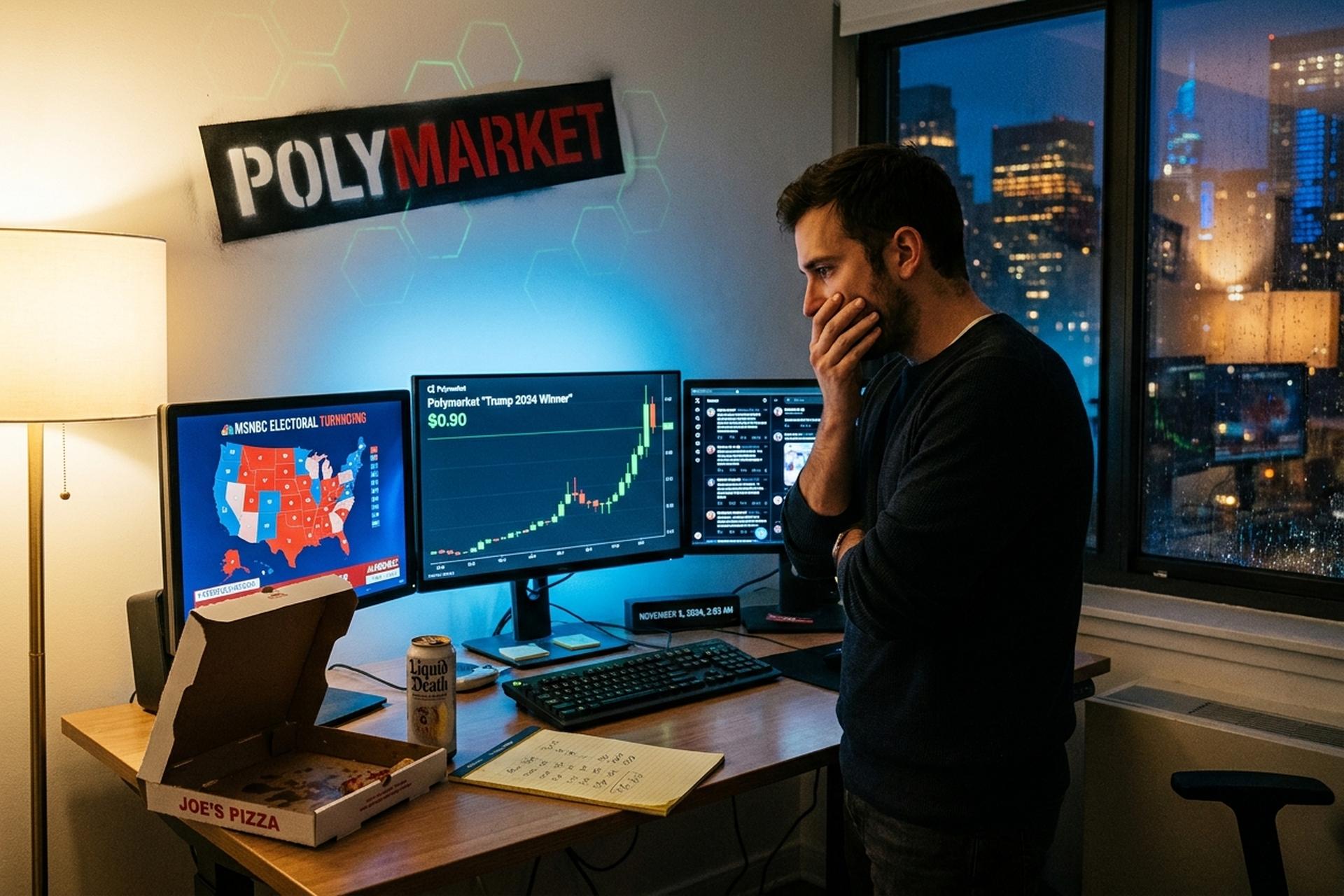
Polymarket went from a 26-year-old's Manhattan apartment to $25.7 billion in monthly trading volume. That took five years. The platform survived a $1.4 million CFTC fine, an FBI raid on its founder's home, two federal investigations, and a yearslong ban from its home market. By March 2026 it had 688,000 monthly active users. It had a CFTC-licensed US affiliate. It had real institutional capital — up to $2 billion from Intercontinental Exchange, the company that owns the New York Stock Exchange.
This article explains what Polymarket is and how its prediction markets work. It covers who resolves the disputes, why the 2024 US election turned the platform into a household name, and what changed in 2025 and 2026. That includes the May 2026 insider-trading stories now drawing fresh regulatory attention. The article runs on Plisio, a crypto payment processor, so the discussion of USDC rails and fiat on-ramps gets a little practical attention along the way.
What Polymarket Is and Why People Care
Polymarket is a decentralized prediction market built on Polygon, the Ethereum layer-2 network. It launched in June 2020. The founder, Shayne Coplan, was then a 22-year-old NYU dropout building from a New York City apartment. Users post collateral in USDC. They trade binary YES/NO shares on whether a defined real-world event will occur. The event can be anything: a political election, a sports outcome, the weather, a conflict timeline, a central-bank decision. Anything that can be resolved against a verifiable source.
Polymarket calls itself the "World's Largest Prediction Market," and as of 2026 the numbers support the slogan. The platform that mattered politically in 2024, when polls were calling a Harris-Trump dead heat and Polymarket's price was already at 60 cents on Trump, is now also the venue where Super Bowl LX did $701 million in a single event.
How Polymarket Works: USDC, Polygon, and Outcome Shares
Sign-up takes a minute. The platform creates an Ethereum wallet linked to the user's email, with the user holding the private keys. Funds are deposited as USDC on the Polygon chain. New users can buy USDC through MoonPay directly inside the Polymarket interface, or through external on-ramps (Plisio among them) that convert fiat to USDC and forward it to a self-custody wallet.
The trading model is binary outcome shares. A given market resolves to either YES or NO. YES shares and NO shares each trade between $0.01 and $1.00. The two prices sum to exactly one dollar. If "Will the Fed cut rates in March?" trades at 61 cents on YES, the implied odds are 61 percent. That is the probability the market is pricing. The corresponding NO trades at 39 cents. When the market resolves, the winning side pays out at $1 per share. The losing side gets nothing.
The pricing implementation has evolved. The original 2020 version used a Logarithmic Market Scoring Rule (LMSR) AMM. That was the classic prediction-market design Robin Hanson published in 2003. By 2026 Polymarket has migrated to an off-chain CLOB-style order book. The book matches buyers and sellers directly, with smart contracts handling settlement. The shift was driven by capital efficiency: an order book lets liquidity providers hold less collateral per dollar of market depth than an LMSR curve does. LMSR is now mostly historical context.
Polymarket charges no fees on trades themselves. Liquidity providers earn a small fraction of each transaction routed through their books, and gas fees on Polygon are typically a fraction of a cent. Fiat-to-USDC on-ramping, whether through MoonPay, Plisio, or any third-party gateway, has its own pricing: typically a percentage spread plus a network fee. Withdrawals back to fiat run on similar economics.
Market types come in three shapes. Binary YES/NO is the default. Categorical markets ("Which party wins the most Senate seats?") split a single dollar across multiple mutually-exclusive outcomes. Scalar markets price a continuous range, like "Closing S&P 500 on December 31, 2026, between X and Y," by issuing tranche shares at intervals. Liquidity concentrates in binary politics and binary sports; the scalar markets matter mostly for institutional hedgers.
The UMA Oracle: How Polymarket Resolves Real-World Events
When a market closes, someone has to declare the outcome. Polymarket delegates that to UMA's optimistic oracle, a dispute-resolution system that has handled resolutions on the platform since 2021.
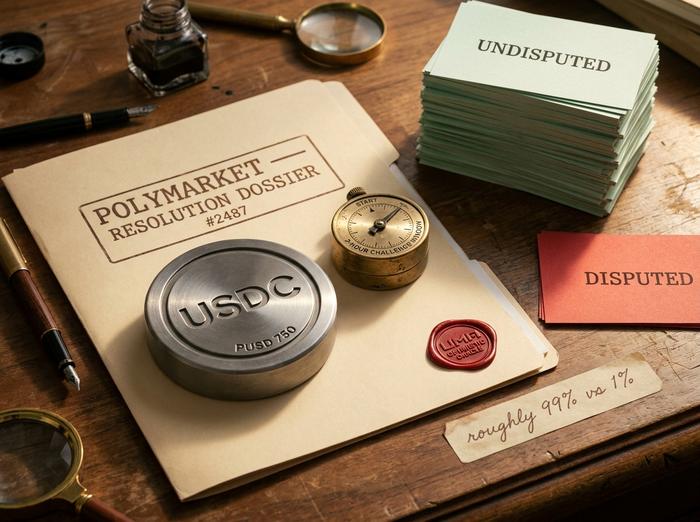
The mechanic is straightforward. Anyone with a wallet can be a resolver. The resolver posts a $750 USDC bond and asserts the market's outcome — for example, "Yes, the Fed cut rates." A two-hour challenge window opens. If no one disputes, the assertion finalizes. The resolver gets the bond back. The market settles. If a counterparty disputes, also by posting a bond, the question escalates to UMA's Data Verification Mechanism. UMA token holders vote on the answer over a window of 48 to 96 hours. The losing side forfeits its bond.
Roughly 99 percent of assertions on Polymarket close without dispute — a striking number given how contested some of these markets are. The exceptions tend to be politically loaded: the 2024 Trump-Kamala debate "winner" market, contested Israel-Gaza ceasefire timing markets in late 2024, and a handful of crypto-price markets where the cutoff candle was ambiguous. When disputes do escalate, the UMA DVM has generally landed on the consensus reading of the source the market cited.
The older 2022 Plisio article referenced a "Market Integrity Committee" or MIC for resolution. That terminology is outdated. UMA's oracle is the current resolution layer, and the bond is $750 USDC, not the higher figures some older guides still quote.
The 2024 Election That Made Polymarket Famous
The 2024 US Presidential Election Winner market is the largest prediction market in the platform's history. Cumulative volume reached roughly $3.6 billion across the cycle. About $1.5 billion was staked on Donald Trump. About $1 billion went on Kamala Harris. In October 2024, Polymarket processed $2.5 billion in monthly trading volume, a number larger than every prior year combined.
Two predictions in particular put the platform on the map. Three weeks before Joe Biden's withdrawal from the race, the Polymarket "Will Biden withdraw?" market traded at 70 percent YES, long before any mainstream pollster called it. The day before Harris announced Tim Walz as her running mate, the relevant market was at 68 percent for Walz. Polls were at 40.
The cycle also produced a now-famous outlier. A French whale operating under the pseudonym Théo deployed an estimated $28 to $38 million across at least eleven Polymarket accounts. Chainalysis later linked the accounts. His strategy was built around the presidential race and real-time news flow. His positioning drove the Trump-vs-Harris price up to 60 percent for Trump in mid-October. Major outlets accused the platform of being manipulated, and the CFTC was reportedly asked to investigate; no charges followed. When Trump won, Théo's combined positions paid out more than $80 million in profit — possibly the single largest individual win in prediction-market history. He gave one anonymous interview to 60 Minutes and went quiet.
The episode raised an uncomfortable question that the platform has not fully answered: when a few large accounts can move the headline price, does the market price still reflect "wisdom of crowds," or just the conviction of whoever can wire eight figures into USDC? The current concentration data (0.1 percent of accounts capture 67 percent of profits) suggests the second.
From FBI Raid to US Relaunch: Polymarket's Regulatory Arc 2022–2026
The platform's relationship with US regulators has been the most consequential thread in its history. The timeline below covers the moves that mattered.
| Date | Event |
|---|---|
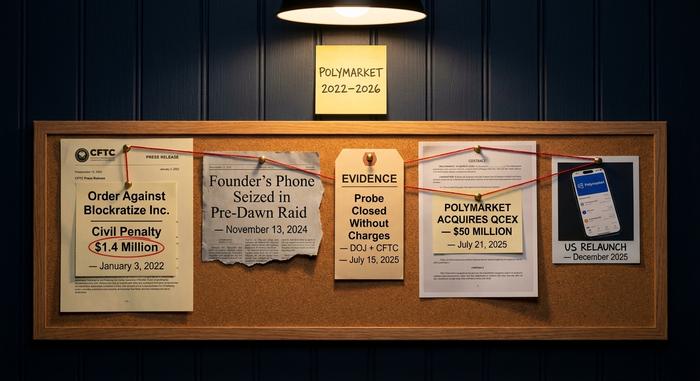
| Jan 3, 2022 | CFTC orders Blockratize Inc. (Polymarket) to pay $1.4M penalty and wind down non-compliant markets |
| 2022 | Polymarket blocks US IP access |
| Nov 13, 2024 | FBI raids Coplan's Manhattan apartment at 6 a.m., seizes phone and electronics |
| Jul 15, 2025 | DOJ and CFTC formally close civil and criminal probes without charges |
| Jul 21, 2025 | Polymarket acquires QCX LLC + QC Clearing LLC ("QCEX") for $112M |
| Sep 3, 2025 | CFTC no-action letter clears QCX to host Polymarket US event contracts |
| Dec 2025 | Polymarket US mobile app launches; live in 48 states (NY and NV restricted) |
The funding numbers tracked the regulatory reversal almost exactly. In May 2024 the company had raised $70 million across two rounds. Founders Fund and Vitalik Buterin took part. By June 2025, Founders Fund led a $200 million round at a $1 billion valuation. In October, Intercontinental Exchange announced an investment of up to $2 billion at an $8 billion valuation. ICE is the parent of the NYSE. By late October, Bloomberg was reporting talks at a $12 to $15 billion target.
What changed wasn't the technology. The protocol of mid-2025 was the same as the one running a year earlier. What changed was Washington's posture under the new administration. The CFTC under acting chair Michael Selig moved from active investigation to active accommodation. The regulatory path that had been closed for three years opened up. Polymarket's $112 million for QCEX was, in retrospect, one of the cheapest licenses in modern fintech history.
Inside the 2026 Insider-Trading Stories
Polymarket's vindication did not last clean. A May 2026 New York Times investigation reported that the platform had "published hundreds of false and misleading posts" promoting itself on social media, and that several recent markets had moved suspiciously before public announcements.
The Justice Department had already filed one indictment by then. A US Army Special Forces soldier was charged in early 2026 with using classified information to win roughly $400,000 on a Polymarket market predicting Venezuelan military intervention before the news became public. Reporting around the same period documented Israeli Air Force officers allegedly placing bets on strike timing inside conflict markets, and one US service member was quoted saying, "the entire air force is betting."
The pattern is clean. When a market resolves on information that some traders see before others do, those traders win. Polymarket's design — pseudonymous accounts, no KYC on the global platform, USDC settlement — makes that hard to police. The regulated US affiliate is a different story. QCX requires registered identity. But the markets that draw the largest insider interest are usually the international ones.
CFTC chair Michael Selig told Wired in May 2026 that the agency is examining what enforcement tools apply to prediction-market insider trading specifically, a legal question the original commodities-trading rules don't cleanly address. The market is now testing whether the post-2025 regulatory truce holds.
Polymarket vs Kalshi and Where Crypto Fits
Two Polymarkets coexist in 2026. The first is the global crypto-native platform. It runs on USDC on Polygon, no KYC, no jurisdiction-specific limits beyond IP filtering. Weekly volume sits at roughly $2.1 billion. The second is Polymarket US, the CFTC-registered product on QCX infrastructure. It uses fiat collateral, requires identity verification, and runs a smaller market list at about $5 million in weekly volume.
The relevant direct competitor in the US is Kalshi, a CFTC-licensed prediction market that has been operating in the country since 2021. Kalshi runs about $2.7 billion in weekly trading volume across all categories, which makes it larger than Polymarket US by orders of magnitude but smaller than Polymarket Global. Kalshi resolves markets through an internal compliance team rather than an external oracle, which is faster and more legible for regulators but less interesting if you care about decentralized infrastructure.
| Venue | Collateral | Regulator | Weekly volume | Custody |
|---|---|---|---|---|
| Polymarket Global | USDC on Polygon | None (self-hosted) | ~$2.1B | Self-custody |
| Polymarket US | Fiat on QCX | CFTC | ~$5M | QCX |
| Kalshi | Fiat | CFTC | ~$2.7B | Internal |
For users coming through Plisio's gateway, the practical implication is straightforward. The crypto-native Polymarket needs USDC and offers more privacy by default; the US affiliate needs a US bank account. Most international traders default to the first, and Plisio's role, like MoonPay's and every other crypto-payment processor's, is making the fiat-to-USDC step painless. The trading itself happens on Polymarket's smart contracts.
POLY Token, Sports, and What's Next
In October 2025, Polymarket CMO Matthew Modabber confirmed on a podcast what the community had been speculating about for months: a POLY governance token is coming, with a retroactive airdrop to historical traders. The snapshot has not yet been taken; the team has signaled mid-2026 as the rough target, contingent on US relaunch stability. Estimates from analytics shops suggest 5 to 10 percent of supply will go to retroactive users.
Sports markets are the other 2026 story. With politics quieter post-2024, sports drove the platform's growth: 3,128 active sports markets as of March 2026, per Laika Labs. Super Bowl LX between the Seattle Seahawks and the New England Patriots in February 2026 became the single largest event market in Polymarket history at $701 million in volume. The 2026 NBA Champion market, open since June 2025, has cleared $383 million. The platform reports roughly one million paying US users with another two million on the waitlist.
The wider prediction-market sector hit $21 billion in cross-platform monthly volume in 2026, according to TRM Labs. What started as an academic curiosity in the 1990s, a thin market for political event derivatives at the University of Iowa, has become a $100 billion-pace industry. Polymarket is its single largest venue.