The Graph (GRT) in 2026 : Subgraphs, Substreams, GRT Price, and AI

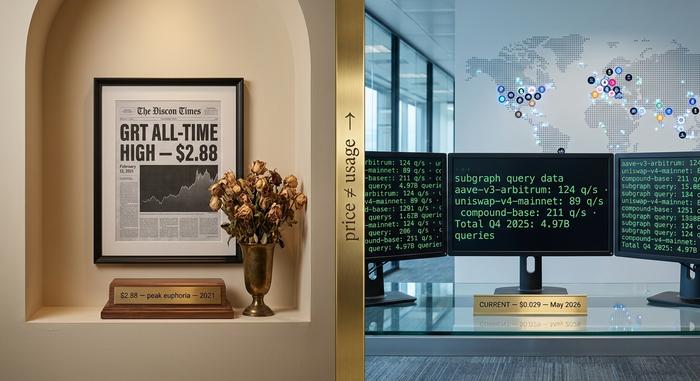
GRT traded at $2.88 on February 12, 2021. In May 2026 it trades around $0.029, a roughly 99 percent drawdown. The network underneath it has gone from a single mainnet supporting Ethereum subgraphs to a multi-chain indexing protocol covering more than 55 chains. It now hosts over 50,000 active subgraphs and processes billions of queries every quarter. The Reddit thread "Is The Graph a dead project?" gets reopened every few months, and the honest answer is: not even close, but the token price has decoupled from the infrastructure usage in ways worth understanding.
This rewrite goes through what The Graph does, the three pivots that defined the 2022–2026 era (Substreams, the Hosted Service sunset, and the Geo / AI agent layer), the GRT token's tokenomics in real numbers, what indexers and delegators actually earn in 2026, and where the price sits relative to fundamentals. The article is on Plisio because The Graph is one of the better explainers for how decentralized infrastructure can keep working at scale even when its market-cap signal stops cooperating.
What The Graph Actually Does and Why
Blockchains store transactions chronologically and emit events, but they are bad at answering questions like "show me every Uniswap v3 pool a wallet has ever provided liquidity to." Doing that natively on Ethereum would require scanning years of block history line by line. The Graph is an indexing protocol that solves this. It builds open APIs called subgraphs, which use the GraphQL query language to retrieve data from blockchains. dApps query these subgraphs via GraphQL instead of running their own indexing infrastructure, and thousands of developers have started building on The Graph for exactly that reason. The Graph Foundation and the broader Graph community maintain the protocol; the Graph team operates out of Edge & Node and the related Graph Council.
The protocol was founded in 2018 by Yaniv Tal, Jannis Pohlmann, and Brandon Ramirez under Edge & Node, and mainnet went live on December 17, 2020, after a $12 million public token sale at $0.03 per GRT in October 2020. By 2026 the indexing protocol is the data backbone for most major DeFi applications. Aave runs 20 subgraphs across 10 networks, recording more than 10 million transactions through The Graph Network. Uniswap v2, v3, and v4 all sit on top of subgraphs. CoinGecko, CoinMarketCap, Messari, and most major dashboard providers pull their on-chain data either directly through The Graph or through a competitor running on similar primitives.
Beyond Subgraphs: Substreams, Firehose, and the Horizon Upgrade
The original 2020 design indexed blockchain data by streaming blocks into a Graph Node, parsing them through TypeScript handlers, and writing the results to Postgres. It worked. It was also slow: complex subgraphs sometimes took weeks to sync from genesis. The bottleneck was that indexing happened sequentially.
In 2021–2022, StreamingFast joined the protocol as a core development team through a grant-based model. They brought two pieces of technology. Firehose is a low-level extraction layer that captures every change at the chain's native data structure, indexed and reorderable. Substreams is a parallel-processing engine built on top of Firehose that lets indexing run across many cores at once, with composable Rust modules instead of TypeScript handlers. A test case called Sparkle cut a complex subgraph's full historical sync from weeks to about six hours.
Substreams is the production indexing path for new subgraphs in 2026, particularly for high-volume protocols where the classical model can't keep up. Firehose is the format the rest of the stack consumes. Both are open-source, used outside The Graph as well, and have become the de facto standard for high-throughput Web3 indexing.
The 2025 Horizon mainnet upgrade extends the protocol beyond subgraphs entirely. Under Horizon, GRT staking secures modular data services: real-time event streams, pre-indexed APIs, analytics endpoints, and AI training datasets. Indexers can offer multiple service types instead of just subgraph hosting, and consumers pay in GRT for whichever flavor they need. The technical effect is significant. The Graph stops being only "an indexing protocol" and becomes a more general data marketplace.
Horizon also adds the technical capability for delegator slashing. Today delegations to misbehaving indexers are not slashed; only the indexer's own self-stake is. Horizon makes future activation possible, though the governance vote to actually enable it has not been taken at the time of writing.
Geo Genesis and the AI Data Layer Pivot
The most ambitious 2025 launch was Geo Genesis, introduced in January 2025 alongside a new on-chain data standard called GRC-20. Geo is a decentralized knowledge graph: a shared, programmable database of facts, relationships, claims, and citations that humans and AI agents can both read and contribute to. GRC-20 is the schema standard for how those facts are encoded.
The reasoning is straightforward. AI agents need structured data to function reliably. Most of that data today comes from centralized providers (Google, OpenAI's training corpora, paid APIs) that are opaque, sometimes wrong, and not aligned with the agent's user. A decentralized knowledge graph indexed by GRT-staked nodes is the same architectural pattern Edge & Node used for blockchain data, applied to general facts. Edge & Node ran a Geo Genesis hackathon from February 3 to March 9, 2025, which seeded the initial set of "knowledge subgraphs" and validated the standard with real contributors.
Whether the AI-agent pivot pays off is an open question. The protocol has the infrastructure. It does not yet have a clear killer agent-facing application. What it does have is positioning: when an LLM in 2027 asks "what is Aave's current TVL on Arbitrum?" the architecturally clean answer is to ask a Graph subgraph rather than a paid API. Edge & Node have telegraphed this thesis in every blog post since early 2025, and the GRC-20 schema is open enough that other AI infrastructure projects are starting to adopt it as a default representation for verifiable structured data on-chain.
GRT Tokenomics: Issuance, Burns, and Net Inflation
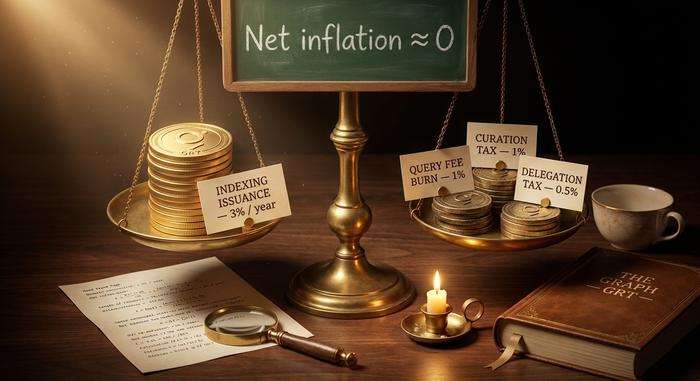
The Graph's token economics are deliberately net-neutral by design. Three things pay GRT to participants and four things burn it; the math is meant to balance over the long run.
| Mechanism | Rate | Direction |
|---|---|---|
| Indexing rewards (issuance) | 3% annually | Mints new GRT |
| Query-fee burn | 1% of all query fees | Burns |
| Curation tax | 1% on signal deposits | Burns |
| Delegation tax | 0.5% on new delegations | Burns |
Genesis supply was 10 billion GRT. There is no hard cap; the 3 percent issuance continues indefinitely. Circulating supply in May 2026 sits around 10.81 billion, suggesting that over the protocol's first five years burns roughly offset issuance — a healthy signal in periods of high query demand and a less healthy one when query volume slows.
Query volume peaked in Q2 2025 at 6.49 billion queries, the all-time quarterly high, per Messari's State of The Graph report for that quarter. Q4 2025 came in at 4.97 billion, down 8.9 percent quarter-on-quarter. New subgraph deployments dropped 15.2 percent in Q3 2025. The decline is real but not catastrophic. The network is still processing several billion queries per quarter, and any drop from peak still puts it in the top tier of decentralized infrastructure usage.
Net inflation in 2026 is roughly neutral. When query fees rise, burns dominate and GRT is mildly deflationary. When usage slows, the 3 percent indexer issuance dominates and GRT inflates. This makes GRT's monetary policy effectively a function of network usage rather than a fixed schedule like Bitcoin's halving.
Indexers, Curators, Delegators: How Roles Pay Off
The protocol has three economic roles, and the GRT yield each role earns depends on what work they do.
Indexers are the node operators. They run a Graph Node, sync subgraphs, and serve queries. Minimum self-stake is 100,000 GRT, which at $0.029 is roughly $2,900. Modest in absolute terms, but with real opportunity cost on staked capital. Indexers accept up to 16 times their self-stake in delegated GRT, meaning a single indexer with 100k GRT self-staked can support roughly 1.6 million GRT in delegations. Indexer rewards split between query fees and protocol issuance; their work is slashable if they serve incorrect data.
Delegators are passive participants. They stake GRT to an indexer they trust without running anything themselves. Expected APY ranges from 9 to 15 percent depending on indexer choice. The unbonding period is 28 days, during which the GRT is frozen and earns nothing. Delegations are currently not slashed when an indexer misbehaves, although Horizon adds the technical capability for future protocol-level activation.
Curators are the most specialized role. They stake GRT on subgraphs they believe deserve indexing attention, signaling demand on a bonding curve. If they curate a successful subgraph early, top positions can earn upwards of 30 percent APY through their portion of query fees. The risk is that curating a subgraph nobody queries means curating dead weight: the bonding curve still works, but query-fee income is zero.
In practice, the median DeFi user picks either delegation or just holding GRT spot. Indexing requires infrastructure; curating requires market judgment.
GRT Price History and 2026 Outlook
GRT's price chart traces the broader 2021–2022 cycle and then a long, ugly drawdown. The all-time high was $2.88, hit on February 12, 2021, eight weeks after mainnet launch. By the end of 2022, the bear market had taken GRT below $0.06. Through 2023, 2024, and into 2025 it traded sideways with occasional flickers, never reclaiming a dollar.
In May 2026 the GRT price today sits at approximately $0.029 on CoinGecko, with a market cap roughly between $257 million and $310 million depending on which tracker is sampled and the exact intraday timing. The price of The Graph in USD has moved in a tight band for most of the past year, with trading volume modest but consistent. Real-time GRT price charts, live The Graph markets data, and historical price history are available on CoinGecko, CoinMarketCap, Coinbase, Kraken, and CryptoRank. Anyone looking to buy The Graph can do so on any of those exchanges, with the GRT to USD pair typically the most liquid; the graph price chart looks like most infrastructure tokens that had a bull-market peak and a hard reset.
The disconnect between price and fundamentals is the whole story. The network handles 5–6 billion queries per quarter. The Hosted Service was retired in June 2024, forcing all traffic onto the paid decentralized network. Major DeFi protocols depend on subgraphs daily. None of this has reflected in the token price, which suggests that GRT's market mostly trades the protocol as a beta on broader DeFi sentiment rather than as a function of query revenue.
Whether that disconnect closes in 2026 or 2027 depends on factors no analyst can call cleanly: whether Horizon's modular data services attract material new fee revenue, whether the AI-agent thesis around Geo and GRC-20 produces a flagship use case, and whether the broader crypto cycle returns to a phase where infrastructure tokens get re-priced.
Competition and the "Is The Graph Dead?" Question
The Graph is not the only Web3 indexing provider in 2026. Goldsky covers 140 or more chains with a real-time focus. Envio's HyperIndex is the fastest indexer in current benchmarks. Subsquid, Chainstack, SubQuery, Allium, Dune, Chainbase, Ormi, and Ponder all compete for parts of the stack. Most of them are centralized and faster; some, like Subsquid, offer mixed centralized/decentralized models.
What The Graph still uniquely offers is decentralization with token-aligned incentives. If your dApp's failure mode includes a centralized indexing provider going offline or pricing you out, a decentralized network indexed by 100-plus economically-aligned operators is the answer. The trade-off is performance — Substreams is fast but a centralized indexer can be faster still — and the trust assumptions a developer wants to make.
The Plisio context here is small but real. Merchants who accept crypto payments and want programmatic on-chain confirmation logic can query a Graph subgraph for their token's transfer events directly, without routing through a paid RPC provider that imposes rate limits. That is one of the under-used everyday utilities of subgraphs.