Quantum Financial System: Conspiracy or Real Tech in 2026?
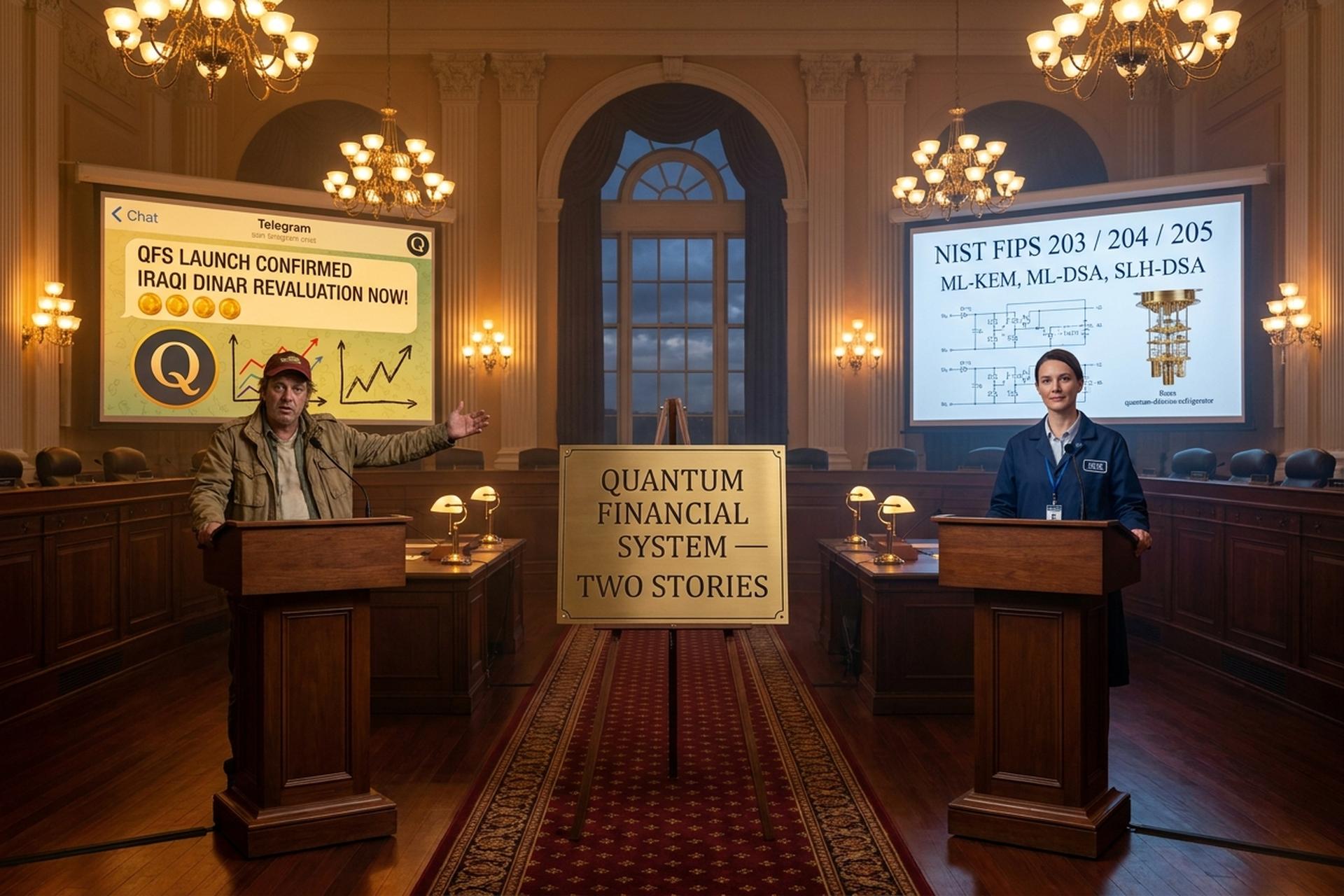
Two very different things share the name Quantum Financial System. The first is a conspiracy theory. It has spread through Telegram channels, YouTube videos, and Discord servers since around 2019. The claim: a secret quantum-powered blockchain is about to replace SWIFT, end the Federal Reserve, and revalue obscure currencies like the Iraqi dinar and Zimbabwe dollar. The second is real quantum finance research. It is happening inside major financial institutions: JPMorgan, HSBC, Goldman Sachs, the Bank for International Settlements, and many national standards bodies. They are working on quantum computing technology and quantum-safe encryption. The two are routinely conflated, and the search traffic that brings most readers to this page sits on top of that conflation. This guide separates them. It names the people behind the conspiracy version, walks through the documented frauds, and then describes the real 2024 to 2026 developments that actually matter: NIST's post-quantum cryptography standards, HSBC's bond-trading pilot with IBM, and the Craig Gidney paper that pulled the RSA-break estimate sharply forward.
What is the Quantum Financial System
The conspiracy QFS claims a secret GESARA-aligned global ledger is running. It is built on quantum computing and blockchain. The pitch promises gold-backed digital dollars, the end of the Federal Reserve, fast settlement that bypasses SWIFT, and a wealth redistribution to holders of certain currencies. None of this has any proof. No central bank or commercial bank has shown such a system exists. No traditional financial system is scheduled to be replaced this way. The term QFS, as people search it, points to a movement and a marketing layer over scams. It is not a real technology. The actual quantum computing work that some of this language echoes is happening in plain view, inside named institutions, and looks nothing like the Telegram story.
The conspiracy: NESARA, GESARA, and how QFS spread
The lineage matters. It shows how the story was built. In 1996 an Atlanta engineer named Harvey Barnard self-published a tax reform plan. He called it the National Economic Stabilization and Recovery Act, or NESARA. The plan was real but never passed. It would have replaced income tax with a national sales tax. Barnard later distanced himself from the conspiracy version of his idea.
Around 2000 a person using the name Shaini Goodwin began to claim that NESARA had in fact been signed into law in secret. Through the 2010s the story spread inside Iraqi dinar revaluation groups. Sterling Currency Group sold dinars and Vietnamese dong to retail buyers. They promised a revaluation event was close. In October 2018 the US Department of Justice secured guilty pleas from Sterling Currency executives. The charges: conspiracy and money laundering.
The QAnon era pushed the story harder. Around 2019 and 2020 the term "Quantum Financial System" began to spread in QAnon-adjacent channels. Promoters like Charlie Ward joined in. Telegram operators like WhipLash347, with over 277,000 subscribers at peak, pumped the narrative. Fake token launches followed. The Stellar Development Foundation flagged some of them. Lead Stories debunked QFS claims in April 2021 and updated the verdict in August 2022. Vice, Logically Facts, New Lines, and Cointelegraph all published their own takedowns. Documented losses sit in the millions of dollars. At least one victim took their own life after losing over $100,000.
If you encounter someone offering a "QFS account," "pre-registration," or asking for crypto to access the QFS, you are looking at a variant of this same conspiracy-funnel. There is no technical reality on the other side of that pitch.
Is the QFS real? Banks and financial institutions
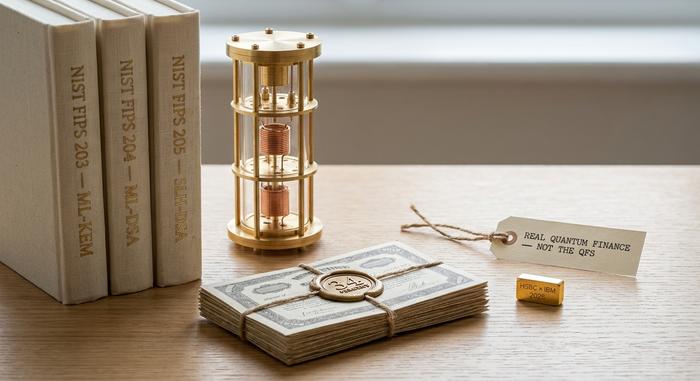
The direct answer to the most common search query, "which banks are using the Quantum Financial System," is none. SWIFT, the Federal Reserve, the European Central Bank, and BIS still run the current financial system. They have all published research on quantum risk. None has deployed a gold-backed quantum ledger. None plans to. JPMorgan, Goldman Sachs, HSBC, BBVA, Wells Fargo, and a few central banks run quantum and post-quantum pilots. We will cover them in the next section. But no live system has been swapped for a "QFS." Anyone who tells you otherwise is either selling you something or has been sold something.
Real quantum computing in finance from 2024 to 2026
The legitimate quantum finance story, leveraging quantum computing research and quantum mechanics principles in concrete financial services, moved faster than most readers realize. The biggest event was on 13 August 2024. That day, NIST (the National Institute of Standards and Technology) published three new post-quantum cryptography standards. They are FIPS 203, 204, and 205. The first is for key exchange. The other two are for digital signatures. Banks, regulators, and certificate authorities are now migrating toward them. Many also run quantum key distribution pilots for the most sensitive financial operations.
Inside the banks, the pilots stack up. JPMorgan worked with Quantinuum on hybrid HHL++ quantum algorithms for portfolio optimization. It also worked with AWS on quantum decomposition. That cut some problem sizes by about 80% in benchmarks. Goldman Sachs teamed with AWS on a Quantum-Inspired Path Method, a kind of quantum Monte Carlo. The work was published in PRX Quantum and applies a speedup from arXiv 1905.02666 to options pricing. HSBC and IBM ran a September 2025 bond-trading trial. It covered more than one million quotes across 5,000 bonds. They reported a 34% lift in fill probability versus the standard baseline. HSBC also worked with Quantinuum on tokenized gold settlement secured by post-quantum cryptography. The work uses quantum machine learning to analyze sensitive financial data. BBVA takes part in the Quantum Software for Finance Forum. Wells Fargo runs joint work with IBM.
Central banks are moving too. BIS Project Leap finished Phases 1 and 2 between 2023 and 2025. The work showed quantum-safe payment systems running across many countries. BIS Papers No. 158 in 2024 set out a roadmap. IMF working paper WP/21/71 covers the same ground from the policy side. Honest scoping: most of this is research and pilot work. It is not yet in production. Full bank cryptography migration runs into the 2030s. None of it will revolutionize financial markets overnight. The real impact is slow rewiring, not a new financial order.
| Institution | Partner | Workload | 2024-2026 milestone |
|---|---|---|---|
| NIST | — | Post-quantum standards | FIPS 203/204/205 published 13 Aug 2024 |
| JPMorgan | Quantinuum, AWS | Portfolio optimization (HHL++) | Hybrid algorithm benchmarks, ~80% problem-size cut |
| HSBC | IBM | Bond-trading liquidity discovery | 34% fill-probability lift across 5,000 bonds (Sept 2025) |
| Goldman Sachs | AWS | Options pricing (Monte Carlo) | QIPM in PRX Quantum, building on arXiv 1905.02666 |
| BIS | Multiple CBs | Quantum-safe payments | Project Leap Phases 1-2 (2023-2025) |
| BBVA | QSFF members | Risk modeling | Active participant in Quantum Software for Finance Forum |
Quantum computing threat to cryptocurrency and Q-day
Why does the post-quantum migration matter? Almost everything online is secured with public-key cryptography. RSA-2048 protects TLS traffic in banks. ECDSA signs Bitcoin and Ethereum transactions. Similar elliptic-curve schemes guard every wallet. A large enough quantum computer running Shor's algorithm can break all of these, if it has enough qubits and good error correction. Until 2025, experts thought you needed about twenty million noisy qubits to do this.
In May 2025 Google's Craig Gidney published arXiv paper 2505.15917 estimating that RSA-2048 could be broken in under a week using fewer than one million noisy qubits — a 95% reduction from his own 2019 estimate. Q-day, the moment a cryptographically relevant quantum computer is operational, is the term of art for when this becomes the world's problem. The Global Risk Institute's 2025 expert survey put the median estimate at 2029 to 2032, with roughly a 34% probability by 2030.
Mosca's theorem captures the strategic problem. Cryptographer Michele Mosca framed it this way. Take the time you need to migrate your systems. Add the time your data needs to stay secret. If that total is longer than the time left until Q-day, you have a problem today. "Harvest now, decrypt later" is the operative attack class: encrypted traffic captured today, decrypted whenever Q-day arrives. For long-lived secrets such as health records, classified diplomacy, and decade-old Bitcoin addresses, that is already today's threat.
Quantum-resistant blockchain projects for the quantum computer era
A small set of blockchain projects was built from scratch for the post-quantum era. They are designed to resist attacks from large quantum computers using many qubits. The Quantum Resistant Ledger (QRL) uses XMSS hash-based signatures, which rely only on the security of cryptographic hash functions and are widely considered safe against quantum attack. Mochimo uses WOTS+ one-time signatures, also hash-based. Cellframe builds on post-quantum lattice signatures and supports plug-in cryptographic modules. Algorand has rolled out incremental post-quantum upgrades to its production chain since 2023, with hash-based fall-back signatures already live for state proofs.
These are not investment recommendations. They are early movers in a real problem space. The same technical urgency that drives NIST and BIS is what makes the underlying engineering interesting; the speculative coins built on top of these chains are a separate question entirely.

How to invest in real quantum technologies, not the QFS
There is no way to invest in the conspiracy version of the QFS, because it does not exist. There are several legitimate avenues for quantum exposure across the financial industry. Public-equity options for quantum computing companies include IBM, Alphabet (parent of Google Quantum AI), Honeywell-spinout Quantinuum's joint-venture parents, IonQ, Rigetti Computing, and D-Wave Quantum, all leveraging quantum hardware progress. Hardware-adjacent picks include the chipmakers and cryogenics suppliers that support quantum stacks. On the crypto side, ISO 20022-aligned tokens that have published post-quantum migration plans are a small but identifiable subset. Banks publishing concrete PQC migration timelines are also a sensible diligence criterion for long-horizon financial exposure.
QFS scams and red flags to avoid in 2026
The pattern is consistent across every documented variant. Red flags include any offer of a "quantum account," any "QFS pre-registration" portal, any token tied to a revaluation of Iraqi dinar, Zimbabwe dollar, or Vietnamese dong, any pitch citing Charlie Ward, Whiplash347, or Quantum Stellar Initiative branding, and any flow that asks you to send crypto first to receive QFS access later. The Sterling Currency prosecution is the documented precedent for the dinar-RV variant; the FBI and the Securities and Exchange Commission have both warned on related schemes.
| Red flag | What it signals |
|---|---|
| "Quantum account" / "QFS account" | No such product exists at any real bank |
| "QFS pre-registration" portal | Phishing entry for credential theft or upfront-fee fraud |
| Iraqi dinar / Zimbabwe dollar RV pitch | Variant of the FBI-prosecuted Sterling Currency scheme |
| Telegram channel branded Charlie Ward / WhipLash347 | Known QFS conspiracy promoters |
| Send crypto first to "activate" QFS | Classic advance-fee fraud structure |
| Promised gold-backed digital dollar via QFS | Has no policy basis at the Fed, ECB, BIS, or any G20 central bank |
If someone tells you a bank insider can get you onto the QFS in advance, the only correct response is to walk away. The legitimate quantum-finance pipeline is public, regulated, and slow — none of those traits match the QFS pitch.
The takeaway on the QFS in 2026
Two narratives share the QFS label and almost nothing else. The conspiracy is provably false and has cost real people real money for over two decades. The real quantum-finance work is genuinely consequential but still mostly pre-production, and its first concrete deliverables, the NIST post-quantum standards, HSBC's bond-trading pilot, and the BIS Project Leap reports, are not what most QFS-curious readers came here looking for. The practical reader takeaway is to ignore the Telegram pumps, watch the NIST migration timelines if you hold long-dated cryptographic exposure, and treat 2030 as the planning horizon for the real quantum-cryptography transition.