Marketplace Payment Processing: How It Works
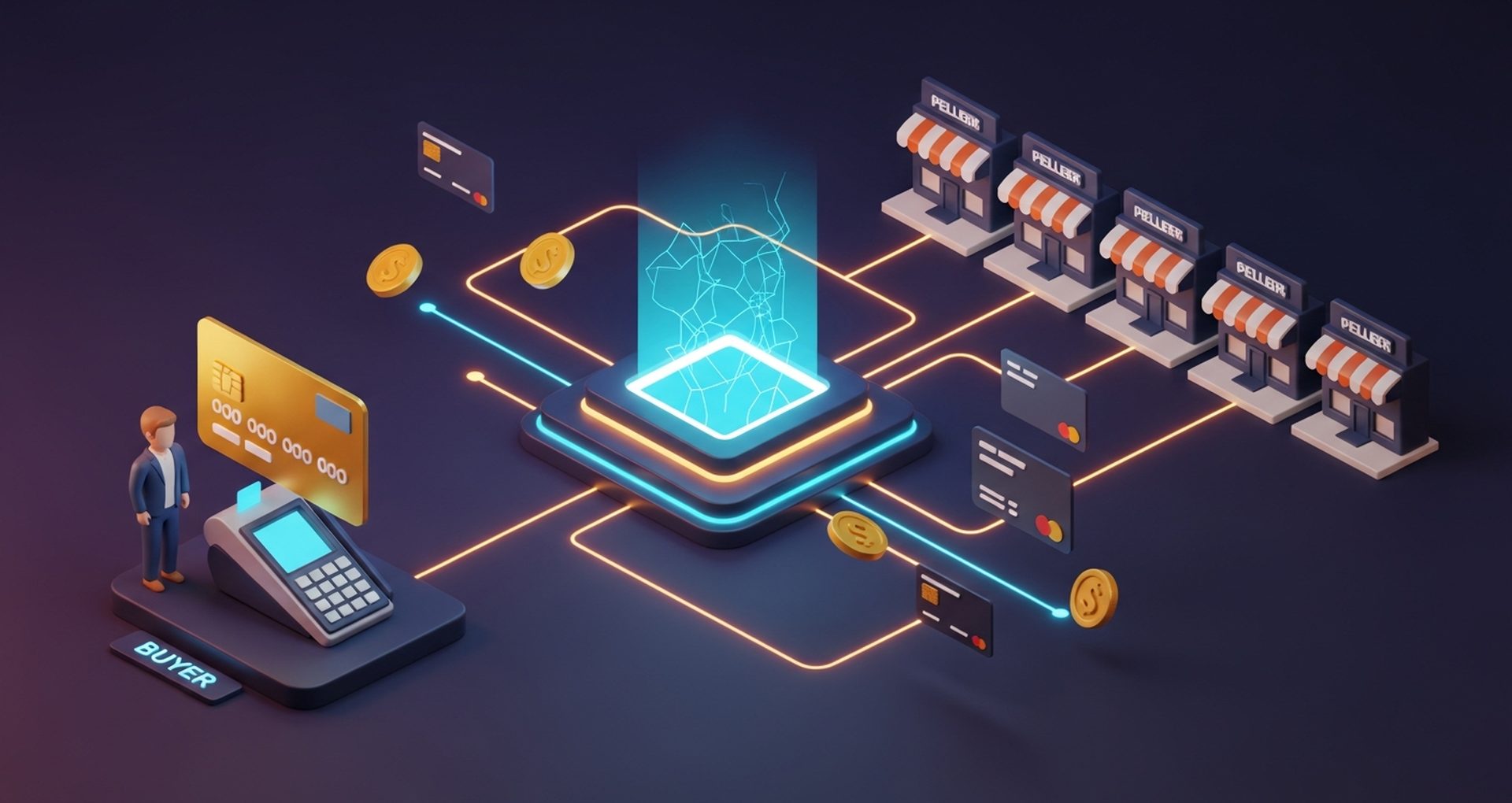
Buying sneakers on Amazon and hiring a freelancer on Upwork look like simple transactions from the outside. Under the hood, they're not. Marketplaces involve multiple parties — the buyer, the seller, and the platform sitting between them — and that changes the entire payment process. Funds have to be collected from one person, held, split, and sent to another, all while satisfying fraud controls and financial regulations that most single-merchant stores never deal with.
So how do marketplaces handle payments? This guide traces the payment process from checkout to payout and covers what payment solutions actually power these flows behind the scenes.
What Are Marketplace Payments?
A marketplace payment is a multi-party transaction. Where a standard e-commerce checkout sends money directly from buyer to merchant, a marketplace sits in the middle: it collects funds from buyers and holds them on behalf of third-party sellers until the conditions for release are met.
Every marketplace payment involves four distinct players:
- Buyer — initiates the transaction, provides payment credentials
- Seller (vendor/merchant) — delivers the product or service
- Marketplace operator — runs the platform, takes a commission
- Payment service provider (PSP) — the infrastructure actually processing the transaction
This is why plugging in a basic Stripe account won't work. Holding and routing funds between multiple parties is a legally distinct activity from processing a single-merchant payment. It requires different infrastructure, different contracts, and in some jurisdictions a different license. Global marketplace e-commerce accounted for 67% of all online retail sales in 2023, and GMV across major platforms is projected to exceed $8.7 trillion — this is not a niche infrastructure problem.
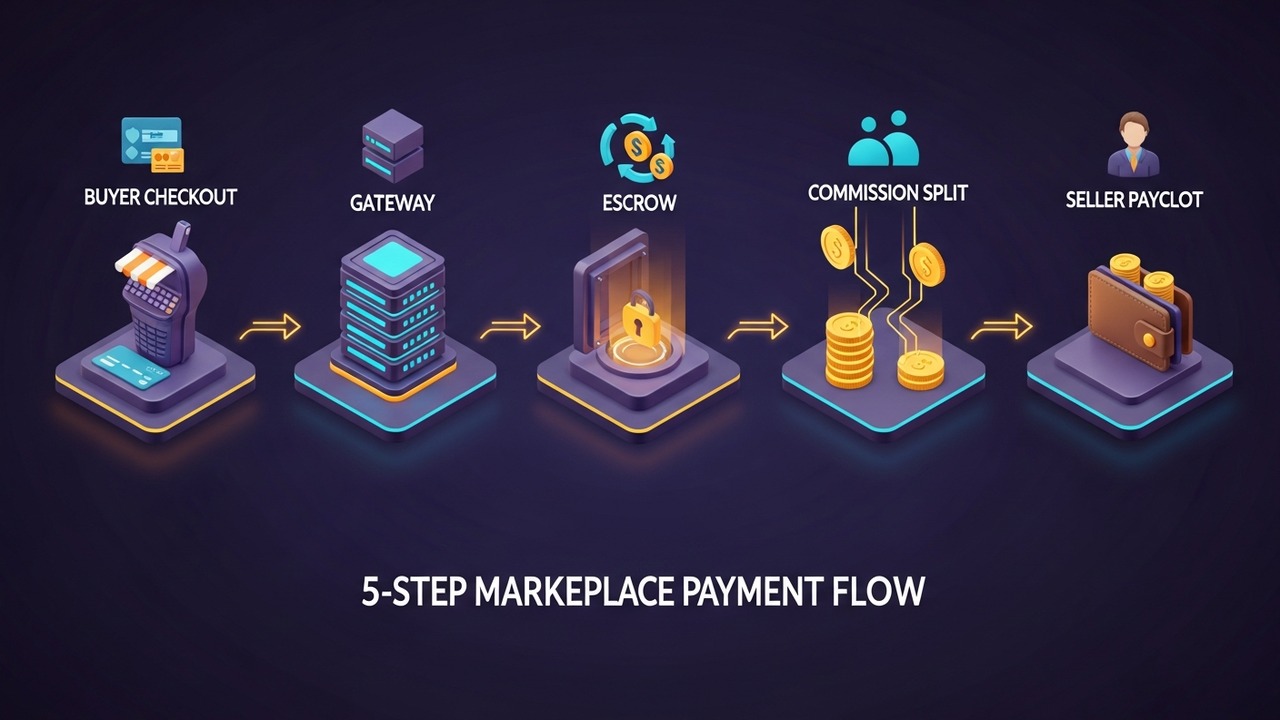
How Marketplace Payments Work Step by Step
Tracing the payment process in a marketplace from start to finish:
- Buyer initiates checkout. The buyer selects a product or service and submits payment details — card number, digital wallet, or crypto address — on the marketplace's checkout page.
- Payment gateway captures the transaction. The marketplace's payment gateway forwards the payment data to a payment processor, which routes it to the buyer's bank for authorization.
- Funds are collected and held. Once authorized, money moves to an intermediary account controlled by the marketplace, not the seller. That holding account can be an escrow arrangement, a pooled platform account, or a dedicated sub-merchant wallet.
- Marketplace deducts its commission. The platform calculates its fee and ring-fences that amount from the collected total.
- Net amount is paid out to the seller. The remaining balance transfers to the seller by bank transfer, digital wallet, or crypto, on whatever payout schedule the platform runs.
Behind each step are standard financial operations: authorization (confirming funds are available), capture (locking the amount), and settlement (the actual movement of money between banks). For card transactions, settlement typically takes one to three business days.
Payment Methods for Online Marketplaces
The payment methods a marketplace supports shape conversion rates, seller satisfaction, and which markets it can realistically enter. Buyers abandon checkouts when their preferred method isn't there, especially on mobile.
The realistic options for any online marketplace:
- Credit and debit cards (Visa, Mastercard, Amex) — highest conversion, works everywhere
- Digital wallets (PayPal, Apple Pay, Google Pay) — faster checkout, strong trust for repeat purchases
- Bank transfers / ACH — preferred in B2B contexts, lower fees at high transaction values
- Buy Now Pay Later (Klarna, Afterpay) — growing in consumer marketplaces, drives up average order values
- Cryptocurrency — no chargebacks, borderless settlement, gaining ground in cross-border and digital goods
- Local payment methods — iDEAL in the Netherlands, Boleto in Brazil, UPI in India; essential for regional expansion
A buyer in Germany may default to SOFORT. One in Southeast Asia probably expects GrabPay. Skipping local payment methods when expanding internationally is a common mistake, and it shows up in conversion: supporting preferred local methods can lift it 20–30% in target markets.
| Payment Method | Best For | Key Advantage |
|---|---|---|
| Credit / Debit Card | All markets, consumer goods | Universal reach, instant auth |
| PayPal | B2C, digital goods | Buyer protection, fast checkout |
| Apple Pay / Google Pay | Mobile-first marketplaces | One-tap checkout, strong CVR |
| Bank Transfer / ACH | B2B, high-value orders | Low fees, no chargeback risk |
| BNPL | Consumer goods, fashion | Higher AOV, flexible for buyers |
| Cryptocurrency | Cross-border, digital goods | No FX fees, no chargebacks |
| Local payment methods | Region-specific expansion | Localization, buyer trust |
Split Payments, Escrow, and Marketplace Payouts
What separates marketplace payment processing from a standard checkout is what happens after the buyer pays. Three mechanisms do the work.
Split payments divide a single buyer transaction automatically. Say a buyer pays $100 on a marketplace charging a 15% commission: the payment solution routes $85 to the seller and $15 to the platform in one operation, no manual reconciliation needed. That automatic routing is the core function a standard gateway doesn't provide.
Escrow holds funds until a condition is satisfied — delivered goods, completed service, confirmed receipt. Upwork holds milestone payments until freelancers mark work complete. Airbnb holds booking funds until check-in. Neither platform invented this; they rely on their PSP's regulated escrow infrastructure, because operating an independent escrow service requires a state license in most jurisdictions.
Payout schedules decide when sellers actually see their money:
- Instant payouts — transferred right after capture, usually with a fee attached
- Rolling daily/weekly payouts — the most common model for consumer marketplaces
- Monthly payouts — standard on service platforms with longer delivery timelines
- Rolling reserves — 5–10% of transaction volume held for 90–180 days in high-chargeback verticals like electronics or travel
Sellers choose platforms partly based on payout speed. Fast, reliable marketplace payouts affect their cash flow directly; that's not something operators can treat as an afterthought.
What Is a Marketplace Payment Gateway?
Most people think of a payment gateway as a simple pipe: card data goes in one end, authorization comes out the other. For a single-merchant store, that's basically accurate. For a marketplace, it breaks down fast.
A marketplace collects funds on behalf of dozens, hundreds, or thousands of different sellers. Legally, that makes it a money transmitter in most jurisdictions — a classification that carries licensing requirements, AML obligations, and compliance overhead that a standard payment gateway contract explicitly prohibits. Run a marketplace on a standard merchant account and you'll eventually lose the account. Some operators learn this the hard way.
Marketplace-specific payment gateways are built around this reality. What they provide that standard options can't:
- Sub-merchant accounts — each seller gets a dedicated account within the platform's master structure
- Split routing — commission logic is baked into the payment orchestration layer, not patched in after the fact
- Seller onboarding and KYC — identity verification sits inside the sign-up flow, not as a separate manual step
- Compliance management — PCI DSS, PSD2, and AML requirements handled at the infrastructure level
Stripe Connect, Adyen for Platforms, PayPal for Marketplaces, and MANGOPAY are the names that come up most often in this space. They're not interchangeable: each has different geographic strengths, pricing models, and tradeoffs around how much compliance the marketplace has to manage itself versus what the provider absorbs.
Compliance and Fraud in Marketplace Payments
Compliance in marketplace payment processing isn't background paperwork. It determines whether payment service providers will work with you at all.
KYC/KYB (Know Your Customer / Know Your Business): Marketplaces have to verify seller identities before paying out. AML rules require it in most jurisdictions. Most PSPs automate this through onboarding flows.
PCI DSS: The Payment Card Industry Data Security Standard sets the rules for handling card data. Marketplaces that accept payments by card must be compliant — or use a PSP that handles it on their behalf, which is how most operate in practice.
PSD2 and Strong Customer Authentication: The EU's PSD2 regulation mandates two-factor authentication on online transactions above €30. Non-compliant checkouts get declined by issuing banks. Any marketplace operating in Europe needs a payment solution that enforces SCA, no exceptions.
On the fraud side, marketplaces face threats that don't exist in single-merchant e-commerce:
- Friendly fraud — buyers claim non-receipt to force chargebacks on legitimate transactions
- Fake seller accounts — fraudsters list products, collect payment, disappear
- Account takeover — stolen credentials redirected to change payout destination
- Card testing — automated scripts running stolen card data through low-friction checkouts
Standard defenses include 3D Secure (3DS2) for card authentication, velocity checks on unusual transaction patterns, and risk scoring integrated at the payment processor level. Chargeback liability in a marketplace is genuinely complicated — whether the platform or seller bears responsibility depends on the dispute reason and how the merchant agreement is structured.
Crypto Payments in Online Marketplace Models
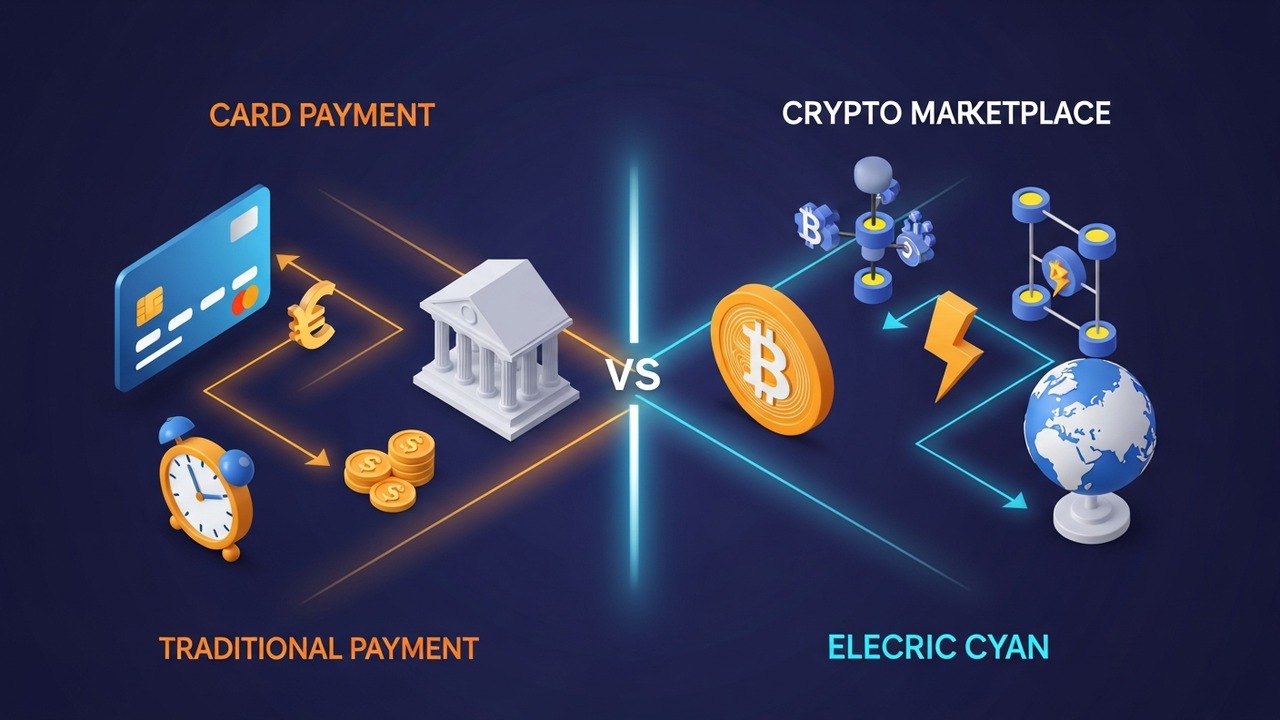
Card networks were built for a world where buyer and seller are in the same country and the same currency. A lot of marketplaces don't look like that anymore. For cross-border platforms dealing with international payment flows, crypto closes gaps that traditional rails handle poorly — or not at all.
Consider what actually happens when a marketplace accepts payments by card for a transaction between a buyer in the US and a seller in Nigeria. The buyer pays in USD, the platform converts, international wire fees eat another 3–5% before the seller sees anything, and settlement takes days. Crypto sidesteps most of that.
The practical advantages for online marketplace operators:
- No chargebacks — transactions are irreversible, which removes the main fraud vector in digital goods
- No FX friction on cross-border orders — a buyer in Singapore and seller in Brazil transact in USDT; neither side pays conversion costs
- Lower fees — crypto payment processors typically charge 0.5–1%, versus 2.5–3.5% for cards
- Stablecoin settlement — USDT and USDC let platforms move funds without worrying about price swings
- Faster international payouts — cross-border crypto transfers clear in minutes, not 3–5 business days
Plisio is a crypto payment gateway built specifically for online marketplaces and platforms. It supports Bitcoin, Ethereum, USDT, USDC, and 20+ other assets, integrates via a clean API, and eliminates chargeback exposure entirely. For teams that want to accept payments in crypto without building custody and compliance infrastructure from scratch, it's the practical path.
How to Choose the Right Payment Solution
No single payment solution fits every marketplace. The right choice depends on geography, product type, seller structure, and how much regulatory complexity the team can absorb. That said, the evaluation criteria are fairly consistent.
What to look at:
- Geographic coverage — does the provider support payments in the countries and currencies you need?
- Split payment capability — built-in, or does it require custom engineering?
- Seller onboarding — how fast and clean is KYC for new sellers?
- Fee structure — flat rate vs. interchange-plus; payout fees; FX costs
- Compliance tools — does the PSP handle PCI DSS, PSD2, and AML, or do you own that?
- Crypto support — can buyers pay in crypto, can sellers receive it?
- Developer API quality — integration time matters, especially at launch
- Dispute management — does the platform give you tools to contest chargebacks?
| Provider | Split Payments | Crypto Support | Best For |
|---|---|---|---|
| Stripe Connect | Yes (built-in) | Limited | Tech-forward marketplaces |
| Adyen for Platforms | Yes | No | Enterprise / global scale |
| MANGOPAY | Yes | No | EU-focused platforms |
| PayPal for Marketplaces | Yes | Limited | Consumer B2C marketplaces |
| Plisio | Via API | Yes (20+ assets) | Crypto-accepting platforms |
Building payment infrastructure in-house gives maximum control but means obtaining a money transmitter license, substantial engineering investment, and permanent compliance overhead. Most marketplace operators use a PSP — then layer in specialized providers for specific payment methods like crypto.
Conclusion
How do marketplaces handle payments? Not the way a single-merchant store does. The moment a platform has multiple sellers, the payment process stops being simple: funds need to be collected from buyers, held in compliance with financial regulation, split on the right schedule, and paid out to sellers who may be in different countries with different banking setups.
None of that works with a standard payment gateway. It requires purpose-built infrastructure — split routing, escrow, KYC, payout management — and a clear decision about which payment methods your buyers and sellers actually need. Get that infrastructure wrong and you're either losing transactions or violating financial law.
The question of whether to accept payments in crypto is worth thinking about early, not as an afterthought. For any marketplace with international sellers or buyers, it changes the economics of cross-border transactions meaningfully. That's not a pitch — it's a structural reality that most payment infrastructure guides skip over.