
LimeWire (LMWR)
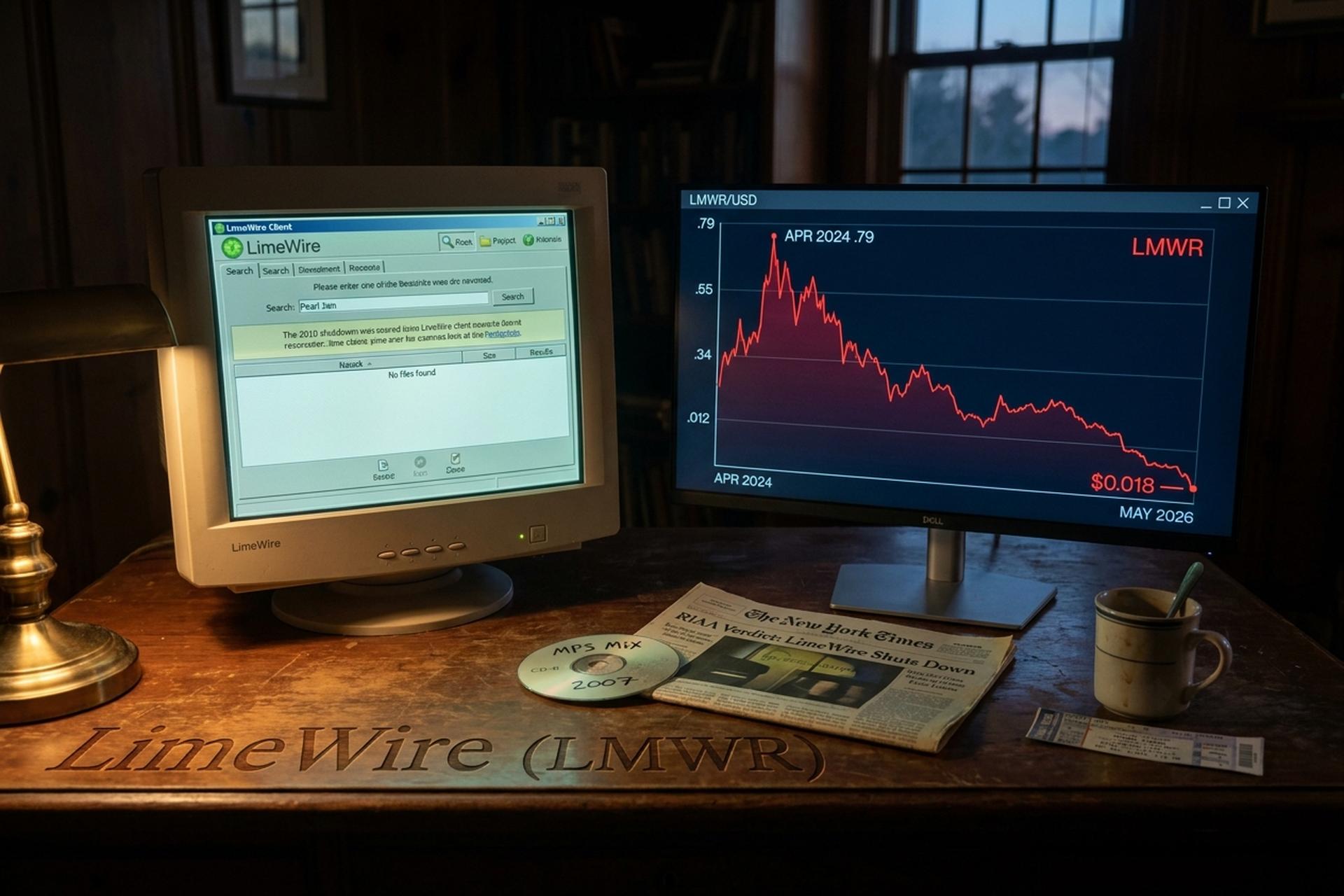
For anyone old enough to remember a beige PC humming through the night, the name LimeWire still triggers a specific kind of nostalgia: green ant logo, blue progress bars, a Pearl Jam track that turned out to be a virus. The brand was synonymous with peer-to-peer file sharing in the 2000s, sat dormant for over a decade after a record-industry lawsuit, and then came back in 2022 as something different. LMWR, the ERC-20 token tied to the new platform, trades near all-time lows in May 2026 at roughly $0.018, with a market capitalisation near $6.7 million according to CoinGecko. That is about 99 percent below its 2024 peak, and the project has now pivoted into its third platform identity in three years.
The arc is worth walking through carefully because the brand recognition keeps the LimeWire story alive longer than the price chart says it deserves to be. What surprises me about the LimeWire revival is how much of the old brand pull has actually transferred to a different audience — the people who recognise the green ant logo are not, on the whole, the people who pay for AI image credits in 2026, and the token is the gap between them. This profile covers what the original LimeWire was, who bought it, how the token works, where it trades, what 2025 did to it, and the team's current bet on decentralized storage.
LimeWire's P2P file-sharing era and the $105 million RIAA settlement
Mark Gorton built the original LimeWire in 2000, in Java, on top of Gnutella, out of a small New York shop called Lime Group LLC. By 2005 it was on millions of desktops. By 2007 it was on tens of millions. People used it because it worked, and because the music industry's licensing model in 2003 effectively offered them a choice between Tower Records prices and an app that asked for nothing. The choice was not difficult.
There were no central servers to seize. LimeWire was a directory — a way for users to find each other and trade files directly. That design is the reason it stuck around for eight years, and also the reason it eventually lost.
In 2006 the RIAA sued. The case ran four years in the Southern District of New York under the caption Arista Records LLC v. Lime Group LLC. Judge Kimba Wood ruled against LimeWire in May 2010, finding the platform had induced mass copyright infringement. By October the injunction was permanent. The client stopped working overnight on every machine that had it installed; an entire generation watched the search bar return a blank list for the first time.
The damages phase dragged into 2011. The RIAA had filed for as much as $1.4 billion. Lime Group settled in May 2011 for $105 million, on the eve of jury deliberations. Gorton's company wound down soon after. The trademark and the iconic file-sharing platform name sat unused for the next eleven years.
Two things survived that decade. One was a real cultural memory — the green ant logo is on T-shirts, in nostalgia threads, in references in TV scripts. The other was a brand both recognisable and tarnished. Whoever revived it would have to handle both at once.
The 2022 revival as an NFT marketplace
In 2021 two Austrian brothers picked up the trademark. Paul and Julian Zehetmayr — entrepreneurs, not music people — announced the relaunch in March 2022. CNBC broke the story. The new LimeWire would be a music-focused NFT marketplace, which was almost embarrassingly on-the-nose: the platform once accused of helping artists lose revenue would now help them capture it directly.
Money turned up fast. A $10.4 million private token pre-sale closed in May 2022, with Kraken Ventures leading, alongside Crypto.com Capital, GSR, and Arrington Capital. That same month, a licensing deal with Universal Music Group hit the press wires. That UMG signature was probably the single biggest reason early investors took the project seriously. Whether the brand alone could have carried it is debatable. UMG made it not debatable.
Launch went to Algorand first, then Ethereum once the team realised the EVM was where the liquidity actually was. The LMWR token generation event happened in May 2023 on Bybit's launchpad. Across private and public rounds, total dollars raised landed near $17.5 million per Music Business Worldwide. (ICO Drops shows a larger figure around $35 million; that one appears to include valuation, not cash.)
Then came the September 2023 pivot. LimeWire bought BlueWillow, a generative AI image platform sitting on a Discord community of about 2.5 million people that had already produced over 500 million images. BlueWillow folded into the new LimeWire AI Studio. The NFT marketplace went quiet; the AI-creator narrative got louder. The LMWR token was rewritten in marketing terms as the credit-and-access mechanism for a generative-AI subscription product. For roughly eighteen months, that was the story everyone told.
How the LMWR utility token actually works
LMWR is an ERC-20 utility token — a relatively conventional structure among cryptocurrencies tied to a content platform — deployed on the Ethereum blockchain at contract address 0x628a3b2e302c7e896acc432d2d0dd22b6cb9bc88. Its design is conventional for platform tokens of its era: capped supply, multi-purpose utility, tier-based benefits for holders, and a staking program with variable rewards.
The headline numbers sit in the table below.
| Metric | Value (May 2026) | Source |
|---|---|---|
| Price | ~$0.0181 | CoinGecko |
| Market cap | ~$6.7M (CoinGecko) / ~$8.3M (CMC) | CoinGecko / CoinMarketCap |
| Circulating supply | 368M (CoinGecko) / 457M (CMC) | both — methodology differs |
| Total supply | 633,045,269 LMWR | CoinGecko |
| Max supply | 1,000,000,000 LMWR | LimeWire docs |
| All-time high | $1.79 (Apr 3, 2024, CoinGecko) / $1.92 (May 15, 2023, CMC) | sources differ |
| All-time low | $0.0177 (May 20, 2026) | CoinGecko |
| 24h volume | $0.5M–$1.1M | CoinGecko/CMC |
| Top exchanges | Kraken, MEXC, Bitget, Bitvavo, KuCoin, BitMart | CoinGecko |
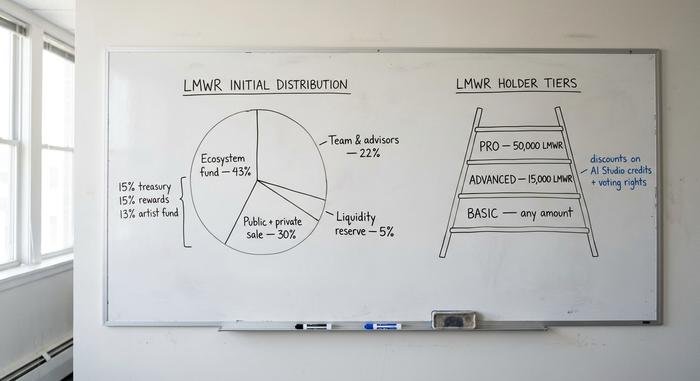
Initial distribution went 43 percent to an ecosystem fund — 15 percent treasury, 15 percent community rewards, 13 percent artist fund — with 30 percent for the combined private and public sale, 22 percent for team and advisors, and a 5 percent liquidity reserve. The team and advisor portions vest. That is why the gap between the 633 million total supply and the 1 billion max supply still matters. Every unlock dilutes existing holders, and there is no buyback program on the other side to offset it.
Inside the platform, LMWR acts as a tiered membership token. Holding any amount unlocks the Basic tier; 15,000 LMWR moves a user to Advanced, with higher reward rates and voting rights on community proposals; 50,000 LMWR unlocks Pro, with the broadest discounts on AI Studio credits and the deepest revenue share for creators publishing through the platform. A separate staking program lets holders lock LMWR for variable periods in exchange for an APY paid in LMWR. The precise current rate for 2026 is not published prominently on the platform any more, and the most recent on-record figures come from a 2024 LimeWire blog post.
Governance is informal rather than fully on-chain. Pro and Advanced tier holders have voting weight on community proposals, but key product decisions — including the platform pivots described below — have come from the operating team rather than token-holder votes.
Where LMWR trades and what the market priced in
Liquidity is the first thing to notice. LMWR's 24-hour trading volume across all exchanges sits between roughly $0.5 million and $1.1 million in May 2026, with most of that activity on Kraken, MEXC, Bitvavo, and Bitget. CoinGecko ranks the token around #1481 by market cap; CoinMarketCap lists it slightly higher around #1069, mostly because of the supply discrepancy. Either way, this is a small-cap with a thin order book and noticeable spread on most venues.
LMWR's price history on any major price chart breaks into three legs. After the May 2023 token generation event the price spiked into the $1.50–$1.92 range, typical TGE behavior on a Bybit launchpad listing. A second peak printed in early April 2024 around $1.79 (CoinGecko's recorded ATH), coinciding with the AI Studio buildout and a broader AI-token rally. From mid-2024 through 2025 the chart bled steadily, hitting an all-time low of $0.0177 on May 20, 2026 — a level that has held within a fraction of a percent at the time of writing.
| Year | Event | LMWR price impact |
|---|---|---|
| 2022 | LimeWire NFT marketplace relaunch; UMG deal; $10.4M pre-sale | n/a — pre-TGE |
| May 2023 | TGE on Bybit, public sale closes ($17.5M total raised) | First peak ~$1.92 |
| Sep 2023 | BlueWillow acquisition; LimeWire AI Studio launches | Price retraces |
| Apr 2024 | AI sector rally; LMWR hits CoinGecko-recorded ATH $1.79 | Second peak |
| 2025 | AI-token narrative collapses across the sector | −88% on the year |
| May 2026 | New ATL $0.0177; team pivots to LimeWire Network/DePIN | Current level |
The AI-token reckoning of 2025
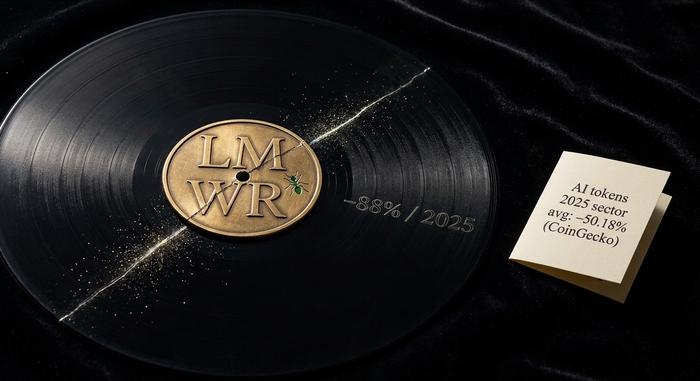
LMWR did not crash alone. CoinGecko's April 2026 narratives report pegged the AI-tokens sector at minus 50.18 percent average return for 2025. Only DePIN (minus 76.74) and Gaming (minus 75.16) did worse. AI tokens came into the year priced for general AI exuberance and left it heavily punished. Most of the sector's market cap sat in tokens whose product traction never caught up with their valuation, and the unwind was as sharp as the rally had been.
LMWR underperformed even that cohort. CoinCodex and Gate data put its 2025 return near minus 88 percent — well below the sector average. Two things explain the gap. First, liquidity. LMWR's order book was thinner than the top AI names, so the selling that hit the sector hit LMWR harder. Second, the AI Studio's market. Image generation went from premium to commodity in 2024–25 as Midjourney, OpenAI's DALL-E line, and Stability's open models compressed unit economics across the board. There was no obvious moat to defend.
For context, the same 2025 saw Real-World Assets return +185.76 percent on average and Layer-1s (excluding Ethereum) return +80.31 percent. Narrative selection mattered more than any individual token's execution. An honest reading of LMWR's chart needs to account for that — even a project shipping well into 2025 would have struggled to fight the sector tide, and LimeWire's execution was uneven enough to amplify the slide rather than dampen it.
The LimeWire Network pivot: DePIN and S3-compatible storage
By late 2025 the team had repositioned the product. LimeWire Network is now described as a decentralized file and object storage network with enterprise-grade performance and full S3 compatibility, claiming to process more than 15 million files per month. In token-economy terms, LMWR shifts from being an AI Studio credit toward being the payment and reward asset on a storage network — which puts the project squarely inside the DePIN sector.
The pivot has internal logic. Storage is a real, billable enterprise market; S3 compatibility lowers the integration cost for developers already on AWS; and a decentralized storage network captures a different value flow than a consumer AI subscription. But the DePIN sector itself was the worst-performing crypto narrative of 2025 at −76.74 percent. LMWR has, intentionally or otherwise, traded one bruised narrative for another. The question is whether enterprise-grade storage usage produces verifiable revenue that closes the gap between the platform's claims and the token's price action.
Risks and signals worth watching on LMWR
Five items belong on any LMWR watchlist. None of them are speculative.
Dilution first. Max supply is 1 billion against a current total of 633 million, and vesting from the 2022–2023 distribution keeps unlocking on a schedule the team controls. Every unlock dilutes you.
Liquidity is the next one. Daily spot volume around $1 million is thin enough that a single large seller can push the price a few percent either way. Watch the depth, not the headline number.
Pivot fatigue is harder to quantify, but real. NFT marketplace, then AI Studio, then decentralized storage. Three product theses in three years. That is a lot of strategic surface area for a small operating team.
Competitive moats look weak. The AI Studio competed with Midjourney and OpenAI. The Network will compete with Filecoin, Arweave, Storj, and AWS itself. Brand recognition does not win enterprise procurement.
Narrative dependence is the last one and probably the biggest. LMWR's chart has tracked sector beta, not platform metrics. A DePIN recovery would help. Continued sector weakness would hurt regardless of how well the team ships. The honest test of whether fundamentals are starting to matter is simple: do weekly network usage figures (files stored, paying enterprise accounts) and the token price start to correlate over the next several quarters? If yes, the story is changing. If not, sector beta is still the whole game.
Final thoughts on LimeWire's third life
The LimeWire brand has done something rare for a 2000s file-sharing label: survived a $105 million legal judgment, sat dormant for a decade, come back as a crypto-native product, and pivoted twice more before its third birthday. Whether LMWR survives as a meaningful asset depends less on the brand and more on whether the LimeWire Network can produce checkable enterprise revenue at a scale that justifies a circulating market cap that is not vanishingly small. The token currently sits at the all-time low. That makes it a clean test of the third pivot — the next twelve months should give a real answer.



