What Is a Soft Fork? Bitcoin Backward Compatibility Explained

Block 481,824. That is when Bitcoin's first major modern soft fork, SegWit, locked itself into the protocol on August 24, 2017. The number matters because a soft fork is the way a blockchain like Bitcoin upgrades itself without splitting the network. New rules ship. Old software keeps running. The two stay on the same chain.
Ask most people what a soft fork is and you get a one-line answer: a backward-compatible change to a blockchain protocol. Technically right. Not very useful. The real picture is messier and more interesting. A soft fork is the end product of a slow dance: developers proposing rule changes, miners signaling support or quietly refusing, node operators picking which software to run, and users in the background insisting on what counts as Bitcoin. This piece walks through the mechanics in plain English. Then it shows you the canonical examples (SegWit and Taproot) at the block-by-block level. And it ends with the live 2026 debate about what to soft-fork next.
Soft Fork Definition: A Backward-Compatible Blockchain Upgrade
Think of a soft fork as a tightening of the rulebook. Anything legal under the new rules stays legal under the old ones. So old nodes keep accepting new blocks just fine. New nodes will reject the old-style blocks that break the tighter rules, but the rules themselves are stricter, not different. The vibe of the network does not change. The grip on what counts as valid does.
A good example: Bitcoin's BIP 16, the Pay-to-Script-Hash soft fork. It activated on April 1, 2012, at block 173,805. Before BIP 16, a transaction type called P2SH did not exist in Bitcoin's script. After it shipped, upgraded nodes enforced P2SH. Old nodes looked at the same outputs and saw a strange script that anyone could spend, shrugged, and accepted the blocks anyway. They never knew there was a rule to break. The chain stayed unified, because the new rule was a subset of the old one. Quietly, Bitcoin had a new capability.
So this is the trick at the heart of it. Old software accepts a superset that includes everything new software accepts. No chain split. No claim period. No new coin. The blockchain network keeps producing one chain that everyone agrees on, no matter which software version they happen to run. It is a strangely elegant piece of social engineering for what looks like a software change.
That property is also the line that separates a soft fork from anything incompatible with old software. If an upgrade can suddenly make a previously valid block look invalid to the old software, you do not have a soft fork. You have a hard fork. The trade-offs change completely. In blockchain technology terms, the divergence between these two fork types comes down to one practical question: do nodes that do not upgrade still accept the new blocks as valid?
Soft Fork vs Hard Fork: The Real Difference
A hard fork goes the other way. It loosens the rules, or changes them in a way the old software will reject outright. Old nodes look at a new block, find it invalid, and refuse to follow. Everyone upgrades or the network splits. Those are the only two options.
Two cases tend to come up. Ethereum's DAO fork on July 20, 2016, at block 1,920,000, moved about 12 million ETH out of two compromised contracts. Old nodes refused that change, kept running the original chain, and Ethereum Classic was born from the refusal. Bitcoin Cash followed a year later. On August 1, 2017, at block 478,559, Bitcoin Cash raised the block size limit from 1 MB to 8 MB. Old Bitcoin nodes rejected the bigger blocks immediately. From that moment Bitcoin Cash was a separate cryptocurrency on a new blockchain.
A soft fork avoids that whole mess by design. The old nodes are not asked to do anything. They keep validating blocks under their less restrictive rules. When a clear majority of miners enforces the new rules, every block that gets mined is valid under both rule sets at once. One economic chain. One ledger. That asymmetry is the structural reason Bitcoin's culture defaults to soft forks and treats hard forks as the option of last resort.
How a Soft Fork Actually Activates on Bitcoin
Most explainers stop here. They will tell you a soft fork "tightens the rules" and move on. The part nobody seems to want to write up is how that tightening actually gets through. A soft fork is not a switch a developer flips. It is a slow, sometimes ugly, coordination problem. And the coordination got engineered into Bitcoin itself.
The classic activation method is miner signaling. A proposed soft fork becomes a BIP, a Bitcoin Improvement Proposal, and gets assigned a bit in the block header version field. Miners running upgraded software flip that bit. The mining power behind those blocks becomes the signal the rest of the network uses to gauge readiness. Once the percentage of blocks signaling crosses a threshold within a defined window, the fork activates. The model used through 2017 was BIP 9: 95% over a rolling 2016-block window. BIP 8 came later. It added a hard deadline so a stalled proposal could not drift forever.
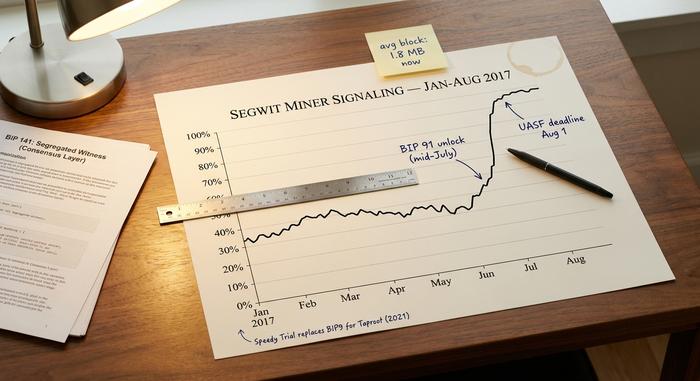
That model worked until it did not. SegWit got stuck in early 2017 at 30 to 45 percent miner support, for months. Big miners had reasons not to signal, none of them flattering. The community had to invent a workaround. BIP 91 dropped the effective threshold and shipped quickly. At the same time, a parallel movement, the user-activated soft fork, specifically BIP 148, set August 1, 2017 as a deadline. After that day, BIP 148 nodes would start rejecting any block that did not signal SegWit. The combination of BIP 91 from one side and UASF political pressure from the other resolved the deadlock. Most people had never seen anything like it. Many of us are still arguing about whose threat actually broke the logjam.
For Taproot, the community tried something cleaner: Speedy Trial. A 90% signaling threshold over a 90-day window. Hit the threshold and the fork activates. Miss it and the proposal expires cleanly, free to be tried again. Taproot crossed the threshold without drama and activated on November 14, 2021, at block 709,632.
Soft fork activation models
| Method | How it triggers | Example | Outcome |
|---|---|---|---|
| BIP 9 | 95% miner signal over rolling 2016-block window | SegWit (initially stuck) | Worked for early forks; deadlocked on SegWit |
| BIP 91 | Lowered threshold to unstick signaling | SegWit in August 2017 | Resolved the SegWit deadlock |
| BIP 148 (UASF) | Nodes set a deadline; reject non-signaling blocks | SegWit August 1, 2017 | Political pressure; immediately superseded by BIP 91 |
| BIP 8 / Speedy Trial | 90% signal within a fixed window or expire | Taproot 2021 | Activated cleanly, no drama |
Bitcoin Soft Forks: SegWit and Taproot Case Studies
SegWit, short for Segregated Witness, is the most cited soft fork in Bitcoin history. It found a way to pull transaction signatures, the "witness data," out of the main transaction body and store them separately. Old nodes saw the new outputs as anyone-can-spend scripts and accepted blocks containing them. New nodes enforced the witness rules properly. The trick was that a soft change to the underlying transaction structure ended up producing an effective capacity gain. Bitcoin's 1 MB block size hard limit got replaced by a 4 million weight unit limit. In practice, a typical block now carries around 1.8 MB of data. The theoretical maximum sits near 2.4 MB.
SegWit activated at block 481,824 on August 24, 2017, at 01:57:37 UTC. The eight months leading up to that block are part of Bitcoin's governance lore now. Miner support had been stuck for most of 2017. The eventual unlock came through BIP 91, the UASF threat, and the so-called SegWit2x agreement. I keep coming back to that period because it is the one case study every subsequent activation looked at.
Taproot is the second-most-cited soft fork, and probably the cleanest activation Bitcoin has had since SegWit. It activated four years after SegWit, on November 14, 2021, at block 709,632. Crossing the 90 percent Speedy Trial threshold turned out to be undramatic. Taproot itself brought in three things: Schnorr signatures, MAST trees, and a unified output type for single-signature, multi-signature, and script-path spends. Those changes also laid the groundwork for solutions like the Lightning Network to get more efficient over time.
The follow-on story for Taproot is worth telling. Adoption climbed steadily through 2023. Then it peaked at roughly 42 percent of all Bitcoin transactions in early 2024, riding the Ordinals inscription boom. By mid-2025 it had dropped back to about 20 percent. Inscriptions cooled off. A side debate opened up about whether Taproot's signature scheme is exposed to future quantum-computing attacks. None of that undid the activation. But the usage curve reminds you that a successful soft fork on the protocol side does not automatically translate into wallet or user adoption.
Bitcoin's soft fork lineage
| BIP / Name | Activated | Block | Threshold |
|---|---|---|---|
| BIP 16 (P2SH) | April 1, 2012 | 173,805 | 55% |
| BIP 34 | March 24, 2013 | 227,835 | 95% |
| BIP 66 | July 4, 2015 | 363,731 | 95% |
| BIP 65 (CLTV) | December 14, 2015 | 388,380 | 95% |
| BIP 141 (SegWit) | August 24, 2017 | 481,824 | 95% (after BIP 91) |
| BIPs 340/341/342 (Taproot) | November 14, 2021 | 709,632 | 90% Speedy Trial |
The 2025-2026 Soft Fork Debate: OP_CTV and OP_CAT
Bitcoin's first serious soft fork conversation since Taproot is happening right now. The argument is mostly about how expressive Bitcoin's script should be. Two proposals lead the debate. Neither one is winning yet.
OP_CHECKTEMPLATEVERIFY, formalized as BIP 119, would add a script opcode that lets a transaction commit to a specific future spending pattern. OP_CAT, formalized as BIP 347 after finally receiving a BIP number in April 2024, would re-enable concatenation of script elements. That was something Satoshi Nakamoto removed back in 2010 over denial-of-service concerns. Both opcodes are gateway primitives for what Bitcoin developers call covenants. Covenants are scripts that restrict where coins can be sent next. They unlock vaults, congestion-control batching, and improvements to network throughput on layers built above the Bitcoin blockchain.
Through 2026, OP_CTV's activation parameters are formally on the table for the first time since 2022. The proposed threshold is 90 percent miner signaling. OP_CAT is being tested on signet, the developer test network. Neither has community consensus. The trade-off the community is wrestling with is real. More expressiveness opens new use cases. It also expands Bitcoin's attack surface. Any new opcode is permanent. I am not convinced either one passes in 2026, but the debate is the clearest sign yet that Bitcoin governance can still consider soft forks.
What a Soft Fork Means for Wallets and Holders
For anyone holding bitcoin, the practical question is whether a soft fork requires action. The honest answer is almost always no. Nothing to do, nothing to claim, nothing to migrate. A soft fork does not create a new digital asset. Existing wallets keep sending and receiving coins under the old rules without any user action.
The exception is when a soft fork introduces a new address format. SegWit added the bc1 address prefix. Wallets had to support the new format to let users send to or from SegWit addresses, and to capture the fee savings the new transaction structure offered. Users with old wallets could still send and receive coins on legacy addresses just fine. The upgrade to the new version was optional. Taproot did the same thing with bc1p addresses. That opt-in shape is the whole point. A soft fork is less disruptive than a hard fork because adoption gets to be gradual and voluntary.
For node operators the picture shifts a bit. Running an old-version node after a soft fork means you are no longer enforcing the new rules yourself. You are trusting upgraded miners and other nodes to do that for you. Nodes that do not upgrade to the new version can still validate blocks under the old software protocol. They just cannot validate the new constraints introduced by the fork. Most operators upgrade promptly anyway. That is one of the reasons Bitcoin's full-node ecosystem matters.
Why Soft Forks Beat Hard Forks for Network Health
The argument for soft forks as the default upgrade path comes down to network resilience, and the math here is actually pretty unforgiving. Bitcoin runs roughly 22,992 reachable full nodes globally per a Bitnodes snapshot from April 27, 2026. Plus an unknown larger population of nodes behind firewalls. A hard fork that loses 10 percent of those nodes to inertia or disagreement is, by definition, a chain split. Two cryptocurrencies. Two ledgers. Two markets. Two communities.
A soft fork that loses 10 percent of miners to non-signaling is just slightly slower confirmation while the 90 percent majority enforces the new rules. The economic chain stays unified. That is the asymmetry that drives Bitcoin's preference for backward compatibility. A successful soft fork rewards coordination without punishing slow movers. A failed soft fork simply does not activate and can be tried again next cycle. A failed hard fork creates a new blockchain, with new branding, and ongoing political weight that nobody asked for.
It is why every major upgrade to the Bitcoin blockchain since 2012, with the single exception of the contentious August 2017 fork that created Bitcoin Cash, has been a soft fork. The majority of the mining power has consistently chosen backward-compatible changes over divergence. The pattern is not an accident.
Soft Fork Risks and Failure Modes
Soft forks are safer than hard forks. They are not risk-free. BIP 66 in July 2015 caused an accidental six-block chain split when some miners signaled support for the new rules but did not actually validate them. Classic failure mode. Upgraded nodes reject the blocks that non-upgraded miners keep producing. Competing chains briefly exist. Security of the network erodes for a few hours. The split resolved itself once the majority caught up. But for several hours, Bitcoin had two competing chains running at once. SegWit's two-year activation window also produced political damage that did not fully heal, including the eventual creation of Bitcoin Cash. And a UASF without a clear miner majority carries the real risk of a permanent split. Backward compatibility is a powerful constraint, not a free pass.