Bitcoin NFTs and the ordinals protocol: how digital artifacts live on the world’s oldest blockchain
If you told a Bitcoin maximalist in 2020 that people would soon pay real money to put cartoon pictures on the blockchain, they would have laughed you out of the room. Bitcoin did one job for fourteen years. Send value. No banks. That was the whole pitch.
Then this guy Casey Rodarmor showed up in January 2023 with something called the ordinals protocol. Short version: it gives every satoshi a number and lets you glue data to it. Images, audio, text, even small video files, stuck right on the Bitcoin blockchain. Not hosted somewhere else. Literally inscribed on-chain.
What happened next was kind of nuts. Over 200,000 ordinal inscriptions popped up in just a few months. By late 2024 the running total blew past 69 million. Half the bitcoin community said this was amazing. The other half said it was spam. Meanwhile, miners were seeing fatter fees and staying quiet about whether they liked it.
Here is everything you need to know about how bitcoin NFTs work, where the market stands in 2026, and whether any of this actually matters for the average person holding BTC.
What are bitcoin ordinals and why do they matter?
OK, quick primer. You know how a dollar has 100 cents? A single bitcoin has 100 million pieces called satoshis, or sats. Normally nobody cares which sat they have. They are all identical, like pennies in a jar.
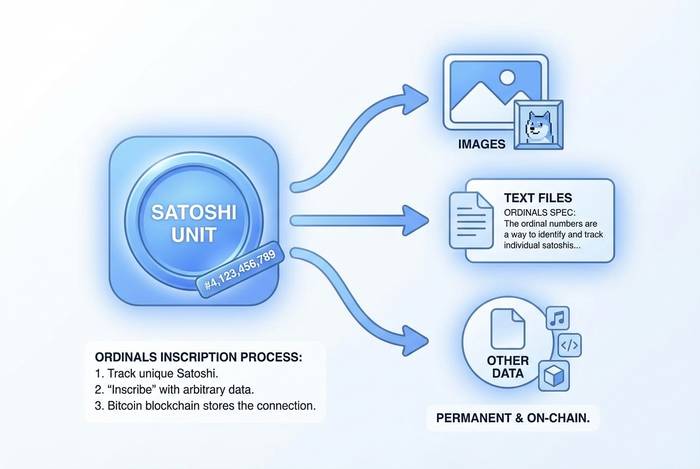
Ordinal theory changes that completely. Under this system, the ordinals protocol assigns each satoshi a serial number tied to when it was mined. Satoshis are numbered in the order they were born, stretching back to block zero that Satoshi Nakamoto mined in 2009. Now every sat is unique, trackable, one of a kind.
And here is the fun part: once a sat has its number, you can inscribe stuff on it. An image, a text file, a short clip, really any arbitrary data. That inscription lives directly on the bitcoin blockchain. Not on a server. Not on IPFS. Not behind a URL that goes dead in six months.
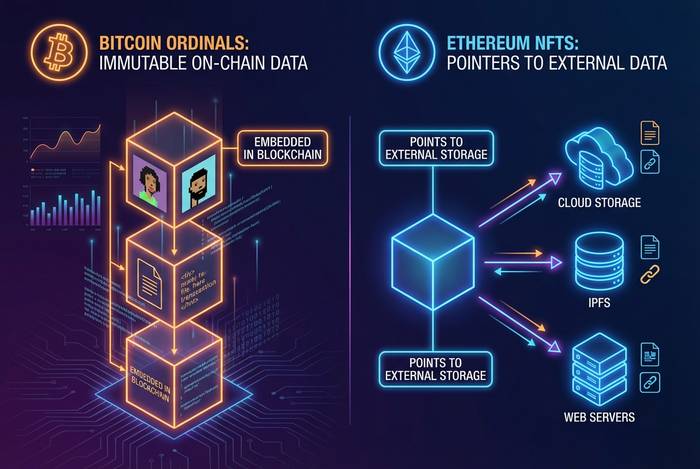
That right there is what separates bitcoin NFTs from traditional NFTs on Ethereum or Solana. The file is on-chain, baked into the bitcoin blockchain permanently. Nobody can take it down, edit it, or lose it because some hosting company pulled the plug.
How bitcoin NFTs work: the technical side, simplified
You do not need a CS degree for this. Let me keep it simple.
SegWit and Taproot: the upgrades that made it possible
Here is the thing nobody planned: bitcoin ordinals are a happy accident. Two older upgrades built for totally different reasons ended up making the whole thing possible.
Segregated Witness (SegWit) went live in August 2017. It changed how Bitcoin stores data in each block. Signature info moved into a new spot called the witness data area. This freed up space and, as a bonus, left room for extra data to be added later.
Taproot came in November 2021. It made smart contract tools better and gave the bitcoin network more privacy. Most importantly, it raised the data cap on the witness area. After Taproot, a single bitcoin transaction could hold up to 4 MB of data. That is enough space for a large image or a short audio file.
Casey Rodarmor looked at all that empty space and had an idea. Why not use it? He combined ordinal theory with Taproot's room to let anyone inscribe content onto individual satoshis. Best part: zero changes to the bitcoin protocol needed. The whole thing runs on top of the bitcoin network exactly as it already works.
Inscriptions: how content gets attached
When you create a bitcoin NFT, the content goes into the witness data of a bitcoin transaction. Think of it like writing a note in the margin of a check. The check still works, but the note rides with it forever.
That note is now a fixed part of the bitcoin blockchain. No one can edit or remove it. Every node that keeps a full copy of the chain also stores every inscription ever made. That is what "on-chain" really means for ordinal inscriptions.
Ordinal rarity: a built-in collectible layer
This is where it gets cool for collectors. Some satoshis are rarer than others, and the rarity comes from real blockchain events, not from some team deciding "only 10,000 will exist." Casey Rodarmor laid out the tiers like this:
| Rarity level | What triggers it | How often it occurs |
|---|---|---|
| Common | Any regular sat | Every block (trillions exist) |
| Uncommon | First sat of a new block | Every ~10 minutes |
| Rare | First sat after a difficulty adjustment | Every ~2 weeks |
| Epic | First sat after a halving | Every ~4 years |
| Legendary | First sat after a conjunction (halving + difficulty adjustment) | Extremely rare |
| Mythic | First sat of the genesis block | Only one will ever exist |
Notice how none of this rarity is made up by a project founder. It all flows from how the bitcoin network actually works. Think of it like coin collectors going crazy over a misprinted quarter. Same energy, different medium.
Bitcoin ordinals vs. traditional NFTs: what sets them apart
Already familiar with NFTs on Ethereum? You might think bitcoin NFTs are basically the same thing on a different chain. Not quite. The gaps run pretty deep.
| Feature | Bitcoin ordinals | Ethereum / Solana NFTs |
|---|---|---|
| Data storage | Fully on-chain (witness data) | Usually off-chain (IPFS, Arweave, or centralized servers) |
| Smart contracts | None needed | Required (ERC-721, ERC-1155) |
| Metadata | Inscribed directly onto a single bitcoin satoshi | Linked via token URI, can be changed |
| Permanence | Immutable, lives as long as Bitcoin exists | Depends on where metadata is hosted |
| Royalties | No built-in royalty mechanism | Programmable via smart contract |
| Blockchain security | Bitcoin (highest hashrate, most decentralized) | Varies by chain |
| Fungibility of base unit | Sats remain spendable as regular BTC | Tokens are non-fungible by design |
So the big win with ordinal inscriptions? They are forever. Content sits inside the bitcoin blockchain and gets the same security as your BTC. The flip side is no smart contracts. Forget auto royalties or on-chain games, at least for now.
How to create bitcoin ordinals: minting your own inscriptions
Making a bitcoin NFT takes more steps than minting on Ethereum, but it has gotten much easier since 2023. There are two main paths.
The technical route: running your own node
For full control, you can run a Bitcoin full node and install the ord app. This is the open-source tool Casey Rodarmor built. It lets you inscribe anything you want on your own. You will need:
- A synced Bitcoin full node (the Bitcoin Core software)
- The ord command-line tool
- A compatible bitcoin wallet (ord has one built in)
- Some BTC to cover transaction fees
This route works best for bitcoin developers who want full control. The catch is that syncing a full node takes time and a lot of disk space.
The easy route: no-code platforms
If running a node sounds like too much, several platforms now let you mint ordinal inscriptions through a simple web interface. Popular options include:
- Gamma charges a platform fee (roughly 10% plus a small fixed amount) and handles all the technical details.
- Ordinals Bot walks you through a step-by-step upload process.
- Magic Eden became one of the largest marketplaces for bitcoin ordinals, supporting both buying and minting.
These tools have brought bitcoin NFTs to a much wider audience. You do not need to touch a command line. You upload your file, pay the bitcoin transaction fee plus the platform fee, and your inscription is live.
Top bitcoin ordinal NFT collections worth knowing
A few NFT collections really took off on Bitcoin. These are the ones that shaped the early market and still get talked about:
Taproot Wizards is one of the most recognized projects, with a planned 2,121 wizard-themed inscriptions. The collection played a major role in popularizing ordinals within the broader crypto community.
Bitcoin Puppets became a cultural phenomenon, trading at floor prices around 0.043 BTC. Their playful art style attracted collectors who were new to the Bitcoin NFT scene.
NodeMonkes emerged as one of the most actively traded collections, recording total volumes above 42 BTC. The project proved that Bitcoin could sustain an active secondary market for digital collectibles.
TwelveFold by Yuga Labs was a big deal because of who made it. The Bored Ape Yacht Club team auctioned 288 inscriptions and kept 12. When a name that big starts building NFTs on Bitcoin, people notice.
BRC-20 tokens: ordinals beyond NFTs
Ordinal inscriptions did more than bring art to Bitcoin. In March 2023, a dev called Domo built the BRC-20 token standard. It sits on top of ordinal theory and lets people deploy, mint, and transfer fungible tokens on the bitcoin blockchain. No sidechain needed.
The idea blew up fast. By May 2023, BRC-20 hit a $1 billion market cap. Tokens like ORDI landed on big exchanges. It showed that the bitcoin network could handle token features without a separate layer.
BRC-20 has limits, though. It is less flexible than Ethereum's ERC-20. Transfers cost more and run slower. Demand has cooled a lot since the early days. As of early 2026, BRC-20 market cap is around $200-$300 million.
In April 2024, Casey Rodarmor launched the Runes protocol as a cleaner option. Runes went live during Bitcoin's fourth halving, and about 7,000 rune tokens were minted in just two days. The buzz was big at first, but trading volume for both BRC-20 and Runes has fallen as the wider NFT market cooled off.
The impact of bitcoin ordinals on the network
Bitcoin ordinals did not show up quietly. They changed how the bitcoin network runs in some big ways.
Block space and fees
Before ordinals, Bitcoin blocks were 0.8 to 1.4 MB on average. After inscriptions took off, that rose to 2.5 MB. At peak times, fees hit $20-$30 per send. That priced out people who just wanted to move BTC.
This caused real fights within the bitcoin community. Fans said higher fees help miners and boost security. Critics said inscriptions are spam that fills up block space and hurts regular bitcoin users.
Miner revenue
Ordinals gave miners a real new income source. Inscription fees stack on top of the normal block reward. After each halving, the block reward drops. So this extra fee money matters a lot. Some experts think ordinals could help keep mining worth doing for years to come.
The philosophical debate
Zoom out and the debate gets philosophical. One side of the bitcoin community is firm: Bitcoin is money, period. Putting memes and token projects on it cheapens the mission.
The other side fires back. Nobody changed the protocol. Casey built this using features that were already baked in. If Bitcoin can handle it without breaking, that is called innovation. Where you land probably depends on why you got into crypto in the first place.
Bitcoin ordinals marketplace landscape in 2026
The places where you can buy and sell bitcoin ordinals have grown a lot since the early days. Here are the main ones:
Magic Eden jumped from Solana and Ethereum into Bitcoin and honestly nailed it. Good search, easy listings, big user base. If you want to buy bitcoin ordinals, this is probably where you start.
Gamma does double duty as a marketplace and a minting tool. It was around from the early days and a lot of creators still use it to create bitcoin ordinals.
OKX Web3 Marketplace rolled ordinals into its bigger NFT section. Handy if you already use OKX for trading crypto.
Open Ordex goes the other direction, more decentralized, no middleman. Smaller crowd, but it appeals to people who really do not want to trust a platform.
Even with better tools, trading volume has dropped from the 2023-2024 highs. The bitcoin ordinals market follows the same trend as the wider NFT space: fewer quick-flip traders, but a more stable group of real collectors and builders. As of early 2026, the total Bitcoin NFT market cap sits near $600-$700 million.
Risks and limitations of bitcoin NFTs
Alright, time for some honesty. Bitcoin NFTs are not all upside. Here are the catches.
High costs. Storing data on the bitcoin blockchain is not cheap. When the network is busy, fees can hit $20-$30 or more per inscription. Compare that to Solana, where fees are fractions of a cent.
No smart contracts. Without smart contracts, bitcoin ordinals cannot do auto royalties, changing metadata, or on-chain games. Artists who count on resale royalties may not like this.
Wallet issues. Not every bitcoin wallet knows about ordinal inscriptions. If you send a sat with a prized inscription from the wrong wallet, you could lose it for good. Wallets like Xverse, Hiro, and Magic Eden Wallet now support bitcoin ordinals, but not all do yet.
Network slowdowns. Lots of inscriptions at once can slow the bitcoin network for everyone. This is still a sore point, mainly during busy times.
Young tools. Next to Ethereum's mature NFT world, Bitcoin's setup for digital assets is still new. Indexing, marketplace features, and dev tools keep getting better but still have gaps.
What comes next for ordinals and bitcoin NFTs
This genie is not going back in the bottle. A few things on the horizon could push ordinals forward or reshape them entirely:
Recursive inscriptions let one inscription point to another. This means you can build complex pieces without copying data. It could lead to more advanced digital assets on the bitcoin blockchain, like layered art or media.
OP_CAT return is a proposed code change that would make Bitcoin more flexible. If it goes through, it could open up new ways to create both fungible and non-fungible tokens. That would fix some of the limits holding back the ordinals world.
Runes AMM agents were announced by Casey Rodarmor in early 2025. They aim to let people trade rune tokens in a trustless, decentralized way right on bitcoin layer 1. This could solve some of the clunky user experience issues that have slowed growth.
Big money paying attention. Firms like Fidelity have put out guides on bitcoin ordinals. As traditional finance warms up to digital assets on the bitcoin blockchain, ordinals could see more eyes and more cash flow in.
Where does this all end up? Probably somewhere in the middle. Bitcoin ordinals are not going to replace Ethereum's NFT scene. But they have carved out a real spot for people who want their digital assets on the most battle-tested blockchain in existence. If permanence and security matter more to you than flashy features, ordinals on top of bitcoin make a lot of sense.